Best IB Schools in Kansai and Osaka 2026: The Definitive Guide for Families

The Kansai region, encompassing Osaka, Kobe, Kyoto, and surrounding prefectures, has quietly become one of Japan’s most compelling destinations for International Baccalaureate education. While Tokyo often dominates the conversation about IB schools in Japan, Kansai offers something that the capital struggles to match: a diverse selection of world-class IB programs at significantly lower tuition rates, set in cities rich with culture, history, and a quality of life that families consistently rank higher than Tokyo.

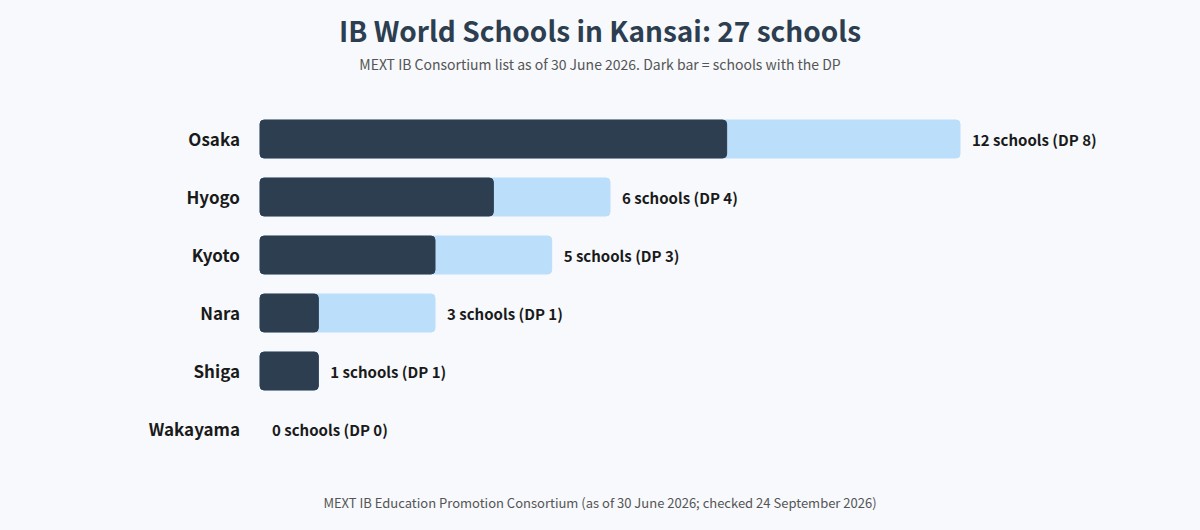
As of 2026, the Kansai region is home to ten IB-authorized schools spanning the Primary Years Programme (PYP), Middle Years Programme (MYP), and Diploma Programme (DP). These range from elite international schools with over a century of history to pioneering public high schools offering the DP entirely free of charge. Whether you are an expatriate family relocating to the Osaka-Kobe-Kyoto corridor, a Japanese family exploring globally oriented education, or a family anywhere in Japan considering boarding options, this guide provides the comprehensive information you need to make an informed decision.

This article covers detailed profiles of every IB school in the region, side-by-side comparison tables, tuition breakdowns, practical application strategies, and answers to the most common questions families ask when navigating the Kansai IB landscape.

  1. Why Kansai Is Emerging as Japan’s Second IB Hub
  2. Top International IB Schools in Kansai
    1. 1. Canadian Academy (Kobe)
    2. 2. Osaka International School of Kwansei Gakuin (OIS-KG, Minoh)
    3. 3. Osaka YMCA International School (OYIS, Osaka City)
    4. 4. Marist Brothers International School (Kobe)
    5. 5. Kyoto International School (KIS)
    6. 6. Doshisha International Academy (DSIA, Kyotanabe)
    7. 7. Abroad International School Osaka
  3. Top Japanese IB Schools in Kansai (Ichijoko and Public Schools)
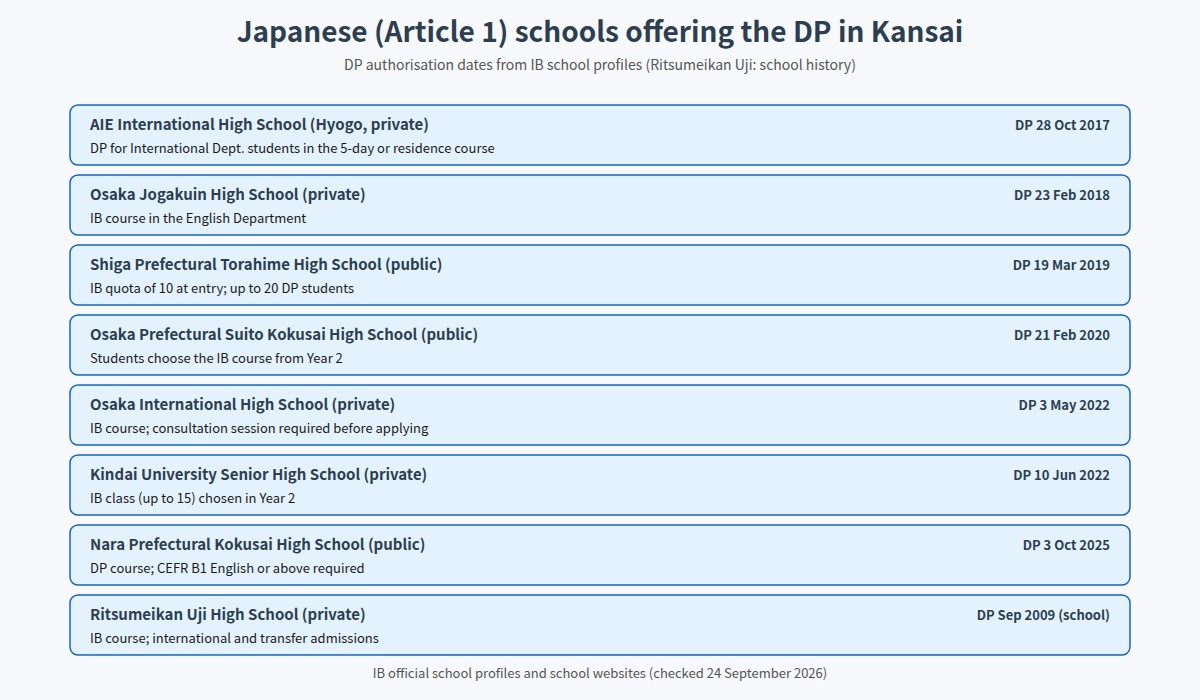
    1. Ritsumeikan Uji Junior and Senior High School (Kyoto)
    2. Osaka Prefectural Suito Kokusai High School
    3. Shiga Prefectural Kohiga High School
  4. Complete Kansai IB Schools Comparison Table
  5. Tuition Comparison: What IB Education Actually Costs in Kansai
  6. How to Choose the Right IB School in Kansai
    1. Factor 1: IB Program Continuity
    2. Factor 2: Location and Commute
    3. Factor 3: Budget
    4. Factor 4: Language Environment
    5. Factor 5: School Culture and Values
  7. Application Tips and Timeline
    1. International Schools (Canadian Academy, OIS-KG, OYIS, Marist Brothers, KIS, DSIA, Abroad IS)
    2. Japanese Schools (Ritsumeikan Uji, Suito Kokusai, Kohiga)
    3. General Tips for All Schools
  8. Frequently Asked Questions
    1. Is the IB Diploma recognized by Japanese universities?
    2. Can Japanese students attend international IB schools?
    3. What is the difference between ichijoko and international schools for the IB?
    4. Is it possible to transfer between IB schools mid-program?
    5. Are there scholarships available for IB programs in Kansai?
    6. My child does not speak English fluently. Can they still join an IB program?
    7. What DP score do I need for top universities?
    8. How does the cost of IB education in Kansai compare to Tokyo?
  9. Summary: The Kansai IB Landscape at a Glance

Why Kansai Is Emerging as Japan’s Second IB Hub

Several factors are driving the growth of IB education in the Kansai region. First, the area has a deep-rooted international character. Kobe has been an international port city since the 1860s, and its foreign community, particularly from Europe, Asia, and the Americas, has sustained demand for international schooling for over a century. Kyoto, as a global cultural destination, attracts academics, researchers, and families from around the world. Osaka, Japan’s second-largest metropolitan area, hosts a growing expatriate business community and is set to gain further global visibility with major infrastructure developments.

Second, the Japanese government’s IB expansion initiative has been particularly successful in Kansai. Two public high schools in the region, Suito Kokusai in Osaka and Kohiga High School in Shiga, now offer the Diploma Programme with zero tuition fees, making the IB accessible to families who could never consider the fees charged by private international schools. This public-sector commitment has brought IB education into the mainstream conversation in a way that few other regions in Japan have achieved.

Third, cost of living in Kansai is substantially lower than in Tokyo. Housing, daily expenses, and even school tuition tend to be 15 to 30 percent more affordable. For families evaluating the total cost of an IB education over 12 or more years, this difference can amount to tens of millions of yen in savings.

Top International IB Schools in Kansai

The following seven international schools represent the core of Kansai’s IB ecosystem. Each is authorized by the International Baccalaureate Organization and serves a diverse, multinational student body with English as the primary language of instruction.

1. Canadian Academy (Kobe)

Programs: PYP, MYP, DP (Full IB Continuum)
Location: Rokko Island, Higashinada-ku, Kobe
Grades: Pre-K through Grade 12
Annual Tuition: 2,100,000 to 3,370,000 JPY
Boarding: Available (approximately 3,500,000 JPY/year additional)
Registration Fee: 400,000 JPY
Language of Instruction: English
IB Average Score: 34.0 points

Canadian Academy is the flagship IB school in the Kansai region and one of the most prestigious international schools in all of Japan. Founded over 100 years ago, it has served the international community of Kobe through world wars, natural disasters, and dramatic social changes, emerging each time as a stronger institution. Today, it offers the complete IB Continuum from PYP through MYP to the Diploma Programme, educating students from over 30 nationalities on its modern Rokko Island campus.

The school’s DP results speak for themselves: an average score of 34.0 places Canadian Academy well above the global average of approximately 30 points. Graduates regularly gain admission to leading universities worldwide, including institutions in Canada, the United States, the United Kingdom, Australia, and top Japanese universities. The school’s century-long track record gives it an alumni network that spans the globe.

What truly distinguishes Canadian Academy from other Kansai schools is its boarding program. It is one of only a handful of international schools in Japan to offer residential facilities, making it accessible to families throughout the country and across Asia. The boarding community enriches the school’s cultural diversity and creates a uniquely immersive educational experience. Boarders live in supervised residences on Rokko Island with full access to the school’s extensive facilities, including science laboratories, performing arts spaces, sports fields, and a library.

Key strengths:

  • Over 100 years of history serving the international community in Kobe
  • Full IB Continuum school (PYP, MYP, DP) with proven academic results
  • Boarding program available, rare among Japanese international schools
  • Students from 30+ nationalities creating a genuinely global community
  • Strong university placement record across multiple continents
  • Modern campus on Rokko Island with comprehensive facilities
  • Accredited by WASC (Western Association of Schools and Colleges)

2. Osaka International School of Kwansei Gakuin (OIS-KG, Minoh)

Programs: PYP, MYP, DP (Full IB Continuum)
Location: Minoh, Osaka (shared campus with Senri International School of Kwansei Gakuin)
Grades: Pre-K through Grade 12
Annual Tuition: 2,180,000 to 2,720,000 JPY
Language of Instruction: English
2025 Top Score: 45/45 (perfect score)

Osaka International School of Kwansei Gakuin holds a special place in Japanese IB history: it was the first school in Japan to be authorized for all three IB programs (PYP, MYP, and DP). With over 25 years of IB experience, the school has accumulated a depth of pedagogical expertise that few institutions in the country can match. That experience translates directly into results. In 2025, the school produced a student who achieved a perfect 45 out of 45 on the Diploma Programme, the highest score possible and a feat achieved by fewer than 1 percent of DP candidates worldwide.

Located in the leafy suburban city of Minoh in northern Osaka Prefecture, OIS-KG shares a campus with Senri International School of Kwansei Gakuin (SIS-KG), its sister school for Japanese-medium education. This dual-school model creates an unusual bilingual environment where international and Japanese students interact daily while following different curricula. The campus itself, nestled in the hills near Minoh Park, offers students access to nature and open spaces that are rare in urban Osaka.

OIS-KG is part of the Kwansei Gakuin educational network, one of Japan’s most respected private educational groups. This affiliation provides students with a pathway to Kwansei Gakuin University, a top-tier Japanese private university, though the vast majority of DP graduates choose to attend universities abroad.

Key strengths:

  • First school in Japan authorized for all three IB programs (PYP, MYP, DP)
  • Over 25 years of IB teaching experience, unmatched in the Kansai region
  • 2025 top DP score of 45/45 (perfect score)
  • Beautiful suburban campus in Minoh with extensive green space
  • Unique dual-school environment with Senri International School
  • Part of the Kwansei Gakuin educational network
  • Strong university counseling with excellent placement results worldwide

3. Osaka YMCA International School (OYIS, Osaka City)

Programs: PYP, MYP, DP (Full IB Continuum)
Location: Dual campus in Osaka City (Tennoji-ku and Chuo-ku)
Grades: Pre-K through Grade 12
Annual Tuition: 1,630,000 to 2,160,000 JPY
Established: 2001
Student Body: 300+ students from 40+ countries
Language of Instruction: English

Osaka YMCA International School is the only IB Continuum school located within Osaka City itself, making it the natural choice for families living in central Osaka who want access to the full range of IB programs without a long commute. Founded in 2001, OYIS has grown steadily from a small community school into a well-established institution serving over 300 students from more than 40 countries.

The school operates a dual-campus model. Younger students attend classes at one campus while older students, including those in the DP program, study at another location within the city. Despite operating across two sites, the school maintains a cohesive community feel, with regular inter-campus events and a strong emphasis on the YMCA values of caring, honesty, respect, and responsibility.

OYIS is particularly noteworthy for its tuition structure. With annual fees ranging from 1,630,000 to 2,160,000 JPY, it is one of the most affordable full IB Continuum schools in the country. For families seeking a complete PYP-through-DP pathway at a manageable cost, OYIS represents outstanding value. The school’s diverse student body, drawn from over 40 nationalities, ensures that children grow up in a genuinely international environment despite the lower price point.

Key strengths:

  • Only IB Continuum school (PYP, MYP, DP) located within Osaka City
  • 300+ students from 40+ countries, creating exceptional cultural diversity
  • Among the most affordable full IB Continuum schools in Japan
  • Dual campus in convenient central Osaka locations
  • Over two decades of educational experience since 2001
  • Strong YMCA values framework integrated with IB philosophy
  • Accessible location with good public transportation connections

4. Marist Brothers International School (Kobe)

Programs: PYP, MYP, DP (Full IB Continuum)
Location: Suma-ku, Kobe
Grades: Pre-K through Grade 12
Annual Tuition: 1,790,000 to 2,160,000 JPY
IB Authorization: Since 2017
Language of Instruction: English

Marist Brothers International School is a Catholic co-educational school located in the Suma-ku district of Kobe. While the school has a much longer history as an educational institution in the Kobe area, its IB journey began in 2017 when it received authorization for the IB programs. Since then, Marist has built all three programs, PYP, MYP, and DP, making it another full IB Continuum option in the Kansai region.

The school’s Catholic Marist tradition emphasizes the education of the whole person: intellectual, spiritual, physical, and social. This holistic philosophy aligns naturally with the IB’s own learner profile attributes, creating a coherent educational experience. The Suma-ku location offers a more suburban, residential feel compared to central Kobe, with the school campus providing green spaces and sporting facilities that support a well-rounded student experience.

At a tuition range of 1,790,000 to 2,160,000 JPY annually, Marist Brothers is competitively priced among Kansai’s international IB schools. As its IB programs continue to mature, with each graduating class building the school’s track record, Marist is establishing itself as a compelling alternative to the more established options in the region, particularly for families who value faith-based education alongside the IB framework.

Key strengths:

  • Full IB Continuum school (PYP, MYP, DP) since 2017
  • Catholic Marist tradition emphasizing holistic education
  • Competitive tuition rates among Kansai international schools
  • Suburban Kobe location with strong facilities
  • Growing IB track record with each graduating cohort
  • Values-based education aligned with IB learner profile

5. Kyoto International School (KIS)

Programs: PYP, MYP, DP (DP starting 2025)
Location: Kyoto City
Grades: Pre-K through Grade 12
Annual Tuition: 1,530,000 to 1,910,000 JPY
Language of Instruction: English

Kyoto International School is the only IB-authorized international school in the ancient capital, making it the default choice for the city’s substantial expatriate and academic community. Kyoto’s unique character as a global center for culture, research, and tourism means that KIS draws families from a wide range of backgrounds: university researchers, diplomats, artists, technology professionals, and families who have chosen Kyoto for its unparalleled quality of life.

The school has offered the PYP and MYP for some time and is now expanding to include the Diploma Programme, with DP classes beginning in 2025. This is a significant development for the Kyoto area, as families previously had to consider sending their children to Kobe or Osaka for DP studies, or switch to a non-IB curriculum for the final years of high school. With the DP launching, KIS is on its way to becoming a full IB Continuum school, allowing students to progress seamlessly from PYP through MYP to DP without changing institutions.

Tuition at KIS is notably affordable by international school standards, with annual fees ranging from 1,530,000 to 1,910,000 JPY. This makes it one of the least expensive IB options in the Kansai region and one of the most competitively priced IB schools in Japan overall.

Key strengths:

  • Only IB-authorized international school in Kyoto
  • PYP and MYP established, with DP launching in 2025
  • Among the most affordable international IB schools in Japan
  • Diverse community of researchers, diplomats, and global professionals
  • Located in one of the world’s most culturally rich cities
  • Growing toward full IB Continuum status

6. Doshisha International Academy (DSIA, Kyotanabe)

Programs: PYP, DP
Location: Kyotanabe, Kyoto Prefecture
Grades: Elementary through Grade 12
Annual Tuition: 1,550,000 to 1,850,000 JPY
Accreditation: WASC (Western Association of Schools and Colleges)
Language of Instruction: English and Japanese (bilingual environment)

Doshisha International Academy, commonly known as DSIA, is part of the Doshisha educational group, one of the oldest and most respected private educational institutions in Japan, founded in 1875 by Joseph Hardy Neesima (Niijima Jo). DSIA offers both the PYP and the DP, providing an IB pathway from elementary school through the completion of the Diploma Programme. The school is also accredited by WASC, the Western Association of Schools and Colleges, a distinction that confirms its international academic standards.

Located in Kyotanabe, a suburban area in the southern part of Kyoto Prefecture, DSIA occupies a spacious, purpose-built campus. The school serves both international and Japanese students in a bilingual environment, which reflects the Doshisha group’s long-standing commitment to bridging Japanese and international education. Students benefit from the prestige and resources of the Doshisha network, which includes Doshisha University, one of Japan’s leading private universities.

One notable characteristic of DSIA is that it offers the PYP and DP but not the MYP. This means students transition from the PYP framework through middle school years before entering the two-year DP program. The school has developed its own approach to the middle years that prepares students effectively for the rigors of the Diploma Programme.

Key strengths:

  • Part of the prestigious Doshisha educational network (founded 1875)
  • WASC-accredited, confirming international academic standards
  • PYP and DP programs offered in a bilingual environment
  • Pathway to Doshisha University for qualified graduates
  • Spacious, modern campus in Kyotanabe
  • Affordable tuition compared to many international IB schools

7. Abroad International School Osaka

Programs: PYP, MYP (DP launching August 2026)
Location: Osaka City
Grades: Pre-K through Grade 10 (expanding to Grade 12 with DP launch)
Annual Tuition: 1,500,000 to 2,000,000 JPY
Language of Instruction: English

Abroad International School Osaka currently offers the PYP and MYP and has announced plans to launch the Diploma Programme in August 2026. Once the DP is operational, Abroad IS will become yet another full IB Continuum school in the Osaka area, further expanding the options available to families.

The school is known for its warm, community-oriented atmosphere and its commitment to genuine inquiry-based learning. Located within Osaka City, it provides convenient access for families living in the urban core. The upcoming addition of the DP is a major step for the school, and families currently enrolled in the PYP and MYP programs are looking forward to the seamless progression it will offer.

With tuition starting at 1,500,000 JPY, Abroad IS Osaka is one of the most budget-friendly international IB schools in the region. For families who want their children to start the IB journey early and eventually complete the DP at the same school, it is well worth considering, especially given the DP launch in 2026.

Key strengths:

  • PYP and MYP authorized with DP launching in August 2026
  • Affordable tuition starting at 1,500,000 JPY annually
  • Community-oriented school culture with personalized attention
  • Convenient Osaka City location
  • On track to become a full IB Continuum school by 2026

Top Japanese IB Schools in Kansai (Ichijoko and Public Schools)

One of the most exciting developments in Japan’s IB landscape has been the emergence of Japanese government-recognized schools (ichijoko) and public high schools offering the Diploma Programme. In the Kansai region, three such schools provide IB education at a fraction of the cost charged by international schools, and two of them charge no tuition at all.

Ritsumeikan Uji Junior and Senior High School (Kyoto)

Programs: DP
Location: Uji, Kyoto Prefecture
School Type: Private ichijoko (Japanese government-recognized school)
DP Pass Rate: Approximately 90%
Language of Instruction: English and Japanese (DP courses)
Affiliation: Ritsumeikan educational group

Ritsumeikan Uji is a well-known private ichijoko that offers the IB Diploma Programme alongside its regular Japanese high school curriculum. The school is part of the Ritsumeikan educational group, which operates Ritsumeikan University and Ritsumeikan Asia Pacific University (APU), among other institutions. This affiliation provides DP students with strong university pathways, particularly to APU, which is itself one of the most internationally oriented universities in Japan.

The school’s DP pass rate of approximately 90 percent reflects its commitment to thorough student preparation and support. Ritsumeikan Uji is located in the city of Uji, which lies between Kyoto and Osaka, offering reasonable access to both cities. The school draws primarily Japanese students who are seeking a globally oriented education while remaining within the Japanese school system. For families who want the rigor and international recognition of the IB Diploma but also value the structure and social environment of a Japanese school, Ritsumeikan Uji represents an excellent compromise.

Key strengths:

  • DP pass rate of approximately 90%, demonstrating strong academic preparation
  • Part of the Ritsumeikan educational network with university pathway benefits
  • Ichijoko status: Japanese government-recognized diploma alongside IB Diploma
  • Bilingual DP instruction (English and Japanese)
  • Location between Kyoto and Osaka with access to both cities
  • Strong track record of university placements in Japan and abroad

Osaka Prefectural Suito Kokusai High School

Programs: DP
Location: Osaka City (Suminoe-ku area)
School Type: Public high school
Tuition: Free (public school)
Language of Instruction: English and Japanese (DP courses)

Suito Kokusai High School is one of the most remarkable IB stories in Japan. As a public high school operated by Osaka Prefecture, it offers the IB Diploma Programme with no tuition fees. For families who believe in the value of an IB education but cannot afford the millions of yen charged by international schools, Suito Kokusai opens a door that was previously closed.

The school was established as part of Osaka Prefecture’s initiative to create globally competitive public education. Its DP program is delivered in a bilingual format, with some subjects taught in English and others in Japanese, preparing students for university study in either language. Because Suito Kokusai is a public school, admission is based on entrance examinations and residency requirements, which means it is primarily accessible to families living in Osaka Prefecture.

The significance of Suito Kokusai cannot be overstated. It demonstrates that IB education does not have to be the exclusive preserve of wealthy families or expatriates. Any student in Osaka Prefecture with the academic ability and motivation can pursue an IB Diploma at zero tuition cost, a model that education reformers across Japan are watching closely.

Key strengths:

  • Completely free tuition as a public high school
  • IB Diploma Programme in bilingual format (English and Japanese)
  • Makes IB education accessible regardless of family income
  • Government-recognized diploma alongside IB Diploma
  • Part of Osaka Prefecture’s commitment to globally competitive public education

Shiga Prefectural Kohiga High School

Programs: DP
Location: Shiga Prefecture (near Lake Biwa)
School Type: Public high school
Tuition: Free (public school)
Language of Instruction: English and Japanese (DP courses)

Kohiga High School in Shiga Prefecture is the second public IB school serving the wider Kansai region. Like Suito Kokusai, it offers the DP at no cost to students, making it an important option for families in Shiga and the surrounding area. Shiga Prefecture borders Kyoto to the east, and the school is reasonably accessible from the Kyoto-Osaka corridor.

Kohiga has embraced the IB Diploma Programme as part of its mission to develop students with global perspectives. The school combines the DP with the standard Japanese high school curriculum, ensuring that graduates hold both a Japanese high school diploma and, upon successful completion, an IB Diploma. This dual qualification opens doors to universities both in Japan and internationally.

Key strengths:

  • Free tuition as a public high school
  • IB Diploma Programme combined with Japanese high school curriculum
  • Accessible from the broader Kyoto-Shiga-Osaka area
  • Dual qualification: Japanese diploma and IB Diploma
  • Strong public commitment to global education

Complete Kansai IB Schools Comparison Table

The following table provides a side-by-side comparison of all ten IB-authorized schools in the Kansai region, covering programs offered, location, school type, and tuition ranges.

School Location IB Programs Type Annual Tuition (JPY) Notable Feature
Canadian Academy Kobe PYP, MYP, DP International 2,100,000 – 3,370,000 100+ year history, boarding available
OIS Kwansei Gakuin Minoh, Osaka PYP, MYP, DP International 2,180,000 – 2,720,000 First in Japan with all 3 IB programs
OYIS Osaka City PYP, MYP, DP International 1,630,000 – 2,160,000 Only IB Continuum in Osaka City
Marist Brothers Kobe PYP, MYP, DP International 1,790,000 – 2,160,000 Catholic Marist tradition
Kyoto International School Kyoto PYP, MYP, DP International 1,530,000 – 1,910,000 Only IB school in Kyoto, DP from 2025
DSIA (Doshisha) Kyotanabe, Kyoto PYP, DP International 1,550,000 – 1,850,000 WASC accredited, Doshisha network
Abroad IS Osaka Osaka City PYP, MYP International 1,500,000 – 2,000,000 DP launching August 2026
Ritsumeikan Uji Uji, Kyoto DP Private Ichijoko Ichijoko fees 90% DP pass rate
Suito Kokusai Osaka City DP Public Free Public school, zero tuition
Kohiga High School Shiga DP Public Free Public school, zero tuition

Tuition Comparison: What IB Education Actually Costs in Kansai

Understanding the true cost of IB education is critical for family planning. The table below breaks down the annual tuition ranges for all Kansai IB schools, organized from most to least expensive.

School Lowest Annual Fee Highest Annual Fee Registration / Entry Fee Additional Costs
Canadian Academy 2,100,000 JPY 3,370,000 JPY 400,000 JPY Boarding: ~3,500,000 JPY/yr
OIS Kwansei Gakuin 2,180,000 JPY 2,720,000 JPY Varies Uniforms, school trips, materials
Marist Brothers 1,790,000 JPY 2,160,000 JPY Varies Uniforms, school trips
OYIS 1,630,000 JPY 2,160,000 JPY Varies Uniforms, activity fees
Abroad IS Osaka 1,500,000 JPY 2,000,000 JPY Varies Standard school expenses
DSIA (Doshisha) 1,550,000 JPY 1,850,000 JPY Varies Standard school expenses
Kyoto International School 1,530,000 JPY 1,910,000 JPY Varies Standard school expenses
Ritsumeikan Uji Standard Japanese private school fees (significantly lower than international schools)
Suito Kokusai Free tuition (public high school). Minor fees for materials and school trips.
Kohiga High School Free tuition (public high school). Minor fees for materials and school trips.

Important note on total costs: Tuition is only one component of the total expense. Families should also budget for registration and entry fees (typically 200,000 to 500,000 JPY for international schools), annual materials and technology fees, school trips, uniforms, extracurricular activities, school lunch programs, and transportation. For Canadian Academy boarders, the boarding fee of approximately 3,500,000 JPY per year is a major additional expense but includes room, meals, and supervision.

Cost comparison with Tokyo: Kansai IB schools are generally 10 to 25 percent less expensive than comparable schools in Tokyo. When combined with the lower cost of living in the Kansai region, including housing, the total financial advantage of choosing a Kansai IB school over a Tokyo counterpart can be substantial over a multi-year enrollment.

How to Choose the Right IB School in Kansai

With ten IB schools to choose from, the decision can feel overwhelming. Here is a structured framework for narrowing down your options based on the factors that matter most to your family.

Factor 1: IB Program Continuity

If you want your child to follow the complete IB pathway from early years through the Diploma Programme at a single school, your options are Canadian Academy, OIS Kwansei Gakuin, OYIS, and Marist Brothers. These four schools offer the full PYP-MYP-DP Continuum, eliminating the need to change schools at any point. Kyoto International School is also moving toward full Continuum status with the DP launching in 2025, and Abroad IS Osaka will follow in 2026.

Factor 2: Location and Commute

Geography matters enormously, especially for younger children. If you live in central Osaka, OYIS and Abroad IS Osaka are the most convenient options. Families in northern Osaka or the Minoh-Toyonaka area are well positioned for OIS Kwansei Gakuin. Kobe-based families can choose between Canadian Academy on Rokko Island and Marist Brothers in Suma-ku. Kyoto residents have Kyoto International School and DSIA in Kyotanabe. For DP-only options, Suito Kokusai is in Osaka City, Ritsumeikan Uji is between Kyoto and Osaka, and Kohiga is in Shiga Prefecture.

Factor 3: Budget

Families with limited budgets should look first at the two free public options: Suito Kokusai and Kohiga High School. For families seeking an international school experience at lower cost, Kyoto International School (from 1,530,000 JPY), Abroad IS Osaka (from 1,500,000 JPY), and DSIA (from 1,550,000 JPY) are the most affordable. At the premium end, Canadian Academy is the most expensive but also offers the most comprehensive facilities, history, and boarding option.

Factor 4: Language Environment

All seven international schools on this list use English as the primary language of instruction, making them suitable for English-speaking expatriate families. However, DSIA operates in a bilingual English-Japanese environment that may be preferable for families wanting stronger Japanese language development. The three Japanese schools (Ritsumeikan Uji, Suito Kokusai, and Kohiga) deliver the DP in a bilingual format with Japanese as the base language, making them more suitable for Japanese-dominant students.

Factor 5: School Culture and Values

Each school has a distinct character. Canadian Academy offers the prestige and stability of a century-old institution. OIS Kwansei Gakuin provides the academic rigor of Japan’s pioneering IB school. OYIS emphasizes community and YMCA values. Marist Brothers integrates Catholic education with the IB framework. DSIA carries the Doshisha tradition of bridging East and West. Consider what values and atmosphere will help your child thrive, and visit each school in person before making a final decision.

Application Tips and Timeline

Applying to IB schools in Kansai requires advance planning. Here is a practical guide to the process and timeline.

International Schools (Canadian Academy, OIS-KG, OYIS, Marist Brothers, KIS, DSIA, Abroad IS)

Application Window: Most international schools accept applications on a rolling basis, though the primary intake period is for the academic year starting in August or September. Applications for the main intake are typically due between January and March.

Required Documents:

  • Completed application form (usually available on the school’s website)
  • Student’s academic records and transcripts from the previous two to three years
  • Teacher recommendation letters (typically two: one from a homeroom teacher and one from a subject teacher)
  • Copy of student’s passport and visa documentation
  • Application fee payment (typically 20,000 to 30,000 JPY, non-refundable)
  • Personal statement or essay (for older students applying to MYP or DP)

Admissions Process:

  • Application review and document screening
  • Student assessment or entrance test (age-appropriate academic assessment, often including English and mathematics)
  • Student and family interview (in person or online)
  • Offer of placement (or waitlist notification)
  • Acceptance and payment of registration fee to secure the place

Japanese Schools (Ritsumeikan Uji, Suito Kokusai, Kohiga)

Application Window: Japanese schools follow the April academic year calendar. Applications are typically submitted between October and January for the following April intake.

Important Differences:

  • Public schools (Suito Kokusai, Kohiga) require entrance examinations and may have residency requirements
  • Ritsumeikan Uji has its own admissions process as a private ichijoko
  • Japanese language proficiency is essential for all three schools
  • The application process follows the standard Japanese high school admissions format more closely than the international school model

General Tips for All Schools

  • Visit in person: Schedule a campus tour well before the application deadline. Most schools offer open houses, information sessions, and individual tours. Seeing the school in action is invaluable.
  • Prepare your child: For schools requiring entrance assessments, ensure your child is comfortable with the language of the test (usually English for international schools) and the format.
  • Apply early: Popular schools and grade levels fill up quickly. Submitting your application early in the admissions window improves your chances, especially at schools with limited capacity.
  • Consider multiple schools: Apply to two or three schools to give your family options. Each school has a different character, and the admissions process may reveal which school is the best fit.
  • Ask about financial aid: Some schools offer scholarships or bursaries. Do not hesitate to inquire about financial assistance during the admissions process.

Frequently Asked Questions

Is the IB Diploma recognized by Japanese universities?

Yes. Since 2015, Japanese law has recognized the IB Diploma as a qualification for university admission. Most major Japanese universities, including the University of Tokyo, Kyoto University, Osaka University, Waseda, and Keio, now have dedicated IB admissions pathways. Students who earn an IB Diploma can apply to Japanese universities without taking the standard entrance examination, though each university sets its own IB score requirements and admissions criteria. The Kansai region’s universities, including Osaka University, Kobe University, Ritsumeikan, and Kwansei Gakuin, are particularly active in recruiting IB graduates.

Can Japanese students attend international IB schools?

Yes, Japanese students can and do attend international IB schools in Kansai. However, families should be aware of an important legal distinction. International schools are generally classified as “miscellaneous schools” (kakushu gakko) under Japanese law, which means their diplomas are not automatically recognized as equivalent to a Japanese high school diploma. This has been largely addressed by the 2015 law recognizing the IB Diploma for university admission, but it can still affect eligibility for certain programs or institutions. Japanese ichijoko schools like Ritsumeikan Uji avoid this issue entirely, as students receive both a Japanese high school diploma and an IB Diploma.

What is the difference between ichijoko and international schools for the IB?

Ichijoko (Article 1 schools) are schools recognized under the Japanese School Education Act. They follow the Japanese curriculum and issue Japanese diplomas, while also offering the IB Diploma Programme as an additional track. Students at ichijoko typically study the DP in a bilingual format (Japanese and English). International schools, by contrast, follow the IB curriculum as their primary program, teach predominantly in English, and issue their own diplomas. The main practical differences are language of instruction, recognition of the diploma under Japanese law, and the student community (ichijoko tend to be predominantly Japanese, while international schools are more diverse).

Is it possible to transfer between IB schools mid-program?

Transferring between IB schools is possible and one of the advantages of the IB system, since the curriculum is standardized worldwide. A student who has been studying the MYP at a school in Tokyo, for example, can transfer to an MYP school in Kansai without having to repeat years or study a completely different curriculum. However, practical differences between schools (such as subject offerings, assessment schedules, and language requirements) mean that transfers work best between academic years rather than mid-year. For the DP specifically, transferring mid-program is very difficult because the two-year DP is assessed as a single unit, and schools have limited flexibility in accepting transfer students partway through.

Are there scholarships available for IB programs in Kansai?

Some international schools offer merit-based scholarships, need-based bursaries, or sibling discounts. Canadian Academy, OIS Kwansei Gakuin, and OYIS have all offered financial assistance in various forms. Availability and amounts vary by year and school, so families should contact each school’s admissions office directly. For the public schools (Suito Kokusai and Kohiga), tuition is already free, making them the most accessible IB option for families of any income level.

My child does not speak English fluently. Can they still join an IB program?

It depends on the school and the program level. Many international IB schools offer English as an Additional Language (EAL) support for students who are still developing their English proficiency, particularly at the PYP and early MYP levels. However, by the time students reach the DP, they need strong English skills, as the examinations and extended essay are conducted in English (or in Japanese at bilingual programs). For Japanese-dominant students, the ichijoko and public school options (Ritsumeikan Uji, Suito Kokusai, Kohiga) may be more suitable, as these programs offer the DP in a bilingual format with significant Japanese language support.

What DP score do I need for top universities?

Score requirements vary widely by university and program. As a general guide: scores of 38 and above are competitive for the most selective universities worldwide (Oxbridge, Ivy League, Tokyo, Kyoto). Scores of 34 to 37 are strong for excellent universities in most countries. Scores of 30 to 33 meet the requirements for a wide range of good universities. Scores of 24 to 29 meet the minimum IB Diploma requirements and are accepted by many universities, though the most selective institutions will expect higher. Canadian Academy’s average of 34.0 and OIS Kwansei Gakuin’s track record of producing 45-point scorers indicate that Kansai schools are well capable of preparing students for competitive university admissions.

How does the cost of IB education in Kansai compare to Tokyo?

IB education in Kansai is generally more affordable than in Tokyo. Tuition at Kansai international schools ranges from approximately 1,500,000 to 3,370,000 JPY, while comparable Tokyo schools often range from 2,000,000 to 3,500,000 JPY or higher. When you add the lower cost of living in Kansai (housing is typically 20 to 40 percent cheaper than Tokyo), the total financial picture is significantly more favorable. Over a 13-year PYP-through-DP journey, the savings can amount to millions of yen.

Summary: The Kansai IB Landscape at a Glance

The Kansai region offers one of the most diverse and accessible IB ecosystems in Japan. With ten IB-authorized schools spread across Osaka, Kobe, Kyoto, and Shiga, families have genuine choices, whether they are looking for a historic international school with boarding facilities, a pioneering IB institution with perfect-score students, an affordable community school in the heart of Osaka, a bilingual program rooted in Japanese education, or even a completely free public school DP program.

Here is a quick summary to help you orient your search:

  • For the most prestigious and comprehensive experience: Canadian Academy (Kobe) offers over a century of history, the full IB Continuum, boarding facilities, and an average DP score of 34.0.
  • For the highest academic IB track record: OIS Kwansei Gakuin (Minoh) was the first school in Japan with all three IB programs, has 25+ years of IB experience, and produced a perfect 45/45 scorer in 2025.
  • For the best value full Continuum in Osaka: OYIS offers the PYP, MYP, and DP at tuition rates starting from 1,630,000 JPY, with 300+ students from 40+ countries.
  • For faith-based IB education: Marist Brothers (Kobe) combines the full IB Continuum with Catholic Marist values at competitive rates.
  • For IB education in Kyoto: Kyoto International School is the city’s only IB school, with the DP launching in 2025, and DSIA in Kyotanabe offers PYP and DP with WASC accreditation.
  • For a growing IB school at low cost: Abroad IS Osaka offers PYP and MYP now with the DP arriving in August 2026, starting from 1,500,000 JPY.
  • For the Japanese school system with IB: Ritsumeikan Uji delivers the DP with a 90% pass rate within the ichijoko framework.
  • For free IB education: Suito Kokusai (Osaka) and Kohiga (Shiga) offer the DP at public high schools with zero tuition.

Whatever your family’s priorities, budget, and circumstances, the Kansai region has an IB school that can provide your child with a world-class education. The most important step is to visit the schools that interest you, meet the teachers and administrators, and see firsthand which environment will bring out the best in your child. IB education is a transformative journey, and the Kansai region is an outstanding place to begin it.

コメント

タイトルとURLをコピーしました