How to Get into the University of Tokyo with an IB Diploma: Complete Admissions Guide (2025-2026)

The University of Tokyo — known as “Todai” in Japan — sits at the very top of the country’s academic hierarchy. Consistently ranked number one in Japan and among the top universities in all of Asia, it is the dream destination for ambitious students worldwide. But here is a question many IB diploma holders ask: Can I actually get into UTokyo with my IB scores?

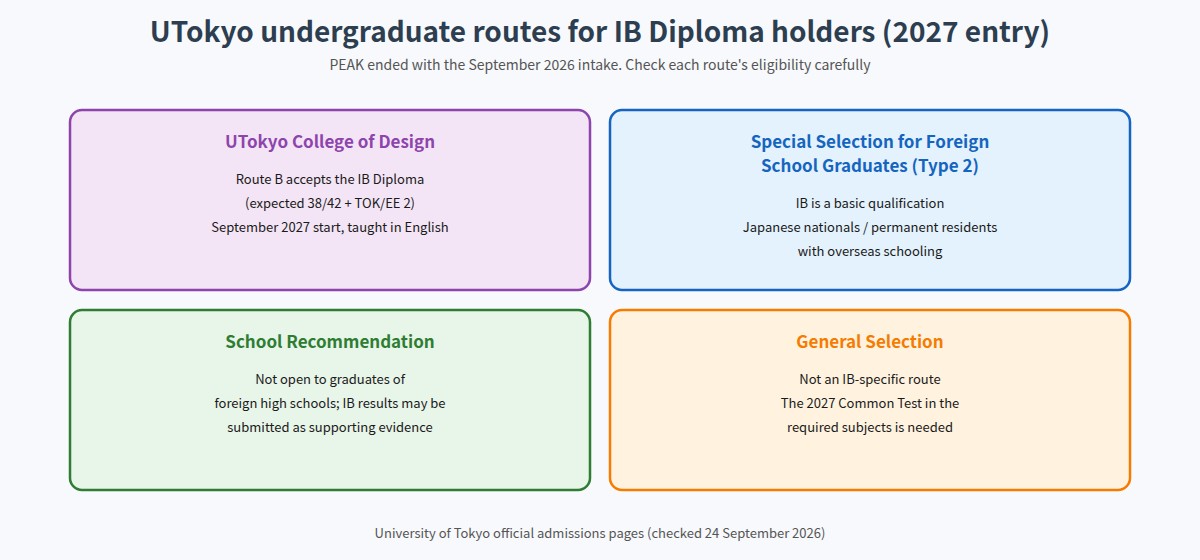
The short answer is yes — but the path is far from straightforward. Unlike universities in the UK or North America where you simply submit your IB predicted scores through a centralized system, the University of Tokyo does not have a single, dedicated IB entrance examination. Instead, IB diploma holders must navigate one of three distinct admissions routes, each with its own eligibility criteria, timeline, and selection process.

This guide walks you through every route in detail, shares realistic IB score targets, breaks down the application timeline, and offers a concrete preparation strategy. Whether you are an IB student in Japan, an international student considering Japan for university, or a parent researching options, this article gives you the complete picture.

Understanding UTokyo’s Admissions Landscape for IB Students

Before diving into the three routes, it is important to understand a fundamental truth about the University of Tokyo: it was designed primarily around Japan’s domestic education system. The standard path into UTokyo involves sitting for the Common Test for University Admissions (formerly the Center Test) followed by the university’s own notoriously difficult secondary examination.

IB diploma holders do not fit neatly into this standard pathway. As a result, UTokyo has created alternative admissions channels that IB students can use — but none of them are specifically “IB admissions” in the way that, say, UK universities accept IB scores directly. You will always be entering through a broader category of special admissions.

Here is a quick overview of your three options:

Route Japanese Name Who Is It For? Language Key Feature
1. School Recommendation Selection 学校推薦型選抜 Students at Japanese high schools (including IB schools in Japan) Japanese School nominates you; IB score is supporting evidence
2. Special Selection for Foreign School Graduates 外国学校卒業学生特別選考 Students who completed 12+ years of education overseas Japanese (mostly) IB diploma accepted as qualification; document screening + interview
3. PEAK (Programs in English at Komaba) PEAK International and domestic students seeking English-taught program English Accepts IB, SAT, A-Levels; fully English-taught liberal arts

Let us now examine each route in full detail.

Route 1: School Recommendation Selection (学校推薦型選抜)

Overview

The School Recommendation Selection is UTokyo’s answer to recommendation-based admissions. It was introduced relatively recently (2016) and allows high schools to nominate their top students for consideration. This is not a route you apply to independently — your school must put you forward.

Eligibility for IB Students

If you attend an IB World School in Japan that is also recognized as a Japanese high school (many dual-track schools fall into this category), your school can nominate you through this channel. Your IB diploma scores are then submitted as part of your supporting materials, alongside your school transcript, recommendation letters, and a personal statement.

How the Nomination Works

This is where things get intensely competitive. Each high school is limited in the number of students it can nominate, and the limits vary by faculty. For many faculties, the rule is:

  • One male student and one female student per school per faculty
  • Some faculties allow additional nominations, but the numbers remain very small

This means that even before you reach UTokyo’s evaluation stage, you must first be the top candidate at your own school. If your IB school has multiple strong students aiming for UTokyo, the internal competition can be fierce.

Selection Process

Stage Details
Document Screening Your application materials — including IB scores, transcript, recommendation, and personal statement — are reviewed
Interview / Presentation Shortlisted candidates are invited for an interview, which may include a presentation on a research topic or area of academic interest
Common Test Requirement For most faculties, provisionally accepted students must still sit for the Common Test and achieve a minimum score (approximately 80% in relevant subjects). IB students taking this route should be prepared for this hurdle

Timeline

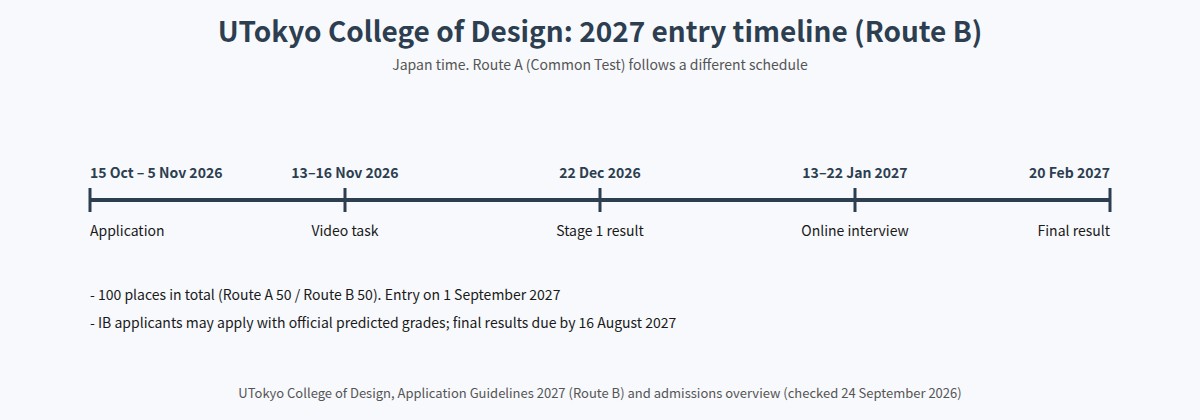
  • September – October: Schools begin internal selection of nominees
  • November: Application submission to UTokyo
  • December: Document screening and interviews
  • February: Final results announced (after Common Test confirmation)

Realistic Assessment

This route is extremely selective. Across all faculties, UTokyo accepts roughly 100 students total through School Recommendation Selection each year. Your IB score is one piece of the puzzle — they are looking for exceptional academic ability, clear research interests, and strong alignment with the faculty you are applying to. Think of this as closer to a holistic admissions process, but with Japanese academic rigor.

Route 2: Special Selection for Foreign School Graduates (外国学校卒業学生特別選考)

Overview

This route is designed for students who have completed their secondary education (12 or more years) at a school outside Japan, or at an international school in Japan that follows a foreign curriculum. If you earned your IB diploma at a school overseas — whether in Singapore, the UK, Germany, or anywhere else — this is likely your primary pathway into UTokyo’s Japanese-taught programs.

Eligibility Requirements

  • You must have completed 12 or more years of formal education in a foreign school system
  • The IB diploma is accepted as a qualifying credential
  • You generally need strong Japanese language proficiency, as the programs are taught in Japanese
  • Some faculties may require specific subject prerequisites (for example, science faculties may require Higher Level Mathematics and science subjects)

Selection Process

The selection for this route typically involves multiple stages:

Stage What to Expect
1. Document Screening Submission of IB diploma and scores, academic transcripts, personal statement, and any required standardized test scores (such as JLPT or EJU for Japanese proficiency)
2. Written Examination / Essay Depending on the faculty, you may be required to write an essay or sit a written exam in Japanese. Topics are faculty-specific and test your academic thinking ability
3. Interview A face-to-face or online interview conducted primarily in Japanese. Faculty members assess your academic motivation, research interests, and suitability for the program

Important Considerations

Japanese language ability is critical. Even though your qualifying credential is the IB diploma (earned in English or another language), once you enroll at UTokyo through this route, your lectures, seminars, assignments, and exams will all be in Japanese. You should realistically be at JLPT N1 level or equivalent to survive — and ideally thrive — in UTokyo’s academic environment.

This route tends to attract a small number of highly capable bilingual students — for example, Japanese nationals who grew up abroad, or international students with deep Japanese language training.

Timeline

The timeline for this route varies by faculty, but a general outline is:

  • Summer (June – August): Application guidelines released; preparation of documents
  • Autumn (September – November): Application submission (varies by faculty)
  • Winter (November – February): Written exams and interviews
  • Early Spring (February – March): Results announced

Always check the specific faculty’s admissions page, as deadlines can differ significantly between departments.

Route 3: PEAK — Programs in English at Komaba

Overview

PEAK is the most accessible route for English-speaking IB students who do not have strong Japanese language skills. Launched in 2012, PEAK is a fully English-taught undergraduate program based at UTokyo’s Komaba campus. It offers a liberal arts education in the first two years, after which students specialize in either International Environmental Science or International Japan Studies.

For many international IB students, PEAK represents the most natural fit — it was specifically designed to bring global diversity to UTokyo’s campus.

Critical Update: PEAK Admissions Ending

IMPORTANT: The University of Tokyo has announced that PEAK will stop accepting new students after the September 2026 intake cohort. If you are considering PEAK, you must apply for entry in September 2026 or earlier. After that point, this route will no longer be available. UTokyo may introduce successor programs, but no details have been confirmed as of 2025. Act now if PEAK is your target.

What PEAK Accepts

PEAK has one of the most internationally friendly admissions processes at UTokyo. It accepts:

  • IB Diploma scores (predicted and final)
  • SAT / ACT scores
  • A-Level results
  • Other internationally recognized qualifications

There is no additional entrance examination. PEAK uses a holistic review process similar to what you might expect from a US or UK university.

Application Components

Component Details
Academic Transcripts Official school transcripts covering the last 3 years
Standardized Test Scores IB diploma (predicted or final), SAT, ACT, or A-Levels
Personal Statement / Essay A written statement explaining your academic interests, motivation for choosing UTokyo, and future goals
Letters of Recommendation Typically two academic references from teachers or counselors
English Proficiency TOEFL or IELTS scores (may be waived if IB was completed in English)
Interview Shortlisted candidates may be invited for an online interview

PEAK Admissions Rounds

PEAK typically offers two admissions rounds:

Round Application Deadline Results Enrollment
Round 1 (Early) Around November – December February – March September of the following year
Round 2 (Regular) Around January – February April – May September of the same year

Note: PEAK enrollment begins in September, not April (which is the standard Japanese academic year start). This aligns well with the IB exam schedule, as May exam results are available before the September start.

Competitiveness

PEAK admits a very small cohort — typically around 30 to 40 students per year across both streams. With applicants from around the world, the acceptance rate is estimated at roughly 5-15%, making it highly competitive. The quality of your personal statement and the overall narrative of your application matter enormously.

Target IB Scores: What Do You Realistically Need?

The University of Tokyo does not publish a minimum IB score requirement for any of its admissions routes. However, based on the general competitiveness of UTokyo and the caliber of admitted students, here is a realistic assessment:

IB Score Range Assessment
42-45 Highly competitive. You are in a strong position for all three routes. At PEAK, this puts you among the top applicants. For School Recommendation, this makes a powerful supporting case.
38-41 Competitive. This is likely the practical threshold for serious consideration. You will need strong extracurriculars, a compelling personal statement, and excellent interview performance to complement your scores.
35-37 Borderline. Not impossible, but you would need exceptional qualities in other areas — outstanding research experience, unique background, or remarkable achievements — to compensate.
Below 35 Unlikely. While there is no published cutoff, UTokyo’s overall selectivity makes admission with scores below 35 very difficult through any route.

Unofficial target: Aim for 38 or above. This is not an official figure from UTokyo, but reflects the consensus among IB counselors and education consultants familiar with Japanese university admissions. A score of 40+ gives you a much more comfortable margin.

Subject Selection Matters

Beyond the total score, UTokyo faculties pay attention to your subject choices:

  • Science faculties: Higher Level Mathematics (Analysis and Approaches preferred) and at least one HL science are essentially required
  • Liberal arts / PEAK: A balanced subject combination with strong performance across all six subjects is ideal
  • Economics / Law: HL Mathematics is a significant advantage

Complete Application Timeline

Planning ahead is essential. Here is a consolidated timeline showing when key milestones fall for each route:

Month School Recommendation Foreign School Graduates PEAK
June – August Research faculties; discuss with school counselor Guidelines released; begin document preparation Research program; begin personal statement drafts
September – October School internal selection process Some faculties open applications Finalize application materials
November Submit application to UTokyo Application submissions (varies) Round 1 application deadline
December Document screening; interviews Written exams begin (some faculties) Round 1 screening
January Common Test (if required) Interviews (some faculties) Round 2 application deadline
February – March Final results Results announced Round 1 results; Round 2 screening
April – May Enrollment (April start) Enrollment (April start) Round 2 results
September Enrollment (September start)

Preparation Strategy for IB Students Targeting UTokyo

Getting into the University of Tokyo requires more than strong IB scores. Here is a year-by-year strategy:

IB Year 1 (DP1): Build Your Foundation

  • Choose subjects strategically. If you have any interest in science or economics at UTokyo, take HL Mathematics (Analysis and Approaches) and at least one HL science. These choices cannot easily be changed later.
  • Start Japanese language preparation. If you are considering Routes 1 or 2, you need near-native Japanese ability. Begin intensive study now if you are not already fluent.
  • Research UTokyo faculties. UTokyo has 10 undergraduate faculties. Understanding which one aligns with your interests early on helps you craft a focused application.
  • Develop a research interest. UTokyo values students with clear academic direction. Start exploring a specific topic deeply — this will strengthen your personal statement and interview.
  • Maintain high grades. Your predicted scores will be based on Year 1 performance. Aim for 6s and 7s from the start.

IB Year 2 (DP2): Execute Your Application

  • Secure strong predicted scores. Work with your teachers to ensure your predicted grades are as high as possible. For UTokyo, every point matters.
  • Write an exceptional personal statement. For PEAK especially, this is your chance to stand out. Be specific about why UTokyo, why your chosen field, and what unique perspective you bring.
  • Prepare for interviews. All three routes involve some form of interview or presentation. Practice articulating your academic interests, research ideas, and motivation clearly and confidently.
  • Get strong recommendation letters. Choose recommenders who know you well and can speak to your intellectual curiosity, not just your grades.
  • Submit applications early. Do not wait until the last minute. Technical issues, document requirements, and time zone differences can all cause delays.

Extended Essay and CAS Strategy

Your IB Extended Essay (EE) and CAS (Creativity, Activity, Service) portfolio can be powerful differentiators:

  • Choose an EE topic related to your intended faculty. An EE in Economics for someone applying to UTokyo’s Faculty of Economics demonstrates genuine academic engagement.
  • CAS activities that show leadership and initiative. UTokyo looks favorably on students who have made meaningful contributions to their communities, not just racked up hours.
  • Japan-related CAS or EE topics can show genuine interest in Japanese society and culture, which strengthens your case for studying in Japan.

Alternative Top Japanese Universities for IB Students

UTokyo is the summit, but Japan has several other world-class universities with more established IB admissions pathways. If UTokyo does not work out — or if you want backup options — consider these institutions:

University IB-Friendly Program Notes
Kyoto University Special selection for IB students (some faculties) Japan’s #2 university; strong in sciences and humanities
Waseda University Multiple English-taught programs; explicit IB admissions Very IB-friendly; SILS and other programs accept IB directly
Keio University PEARL program (Economics); GIGA program English-taught options; strong brand recognition in Japan
Sophia University Faculty of Liberal Arts (English-taught) Central Tokyo location; long history of international education
University of Tsukuba Dedicated IB admissions track One of the most explicitly IB-friendly national universities
Osaka University Special admissions for IB holders Top national university; strong in STEM fields
Tohoku University Future Global Leadership (FGL) program English-taught STEM programs; generous scholarships

Applying to a spread of these universities alongside UTokyo is a sensible strategy. Several of them — particularly Waseda and Tsukuba — have admissions processes that are explicitly designed for IB students, making them excellent safety and match options.

Frequently Asked Questions

Can I apply to UTokyo with predicted IB scores?

For PEAK, yes — you can apply with predicted scores and submit final results later. For the School Recommendation and Foreign School Graduate routes, the process typically requires or strongly prefers final scores, though predicted scores may be accepted during the initial screening stage. Always check the most current guidelines on UTokyo’s admissions website.

Do I need to speak Japanese to attend UTokyo?

It depends on the route. For PEAK, no — the entire program is taught in English (though basic Japanese courses are included in the curriculum). For Routes 1 and 2, strong Japanese ability is essential, as all instruction is in Japanese. Realistically, you need JLPT N1 level or equivalent for the Japanese-taught programs.

What are the tuition fees at UTokyo?

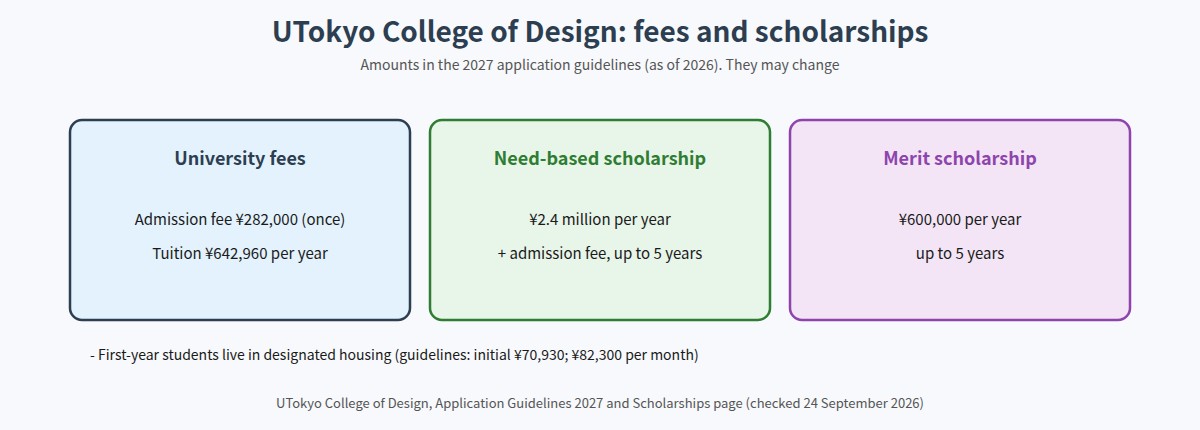
As a national university, UTokyo’s tuition is standardized and remarkably affordable compared to private universities: approximately 535,800 yen per year (roughly USD 3,600 at current exchange rates). There is also an enrollment fee of 282,000 yen. Scholarships and fee waivers are available for students with financial need.

Is PEAK really closing?

PEAK will stop accepting new students after the September 2026 cohort. Current students will be able to complete their degrees, but no new students will be admitted after that intake. UTokyo has signaled interest in developing successor international programs, but as of 2025, no specific replacement has been announced.

How does UTokyo compare to applying to UK or US universities with IB?

The process is less standardized and less transparent than UK (UCAS) or US (Common App) admissions. There is no centralized platform for Japanese university applications. Each route at UTokyo has its own forms, deadlines, and requirements. The interview and document screening components are more similar to Oxbridge than to the typical US admissions process.

Can I transfer to UTokyo from another Japanese university?

Transfer admissions (編入学) exist at UTokyo but are extremely limited and competitive. It is generally much better to enter as a first-year student through one of the three routes described above.

What is the acceptance rate at UTokyo?

UTokyo’s overall acceptance rate for its general entrance examination is approximately 30-35%, but this figure is misleading — the applicant pool is already heavily self-selected. For the School Recommendation route, the acceptance rate is much lower. For PEAK, with roughly 30-40 spots and hundreds of applicants from around the world, the effective acceptance rate is estimated at 5-15%.

Should I take the SAT or ACT in addition to my IB diploma?

For PEAK, submitting SAT or ACT scores alongside your IB diploma can strengthen your application, especially if your scores are very high. For Routes 1 and 2, SAT/ACT scores are generally not required or relevant. Focus your energy on maximizing your IB scores and preparing route-specific materials instead.

Key Takeaways and Final Advice

Getting into the University of Tokyo with an IB diploma is absolutely possible, but it requires careful planning, realistic self-assessment, and strategic application choices. Here is a summary of the most important points:

  • There is no single “IB admissions” at UTokyo. You must choose from three routes, each with different requirements and processes.
  • Aim for an IB score of 38 or higher. While there is no published minimum, this is the realistic threshold for competitive consideration.
  • Japanese language ability determines your options. Without strong Japanese, PEAK is your only viable route — and it is closing after September 2026.
  • Start preparing early. IB Year 1 decisions on subject choices and language preparation set the foundation for your entire application.
  • PEAK’s closure is a critical deadline. If you are an international student without strong Japanese, the September 2026 cohort may be your last chance to enter UTokyo through an English-taught program.
  • Apply to multiple universities. Even the strongest candidates should have backup options. Waseda, Keio, Tsukuba, and other top Japanese universities have more established IB pathways.
  • Quality of application matters as much as scores. Your personal statement, interview performance, and recommendation letters can make or break your application, especially for PEAK and School Recommendation routes.

The University of Tokyo offers a world-class education at a fraction of the cost of comparable Western institutions. For IB students willing to put in the work — both academically and in navigating the admissions process — it remains one of the most rewarding university destinations in the world. Start early, prepare thoroughly, and apply strategically. Good luck.

コメント

タイトルとURLをコピーしました