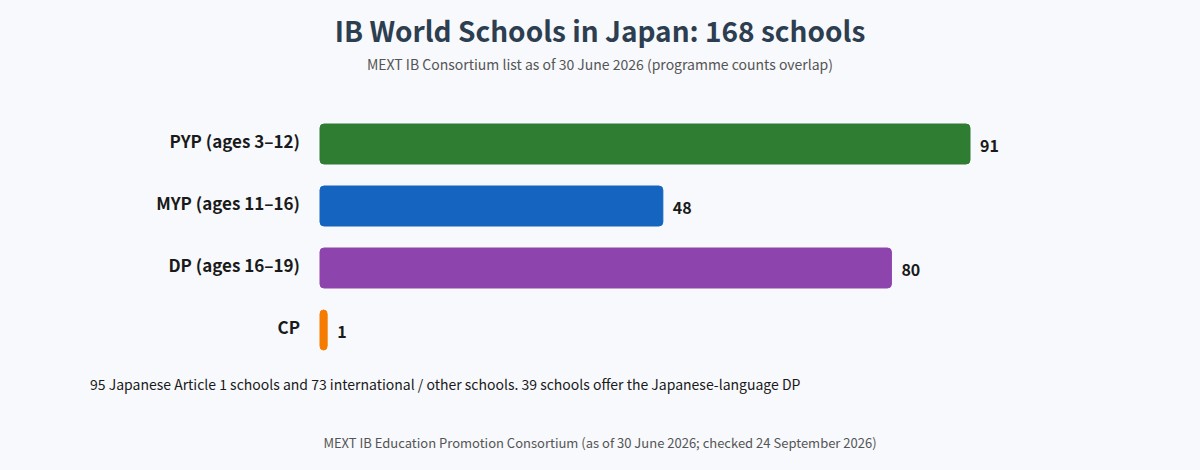
Japan is home to one of Asia’s most dynamic International Baccalaureate landscapes, with over 80 IB-authorized schools spread across the archipelago from Hokkaido to Okinawa. Yet for families trying to identify the very best IB schools in the country, the research process can be overwhelming. Official IB exam score data is not published by the IB Organization on a per-school basis, making direct comparisons difficult. School marketing materials rarely tell the full story, and English-language information about Japanese private schools offering the IB remains scarce.
This ranking is designed to fill that gap. Drawing on publicly available information, school disclosures, alumni networks, educational consultant insights, and years of coverage of the Japanese IB sector, we have assembled what we believe is the most comprehensive English-language ranking of IB schools in Japan. We cover international schools, private Japanese-accredited schools (ichijoko), and public schools offering the IB Diploma Programme.
A critical caveat before we begin: this ranking is editorial in nature. The IB Organization does not release individual school score data publicly, and most schools in Japan do not voluntarily disclose their average DP scores. Where exam results or university placement data are referenced, they come from school publications, media reports, or publicly available disclosures. We have made every effort to be transparent about what is known and what is estimated. Readers should treat this as a well-informed guide rather than a definitive league table.
- Ranking Methodology: How We Evaluated Japan’s IB Schools
- Top International Schools for the IB in Japan
- #1. Osaka International School of Kwansei Gakuin (OIS) — Osaka
- #2. K. International School Tokyo (KIST) — Tokyo
- #3. Aoba-Japan International School (A-JIS) — Tokyo
- #4. Canadian Academy — Kobe
- #5. Yokohama International School (YIS) — Yokohama
- #6. Osaka YMCA International School (OYIS) — Osaka
- #7. Hiroshima International School (HIS) — Hiroshima
- Top Private Japanese Schools (Ichijoko) for the IB
- Top Public Schools for the IB
- Master Comparison Table: All Ranked Schools
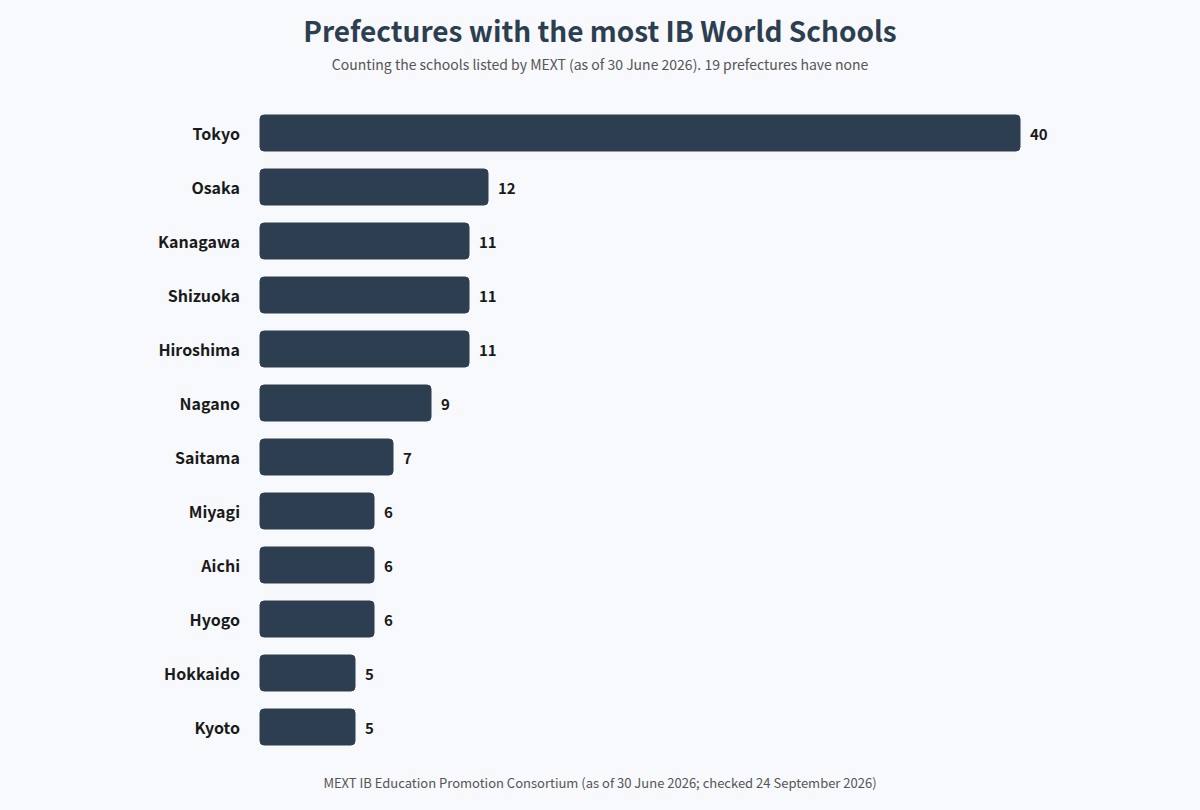
- Regional Guide: Finding IB Schools Across Japan
- How to Choose the Right IB School in Japan
- Frequently Asked Questions
- What is the IB Diploma pass rate at the best schools in Japan?
- Can Japanese students attend international schools for the IB?
- How much does IB education cost in Japan?
- Is the IB recognized by Japanese universities?
- What IB score is needed for top universities?
- How competitive is admission to public IB schools in Japan?
- Should my child start IB from PYP, or can they join at the DP stage?
- Summary and Key Takeaways
Ranking Methodology: How We Evaluated Japan’s IB Schools
Our ranking methodology weighs five core criteria, each reflecting a different dimension of what makes an IB school excellent. Schools were evaluated across all five areas, with the final ranking reflecting a holistic judgment rather than a rigid points-based formula.
| Criterion | Weight | What We Assessed |
|---|---|---|
| IB Track Record | 30% | Years of IB authorization, number of DP cohorts graduated, consistency of program delivery, IB evaluation reports (where available) |
| Exam Results | 25% | Known or reported DP average scores, pass rates, incidence of high scorers (40+ points), bilingual diploma rates |
| University Placement | 20% | Acceptance to top-tier universities worldwide (Oxbridge, Ivy League, Russell Group, Go8, top Japanese national universities), breadth of global destinations |
| Program Breadth | 15% | Number of IB programs offered (PYP, MYP, DP), range of DP subjects, availability of bilingual diploma pathway, additional accreditations (CIS, WASC, NEASC) |
| Facilities and Support | 10% | Campus quality, science labs, libraries, sports and arts facilities, learning support services, university counseling resources |
Important note on IB score data: The global IB average for May 2024 examinations was approximately 30.3 points out of 45. The worldwide DP pass rate was around 80%. Where we reference a school’s results as “above average” or “well above average,” we are comparing against these global benchmarks using whatever information is publicly available. Schools that do not disclose scores are evaluated more heavily on the other four criteria.
Top International Schools for the IB in Japan
International schools in Japan operate outside the formal Japanese education system (they are not “ichijoko” or Article 1 schools under Japanese law). They primarily serve the expatriate community and deliver instruction in English. These schools typically have the longest IB track records in the country, as many were early adopters of the IB framework decades before the Japanese government began promoting it.
#1. Osaka International School of Kwansei Gakuin (OIS) — Osaka
| OIS Kwansei Gakuin at a Glance | |
|---|---|
| Location | Minoh, Osaka (new campus from 2021); additional campus in central Osaka (Kita-ku) |
| IB Programs | PYP, MYP, DP (Full Continuum) |
| IB Authorization | DP since 2001 (25+ years of IB experience) |
| Language of Instruction | English |
| Grades | Pre-K through Grade 12 |
| Annual Tuition (approx.) | JPY 1,800,000 – 2,400,000 |
| Accreditations | IB World School, CIS, WASC |
Why OIS takes the top spot: Osaka International School of Kwansei Gakuin earns our number-one ranking among international schools based on an exceptional combination of IB longevity, recent exam performance, and institutional depth. With over 25 years of IB Diploma Programme delivery, OIS has one of the longest continuous IB track records of any school in Japan. The school reported a 45-point perfect scorer in its 2025 DP cohort, a feat achieved by only a fraction of IB candidates worldwide. This level of individual academic excellence, combined with consistently strong cohort performance, places OIS at the pinnacle of IB achievement in Japan.
Backed by the Kwansei Gakuin educational group, one of Japan’s most prestigious private educational institutions founded in 1889, OIS benefits from extraordinary institutional resources. The school’s 2021 move to a purpose-built campus in Minoh, Osaka, gave it state-of-the-art science laboratories, performing arts spaces, and sports facilities that rival any international school in Asia. The Kwansei Gakuin affiliation also provides students with a streamlined pathway to Kwansei Gakuin University, one of Japan’s top private universities, while graduates also regularly gain admission to universities in the US, UK, Canada, and Australia.
OIS delivers the full IB Continuum (PYP, MYP, and DP), ensuring pedagogical coherence from early childhood through to university entrance. The school community draws from over 30 nationalities, creating a genuinely international learning environment in the Kansai region.
#2. K. International School Tokyo (KIST) — Tokyo
| KIST at a Glance | |
|---|---|
| Location | Koto-ku, Tokyo (Shinonome, near Toyosu waterfront) |
| IB Programs | PYP, MYP, DP (Full Continuum) |
| IB Authorization | Among the first full-continuum schools in Japan |
| Language of Instruction | English (with Japanese language classes) |
| Grades | Kindergarten through Grade 12 |
| Annual Tuition (approx.) | JPY 2,200,000 – 2,500,000 |
| Accreditations | IB World School, CIS |
Why KIST ranks so highly: K. International School Tokyo has built an outstanding reputation as one of the most academically rigorous international schools in Tokyo. KIST’s DP pass rate consistently exceeds the global average, and the school has a strong record of graduates gaining admission to top-tier universities worldwide, including Oxbridge, Ivy League institutions, and leading Japanese universities such as the University of Tokyo and Keio University.
What sets KIST apart is the combination of academic intensity and a relatively intimate school community. With class sizes typically ranging from 15 to 20 students, KIST offers a level of personalized attention that larger international schools struggle to match. The school’s university counseling program, which begins in earnest from Grade 9, is widely regarded as one of the strongest in the Tokyo international school community.
KIST’s modern waterfront campus in the rapidly developing Koto-ku area features excellent science and technology facilities. The school draws students from over 40 nationalities, and its strong Japanese language program makes it particularly attractive to bicultural families who want their children to maintain Japanese proficiency alongside English-medium IB studies.
#3. Aoba-Japan International School (A-JIS) — Tokyo
| A-JIS at a Glance | |
|---|---|
| Location | Hikarigaoka (Nerima-ku), Meguro, and Bunkyo-ku campuses, Tokyo |
| IB Programs | PYP, MYP, DP (Full Continuum) |
| Founded | 1976 |
| Language of Instruction | English |
| Grades | Pre-K (age 1.5) through Grade 12 |
| Annual Tuition (approx.) | JPY 2,000,000 – 2,600,000 |
| Accreditations | IB World School, CIS, NEASC |
Why A-JIS stands out: Aoba-Japan International School is one of only a handful of schools in Japan to offer the complete IB Continuum from PYP through MYP to DP. Founded in 1976, A-JIS has nearly five decades of experience in international education, and its triple accreditation (IB, CIS, NEASC) speaks to the quality assurance infrastructure underlying its programs.
A-JIS operates across three campuses in Tokyo, each serving different age groups. The school draws students from over 30 nationalities and has built a particularly strong reputation in STEAM education, integrating science, technology, engineering, arts, and mathematics across all IB stages. The school’s bilingual preschool feeder program (Aoba-Japan Bilingual Preschool, operating across five campuses) creates a pipeline for families who want to begin with a bilingual environment before transitioning to full English-medium IB education.
DP results at A-JIS have been consistently competitive, with graduates gaining admission to universities across the UK, US, Canada, Australia, and Japan. The school’s active CAS (Creativity, Activity, Service) program and community engagement initiatives reflect the IB’s mission of developing globally minded citizens.
#4. Canadian Academy — Kobe
| Canadian Academy at a Glance | |
|---|---|
| Location | Rokko Island, Kobe, Hyogo Prefecture |
| IB Programs | PYP, MYP, DP (Full Continuum) |
| Founded | 1913 |
| Language of Instruction | English |
| Grades | Pre-K through Grade 12 (boarding available from Grade 7) |
| Annual Tuition (approx.) | JPY 2,000,000 – 2,700,000 (boarding additional) |
| Accreditations | IB World School, CIS, WASC |
Why Canadian Academy excels: Founded in 1913, Canadian Academy is one of the oldest international schools in Japan and one of the most established IB schools in the Kansai region. Located on Rokko Island in Kobe, the school offers the full IB Continuum and is one of very few international schools in Japan with boarding facilities, making it accessible to families across western Japan and beyond.
Canadian Academy’s DP results have historically been strong, with the school’s average score typically exceeding the world average. The school’s relatively small size fosters close relationships between students and faculty, and its university counseling program has an excellent track record of placing graduates at competitive universities in North America, the UK, and Australia. The school’s location in Kobe, a city with deep international heritage and a vibrant expatriate community, enriches the educational experience with genuine cross-cultural immersion.
The campus on Rokko Island provides a safe, self-contained environment with modern facilities including science labs, art studios, a library, sports fields, and a swimming pool. The boarding program, available from Grade 7, accommodates students from across Japan and the wider Asia-Pacific region.
#5. Yokohama International School (YIS) — Yokohama
| YIS at a Glance | |
|---|---|
| Location | Naka-ku, Yokohama, Kanagawa Prefecture |
| IB Programs | PYP, MYP, DP (Full Continuum) |
| Founded | 1924 |
| Language of Instruction | English |
| Student Body | Approximately 750 students from 50+ countries |
| Annual Tuition (approx.) | JPY 2,200,000 – 2,700,000 |
| Accreditations | IB World School, CIS, WASC |
Why YIS is a top choice: Yokohama International School is one of the oldest international schools in the world, having been founded in 1924 in the aftermath of the Great Kanto Earthquake. It was among the first schools globally to adopt the name “International,” and its century of experience in international education is virtually unmatched in Japan. YIS delivers the full IB Continuum, with PYP authorization dating back to 2001.
YIS enrolls approximately 750 students from over 50 countries and territories, making it one of the most diverse school communities in Japan. The school’s DP results are consistently strong, and its university placement record spans top institutions across North America, Europe, and the Asia-Pacific. The school’s location in Yokohama’s Naka-ku, about 30 minutes from central Tokyo, provides easy access for families based in the Greater Tokyo area while offering a somewhat less hectic environment than central Tokyo itself.
#6. Osaka YMCA International School (OYIS) — Osaka
| OYIS at a Glance | |
|---|---|
| Location | Tennoji-ku, Osaka |
| IB Programs | PYP, MYP |
| Language of Instruction | English |
| Grades | Pre-K through Grade 9 |
| Annual Tuition (approx.) | JPY 1,400,000 – 1,800,000 |
| Accreditations | IB World School |
Why OYIS deserves attention: Osaka YMCA International School occupies a unique niche in the Kansai international school market. As a PYP and MYP school, it does not offer the Diploma Programme, but its strength lies in providing an excellent IB foundation for younger learners at a significantly lower tuition point than many competing international schools. For families in Osaka seeking a well-established IB pathway for primary and middle school years, OYIS is a compelling option. Many OYIS graduates transition to DP-offering schools such as OIS Kwansei Gakuin or Canadian Academy for their senior years.
The school benefits from the YMCA’s global network and its values-driven approach to education, emphasizing community service and character development alongside academic rigor. Its location in Tennoji-ku provides convenient access from across the Osaka metropolitan area.
#7. Hiroshima International School (HIS) — Hiroshima
| HIS at a Glance | |
|---|---|
| Location | Asakita-ku, Hiroshima |
| IB Programs | PYP, MYP, DP (Full Continuum) |
| Founded | 1962 |
| Language of Instruction | English |
| Student Body | Students from 20+ countries (ages 3-18) |
| Annual Tuition (approx.) | JPY 1,500,000 – 2,200,000 |
| Accreditations | IB World School, CIS, JCIS member |
Why HIS matters: Hiroshima International School has been delivering international education since 1962, making it one of the longest-established international schools outside of the Tokyo-Kansai corridor. HIS offers the complete IB Continuum and is accredited by CIS. Its unique identity is shaped by Hiroshima’s status as an international city of peace; the school’s motto, “Diversity, Inclusion, Peace,” reflects a commitment to peace education that goes beyond curriculum and permeates school culture.
For families living in the Chugoku region or relocating to Hiroshima, HIS represents the only full-continuum IB international school option. The school’s campus in Asakita-ku, surrounded by natural beauty, provides a peaceful learning environment with purpose-built facilities. While smaller than Tokyo or Osaka international schools, HIS’s intimate community and dedicated faculty offer a highly personalized educational experience.
Top Private Japanese Schools (Ichijoko) for the IB
Private ichijoko (Article 1 schools recognized under Japanese law) that offer the IB represent a fascinating category. These schools satisfy Japanese curriculum requirements while simultaneously delivering one or more IB programs. Graduates receive both a Japanese high school diploma and, if they complete the DP, the IB Diploma. This dual qualification pathway is increasingly attractive to Japanese families who want international educational quality without sacrificing domestic university entrance options.
#1. Tamagawa Gakuen (Tamagawa Academy) — Tokyo
| Tamagawa Gakuen at a Glance | |
|---|---|
| Location | Machida, Tokyo |
| IB Programs | MYP (since 2009), DP (since 2010) |
| Founded | 1929 |
| School Type | Private K-12 ichijoko (kindergarten through high school) |
| Campus | 610,000 sq. meters |
| Annual Tuition (approx.) | JPY 1,200,000 – 1,800,000 (IB class premium applies) |
| Access | 3-minute walk from Tamagawa-Gakuen-Mae Station (Odakyu Line, ~30 min from Shinjuku) |
Why Tamagawa Gakuen leads the ichijoko category: Tamagawa Gakuen holds a unique distinction as one of the earliest Japanese ichijoko to adopt IB programs. MYP authorization came in 2009 and DP in 2010, giving the school over 15 years of IB experience, an extraordinary tenure for a Japanese domestic school. Founded in 1929 by educator Kuniyoshi Obara on the philosophy of “Zenjin Kyoiku” (whole-person education), the school’s founding principles align remarkably well with the IB’s emphasis on holistic development.
The school’s 610,000-square-meter campus in Machida is one of the largest educational campuses in the Tokyo metropolitan area, featuring extensive science facilities, performing arts spaces, athletic grounds, and a university campus (Tamagawa University) on the same site. This seamless K-12-through-university environment gives IB students access to university-level resources that few secondary schools anywhere in the world can offer.
Tamagawa Gakuen’s IB students benefit from a dual-track system where they can earn both a Japanese high school diploma and the IB Diploma. Graduates have been accepted at universities in Japan (including top national universities), the UK, US, Canada, and Australia. The school’s long IB track record means it has developed institutional expertise in DP preparation that newer IB schools are still building.
#2. Gunma Kokusai Academy (GKA) — Gunma
| GKA at a Glance | |
|---|---|
| Location | Ota City, Gunma Prefecture |
| IB Programs | MYP (since 2022), DP (since 2011) |
| School Type | Private K-12 ichijoko (English immersion) |
| Language of Instruction | English (all subjects except Japanese) |
| Annual Tuition (approx.) | JPY 900,000 – 1,300,000 |
| Access | Ota City, ~90 minutes from central Tokyo by train |
Why GKA is exceptional: Gunma Kokusai Academy is one of the most innovative schools in Japan. As an ichijoko that delivers all subjects except Japanese in English (full English immersion), GKA bridges the gap between international schools and domestic Japanese schools in a way that no other institution in the country quite replicates. DP authorization since 2011 gives the school over a decade of Diploma Programme experience.
What makes GKA particularly remarkable is its value proposition. Located in Ota City, Gunma Prefecture, the school offers tuition significantly below that of Tokyo-based international schools, while delivering an English-immersion IB education that produces graduates with near-native bilingual proficiency. Most students enter with little or no English ability in elementary school and emerge from high school fully bilingual, a transformation that speaks to the effectiveness of the immersion methodology.
GKA has been recognized nationally as a model for Japan’s push to expand English-medium education, and its graduates have been accepted at universities both in Japan and overseas. For families willing to look beyond Tokyo, GKA represents one of the highest-value IB education options in the country.
#3. Katoh Gakuen Gyoshu Junior and Senior High School — Shizuoka
| Katoh Gakuen at a Glance | |
|---|---|
| Location | Numazu City, Shizuoka Prefecture |
| IB Programs | MYP, DP (20+ years of IB experience) |
| Founded | 1926 |
| School Type | Private ichijoko (junior and senior high school) |
| Annual Tuition (approx.) | JPY 800,000 – 1,200,000 |
| Access | Numazu City, ~1 hour from Tokyo by Shinkansen |
Why Katoh Gakuen is a pioneer: Katoh Gakuen holds a special place in the history of IB education in Japan. It was one of the first Japanese ichijoko to receive IB authorization, with over two decades of continuous IB programme delivery. This extraordinary longevity means that Katoh Gakuen has graduated more DP cohorts than almost any other domestic Japanese school, accumulating institutional expertise that is genuinely rare in the Japanese IB landscape.
Located in Numazu City, Shizuoka Prefecture, with views of Mount Fuji, the school offers both MYP and DP. Its founding philosophy of “Jiyu Jiritsu” (independence and self-reliance) from 1926 aligns naturally with the IB’s emphasis on independent thinking and self-directed learning. Katoh Gakuen’s graduates have gained admission to universities both in Japan and abroad, and the school’s affordable tuition makes it one of the most accessible IB options for middle-class Japanese families.
For families in the Shizuoka, Kanagawa, or eastern Tokai region, Katoh Gakuen offers a proven IB track record that many newer IB schools in Tokyo are still working to establish.
#4. Kaichi Nihonbashi Gakuen — Tokyo
| Kaichi Nihonbashi Gakuen at a Glance | |
|---|---|
| Location | Chuo-ku (Nihonbashi), Tokyo |
| IB Programs | MYP (since 2018), DP (since 2018) |
| Founded | 1905 |
| School Type | Private ichijoko (junior and senior high school, co-educational) |
| Annual Tuition (approx.) | JPY 900,000 – 1,200,000 |
| Notable | First private school in Tokyo’s 23 wards to receive both MYP and DP authorization |
Why Kaichi Nihonbashi Gakuen is rising rapidly: Kaichi Nihonbashi Gakuen achieved a significant milestone in 2018 when it became the first private school within Tokyo’s 23 central wards to receive both MYP and DP authorization from the IB. Located in the historic Nihonbashi district of Chuo-ku, the school offers families in central Tokyo a domestic school option that delivers IB education without the premium tuition of international schools.
The school traces its history to 1905, giving it 119 years of educational tradition, but its adoption of the IB represents a bold modernization strategy. Kaichi Nihonbashi Gakuen is part of the broader Kaichi Educational Group, which also operates Kaichi Nozomi Elementary School (PYP-authorized), creating a potential feeder pathway for families seeking IB continuity from primary school. The school’s central Tokyo location makes it highly accessible by public transportation, a practical advantage that should not be underestimated for daily commuting families.
Top Public Schools for the IB
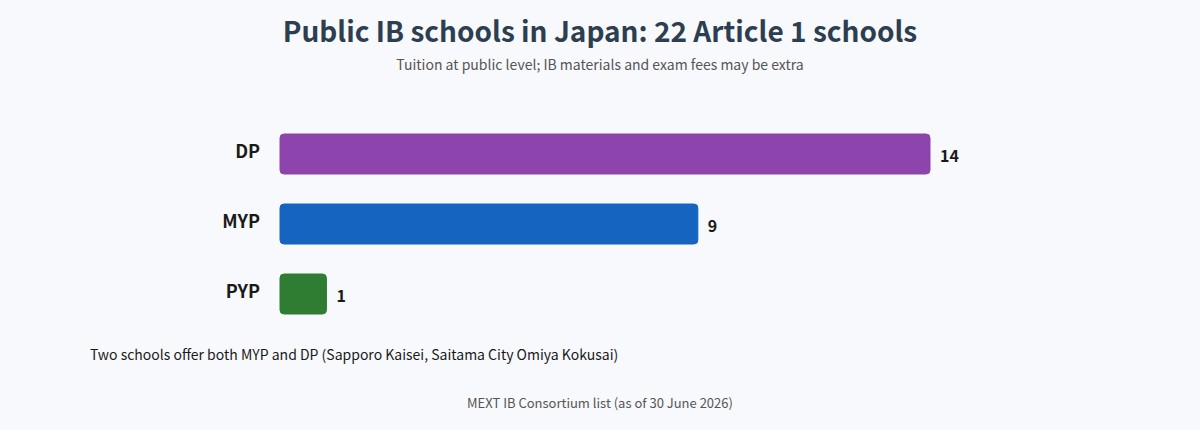
Japan’s public IB schools represent perhaps the most exciting development in the country’s IB landscape. These schools make IB education accessible at minimal or no tuition cost, democratizing access to a program that has traditionally been the preserve of expensive private and international schools. The trade-off is that admission is highly competitive, with entrance examination pass rates often in single digits.
#1. Tokyo Metropolitan Kokusai High School — Tokyo
| Tokyo Metropolitan Kokusai at a Glance | |
|---|---|
| Location | Komaba, Meguro-ku, Tokyo (adjacent to University of Tokyo Komaba Campus) |
| IB Programs | DP (authorized May 2015) |
| Founded | 1989 |
| School Type | Tokyo Metropolitan (public) high school |
| Student Body | ~720 students total; ~30% returnees/foreign nationals from 40+ countries |
| Tuition | Effectively free under Tokyo’s public high school tuition waiver (since 2024) |
| Access | 5-minute walk from Komaba-Todaimae Station (Keio Inokashira Line) |
Why Tokyo Metropolitan Kokusai is the top public IB school: Tokyo Metropolitan Kokusai High School holds the historic distinction of being the first public high school in Japan to receive IB Diploma Programme authorization, in May 2015. This pioneering status, combined with its location in one of Tokyo’s most prestigious academic neighborhoods (adjacent to the University of Tokyo’s Komaba Campus), makes it the most prominent public IB school in the country.
The school’s International Studies department, established in 1989, has over three decades of experience in international education. Approximately 30% of the student body consists of returnees and foreign nationals representing over 40 countries, creating a genuinely multicultural environment within a public school setting. The school has been designated a “Shingaku Shido Tokubetsu Suishin-ko” (Special University Guidance Promotion School) by the Tokyo Metropolitan Government, reflecting confidence in its academic standards.
The practical advantage of Tokyo Metropolitan Kokusai is transformative: under Tokyo’s public high school tuition policy effective from 2024, the IB Diploma Programme is available at essentially zero tuition cost. For families in Tokyo, this makes world-class IB education accessible regardless of financial circumstance, though competition for admission is fierce.
#2. Saitama Municipal Omiya International Secondary School — Saitama
| Omiya International Secondary School at a Glance | |
|---|---|
| Location | Omiya-ku, Saitama City, Saitama Prefecture |
| IB Programs | MYP, DP |
| Founded | 2019 |
| School Type | Municipal secondary school (public, 6-year integrated junior and senior high) |
| Student Body | 80 students per year group |
| Tuition | Minimal (public school fees only) |
| Notable | First graduating DP cohort in March 2025 |
Why Omiya International is one to watch: Saitama Municipal Omiya International Secondary School opened in 2019 and achieved both MYP and DP authorization within its first three years of operation, an impressively rapid timeline that reflects strong institutional commitment and careful planning. The school produced its first graduating DP cohort in March 2025, making it one of the newest schools on this list but also one of the most ambitious.
Built on the “3G” philosophy (Grit, Growth, Global), the school offers a fully integrated 6-year secondary program (equivalent to Grades 7-12) where all students engage with IB methodology from day one. As a public school, tuition is minimal, making it one of the most affordable routes to the IB Diploma in the Greater Tokyo area. The school is located in Saitama City, accessible from central Tokyo via the JR Takasaki or Keihin-Tohoku lines.
While it is too early to assess long-term DP results or university placement trends, the school’s design, purposeful IB integration, strong municipal backing, and small cohort sizes, suggests it has the ingredients to become one of Japan’s premier public IB institutions.
#3. Hiroshima Prefectural Hiroshima Global Academy (HiGA) — Hiroshima
| HiGA at a Glance | |
|---|---|
| Location | Osakikamijima Island, Hiroshima Prefecture (Seto Inland Sea) |
| IB Programs | MYP (since 2020), DP (since 2021) |
| Founded | 2019 |
| School Type | Prefectural (public) integrated secondary school, full boarding |
| Student Body | Up to 480 students (240 junior high + 240 senior high) |
| Tuition | Public school fees + boarding costs |
| Notable | Japan’s only public full-boarding IB school; located on a Seto Inland Sea island |
Why HiGA is unique in Japan: Hiroshima Global Academy is unlike any other school in Japan. It is the country’s only public, full-boarding IB school, located on the small island of Osakikamijima in the Seto Inland Sea. Every student, from Grade 7 through Grade 12, lives on campus. This total immersion environment, combined with the island setting, creates an educational experience that is genuinely transformative.
HiGA was established as the flagship project of Hiroshima Prefecture’s “Learning Transformation” action plan, with the explicit goal of developing global leaders capable of contributing to peace and sustainability. The school achieved MYP authorization in 2020 and DP authorization in 2021, remarkably quickly for a new institution. All students follow the IB pathway from the time they enter in Grade 7, making this one of the few schools in Japan where the entire student body is enrolled in IB programs.
The boarding school model draws students from across Japan, meaning admission is not limited by geography. For families anywhere in the country who want their child to experience a fully immersive IB education in a unique natural environment, at public school cost, HiGA is an extraordinary option. The school’s emphasis on peace education, rooted in Hiroshima Prefecture’s identity, adds a dimension of purpose and meaning that is difficult to replicate elsewhere.
Master Comparison Table: All Ranked Schools
The following table provides a side-by-side comparison of all schools featured in this ranking. Use it to quickly compare key attributes across categories.
| School | Category | Location | IB Programs | IB Since | Tuition (JPY/yr) | Boarding | Language |
|---|---|---|---|---|---|---|---|
| OIS Kwansei Gakuin | International | Osaka | PYP, MYP, DP | 2001 | 1.8M – 2.4M | No | English |
| KIST | International | Tokyo | PYP, MYP, DP | Early 2000s | 2.2M – 2.5M | No | English |
| Aoba-Japan IS | International | Tokyo (3 campuses) | PYP, MYP, DP | Various | 2.0M – 2.6M | No | English |
| Canadian Academy | International | Kobe | PYP, MYP, DP | Long-established | 2.0M – 2.7M | Yes (Gr 7+) | English |
| Yokohama IS | International | Yokohama | PYP, MYP, DP | 2001 (PYP) | 2.2M – 2.7M | No | English |
| OYIS | International | Osaka | PYP, MYP | Established | 1.4M – 1.8M | No | English |
| Hiroshima IS | International | Hiroshima | PYP, MYP, DP | Established | 1.5M – 2.2M | No | English |
| Tamagawa Gakuen | Private Ichijoko | Tokyo (Machida) | MYP, DP | 2009/2010 | 1.2M – 1.8M | No | English/Japanese |
| GKA | Private Ichijoko | Gunma | MYP, DP | 2011/2022 | 0.9M – 1.3M | No | English (immersion) |
| Katoh Gakuen | Private Ichijoko | Shizuoka | MYP, DP | 20+ years | 0.8M – 1.2M | No | Japanese/English |
| Kaichi Nihonbashi | Private Ichijoko | Tokyo (Chuo-ku) | MYP, DP | 2018 | 0.9M – 1.2M | No | Japanese/English |
| Tokyo Met. Kokusai | Public | Tokyo (Meguro-ku) | DP | 2015 | Free* | No | English/Japanese |
| Omiya International | Public | Saitama | MYP, DP | 2021/2022 | Minimal* | No | Japanese/English |
| HiGA | Public | Hiroshima (island) | MYP, DP | 2020/2021 | Minimal* + boarding | Yes (all students) | Japanese/English |
* Public school tuition in Japan is free or near-free under national and prefectural subsidy programs. Families may incur costs for materials, uniforms, trips, and (at HiGA) boarding fees.
Regional Guide: Finding IB Schools Across Japan
IB schools in Japan are concentrated in certain regions but are increasingly available nationwide. The following regional breakdown helps families identify options based on where they live or plan to relocate.
| Region | Key IB Schools | Characteristics |
|---|---|---|
| Tokyo | KIST, A-JIS, Tokyo Met. Kokusai, Kaichi Nihonbashi, Tamagawa Gakuen, Seisen IS (PYP), Saint Maur IS | Highest concentration of IB schools in Japan. Mix of premium international schools and increasingly available domestic options. Strongest competition for public school places. |
| Greater Tokyo (Kanagawa, Saitama, Chiba) | YIS (Yokohama), Omiya International (Saitama), Saint Maur IS (Yokohama) | Expanding rapidly. YIS is a century-old institution. Omiya International is one of the most exciting new public IB schools. More affordable living costs than central Tokyo. |
| Kansai (Osaka, Kyoto, Kobe) | OIS Kwansei Gakuin, Canadian Academy, OYIS, Doshisha International Academy, Senri & Osaka Suito Kokusai (public) | Japan’s second major IB hub. Strong mix of established international schools and growing domestic offerings. OIS is arguably the top IB school in the country. More affordable than Tokyo. |
| Chubu (Shizuoka, Gunma, Nagano) | Katoh Gakuen (Shizuoka), GKA (Gunma), Matsumoto Kokusai (Nagano, public) | Home to some of Japan’s oldest ichijoko IB programs. Significantly lower costs than urban centers. Natural environments with excellent quality of life. |
| Chugoku/Shikoku | HIS (Hiroshima), HiGA (Hiroshima, boarding), AICJ (Hiroshima) | Growing IB presence anchored by Hiroshima. HiGA is unique as a full-boarding public IB school. Limited international school options outside Hiroshima. |
| Kyushu/Okinawa | Fukuoka Daiichi HS, Okinawa International School | Emerging IB region. Fewer options than other major regions but growing interest. Okinawa’s military community drives some international school demand. |
| Tohoku/Hokkaido | Limited options; nearest strong IB schools are in Greater Tokyo | Fewest IB options in the country. HiGA’s boarding model or relocation may be necessary for families seeking IB education in these regions. |
How to Choose the Right IB School in Japan
Selecting the right IB school involves balancing multiple factors. The following framework can help families structure their decision-making process.
Step 1: Determine Your School Category
| Factor | International School | Private Ichijoko | Public School |
|---|---|---|---|
| Language | Full English | English/Japanese mix | Primarily Japanese with English DP |
| Japanese Diploma | No (IB Diploma only) | Yes (dual qualification) | Yes (dual qualification) |
| Cost | JPY 2M-3M/year | JPY 0.8M-1.8M/year | Free to minimal |
| Admission | Application-based, English proficiency required | Entrance exam (may include English) | Highly competitive entrance exam |
| Best For | Expat families, globally mobile families, families prioritizing English-medium education | Japanese families wanting IB + Japanese diploma, bicultural families | Academically strong students from any background; families seeking IB on a budget |
Step 2: Evaluate Key Factors
Academic fit: Consider your child’s current language abilities, learning style, and academic strengths. A student with strong English but limited Japanese may thrive at an international school but struggle at a public IB school where the general curriculum is taught in Japanese. Conversely, a Japanese-dominant student may find the transition to a full-English international school challenging without strong EAL (English as an Additional Language) support.
University destination: If your family plans to apply to Japanese national universities, a school that provides a Japanese high school diploma alongside the IB Diploma offers the most flexibility. If overseas universities are the primary target, an international school’s English-medium environment and established overseas university counseling networks may be more advantageous.
Program continuity: Schools offering the full IB Continuum (PYP, MYP, DP) provide the most seamless educational pathway. However, many excellent ichijoko and public schools offer only MYP and DP, or only DP. A student entering the DP at age 16 without prior IB experience can still succeed, but the transition requires adjustment to the IB’s inquiry-based, assessment-heavy methodology.
Practical considerations: Commuting time, school bus availability, after-school care, extracurricular options, and community fit all matter enormously in the day-to-day experience. A slightly lower-ranked school that is a 20-minute commute may serve your family far better than a top-ranked school requiring 90 minutes each way.
Step 3: Visit and Compare
No ranking can substitute for visiting schools in person. Attend open days, sit in on classes if possible, speak with current parents, and pay attention to the school’s atmosphere. The IB is a demanding program, and the support environment matters as much as the academic content. Ask schools directly about their DP pass rates, average scores (many will share this in private even if they do not publish it), and university placement statistics.
Frequently Asked Questions
What is the IB Diploma pass rate at the best schools in Japan?
Most top international schools in Japan report DP pass rates above the global average (approximately 80% in recent years). Schools like KIST, OIS Kwansei Gakuin, and Canadian Academy have historically maintained pass rates well above this benchmark. However, exact figures are not always publicly available, as the IB Organization does not publish per-school results and disclosure is voluntary. When evaluating schools, ask directly during your visit or admissions inquiry.
Can Japanese students attend international schools for the IB?
Yes, Japanese nationals can attend international schools offering the IB. However, there are important caveats. International schools are not ichijoko (Article 1 schools under Japanese law), meaning their diplomas are not automatically recognized as equivalent to a Japanese high school diploma. This can affect eligibility for some Japanese university entrance pathways. Many Japanese universities now accept the IB Diploma for admission, but families should verify specific university requirements. If retaining a Japanese high school diploma is important, an ichijoko IB school or a public IB school may be a better choice.
How much does IB education cost in Japan?
Costs vary enormously by school type. At one extreme, public IB schools like Tokyo Metropolitan Kokusai and HiGA cost little more than materials and boarding fees (for HiGA). At the other, premium international schools such as YIS and Canadian Academy can cost JPY 2.5 million to 3 million per year including fees. Private ichijoko with IB programs fall in between, typically ranging from JPY 800,000 to JPY 1.8 million. Families should also budget for the IB examination registration fee (currently around USD 800-900 for the full DP), textbooks, and any additional tutoring or support materials.
Is the IB recognized by Japanese universities?
Increasingly, yes. As of 2025, most major Japanese national and private universities accept the IB Diploma for admission through dedicated IB entrance pathways or general admissions processes. The University of Tokyo, Kyoto University, Osaka University, Waseda University, Keio University, and many others have IB-specific admissions routes. The Japanese government’s promotion of IB education since the 2010s has driven this expansion of recognition. However, specific score requirements and accepted subjects vary by university and faculty, so families should research their target institutions’ requirements carefully.
What IB score is needed for top universities?
Score requirements depend on the university and country. For top UK universities (Oxford, Cambridge, Imperial, UCL), offers typically require 38-42 points with specific subject scores of 6 or 7 at Higher Level. For competitive US universities, a strong IB score (36+ total) is beneficial but is considered alongside other factors in the holistic admissions process. For top Japanese universities using IB admission pathways, requirements vary but generally expect scores in the range of 30-38+ points, depending on the institution and faculty.
How competitive is admission to public IB schools in Japan?
Extremely competitive. Tokyo Metropolitan Kokusai’s IB course accepts a very limited number of students each year, and the entrance examination is rigorous. Saitama Omiya International Secondary School admits 80 students per year group through a selective process. HiGA draws applicants from across the country for its boarding program. Families should begin preparation well in advance and consider backup options.
Should my child start IB from PYP, or can they join at the DP stage?
Both pathways can lead to success. Starting from PYP provides the most seamless progression, as students develop inquiry-based learning habits from an early age. However, many successful DP students worldwide enter the program at age 16 without prior IB experience. The key factor is the student’s readiness for the DP’s demanding workload, which includes extended essays, Theory of Knowledge, and CAS requirements alongside six subject groups. Schools with strong transition support programs are particularly valuable for students entering the IB at the DP stage.
Summary and Key Takeaways
Japan’s IB landscape has matured significantly over the past decade. What was once a niche offering limited to a handful of international schools has evolved into a diverse ecosystem spanning international, private, and public institutions across the country. Here are the key takeaways from our ranking.
For families seeking the strongest overall IB track record: OIS Kwansei Gakuin in Osaka stands out for its combination of longevity (25+ years of DP delivery), proven exam results (including a 45-point scorer in 2025), and the institutional depth of the Kwansei Gakuin educational group. In Tokyo, KIST and Aoba-Japan International School are the leading full-continuum options.
For families seeking IB within the Japanese education system: Tamagawa Gakuen offers the longest track record among ichijoko, with over 15 years of MYP/DP delivery. Katoh Gakuen in Shizuoka is a pioneer with over two decades of IB experience. GKA in Gunma provides a unique English-immersion ichijoko model at remarkable value. Kaichi Nihonbashi Gakuen offers MYP/DP in central Tokyo at a fraction of international school costs.
For families seeking IB at the lowest possible cost: Tokyo Metropolitan Kokusai (free tuition), Saitama Omiya International (minimal fees), and Hiroshima Global Academy (minimal fees plus boarding) represent extraordinary value. Competition for places is intense, and preparation is essential.
For families outside major urban centers: Katoh Gakuen (Shizuoka), GKA (Gunma), and Hiroshima International School serve the Chubu and Chugoku regions. HiGA’s full-boarding model makes it accessible from anywhere in Japan.
For families prioritizing boarding: Canadian Academy (Kobe, from Grade 7) and HiGA (full boarding, all grades) are the primary options among top-ranked schools.
Whatever your family’s circumstances, the expansion of IB education in Japan means there are more options than ever before. The schools featured in this ranking represent the best of what Japan has to offer, but the “best” school for any individual student is the one that fits their learning style, language needs, family circumstances, and long-term goals. We encourage families to use this ranking as a starting point for deeper research, including school visits, conversations with current families, and direct engagement with admissions teams.
Disclaimer: This ranking is based on publicly available information and editorial judgment as of early 2026. The IB Organization does not publish per-school exam results, and score data referenced in this article comes from school disclosures, media reports, or other public sources. Rankings should be viewed as one input among many in the school selection process. We have no commercial relationship with any school listed in this article.

コメント