The number of IB World Schools in Japan keeps attracting attention, from international schools in Tokyo to public high schools that teach the Diploma Programme partly in Japanese. Many “best school” rankings exist online, but there is no official ranking of IB schools in Japan, and schools differ too much in language, age range and fees to put them on one list. Instead, this guide gives you the official numbers and a clear map of where IB schools are and what types exist.
It is based on the Japanese Ministry of Education (MEXT) IB Education Promotion Consortium list (as of 30 June 2026) and the IB’s official information, checked on 24 September 2026.
Japan at a glance: 168 schools on the MEXT list
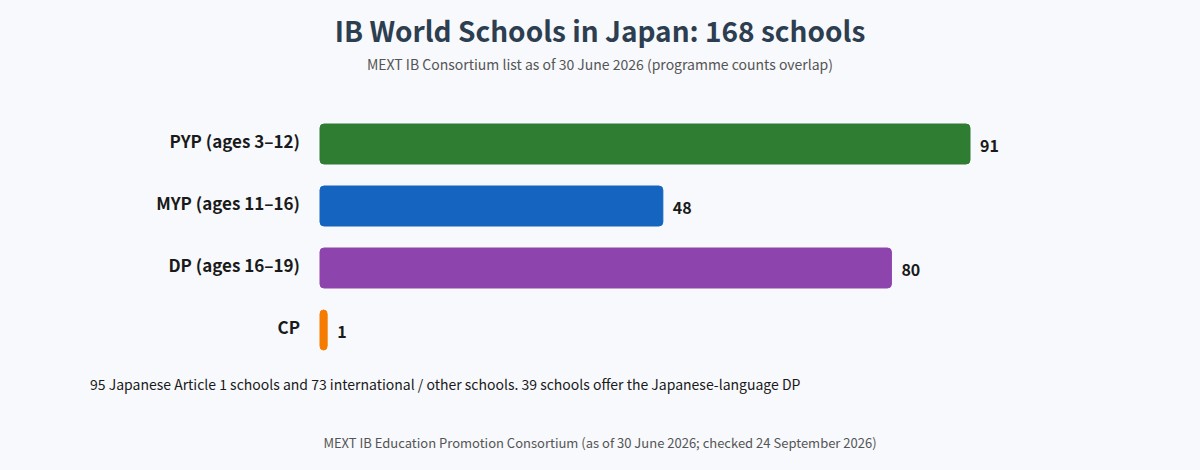
Counting the schools listed by the MEXT consortium, Japan has 168 IB-authorised schools: 95 Japanese “Article 1” schools under the School Education Act and 73 international schools and other schools (MEXT IB Consortium: IB authorised and candidate schools). By programme, the list shows:
- PYP (Primary Years Programme, ages 3–12): 91 schools
- MYP (Middle Years Programme, ages 11–16): 48 schools
- DP (Diploma Programme, ages 16–19): 80 schools, of which 39 offer the Japanese-language DP
- CP (Career-related Programme): 1 school
The consortium counts by programme, so a school offering several programmes appears in several rows; the programme numbers do not add up to 168. The IB’s own website counts schools differently (it groups some Japanese schools into one profile), so its total for Japan is lower than the MEXT count (IBO: Japan).
Where are the IB schools? By prefecture
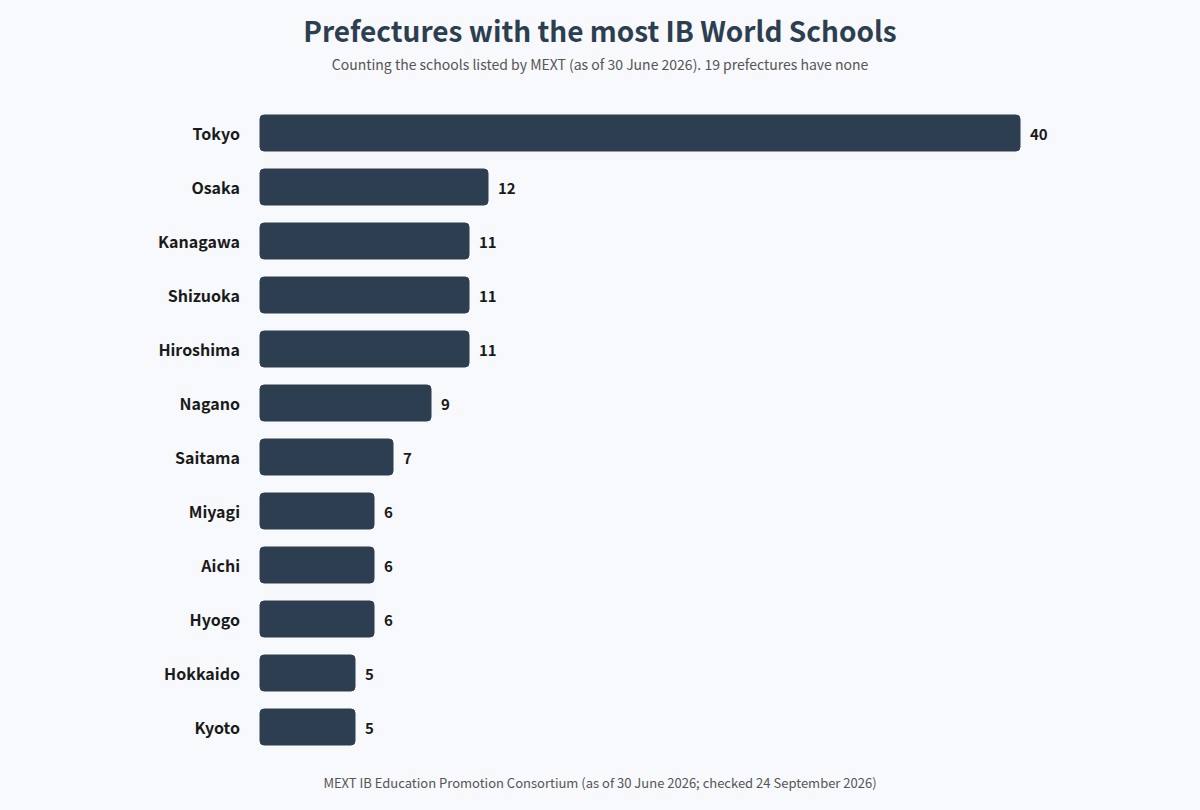
Tokyo has by far the most, with 40 schools. It is followed by Osaka (12), Kanagawa, Shizuoka and Hiroshima (11 each), Nagano (9), Saitama (7), Miyagi, Aichi and Hyogo (6 each), and Hokkaido and Kyoto (5 each). Nineteen prefectures had no IB-authorised school listed: Iwate, Akita, Yamagata, Fukushima, Tochigi, Chiba, Niigata, Toyama, Fukui, Mie, Wakayama, Shimane, Yamaguchi, Tokushima, Ehime, Saga, Nagasaki, Oita and Miyazaki.
Four types of IB school in Japan
1. Public schools
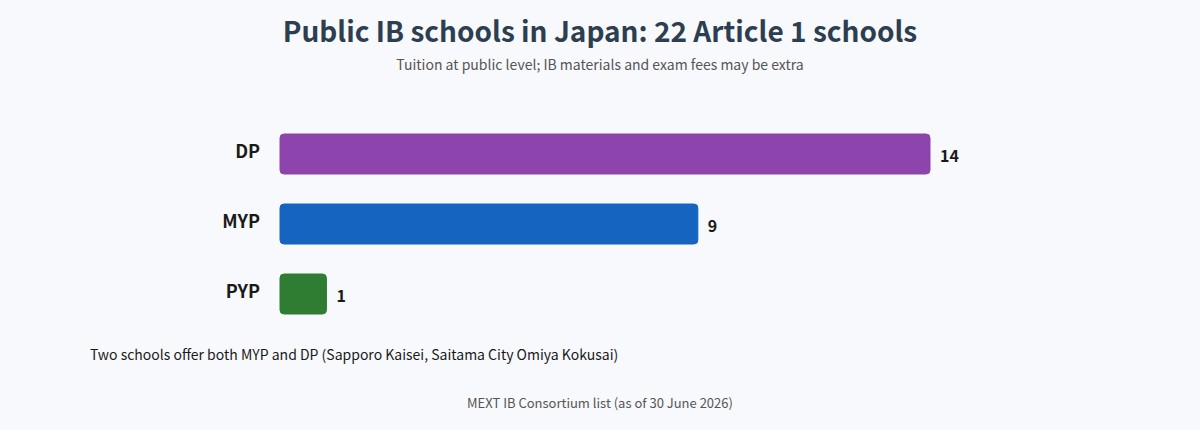
There are 22 public Article 1 IB schools (prefectural, municipal and town schools): 14 with the DP, 9 with the MYP and 1 with the PYP. Examples include Sapporo Kaisei Secondary School (MYP, DP), Saitama City Omiya Kokusai Secondary School (MYP, DP), Tokyo Metropolitan Kokusai High School (DP), Osaka Prefectural Suito Kokusai High School (DP) and Hiroshima Global Academy (a boarding school listed as two schools: junior high MYP and senior high DP). Most public DP schools offer the Japanese-language DP. Public high school tuition is ¥118,800 per year, and from April 2026 Japan’s High School Tuition Support Fund can cover it without an income limit, subject to an application and nationality/residence conditions (MEXT). Some schools charge IB materials and exam fees separately.
2. National schools
University-attached national schools such as Tokyo Gakugei University International Secondary School (MYP, DP), Tokyo Gakugei University Oizumi Elementary School (PYP) and Ikeda Junior High School attached to Osaka Kyoiku University (MYP) are also IB-authorised.
3. Japanese private schools
Many private junior and senior high schools run IB courses, often with the Japanese-language DP, while also giving students a Japanese high school diploma. Entry routes differ: some recruit into an IB course at Year 10, others let students choose the IB class in Year 11.
4. International schools and preschools
International schools such as Tokyo International School, Canadian Academy, Osaka International School of Kwansei Gakuin and Kyoto International School offer the full PYP–MYP–DP continuum in English, and many bilingual preschools offer the PYP. MEXT explains that, in principle, attending an international school that is not an Article 1 school does not by itself fulfil the compulsory education obligation for children of Japanese nationality, so families should check with their local authority (MEXT).
How to choose the right IB school
- Diploma and qualifications: do you need a Japanese school diploma (Article 1 school), or is an international pathway enough?
- Language: English-medium, or the Japanese-language DP?
- Entry point: can your child join at the age you need, and is there internal selection for the DP?
- Costs: tuition, IB fees, boarding and entrance fees, and which support schemes apply
- Location: 19 prefectures have no IB school, so boarding or commuting may be part of the decision
Frequently asked questions
What is the best IB school in Japan?
There is no official ranking. Schools differ in language, programmes, entry points and costs, so the best school is the one that fits your child’s age, language and future plans.
How many IB schools offer the DP in Japanese?
The MEXT list marks 39 schools as offering the Japanese-language DP (as of 30 June 2026).
Key takeaways
- The MEXT list shows 168 IB-authorised schools in Japan (as of 30 June 2026): 95 Article 1 schools and 73 others
- PYP 91, MYP 48, DP 80 (39 Japanese-language DP) and CP 1
- Tokyo has 40; 19 prefectures have none
- 22 public Article 1 schools offer the IB, mostly the DP
Use the official list as your starting point, then visit schools with your child to see which learning environment suits them best.
Sources and references
- MEXT IB Education Promotion Consortium: IB authorised and candidate schools (as of 30 June 2026)
- MEXT: High School Tuition Support Fund
- IBO: Japan
- MEXT: International schools and compulsory education
This article is based on information checked on 24 September 2026. Please confirm the latest details on the official list and each school’s website.
コメント