Tsukuba International School (TIS) is a small, English-medium IB World School in a forest on the western edge of Tsukuba, Ibaraki Prefecture. Founded in September 1992 by local foreign residents, it now teaches children from Pre-Kindergarten (age 3) to Grade 12. If your family is moving to Tsukuba Science City for a research post, or you are looking for an IB education in English in southern Ibaraki, this guide brings together what the school publishes about its programmes, 2026-27 fees, admissions and graduates.
Please note that this is not Tokyo International School, which uses the same initials. Everything below is based on the school’s official website (tis.ac.jp) and the Japanese Ministry of Education (MEXT) IB consortium list, checked on 26 September 2026. Fees and admissions details change every year, so do confirm with the school before making decisions.
TIS at a glance
TIS describes itself as a non-profit, independent and religiously neutral day school, with only one class per grade.
| Item | Details |
|---|---|
| Founded | September 1992 |
| Legal status | Operated by Tsukuba Global Academy, recognised by Ibaraki Prefecture as an educational corporation in March 2009, with TIS registered as a “miscellaneous school” (per the school’s history page); listed by MEXT as a non-Article-1 school |
| Address | Kamigo 7846-1, Tsukuba, Ibaraki 300-2645 |
| Grades | Pre-Kindergarten (age 3) to Grade 12, one class per grade |
| Students | Approximately 300 (as of 2025); about 50 staff |
| Maximum class size | 14 (Pre-K 1), 16 (Pre-K 2), 22 (elementary), 25 (secondary) |
| IB programmes | PYP, MYP and DP; no Career-related Programme (MEXT list, as of 30 June 2026) |
| Accreditation | Council of International Schools (CIS): accredited 2018, reaccredited 2025 |
| Principal | Shaney Crawford (principal since 2011) |
| School year | Late August to late June; no school lunch (packed lunches) |
The school’s story is a very human one. In 2009 Masayasu Kano, a long-serving teacher at Meikei Gakuen, gave the school its first own building, a log house, to pursue his dream of an IB World School. He died suddenly in March 2011, Shaney Crawford became principal, and eight months later the school gained its first IB authorisation. The history page says Ms Crawford has seen the school grow from eight students to over 300 during her time as principal (its timeline lists nine students enrolled in April 2008). On its website, TIS states that it is the only international school registered in Ibaraki Prefecture.
IB programmes: a full continuum from age 3
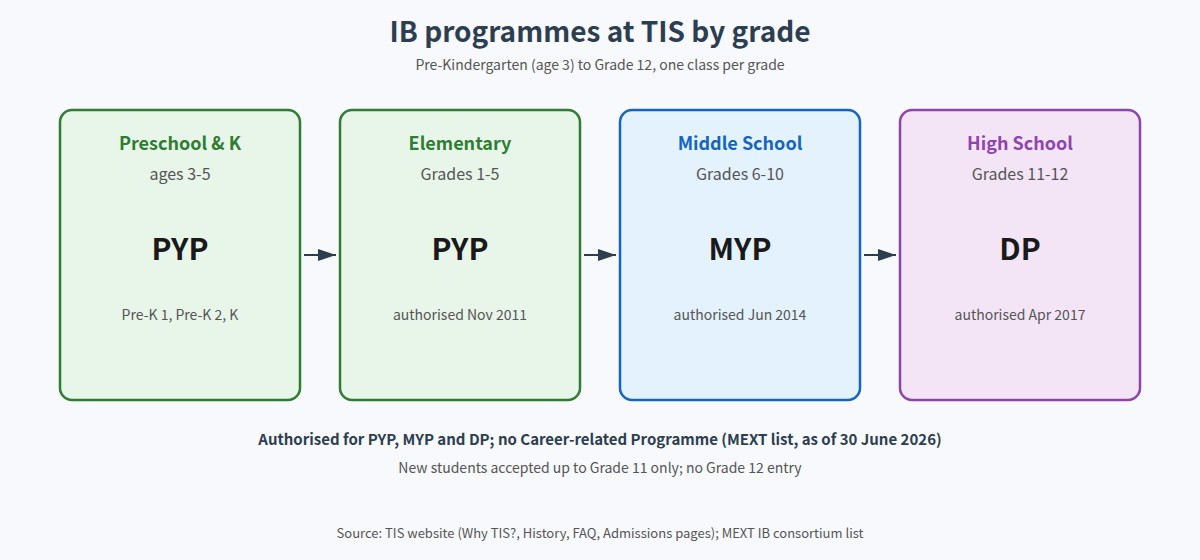
TIS is an “IB continuum” school, so your child can follow IB frameworks from preschool to the end of high school. The MEXT IB consortium list (as of 30 June 2026) shows TIS as authorised for the Primary Years Programme (PYP), the Middle Years Programme (MYP) and the Diploma Programme (DP), listed among non-Article-1 schools. The school’s history page dates the authorisations to November 2011 (PYP), June 2014 (MYP) and April 2017 (DP). In its FAQ, TIS says that in 2017 it became the only school in Ibaraki, and the sixth in Japan, authorised for all three.
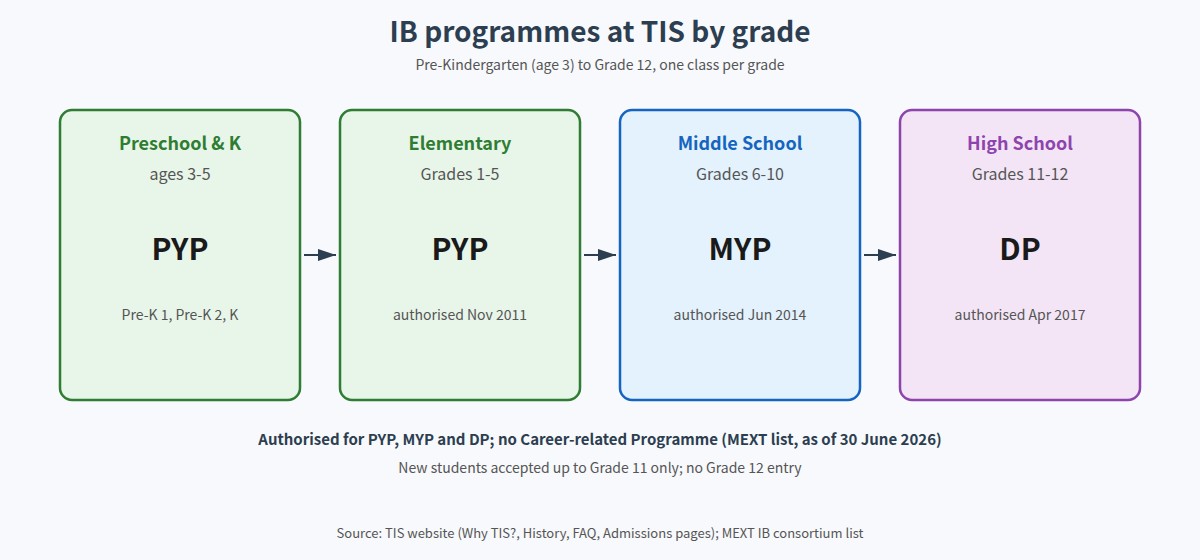
As Figure 1 shows, preschool and Kindergarten (ages 3 to 5) and Elementary School (Grades 1 to 5) follow the PYP. Middle School runs from Grade 6 all the way to Grade 10, because that is where the MYP ends, and Grades 11 and 12 take the DP. All subjects are taught in English except Japanese, which is offered both for learners (language acquisition) and for native speakers (language and literature).
What can students study in the Diploma?
Because TIS is small, the on-campus DP list is compact. For the Class of 2028, the school lists English and Japanese (language and literature), Japanese (language acquisition), Global Politics, Biology, Chemistry, Physics, both IB mathematics courses, Art and Music, each at SL and HL, plus Theory of Knowledge, the Extended Essay and CAS. Students may add at most one online course through the provider Pamoja, such as Economics, Psychology, Business Management or a beginners’ language.
Graduates and university destinations
The first Diploma students graduated in June 2019, and the University Acceptance page lists the size of each graduating class.
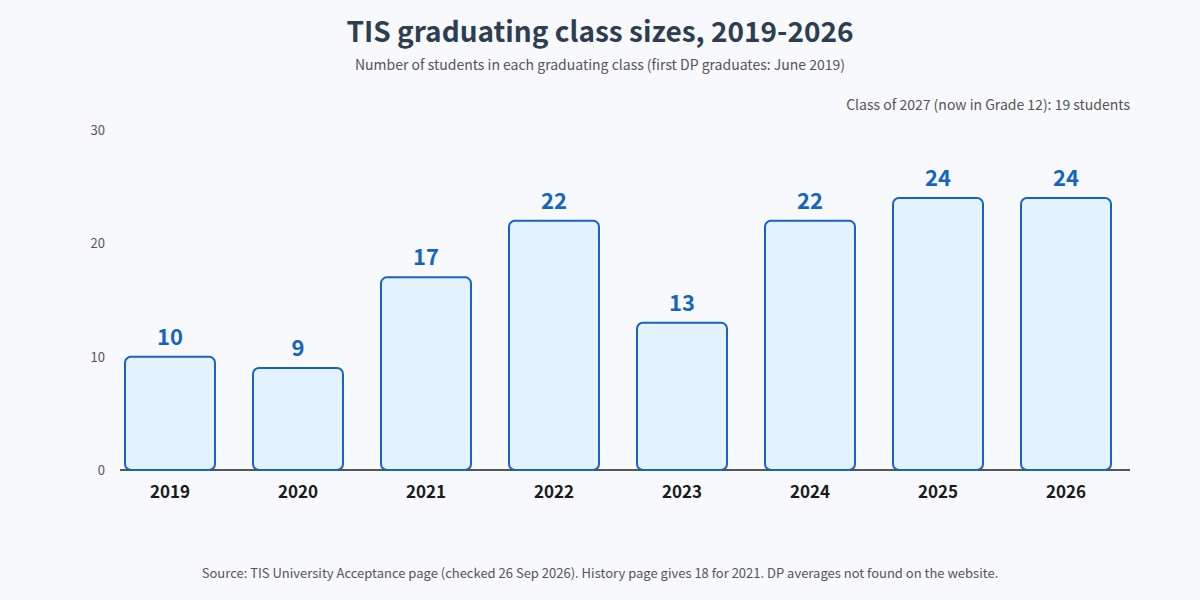
As Figure 2 shows, classes have ranged from 9 students (2020) to 24 (2025 and 2026). The Class of 2027, now in Grade 12, is listed as 19 students. (The history timeline gives 18 for 2021.) We could not find Diploma average scores or pass rates on the website (see the questions below).
The acceptance list covers offers, with enrolments marked in bold on the page. In Japan it includes Kyoto, Osaka, Tohoku and Tsukuba universities, Akita International University, ICU, Keio, Sophia and Waseda. Overseas it includes Imperial College London, UCL, King’s College London and Edinburgh in the UK, the University of Toronto, UC Berkeley, the University of Melbourne, Leiden and Trinity College Dublin. It does not give numbers per university. A full-time college counsellor advises students and parents.
Tuition and fees for 2026-27
Let’s be honest: fees are usually the first thing parents want to see, and TIS keeps them simple, with a single tuition amount for every grade. These figures are from the school’s 2026-27 School Fees page (August 2026 to June 2027).
| Fee (2026-27) | Amount (JPY) | Type and timing |
|---|---|---|
| Application Fee | ¥20,000 | One time, after acceptance is confirmed |
| Registration Fee | ¥300,000 | One time, by 1 June |
| Facilities Fee | ¥210,000 | Annual, by 1 June |
| Materials Fee | ¥240,000 | Annual, by 1 June |
| Tuition Fee (all grades) | ¥1,560,000 | Annual, by 1 June or in three instalments (1 June, 1 October, 1 February) |
| Annual total | ¥2,010,000 | Our calculation (facilities + materials + tuition) |
| First year, new student | ¥2,330,000 | Our calculation (annual total + application + registration) |
So a new student’s first year in 2026-27 comes to ¥2,330,000 (¥20,000 + ¥300,000 + ¥210,000 + ¥240,000 + ¥1,560,000), and each following year at 2026-27 rates is ¥2,010,000. The page does not say whether amounts include consumption tax.
Discounts
- Lump-sum payment: ¥90,000 off tuition when the full year is paid by 1 June (a new student’s first year would then be ¥2,240,000).
- Younger siblings: ¥240,000 off tuition; this cannot be combined with another discount.
- Researchers in Tsukuba: under an agreement with the Tsukuba Science City Network, tuition is reduced by ¥240,000 for children of researchers at affiliated institutes and universities, provided one or both parents are non-Japanese and the parents’ combined gross salary does not exceed ¥8,000,000 a year. Up to five students a year can use it, applications go through the employer, and researchers on contracts under 12 months may apply to have the registration fee waived.
Discounts do not apply to DP assessment or online course fees. Be aware that an older “School Fee Support” page on the same site still describes a 10% lump-sum and a 25% sibling discount; we have followed the year-specific 2026-27 page, but please confirm which rules apply to you.
Other costs to budget for (2026-27)
- Class trips (compulsory): approximately ¥5,000 (Pre-K and K) rising to ¥50,000 (Grades 6 to 9) and ¥100,000 (Grade 10).
- Technology: ¥75,000 over Grades 3 to 5 for a school-managed Chromebook; from Grade 6 students bring their own laptop, per the Bring Your Own Laptop page (the fees page says Grades 5 to 12).
- Grade 12 DP exam fees: about ¥100,000 (an estimate the school dates to January 2024). An optional online DP course costs 1,535 or 1,655 US dollars per subject per year, billed by the external provider (check the current fee page).
- School bus: ¥18,000 a month return from Banpaku Kinen Koen Station, ¥21,000 from other stops, or ¥15,000 a month one way.
- After-school care for PYP students until 4:40 pm: ¥1,500 a day, or ¥40,000 to ¥200,000 a year depending on days per week.
A heads-up about 2027-28
The 2027-28 fees are already published: tuition rises to ¥1,860,000, the Materials Fee no longer appears, and the other fees stay the same. By our calculation the annual total becomes ¥2,070,000 and a new student’s first year ¥2,390,000. The page also says tuition will rise again in 2028-29.
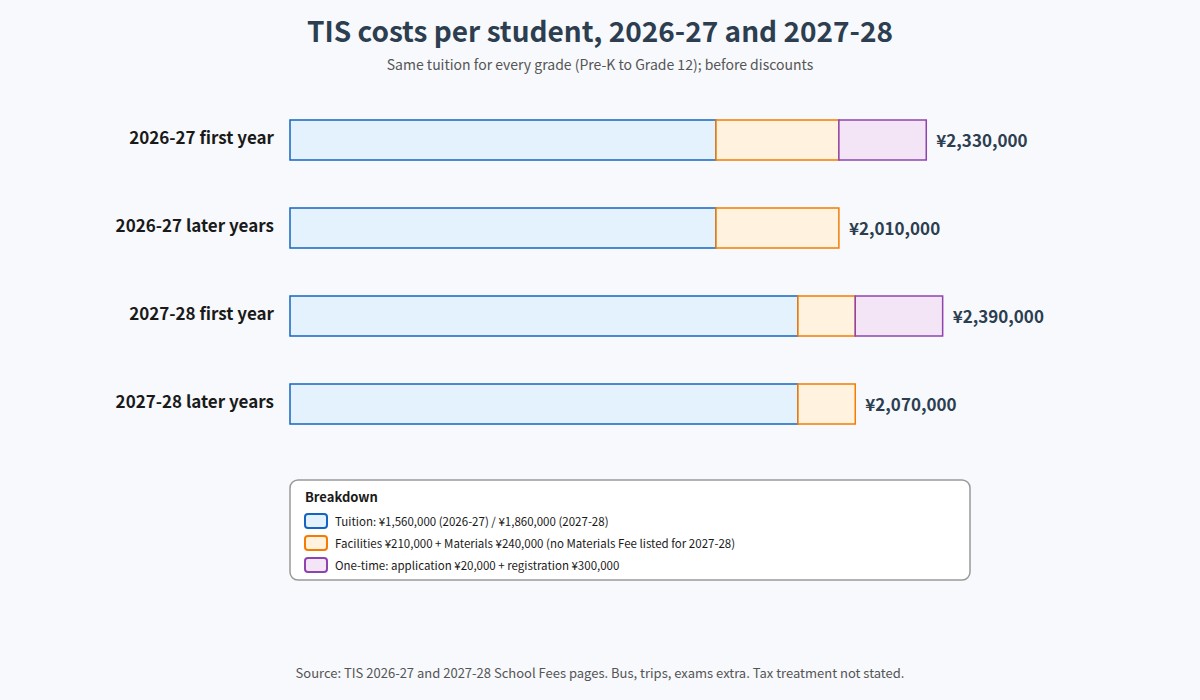
Figure 3 compares the two years. The fee support page notes that Tsukuba residents may qualify for a local preschool subsidy, and that the national high school tuition support scheme may apply in Grades 10 to 12 depending on household income. Note that a MEXT notice of 31 March 2026 removed foreign schools (kakushu gakko mainly for foreign nationals) from the national support fund itself from 1 April 2026: students enrolled before then keep the previous terms, and new entrants at previously designated foreign schools may receive equivalent support through the prefecture-run budget programme Koukousei-tou Shin-Shugaku Shien (MEXT), so ask the school which applies to your child.
Admissions: who can apply and how it works
Which grades are open?
For 2026-27, TIS accepts applications from Pre-Kindergarten (age 3) to Grade 11 (age 17). Because the Diploma is a two-year programme, the school says it is “very difficult for students to join our school as new students after the start of Grade 11”, and there is no Grade 12 entry. With one class per grade, places are tight: the waiting pool update as of 30 June 2026 showed spaces in Pre-K 1, Pre-K 2 and Grades 6 and 7, waiting pools for Kindergarten, Grades 1 to 5 and Grades 8 to 10, and no Grade 11 spaces. The FAQ suggests starting in the preschool, as Grade 1 can be hard to get into.
Age, eligibility and English
Preschool entrants must be 3, fully toilet trained and able to separate from their caregiver. The FAQ says a child must be 3 by 31 December to join Pre-K 1 and 6 by 31 December for Grade 1; the age rule may be waived for transfer students who have completed at least one term elsewhere. Japanese students are welcome if they can communicate in English and have a clear need for an English-medium education (for example, returning from or moving abroad). At least one parent must be willing to communicate with the school in English, though full fluency is not required.
English is assessed at the interview. Young PYP children need some English but not proficiency; from the upper PYP through the MYP and DP, students are expected to have functional English at or near grade level. The school’s rough guide is approximately Eiken Pre-2 or higher for Grade 6, Eiken Grade 2 or higher for Grade 8 and Eiken Pre-1 or higher for Grade 11. We found no separately named EAL programme, so ask what support is available in your child’s grade.
Steps to apply
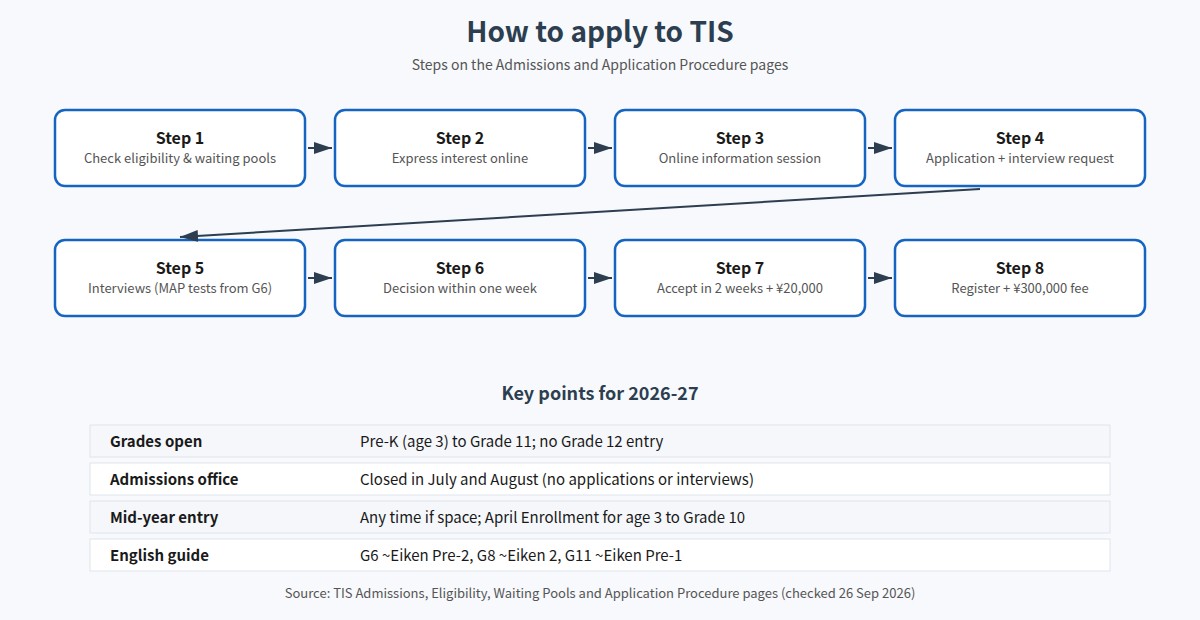
As Figure 4 shows, you first check eligibility and waiting pools, express interest online and attend an online information session (the next one listed is Wednesday 11 November 2026 at 10:00 am). You then send the application form, your child’s latest report card and any transcripts, and request an interview. Your child has an assessment interview with a teacher, you meet the principal (both parents, in principle), and students in Grade 6 and above take MAP tests in English and Maths. The decision comes within one week; you accept within two weeks, returning health forms and paying the ¥20,000 application fee, and when a place is available you complete the online registration form and pay the ¥300,000 registration fee and the remaining school fees by the stated deadline.
Two timing points are easy to miss. The admissions office is closed in July and August, so apply in spring if you are relocating for an August start. And students can join mid-year when there is space, with April Enrollment (April to June) available from age 3 to Grade 10 for children moving from Japanese schools.
Learning support and school life
TIS says it is committed to inclusive education and has a Learning Support Coordinator, but it is candid that, because of its size and resources, it may be unable to meet some students’ needs. Please tell the school about any identified needs from the start.
The campus is a real draw: a log-house West Building in Finnish pine (2009), which the school says won a “Loghouse of the Year” award, a matching East Building in local cedar and cypress (2016), Music, Design and Art Cottages (2023 and 2025), two basketball courts under the trees and a library of about 10,000 volumes. School runs Monday to Friday, with a 2:15 pm finish for everyone on Thursdays.
Getting to TIS
The school is in Kamigo, in the far west of Tsukuba, surrounded by fields and forest. The school runs five school buses, which stop around Tsukuba and Tsuchiura, including Tsukuba Center, Kenkyu Gakuen and Banpaku Kinen Koen Station on the Tsukuba Express. Visitors can take the TsukuBus West (Seibu) Route from Banpaku Kinen Koen to the TIS Entrance stop, but the school warns it makes only seven trips to the school a day; a taxi from Banpaku Kinen Koen Station is about 5.4 km.
Questions parents often ask
My child speaks very little English. Can they still join?
For the youngest children, usually yes, provided they have some English; they are expected to become fluent through immersion. From Grade 6, functional English near grade level is expected, and the Eiken guide above gives a rough idea.
Can my child join for the last year of high school?
No. Grade 11 is the last grade open to new students, the school says joining after the start of Grade 11 is very difficult, and as of 30 June 2026 there were no Grade 11 spaces for 2026-27. Grade 10 or earlier is the realistic time to move.
Does TIS publish its IB exam results?
We could not find Diploma average scores or pass rates on the website. If results matter to you, ask for several years of figures; with classes of around 20, one year’s average can swing a lot.
Summary
- A small IB continuum school: PYP, MYP and DP (MEXT list, June 2026), authorised in 2011, 2014 and 2017, with one class per grade and about 300 students (2025).
- Simple fees: in 2026-27, one tuition rate for all grades (¥1,560,000), ¥2,010,000 a year in core fees and ¥2,330,000 for a new student’s first year; tuition rises to ¥1,860,000 in 2027-28.
- Help for researchers: a ¥240,000 tuition reduction for eligible international researchers’ children, plus sibling and lump-sum discounts.
- Entry up to Grade 11 only: waiting pools in many grades, no summer admissions, and English expectations that rise with age.
If TIS sounds right for you, check the waiting pool and book an information session early.
Sources and references
- TIS: Why TIS? and At-a-Glance (checked 26 September 2026)
- TIS: History of the School
- TIS: Diploma Programme and International Baccalaureate at TIS
- TIS: University Acceptance
- TIS: 2026-27 School Fees and 2027-28 School Fees
- TIS: Tsukuba Science City Network Agreement and School Fee Support
- TIS: Admissions, Eligibility, Waiting Pools and Application Procedure
- TIS: FAQ and April Enrollment
- TIS: Maps and Directions and School Bus
- MEXT IB Education Promotion Consortium: IB schools in Japan (as of 30 June 2026)
- International Baccalaureate: Tsukuba International School
コメント