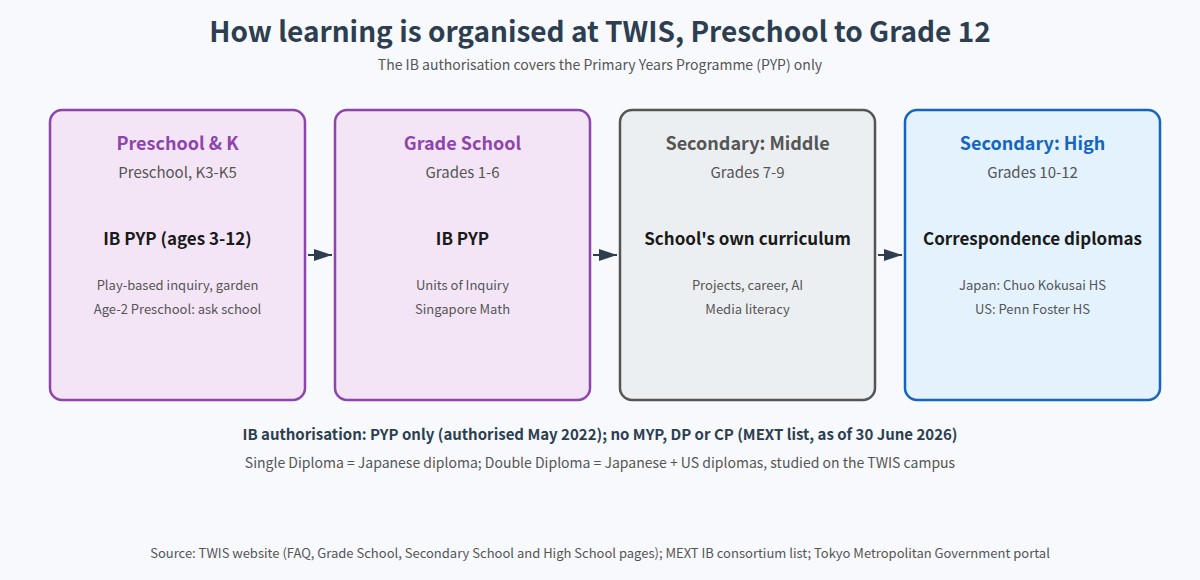
Tokyo West International School (TWIS) is a small, co-educational international school in Hachioji, in the green western suburbs of Tokyo, teaching children from Preschool all the way to Grade 12. It is an authorised IB World School for the Primary Years Programme (PYP), and its high school students can earn a Japanese high school diploma, and optionally a US one as well, while studying on the TWIS campus every day. If you live in the Tama area, or around Tachikawa, Hachioji or Machida, and you would like an English-medium school without a long commute into central Tokyo, it is well worth a look.
In this guide we have gathered what the school publishes about its IB programme, its curriculum at each stage, fees for the 2026-2027 school year, and how admissions work. Everything is based on the school’s official website and fee sheets, the Tokyo Metropolitan Government’s international school portal and the Japanese Ministry of Education (MEXT) IB consortium list, all checked on 26 September 2026. Fees and dates change every year, so please do confirm the details with the school before you apply.
TWIS at a glance
| Item | Details |
|---|---|
| School name | Tokyo West International School (TWIS) |
| Founded | April 2010, in Tachikawa; moved to the current Hachioji campus in April 2015 |
| Campus | 185 Umetsubo-machi, Hachioji-city, Tokyo 192-0013 |
| Grades | Preschool, Kindergarten (K3 to K5), Grade School (Grades 1 to 6) and Secondary School (Grades 7 to 12) |
| School year | April to March |
| IB programme | Primary Years Programme (PYP) only, authorised in May 2022; no MYP, DP or CP (MEXT list, as of 30 June 2026) |
| Accreditation and memberships | Cognia accreditation (since 2013, when it was called AdvancED); CIS and EARCOS membership |
| Capacity (2026) | 244 places in total: Kindergarten 70, Elementary 120, Junior High 30, High School 24 (Tokyo Metropolitan Government portal; capacity, not current enrolment) |
| Average class size (2026) | Kindergarten 17, Elementary 15, Junior High 10, High School 8 (same portal) |
| Status in Japan | Not an “Article 1” school under Japan’s School Education Law (listed among non-Article 1 schools on the MEXT IB list) |
| Leadership | Yoshinori Kato (Founder and Chairperson), Sockchong Han (Head of School and Vice Chairperson), Daniel Prieto (Principal), per the school’s About page |
The school does not publish its actual enrolment. Its admissions page mentions students and teachers “from over 15 countries” and says about half of the students are non-Japanese nationals.
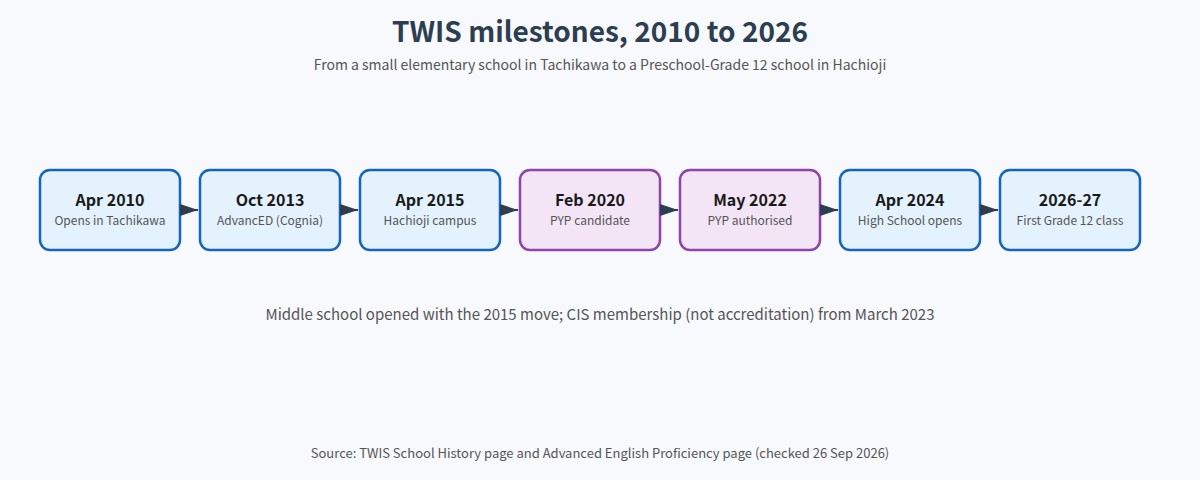
As Figure 1 shows, TWIS has grown step by step: it opened as an elementary school in Tachikawa in 2010, moved to Hachioji and opened its middle school in 2015, and was authorised for the PYP in May 2022. The high school opened in April 2024, and the first Grade 12 class started in the 2026 academic year.
The IB at TWIS: PYP only
This is the most important point to understand. TWIS is authorised by the IB for the Primary Years Programme only. The MEXT IB consortium list (as of 30 June 2026) shows a PYP mark for Tokyo West International School and nothing for the MYP, Diploma Programme (DP) or Career-related Programme (CP), and the school states that it has been an authorised IB PYP school since 4 May 2022.
The school’s FAQ says it is authorised to provide the PYP “for children aged 3 to 12” and that it provides “a consistent IB program from Kindergarten through Elementary school”. In practice, the Grade School page describes Units of Inquiry (UOI) built around the six PYP transdisciplinary themes, bringing together Japanese, maths, science, social studies, English, ICT, art, music and PE. The youngest children learn through play and hands-on activities, including the school’s garden program. If your child will be in the Preschool class at age 2, it is worth asking how the PYP framework applies at that age, because the FAQ describes the PYP as starting at 3.
Two other features stand out in the elementary years. Maths is taught with the Singapore Math approach, and the school says students in Grades 3 to 9 take the ACER International Schools’ Assessment (ISA) every year. The school has not published its ISA results, so we cannot tell you how students perform.
Japanese is part of daily life too. The FAQ says there are Japanese classes every day from Elementary through High School, using the MEXT guidelines as a reference in the elementary years, with Japanese as a Second Language (JSL) support for returnees and children whose first language is not Japanese.
Secondary School: the school’s own curriculum and a double diploma
After Grade 6, the curriculum is no longer IB. The Tokyo Metropolitan Government portal describes the junior high school as following “the school’s original curriculum” and the high school as based on the curricula of partner correspondence high schools in the US and Japan. Since April 2026 the school presents Grades 7 to 12 as one Secondary School in three stages: Explore (Grades 7 and 8), Apply (Grades 9 and 10) and Contribute (Grades 11 and 12), with an emphasis on projects, presentations, AI and media literacy, and career awareness.
The high school (Grades 10 to 12) is where TWIS is quite different from most international schools. Students attend the TWIS campus every day, but their diplomas come from partner correspondence schools:
- Japanese high school diploma: from Chuo Kokusai High School. This is what the Single Diploma course leads to, and the school’s fee sheet says tuition includes the Chuo Kokusai fees.
- US high school diploma: from Penn Foster High School. Students on the Double Diploma course work towards both diplomas at the same time.
Why does this matter? A Japanese high school diploma means your child can sit ordinary Japanese university entrance exams as well as comprehensive and returnee-style selections, which the school highlights in its FAQ. The US diploma is meant to help with applications abroad. What TWIS does not offer is the IB Diploma, so if you are set on the IB DP for the last two years, you would need to plan a move to another school. The school’s Career Design Center offers counselling, internships, portfolio and essay support, and help with both Japanese and overseas university applications, but as the first Grade 12 class only started in the 2026 academic year, there are no published university destinations yet.
The admissions page does list Japanese middle and high schools that alumni have been accepted to, and international schools former students have transferred to (such as ASIJ, Nishimachi, AOBA and Yokohama International School), without years or numbers.
Tuition and fees for 2026-2027
Let’s talk about money honestly, because TWIS is priced quite differently from the large central Tokyo international schools. These figures come from the school’s “School Fees 2026-2027” sheets for each division, covering April 2026 to March 2027.
| Division (2026-2027) | Enrolment fee (one-time) | Yearly fees | Tuition |
|---|---|---|---|
| Preschool | ¥150,000 | ¥390,000 | ¥100,000 per month |
| Kindergarten | ¥250,000 | ¥390,000 | ¥95,000 per month |
| Elementary School | ¥352,000 | ¥517,000 | ¥1,463,000 per year |
| Middle School | ¥352,000 | ¥341,000 | ¥913,000 per year |
| High School: Single Diploma | ¥220,000 | ¥349,000 | ¥913,000 per year |
| High School: Double Diploma | ¥220,000 + ¥250,000 Double Diploma Fee = ¥470,000 | ¥349,000 | ¥913,000 per year |
The “yearly fees” are a bundle of four items paid every year: a facility fee, a materials fee, a school improvement fee and a general management fee (which covers things like events, health checks and disaster preparedness). For example, the Elementary total of ¥517,000 is ¥176,000 + ¥176,000 + ¥110,000 + ¥55,000. Field trips are billed separately. The Elementary and Middle School sheets are marked “Tax Included”; the Preschool, Kindergarten and High School sheets do not say so either way, so please ask.
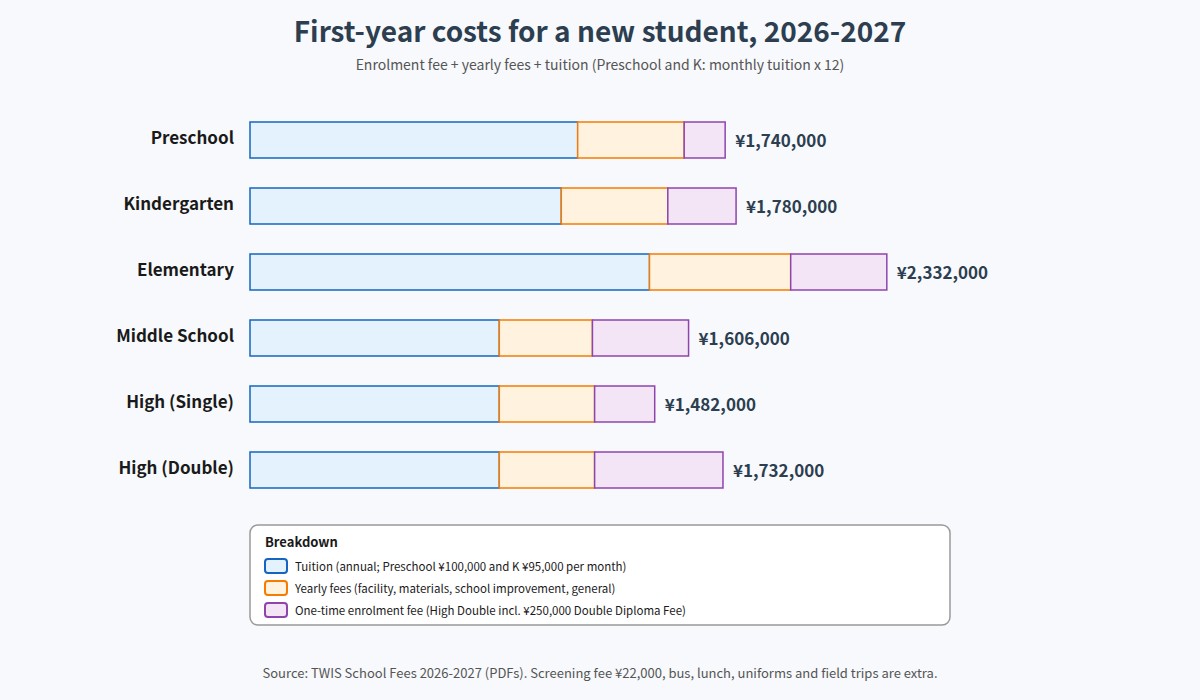
Adding it up, the first year for a new student comes to ¥2,332,000 in Elementary School, ¥1,606,000 in Middle School, ¥1,482,000 on the High School Single Diploma course and ¥1,732,000 on the Double Diploma course. For Preschool and Kindergarten, tuition is monthly; if you pay all twelve months of the April to March year, the first year would be ¥1,740,000 for Preschool and ¥1,780,000 for Kindergarten (the Tokyo portal also shows ¥1,140,000 as the Kindergarten tuition, which matches ¥95,000 × 12). From the second year, without the enrolment fee, the yearly cost is ¥1,980,000 in Elementary, ¥1,254,000 in Middle School and ¥1,262,000 in High School. Interestingly, Elementary tuition is noticeably higher than Middle and High School tuition this year.
A few more things to budget for:
- A screening test fee of ¥22,000 (tax included), paid on the test day.
- The school bus, lunches, after-school programs, uniforms and PE kit, which the FAQ lists as extra costs. Their prices are not published, so ask the office for a quote.
- For high school students, the fee sheets say families can apply for Japan’s High School Tuition Support Fund, but they quote the earlier support amounts (¥300,750 or ¥120,300 a year, depending on household income). From April 2026, according to a MEXT leaflet, the new system has no income cap for eligible students (Japanese nationals, and others who meet nationality and residence-status requirements), with an annual cap of ¥337,200 for private correspondence high schools. Please check the amount that applies to your child with the school. Note that a MEXT notice of 31 March 2026 removed foreign schools (kakushu gakko mainly for foreign nationals) from the national support fund itself from 1 April 2026: students enrolled before then keep the previous terms, and new entrants at previously designated foreign schools may receive equivalent support through the prefecture-run budget programme Koukousei-tou Shin-Shugaku Shien (MEXT), so ask the school which applies to your child.
- For Kindergarten, the school’s 2026 Kindergarten Scholarship sheet says TWIS Kindergarten holds a certificate showing it meets the standards for unlicensed childcare facilities and can receive subsidies under Japan’s free childcare system, so your family may be eligible. Ask the school and your city office.
- The school ran scholarships for 2026 entry (enrolment fee waiver plus 50% of tuition for one year, about three places each for Kindergarten and for Grades 1 to 12), with applications from 8 December 2025 to 9 January 2026. That round has closed; watch the school website for any 2027 round.
Admissions: steps, timing and English
How the process works
The admissions page sets out four steps: an Open House or private School Tour, the application documents, a screening test with a parent interview, and the result. A place is confirmed once you pay the entrance fee by the deadline. For most grades admission is rolling: the test is held about one month before the desired start date, results come about a week later, and enrolment is completed within a week of acceptance. The school’s Q&A adds that mid-year entry is possible when there is a seat, and that because classes are small, some grades may reach capacity, in which case applicants are placed on a waiting list.
New Grade 1 has fixed dates
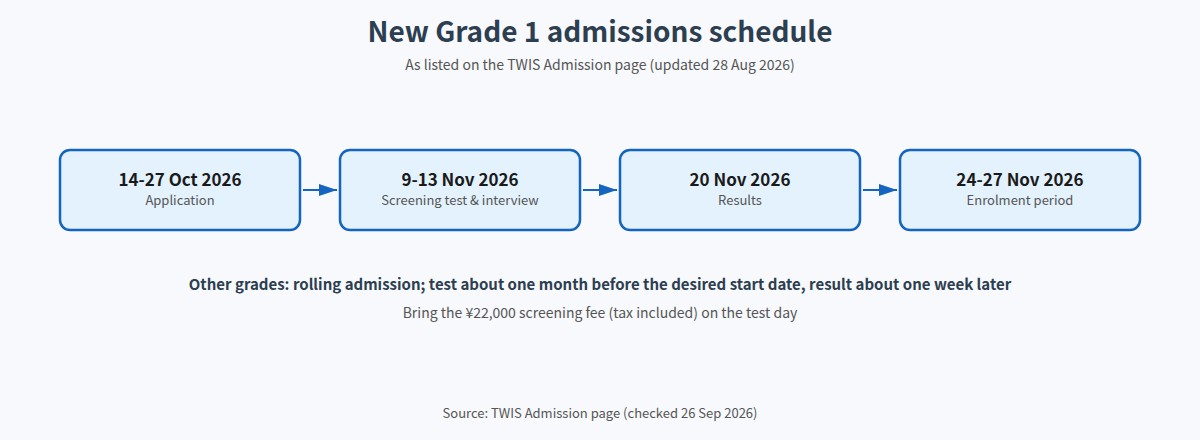
New Grade 1 applicants follow a fixed calendar: applications from 14 to 27 October 2026, the screening test and interview from 9 to 13 November, results on 20 November and enrolment from 24 to 27 November 2026. The page does not state the school year, but as the school year starts in April, these dates would fit entry in April 2027. Please confirm with the school, and if you are aiming for this intake, note the 27 October deadline now.
Age and grade placement
TWIS places children by date of birth, using the Japanese April-to-March year. For 2026-2027, for example, Grade 1 is for children born between 2 April 2019 and 1 April 2020, K3 is for children born between 2 April 2022 and 1 April 2023, and Preschool is for children born on or after 2 April 2023 who are at least 2 years old. The school has not yet posted the 2027-2028 table.
What the tests look like
The FAQ explains that assessment depends on age:
- Kindergarten and lower elementary: mainly a trial day and behavioural observation, looking at how children interact, follow instructions and show enthusiasm for learning.
- Upper elementary, middle and high school: written tests in English reading and writing and in maths, plus an interview in English.
- High school: an English essay submitted in advance, in addition to the above.
- Parents: an interview, in Japanese or English as you prefer.
Good news for families still building their English: the FAQ says a child does not need to be perfectly fluent when joining. The school looks at the child’s motivation to learn in English, their current academic level and whether its EAL (English as an Additional Language) support is a good fit. It also says parents’ English does not directly affect the decision.
Documents
You will need the application form, a medical certificate issued within the last three months, the Educational Support Questionnaire, a progress report from the current or previous school, and a graduation or attendance certificate. The Secondary School forms include an English essay format, which the FAQ says is for high school applicants. The Educational Support Questionnaire asks about development, past learning support and any diagnoses, so if your child has additional learning needs, it is best to talk openly with the school early on; the school does not publish the limits of the support it can offer.
Learning support and student life
Support. According to the FAQ, EAL support can start from day one for mid-year arrivals, with a buddy system to help new students settle in. The admissions page also mentions a full-time nurse and a visiting school counsellor.
Daily life. The on-campus garden is used as a “living classroom” where each grade grows vegetables. After-school programs may vary by term (sports, arts, programming and more) and are charged per program. Lunches are cooked in the school kitchen, or children can bring a bento. School notices come in English and Japanese, and the office has Japanese-speaking staff.
Getting there
By public transport, take a Nishi Tokyo bus (routes ひ01, ひ03, ひ06, ひ07 or ひ08) from stop 12 outside the North Exit of JR Hachioji Station and get off at Michi-no-eki Hachioji Takiyama Entrance, about 12 minutes.
For the school bus, the access page gives approximate journey times of 10 minutes from Hachioji Station, 20 minutes from Akishima, 30 minutes from Tachikawa, 40 minutes from Tamagawa-Josui and Tama Center, and 60 minutes from Machida. The FAQ says routes (covering areas such as Hino, Inagi, Sagamihara, Haijima and Fussa) are adjusted every year to suit the families using them.
Questions parents often ask
Can my child do the IB Diploma at TWIS?
No. TWIS is authorised only for the PYP. Its high school leads to a Japanese diploma (Chuo Kokusai High School) and, on the Double Diploma course, a US diploma (Penn Foster High School). If the IB Diploma is your goal, plan for a move before Grade 11.
We are a Japanese family. Is there anything to be aware of?
Yes. TWIS is not an Article 1 school, and in general, attending a non-Article 1 school does not count as fulfilling compulsory education under Japanese law. Please think carefully about this and discuss it with the school and your local education office if a later move into the Japanese system is possible. In high school, the Chuo Kokusai diploma is a Japanese high school diploma.
My child’s English is limited. Can they still apply?
Yes, according to the FAQ, full fluency is not required, and EAL support is available. From upper elementary onwards, though, there are written English and maths tests and an English interview, so older children will need enough English to cope with these.
Summary
- A small Preschool to Grade 12 school in Hachioji: capacity of 244, average classes of 8 to 17 students (2026), bilingual English and Japanese environment.
- IB PYP only: authorised in May 2022 for the early years and elementary; the junior high years use the school’s own curriculum, the high school is based on the partner correspondence schools’ curricula, and there is no MYP or DP.
- High school double diploma: a Japanese diploma from Chuo Kokusai High School and, optionally, a US diploma from Penn Foster High School; the first Grade 12 class is in 2026-27.
- 2026-27 fees: first-year costs from ¥1,482,000 (High School Single Diploma) to ¥2,332,000 (Elementary), plus the ¥22,000 test fee, bus and lunch.
- Admissions: rolling for most grades; new Grade 1 applications run from 14 to 27 October 2026; perfect English is not required.
If TWIS sounds like a good fit, the best next step is to book an Open House or a School Tour through the admissions page and ask about seats, bus routes and the extra costs for your child’s grade.
Sources and references
- Tokyo West International School: official website (checked 26 September 2026)
- TWIS: Admission (process, New G1 schedule, birthdate table, alumni pathways)
- TWIS: Q&A
- TWIS: School History and About
- TWIS: Grade School and Secondary School
- TWIS: High School and Advanced English Proficiency
- TWIS School Fees 2026-2027 (PDF): Preschool, Kindergarten, Elementary, Middle School, High School Single Diploma, High School Double Diploma
- TWIS: Access
- Tokyo Metropolitan Government, Tokyo International Schools Portal: Tokyo West International School (last updated 2026)
- MEXT IB Education Promotion Consortium: IB schools in Japan (as of 30 June 2026)
- International Baccalaureate: Tokyo West International School
- MEXT: High School Tuition Support leaflet, 2026 edition (PDF, Japanese)
- TWIS: 2026 Kindergarten Scholarship (PDF)
コメント