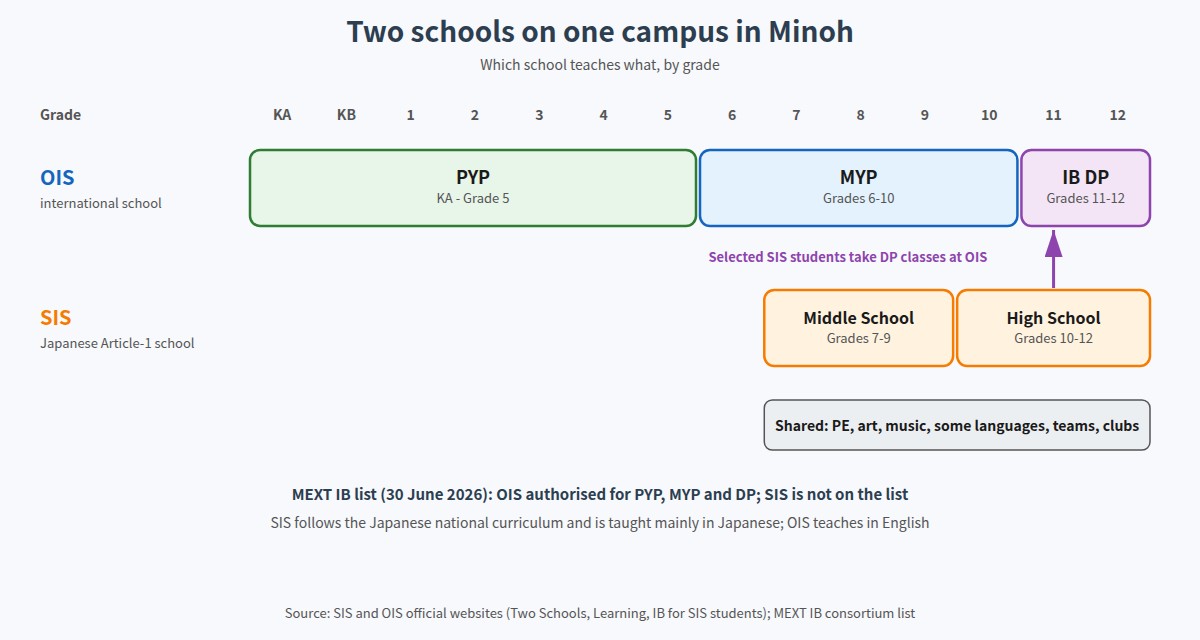
Senri International School of Kwansei Gakuin (SIS) and its sister school, Osaka International School of Kwansei Gakuin (OIS), share one campus in Minoh, in the green northern suburbs of Osaka. The two names are often used almost interchangeably, but they are different schools, and the difference matters a great deal for the IB, fees and admissions. This guide explains the “Two Schools Together” arrangement and which school does what.
Everything here comes from the two schools’ official websites, the SIS returnee and overseas admissions guide (2026 exams), the OIS 2026-2027 School Profile and the IB consortium list of the Ministry of Education (MEXT), all checked on 26 September 2026. Fees and exam dates change every year, so please confirm the details with each school’s admissions office before you apply.
SIS and OIS at a glance
In short, OIS is an English-medium international school for Kindergarten to Grade 12 that runs the IB programmes. SIS is a Japanese private middle and high school (Grades 7 to 12) that follows the Japanese national curriculum approved by MEXT, with students studying for Japanese middle school and high school diplomas. In Japan, this kind of officially recognised school is often called an “Article 1 school”. The two schools share buildings, a mission and many activities, but they keep separate curricula and separate admissions.
| Item | SIS | OIS |
|---|---|---|
| Japanese name | 関西学院千里国際中等部・高等部 | 関西学院大阪インターナショナルスクール |
| Type | Japanese private middle and high school (Article 1 school) | International school (not an Article 1 school) |
| Grades | Grades 7 to 12 | KA (age 4) to Grade 12 |
| Main language of teaching | Japanese | English |
| IB authorisation | None (not on the MEXT IB list); selected students take the DP through OIS | PYP, MYP and DP (MEXT list as of 30 June 2026) |
| Accreditation | Japanese national curriculum (MEXT) | WASC; member of CIS, JCIS and EARCOS |
| Operator | Kwansei Gakuin Educational Foundation (both schools joined Kwansei Gakuin in 2010) | |
| Campus | 4-4-16 Onohara-nishi, Minoh, Osaka (shared “SOIS” campus) | |
Both schools say they were founded in 1991 to bring together “the best of Japanese and non-Japanese educational ideas” for returnee, Japanese and international families in Kansai. Their shared mission is to develop “informed, caring, creative individuals contributing to a global community”. The OIS website gives its own size as approximately 270 students of 34 nationalities (the page is not dated), and the 2026-27 OIS School Profile says over 35 nationalities are represented on the shared campus.
Who offers which IB programme?
This is the point that confuses many parents, so let’s be precise. On the MEXT IB consortium list (as of 30 June 2026), Osaka International School of Kwansei Gakuin is listed as authorised for the Primary Years Programme (PYP), the Middle Years Programme (MYP) and the Diploma Programme (DP). It appears in the section for schools that are not Article 1 schools. SIS does not appear on the list at all. In other words, the IB World School on this campus is OIS.
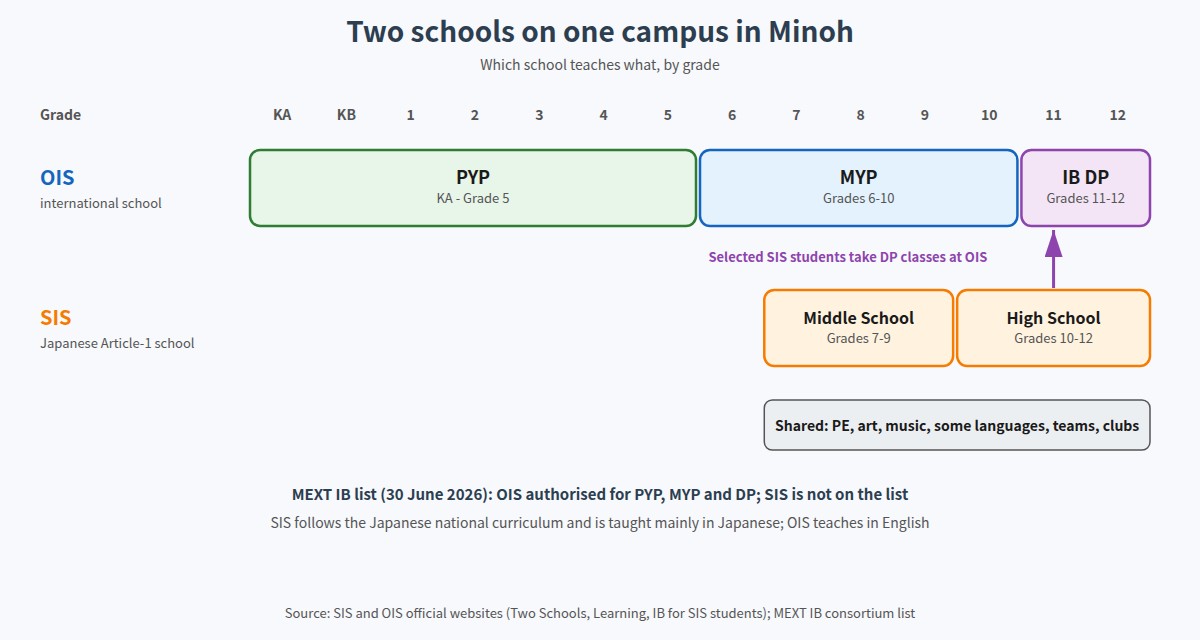
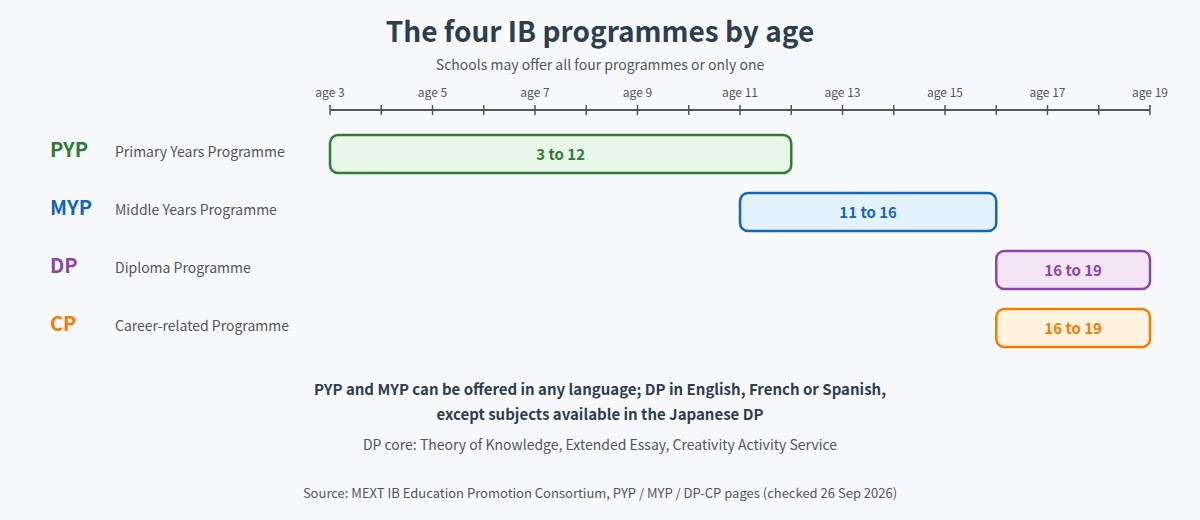
As Figure 1 shows, at OIS the PYP covers KA to Grade 5, the MYP covers Grades 6 to 10, and the DP covers Grades 11 and 12. OIS says it has offered the PYP and MYP since 2004. The school’s own pages give different starting years for the DP (its Learning page says 1991 and its Accreditation page says 1994), so we simply note that OIS has run the Diploma since the early 1990s. OIS describes itself as the first school in Japan to offer all three IB programmes.
OIS students who do not take the full Diploma can graduate with the OIS High School Diploma, which the school describes as WASC-accredited and equivalent to a US high school diploma (24 credits over four years). The About OIS page states that from 2013 through 2022, 94% of students studied the full IB Diploma, with a pass rate of 96%.
Shared classes: what “Two Schools Together” really means
OIS and SIS students take PE, art and music together, along with selected language options. Bands, orchestras, choirs, sports teams and student government draw on both schools, and the library, cafeteria, gym, science labs and art and music rooms are shared. It does not mean a fully bilingual school: SIS classes are mainly in Japanese and OIS classes are in English.
How SIS students take the IB Diploma
Since autumn 2013, SIS students have been able to take OIS’s IB Diploma classes as shared classes while remaining enrolled at SIS. Students who complete both can graduate with a Japanese high school diploma from SIS and the IB Diploma.
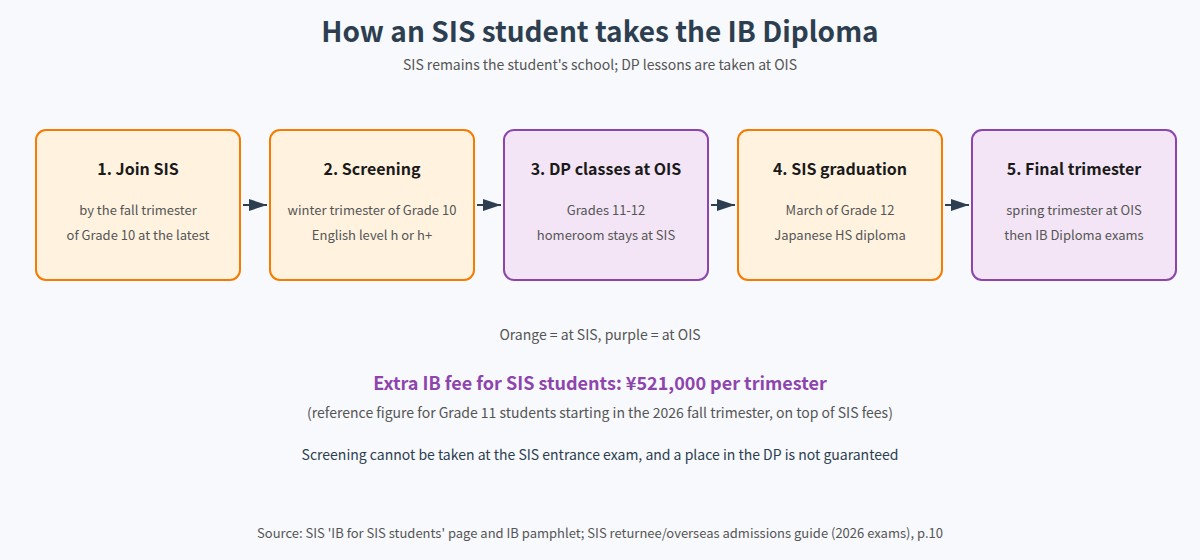
Figure 2 sums up the steps. The conditions on the SIS page are strict, so please read them carefully:
- Join early enough: students must take at least two trimesters of SIS high school classes before starting the DP, so they must join SIS by the fall trimester of Grade 10 at the latest.
- Internal screening: SIS students who want the DP are screened in the winter trimester of Grade 10. The DP is not guaranteed, and the screening cannot be taken at the same time as the SIS entrance exam.
- English level: the SIS IB pamphlet says students need high English proficiency and an “h” or “h+” level on the SIS English placement test to apply, followed by an interview with the OIS high school principal and three tests.
- Daily life: morning homeroom is at SIS and lessons are at OIS.
- The final trimester: students graduate from SIS in March of Grade 12, then attend the final spring trimester at OIS to finish the Diploma.
There is an extra cost too. The SIS admissions guide gives a reference IB fee of ¥521,000 per trimester for Grade 11 students starting the DP in the 2026 fall trimester, charged on top of SIS fees. Ask SIS for the full two-year cost, including the final OIS trimester.
Parents often ask about DP subjects. The OIS 2026-27 School Profile lists results in English A, Japanese A, Japanese B and ab initio, Spanish ab initio, Economics, History, Business Management, Biology, Chemistry, Physics, both Mathematics courses and Visual Arts, plus some online Pamoja courses (which cost extra). Availability changes by year, so check with the DP Coordinator.
Results and university destinations
OIS IB Diploma results 2026
According to the OIS 2026-27 School Profile, all DP candidates in 2026 passed the IB Diploma (23 candidates), with an average score of 34 points. The highest score was 41 points, and just under one third of candidates received a Bilingual Diploma. The profile does not say whether SIS students are included. With small cohorts (the Class of 2027 has 28 seniors), results move from year to year.
The same profile lists OIS university matriculation for 2022 to 2026, including Kwansei Gakuin, Osaka, Waseda, Keio (PEARL), Sophia and ICU in Japan, and Cambridge, Oxford, LSE, King’s College London, Toronto, UBC, McGill, Yale and Princeton overseas. It does not give the number of students at each university. Remember these are OIS graduates, not SIS graduates.
SIS graduates and Kwansei Gakuin University
SIS publishes how many graduates went on to Kwansei Gakuin University, including through internal recommendation and other routes (figures as of 1 April 2026):
| SIS graduating class | Graduates | Entered Kwansei Gakuin University | Share (calculated) |
|---|---|---|---|
| Class of 2024 | 91 | 55 | about 60% |
| Class of 2025 | 100 | 61 | 61% |
| Class of 2026 | 101 | 66 | about 65% |
The largest group each year went to the School of International Studies. SIS says students who meet the criteria can use the internal recommendation system, and its career page also lists offers from other Japanese and overseas universities (those tables count offers, including from former students, rather than enrolments).
Tuition and fees
Let’s be honest about money: SIS fees are those of a Japanese private school, while OIS fees are those of an international school.
SIS fees (students entering in 2026)
| Fee (2026 entrants) | Amount (JPY) |
|---|---|
| Entrance fee (one-time, non-refundable) | ¥300,000 (¥150,000 when moving up from SIS middle school) |
| Tuition (annual, fixed until graduation) | ¥1,266,000 |
| Expense deposit (annual, settled at year end) | ¥90,000 |
| Parents’ association and Kwansei Gakuin support association (annual) | ¥9,000 + ¥3,000 |
| Grade trip savings (Grade 11 only) | ¥180,000 |
| First-year total (Grade 11 entry adds the trip savings) | ¥1,668,000 (¥1,848,000) |
SIS collects fees in three instalments. A second foreign language elective costs extra (¥16,000 per weekly lesson per trimester in 2026), and the admissions guide notes that SIS is not covered by Osaka Prefecture’s free private high school tuition scheme. Fees for students entering in 2027 had not been decided when we checked.
OIS fees (2026-2027)
| Fee (2026-2027) | Amount (JPY) |
|---|---|
| Application fee (one-time, non-refundable) | ¥40,000 |
| Registration fee (one-time, due on acceptance) | ¥330,000 |
| Tuition KA to Grade 5 (annual) | ¥2,270,000 |
| Tuition Grades 6 to 10 (annual) | ¥2,708,000 |
| Tuition Grades 11 to 12 (annual) | ¥2,828,000 |
| PTA fee (annual) | ¥5,000 |
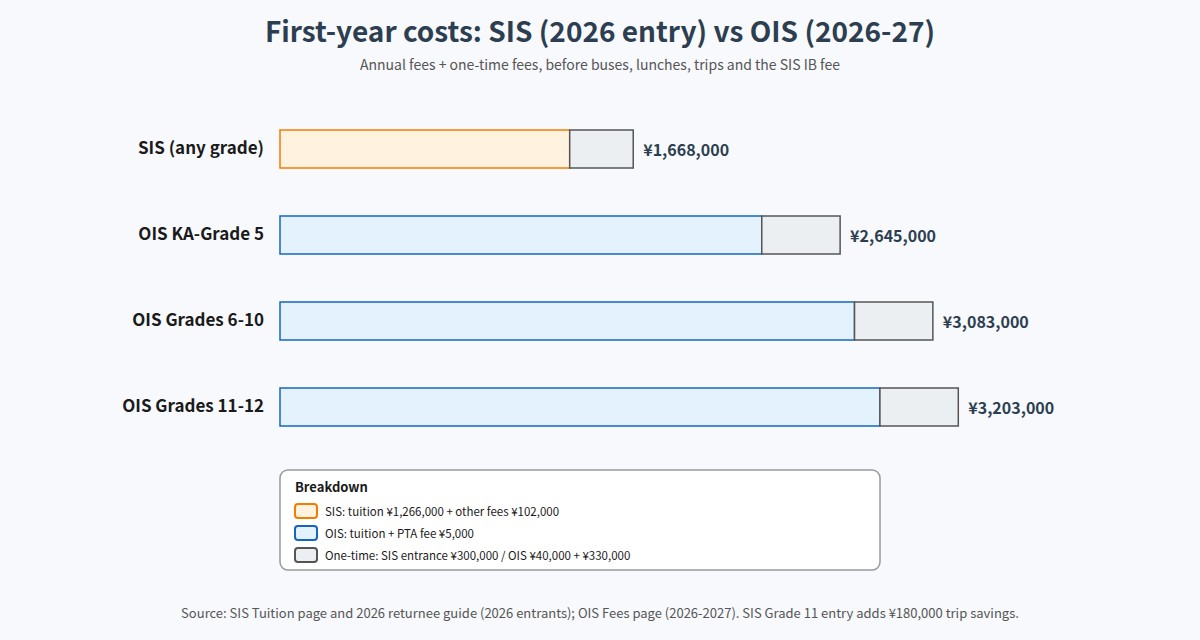
Putting it together (Figure 3): a new OIS student in Grades 6 to 10 pays ¥3,083,000 in the first year (¥40,000 + ¥330,000 + ¥2,708,000 + ¥5,000), and a new student in Grades 11 to 12 pays ¥3,203,000. At SIS the first year is ¥1,668,000 for most grades. OIS says its 2026-27 fees rose by approximately 4% for all grades. School buses are extra at OIS, ranging from ¥28,010 per trimester (Kitasenri) to ¥89,630 per trimester (Ashiya and Nishinomiya), and lunches are charged separately for kindergarten and elementary grades. The OIS fees page also notes that new students in Grades 10 to 12 may apply for the government’s “Tuition Support for High School Students” and that limited financial aid is available if circumstances change. Note that a MEXT notice of 31 March 2026 removed foreign schools (kakushu gakko mainly for foreign nationals) from the national support fund itself from 1 April 2026: students enrolled before then keep the previous terms, and new entrants at previously designated foreign schools may receive equivalent support through the prefecture-run budget programme Koukousei-tou Shin-Shugaku Shien (MEXT), so ask the school which applies to your child.
Admissions
The two schools run their admissions completely separately. If you are applying to OIS, contact the OIS Admissions Office; SIS applications go to SIS Admissions.
SIS: returnee and overseas entry
SIS has four types of applicant: returnees (kikokushijo), overseas students, general students and international students. The high school only admits children who qualify as returnees (through the returnee, overseas or special exams), so general and international entry is for Grade 7 only. For returnee families, the key rules in the 2026 exam guide are:
- Time abroad: the child’s most recent continuous stay overseas must be at least one year, attending a primary or secondary school. If the stay was at least one year but less than two years, the exam must be within two years of returning to Japan; if two years or more, within three years.
- Studying abroad alone: children who studied abroad without their parents need at least two continuous years and must sit the exam within one year of returning.
- Nationality: children without Japanese nationality need a residence status such as permanent resident, spouse or child of a Japanese national, long-term resident or dependant visa. SIS does not accept students who need a student visa.
- Age: applicants usually sit for the grade that matches their age in the Japanese system; for April entry to Grade 10 the child must be 15 by the end of the previous March.
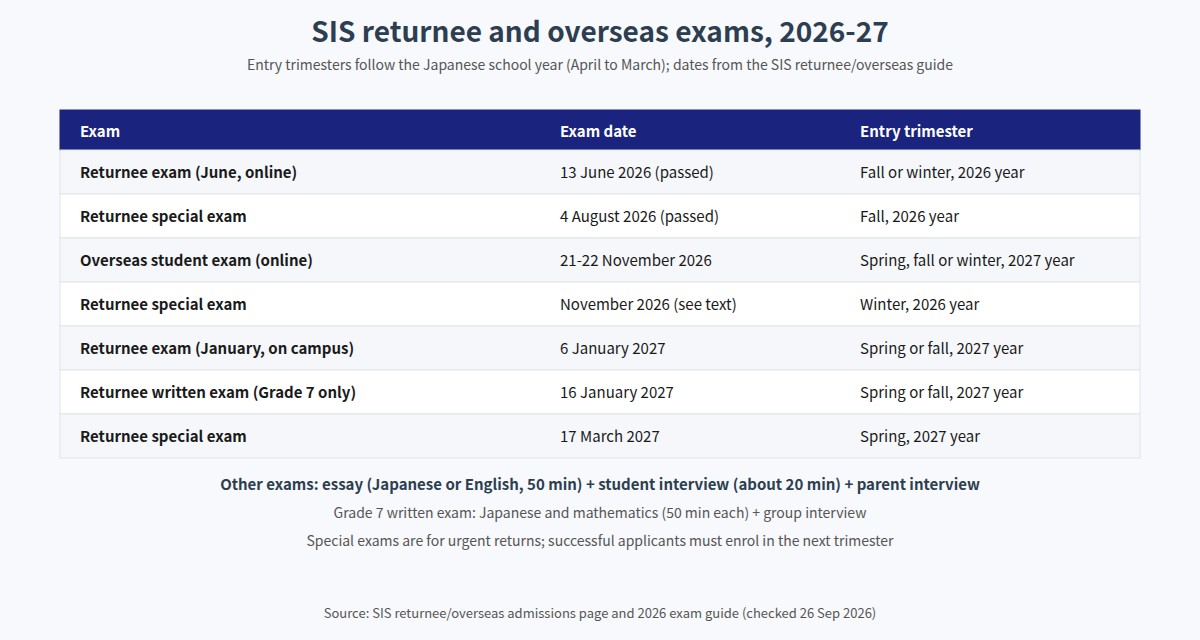
Figure 4 lists the exam dates; entry trimesters follow the Japanese school year, which starts in April (the 2026 winter trimester starts on 25 November). Apart from the Grade 7 written exam, the returnee, overseas and special exams consist of a 50-minute essay written in Japanese or English (the school says both are marked on the same criteria), a student interview of about 20 minutes held mainly in Japanese, and a parent interview. The written exam for Grade 7 returnees is Japanese and mathematics with a group interview. For the upcoming winter special exam, the guide’s table shows 21 November 2026 while the web page shows 22 November, so please confirm it with the school. The exam fee is ¥28,000.
As of 16 June 2026, SIS was accepting returnee applicants for Grades 7 to 10, had a few places in Grade 11 and was closed for Grade 12. Because of the IB conditions above, a family hoping for the IB Diploma via SIS should aim for entry no later than the fall trimester of Grade 10.
SIS: general and international entry (Grade 7)
The Grade 7 exam for general, international and returnee written applicants is on 16 January 2027, and the 2027 guide was due in October 2026. The “international student” category is for children at Japanese elementary schools who have a foreign-born or foreign-national parent, or who have at least two years of local or international schooling abroad. The qualification interview period runs from 7 September to 7 November 2026.
OIS admissions
OIS accepts applications at any time of year, with its main intake at the start of the school year in late August. It says it exists primarily for expatriate families in Kansai who need an English-based education, and lists its priorities in this order: children of expatriates from English-speaking countries, children of other expatriates, Japanese returnees (defined as at least two years of international-style education in English immersion), and children of Japanese parents who can demonstrate “a compelling need for an international style education in English immersion”.
The process starts with an online enquiry form. After the Admissions Office replies, you submit the application form, official records and standardized test results from previous schools, and two recommendations sent directly by the current school. Every applicant takes language, mathematics and cognitive tests and has an interview, and both parents are asked to meet the school where possible. OIS notes that admission for non-English speakers may be limited in each grade, that children moving from a different school calendar are usually placed in the lower grade, and that families need a valid visa (OIS cannot sponsor student visas). OIS does not publish a single age cut-off date, so ask about grade placement early.
Student life and support
Both schools use a three-trimester year, but the calendars differ: SIS follows the Japanese year starting in April (the 2026 fall trimester began on 24 August), while OIS runs from late August to late June. OIS offers English Language Support for students still building their English, and SIS has a dormitory, Akebono-ryo, for students from Grade 9 whose parents live far away, including overseas. For 2026 the dormitory cost ¥998,700 a year plus ¥270,000 for meals and a ¥50,000 entry fee; rooms can be full, so ask before applying.
Getting there
From central Osaka, take the Midosuji subway line to Senri-Chuo or the Hankyu Senri line to Kita-Senri, then Hankyu Bus 78 to the school (about 25 minutes from Senri-Chuo and about 15 minutes from Kita-Senri, according to OIS). OIS also runs school buses.
Questions parents often ask
Is SIS an IB school?
No. SIS is a Japanese Article 1 school and is not on the MEXT IB list. The IB World School on the campus is OIS. Selected SIS students can take the IB Diploma through OIS while staying enrolled at SIS.
We are returning to Japan in the middle of the year. Can our child still join SIS?
Often, yes. SIS holds returnee exams several times a year and admits students at the start of each trimester, and the special exams are designed for sudden returns. Check the current openings for your child’s grade first, since some grades may be closed.
My child wants the IB Diploma. Should we apply to SIS or OIS?
It depends on your child’s language and plans. OIS is an English-medium IB continuum school. SIS suits a child who wants a Japanese education, with the IB Diploma as a later option that depends on Grade 10 screening, a high English level and an extra fee.
Are the fees at SIS much lower than OIS?
Yes, at the 2026 rates: SIS tuition is ¥1,266,000 a year, compared with ¥2,708,000 to ¥2,828,000 for OIS Grades 6 to 12. But an SIS student taking the DP pays an additional IB fee (¥521,000 per trimester as a 2026 reference figure).
Summary
- Two separate schools, one campus: SIS is a Japanese middle and high school; OIS is an English-medium K-12 international school. Both are run by Kwansei Gakuin.
- IB belongs to OIS: OIS is authorised for the PYP, MYP and DP (MEXT list, June 2026); SIS is not on the list.
- A dual-diploma route: since 2013, selected SIS students take OIS’s DP classes and can graduate with an SIS diploma and the IB Diploma, subject to Grade 10 screening, English level and an extra fee.
- Fees: SIS ¥1,668,000 in the first year for 2026 entrants (¥1,848,000 for Grade 11 entry); OIS ¥2,645,000 to ¥3,203,000 in the first year for 2026-27.
- Returnee-friendly admissions: SIS holds several returnee exams a year (most with an essay in Japanese or English); OIS accepts applications year-round.
If this campus sounds right for your family, join an information session or campus visit and ask each school directly about the grade you have in mind.
Sources and references
- Senri International School of Kwansei Gakuin: official website (checked 26 September 2026)
- SIS: IB for SIS students
- SIS: Tuition (2026 entrants)
- SIS: Entrance examination for returnees and overseas students
- SIS: Entrance examination for general and international students
- SIS: Career development (as of 1 April 2026)
- OIS: The Two Schools and About OIS
- OIS: Learning and Accreditation and Evaluation
- OIS: Profile for Colleges and Universities 2026-2027 (PDF, linked from the About OIS page)
- OIS: Fees (2026-2027)
- OIS: Admissions and Enquiries and Enrolment Procedures
- OIS: Contacts and Location
- MEXT IB Education Promotion Consortium: IB schools in Japan (as of 30 June 2026)
コメント