The International Baccalaureate (IB) is one of the first things many international families hear about when they start looking at schools in Japan. Maybe a colleague’s children are at an IB school, or maybe your child’s current school overseas is one. Either way, you probably have a list of questions: How do the programmes fit together? Is an IB school here the same as an international school? What happens if we are Japanese nationals? And how much will it really cost?
This guide answers those questions in ten short sections. We have based it on official sources: the IB pages of the Japanese Ministry of Education (MEXT) and its IB Education Promotion Consortium, MEXT’s rules on school attendance and university entrance, UCAS, and the fee pages of two IB schools, all checked on 26 September 2026. Rules and fees change, so please treat this as a starting point and confirm the details with each school.
- 1. The IB is four programmes, not one
- 2. An “IB school” in Japan can be a Japanese school or an international school
- 3. For Japanese nationals, compulsory schooling rules apply
- 4. The Diploma can be taken partly in Japanese
- 5. Japan has 168 IB World Schools, but read the numbers carefully
- 6. The Diploma is scored out of 45, and the core really counts
- 7. The Diploma opens doors in Japan and abroad
- 8. Costs vary widely, so look at real fee tables
- 9. Ask exactly how English (and Japanese) support works
- 10. Visit early, and know the paperwork before you apply
- Questions parents often ask
- Summary
- Sources and references
1. The IB is four programmes, not one
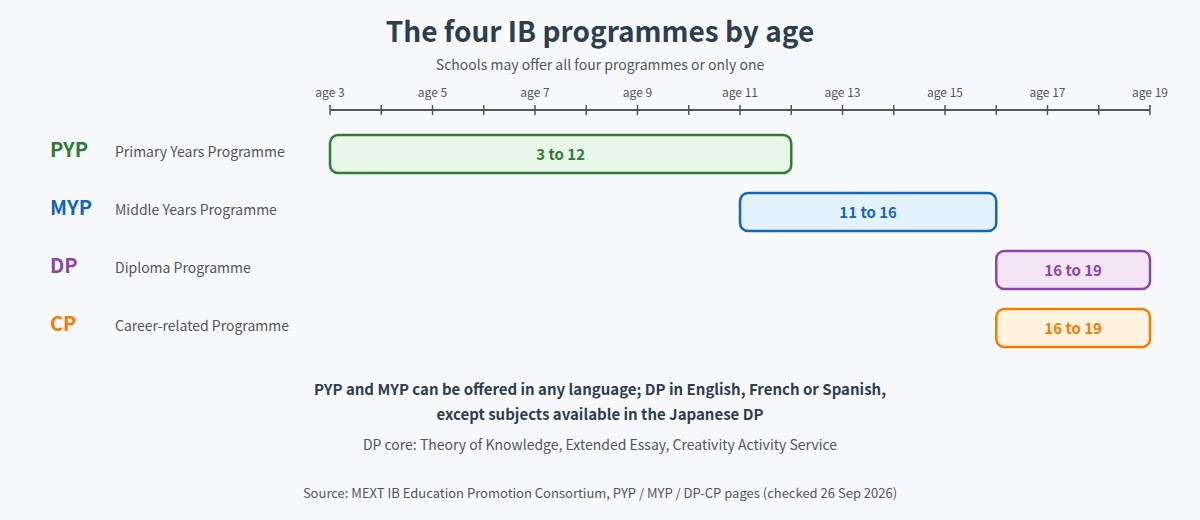
When people say “IB”, they often mean the Diploma at the end of high school. In fact the IB offers four programmes, and a school can offer all of them or just one. According to the MEXT IB consortium, the age ranges are:
- Primary Years Programme (PYP): ages 3 to 12. Learning is organised around six transdisciplinary themes, so children explore big questions across subjects rather than only subject by subject.
- Middle Years Programme (MYP): in principle ages 11 to 16. It helps students connect what they learn with the world around them.
- Diploma Programme (DP): ages 16 to 19. A two-year course of six subjects plus a “core” of Theory of Knowledge (TOK), the Extended Essay (EE) and Creativity, Activity, Service (CAS). Students take three or four subjects at Higher Level (240 teaching hours each) and the rest at Standard Level (150 hours each).
- Career-related Programme (CP): ages 16 to 19. Students take at least two DP subjects, a CP core and career-related study provided by the school. MEXT notes that the CP was created in 2012.
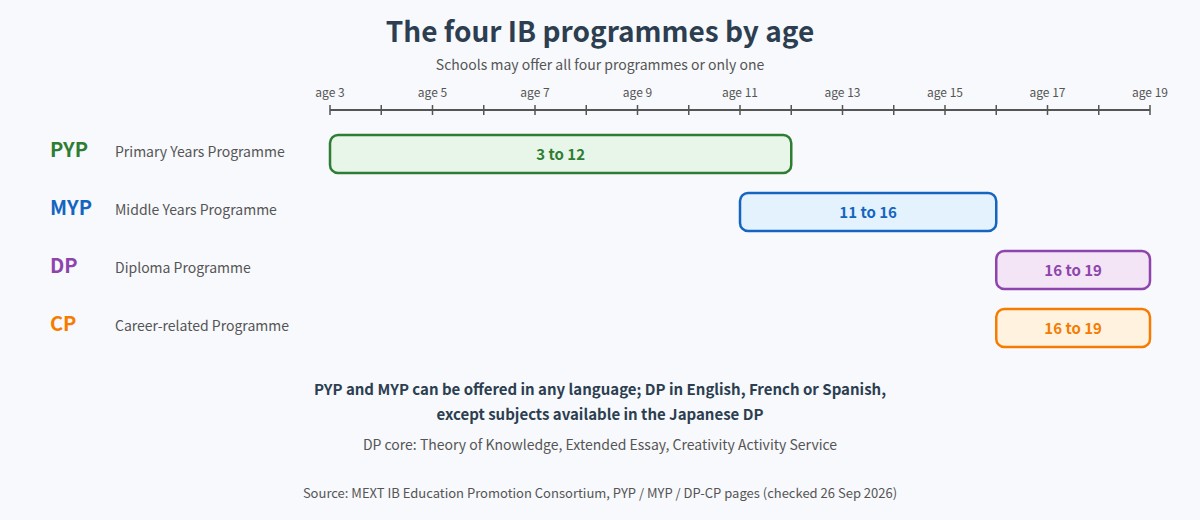
As Figure 1 shows, the ranges overlap a little. The practical question for you is simple: which programmes does the school you are looking at actually offer? A school that is authorised only for the DP may teach its own curriculum in the younger grades, and that is perfectly normal. For a fuller introduction to each programme, see our guide What Is the International Baccalaureate (IB)?.
2. An “IB school” in Japan can be a Japanese school or an international school
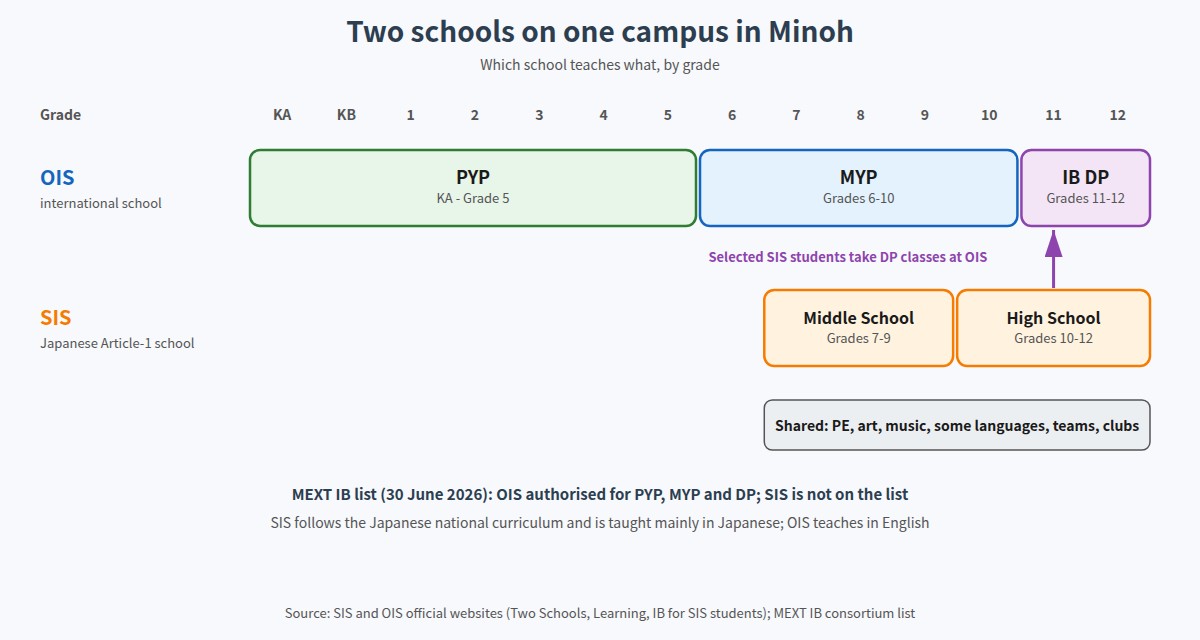
This is the point that surprises most newcomers. In Japan, schools recognised under Article 1 of the School Education Act (often called “Article 1 schools”, or ichijo-ko) are the regular Japanese schools: elementary schools, junior high schools, high schools and so on, whether public or private. Many international schools are not Article 1 schools. MEXT’s FAQ explains that the term “international school” has no specific legal definition, and that while some international schools are recognised as Article 1 schools, many are “miscellaneous schools” (kakushu gakko, Article 134) or have no approval at all.
Both kinds of school can be IB World Schools. The MEXT consortium list separates them: Article 1 schools on one side, and non-Article-1 schools (miscellaneous schools, specialised training colleges, nurseries and kindergartens, overseas Japanese schools and unapproved schools) on the other. It adds that non-Article-1 schools are not held to the standards required of Article 1 schools.
Why does this matter to you? The type of school affects the language of teaching, the school calendar, how the Japanese national curriculum is covered, and, as the next point explains, whether a Japanese child’s attendance counts as compulsory schooling. MEXT notes that Article 1 IB schools must meet both Japanese law and the IB curriculum. If you are unsure about a school’s legal status, the consortium page itself suggests asking the school directly.
3. For Japanese nationals, compulsory schooling rules apply
If your child has Japanese nationality, please read this point carefully. The MEXT IB consortium list states: “日本人の保護者は義務教育段階の子を一条校に就学させる義務を負っています” (Japanese parents have a duty to send children of compulsory school age to an Article 1 school).
MEXT’s FAQ on international schools goes further: “保護者が日本国籍を有する子を一条校として認められていないインターナショナルスクールに就学させたとしても、法律で規定された就学義務を履行したことにはなりません” (even if parents send a child of Japanese nationality to an international school that is not recognised as an Article 1 school, this does not fulfil the legal duty of school attendance).
The same FAQ adds a consequence that many families do not expect: a child who finishes the elementary section of a non-Article-1 international school is not allowed to enter a Japanese junior high school on that basis, and the same applies to transferring partway through an international school’s middle years.
Note that the FAQ’s wording is about children who have Japanese nationality. If this applies to your family and you are considering an international school, it is wise to read the FAQ in full and talk to your local board of education first. The MEXT pages we checked do not show a publication year, so please check the current wording before you decide.
4. The Diploma can be taken partly in Japanese
The MEXT consortium explains that DP classes and exams are, in principle, taught in English, French or Spanish. MEXT says that it and the IB are working together to develop the Japanese DP (officially the Dual Language Diploma Programme, DLDP), in which some subjects can be taken in Japanese. The subjects that MEXT lists as available, or planned to be available, in Japanese are:
- Language A: literature and Language A: language and literature (Group 1)
- Geography, History and Economics (Group 3)
- Biology, Chemistry and Physics (Group 4)
- Mathematics: analysis and approaches, and Mathematics: applications and interpretation (Group 5)
- Music and Visual Arts (Group 6)
- All three core elements: the Extended Essay, TOK and CAS
There is an important condition. MEXT says that even in the Japanese DP, two of the six subjects (usually the Group 2 foreign language plus one more) must be taken in English or another language. Not every school offers every subject in Japanese either, so ask each school for its own subject list. On the MEXT list of 30 June 2026, 37 Article 1 schools, 2 non-Article-1 schools and 1 overseas school are marked as Japanese DP schools.
For international families, this means two things. If your child is fluent in Japanese, a Japanese DP school can be a realistic option. If your child is still learning Japanese, you will usually be looking at schools that teach the DP in English. The PYP and MYP are more flexible still: MEXT notes that both can be offered in any language.
5. Japan has 168 IB World Schools, but read the numbers carefully
How many IB schools are there? The MEXT consortium list (as of 30 June 2026) gives a headline figure of 273, but that counts programmes, not schools, and includes candidate schools that are still working towards authorisation. The breakdown is:
| Programme (as of 30 June 2026) | Authorised | Candidate | Authorised at Article 1 schools | Authorised at non-Article-1 schools |
|---|---|---|---|---|
| PYP | 91 | 36 | 24 | 67 |
| MYP | 48 | 10 | 27 | 21 |
| DP | 80 | 6 | 50 | 30 |
| CP | 1 | 1 | 1 | 0 |
| Schools (authorised) | 168 | – | 95 | 73 |
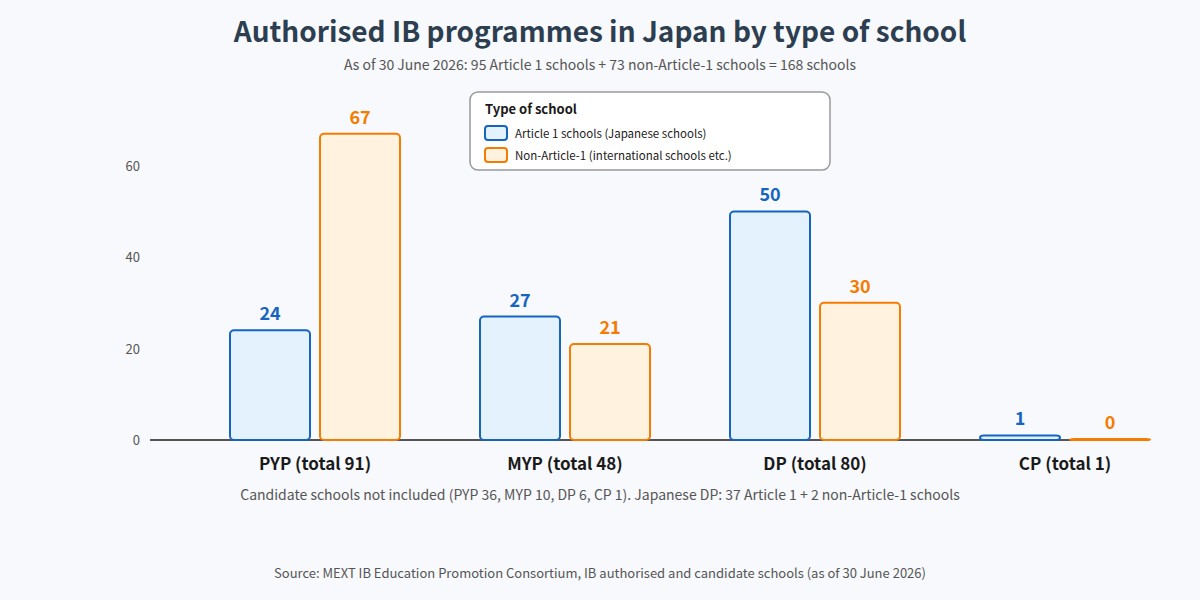
The list gives totals of 95 Article 1 schools and 73 non-Article-1 schools, which makes 168 authorised schools in Japan. (One more school, in London, appears in a separate overseas section.) Because many schools offer more than one programme, the programme numbers add up to more than 168. MEXT also notes that its counts are made per programme and differ from the figures the IB publishes, and that worldwide there are about 6,200 IB schools in 163 countries and regions (June 2026).
Figure 2 shows a pattern worth knowing: most authorised PYP programmes are at non-Article-1 schools, such as international schools and preschools, while more than half of the authorised DP programmes are at Article 1 schools. If you want to browse the schools themselves, our overview IB World Schools in Japan 2026 lists them by programme and prefecture.
6. The Diploma is scored out of 45, and the core really counts
The DP score is quite different from the grade point averages or percentage marks you may know. MEXT’s consortium page explains it like this:
- Each of the six subjects is graded out of 7, for a maximum of 42 points.
- TOK and the Extended Essay together earn up to 3 more points, depending on the combination of their results.
- That makes a maximum of 45 points. In principle, a student needs 24 points or more to earn the Diploma.
- CAS is not scored, but it is a required part of the programme.
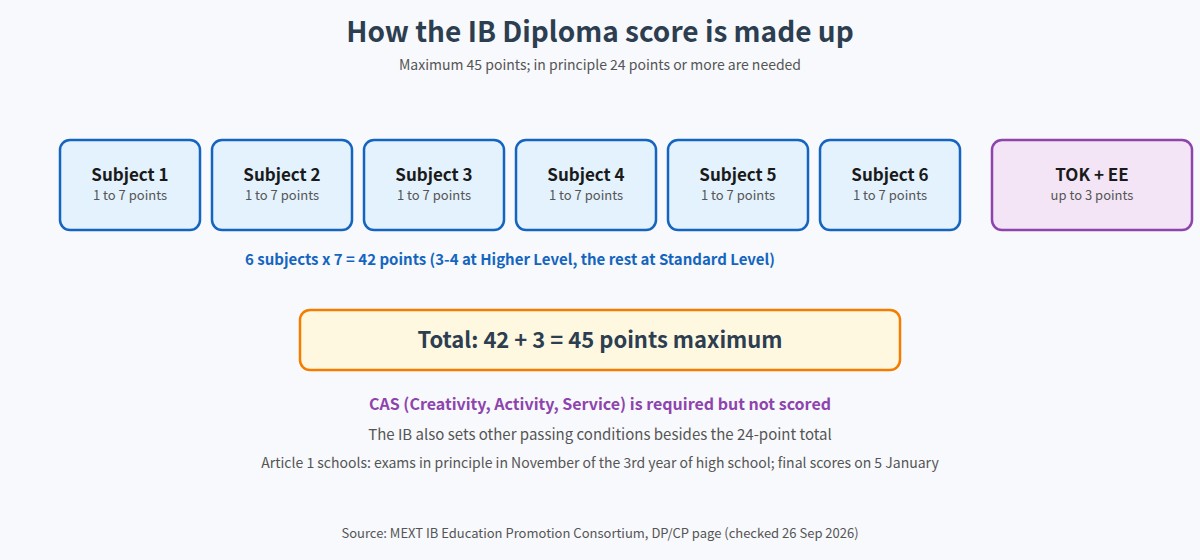
The IB also sets other passing conditions besides the 24-point total, so a student with 24 points does not automatically receive the Diploma; your school’s DP coordinator can explain them. Grades come from both external exams and internal assessment (coursework marked by teachers and checked by the IB), so steady work across the two years matters. The Extended Essay is up to 4,000 words (8,000 characters if written in Japanese, according to MEXT).
Exams take place twice a year, in May and November. MEXT notes that at Article 1 schools the exams are, in principle, held in November of the third year of high school, with final scores sent on 5 January of the following year. For context, Tes reported on 6 July 2026 that the worldwide average Diploma score for the May 2026 session was 30.88 points. Our parent’s guide to IB assessment goes into more detail.
7. The Diploma opens doors in Japan and abroad
In Japan. MEXT’s page on university entrance eligibility lists holders of “外国の大学入学資格である国際バカロレア” (the International Baccalaureate, as a foreign university entrance qualification) among those eligible to apply to Japanese universities. The same page also recognises students who complete a 12-year programme at a school accredited by WASC, CIS, ACSI, NEASC, Cognia or COBIS, which is useful to know if your child attends an accredited international school but does not take the full Diploma.
Eligibility is not the same as admission. MEXT’s consortium explains that each university runs its own selection, often an admissions office (AO) or returnee route that uses IB scores together with essays or interviews. Its table of universities using IB scores in admissions, dated January 2025, lists 82 universities, from national universities such as Hokkaido, Tohoku, Tokyo, Kyoto and Osaka to private ones such as ICU, Keio, Sophia and Waseda. Because that table is from January 2025, please check each university’s application guidelines for the year your child will apply. Our guide to Japanese universities accepting IB scores looks at this in more depth.
Abroad. MEXT notes that the Diploma is widely accepted around the world, that UCAS in the UK publishes a tariff that converts IB scores, and that many overseas universities give credit for strong Higher Level results. The timing matters. For 2027 entry, UCAS lists 15 October 2026 (18:00 UK time) as the deadline for Oxford, Cambridge and most courses in medicine, dentistry and veterinary science, and 13 January 2027 for most other undergraduate courses. Students taking May exams apply before their final results arrive, so predicted grades matter; for November candidates it depends on the deadline.
8. Costs vary widely, so look at real fee tables
Let’s be honest: this is often the deciding factor. Fees depend far more on the type of school than on the IB itself. To give you a sense of the range, here are two real 2026-27 fee tables from IB international schools. They are examples, not a comparison of quality.
| Fee (2026-27) | Yokohama International School, Grades 6 to 11 | Tsukuba International School (single tuition rate listed) |
|---|---|---|
| Application fee (one-time) | ¥50,000 | ¥20,000 |
| Registration fee (one-time) | ¥1,480,000 | ¥300,000 |
| Annual tuition | ¥3,345,000 | ¥1,560,000 |
| Other annual fees | Campus Development Fee ¥399,000 | Facilities ¥210,000 + Materials ¥240,000 |
| First-year total (calculated) | ¥5,274,000 | ¥2,330,000 |
| Each following year at 2026-27 rates (calculated) | ¥3,744,000 | ¥2,010,000 |
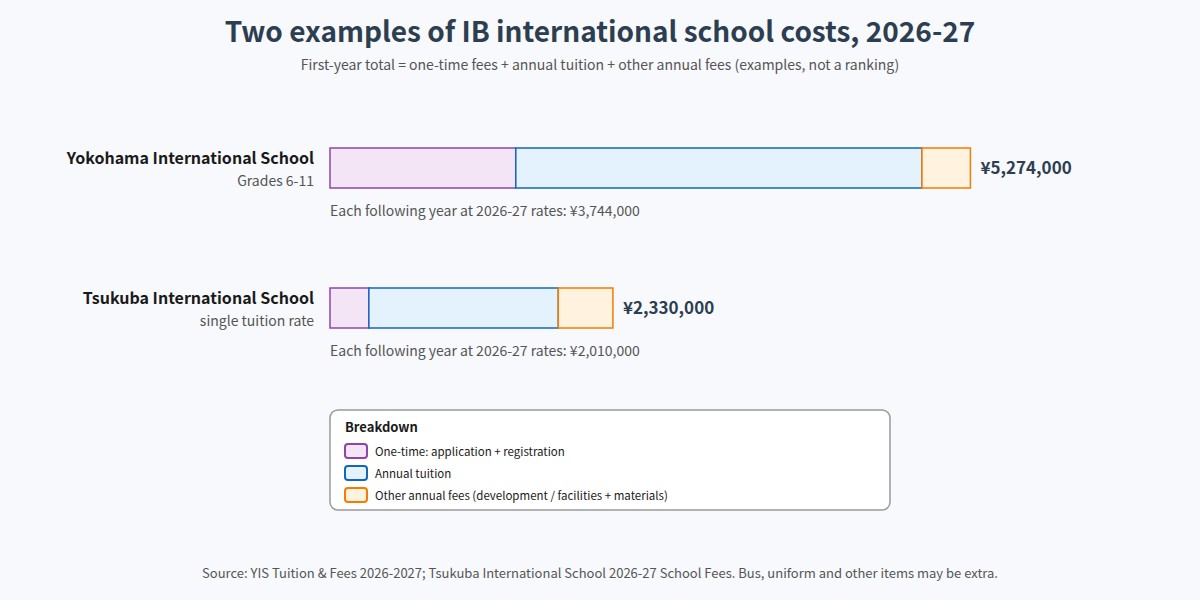
How we calculated the totals in Figure 4: at YIS, ¥50,000 + ¥1,480,000 + ¥3,345,000 + ¥399,000 = ¥5,274,000 in the first year, then ¥3,345,000 tuition + ¥399,000 Campus Development Fee = ¥3,744,000 each year after that. At Tsukuba International School, ¥20,000 + ¥300,000 + ¥1,560,000 + ¥210,000 + ¥240,000 = ¥2,330,000 in the first year, then ¥1,560,000 + ¥210,000 + ¥240,000 = ¥2,010,000.
A few details from the same pages are worth knowing. YIS’s FAQ gives the Tokyo bus at ¥395,000 a year including tax. Tsukuba International School’s page covers August 2026 to June 2027, offers a ¥90,000 discount for paying tuition in one lump sum by 1 June (already passed for 2026-27) and a ¥240,000 tuition discount for younger siblings (not combinable with another discount), estimates DP exam fees at about ¥100,000 (an estimate as of January 2024), and says tuition will rise from 2027-28. Always ask for the full list of extras.
Public support works differently depending on the type of school. MEXT reports that a law amending the national High School Tuition Support Fund (shugaku shienkin) was passed on 31 March 2026 and took effect on 1 April, removing the income limit. However, MEXT’s notice of 31 March 2026 also removed so-called foreign schools (miscellaneous schools mainly for foreign nationals, which includes many international schools) from the fund from 1 April 2026. Students already enrolled before then keep the previous terms, and MEXT says students outside the fund can receive equivalent support through a separate budget programme (「高校生等・新修学支援」). If your child is at an international high school, ask the school and your prefecture which scheme applies. For more on costs, see our guide to IB school costs in Japan.
9. Ask exactly how English (and Japanese) support works
Language support is where schools differ most, and it is often the biggest worry for families arriving in Japan. Many international schools offer English as an Additional Language (EAL) support, but entry requirements usually become stricter as children get older. Yokohama International School’s admissions FAQ is a clear example:
- Early Learning Center and Elementary: “Children are admitted regardless of English proficiency, provided there are no other additional learning needs.”
- Middle School: “Students should have sufficient competency in academic English to benefit from our programs.”
- High School: “A high degree of academic English proficiency is required.”
The same FAQ says all its teachers are trained to support language acquisition and that EAL specialists give additional instruction, but that there is no separate ESL track. Other schools may teach EAL in separate classes, charge extra for it or limit it to certain grades, so it is worth asking: Which grades get EAL support? Is it in class or in separate lessons? Is there a fee? What level does a student need to join the DP?
Parents’ language matters too. YIS, for example, requires at least one parent living with the child to be able to communicate effectively in English, both spoken and written.
10. Visit early, and know the paperwork before you apply
Admissions tend to work differently depending on the type of school (some international schools are Article 1 schools, so check each school’s own process).
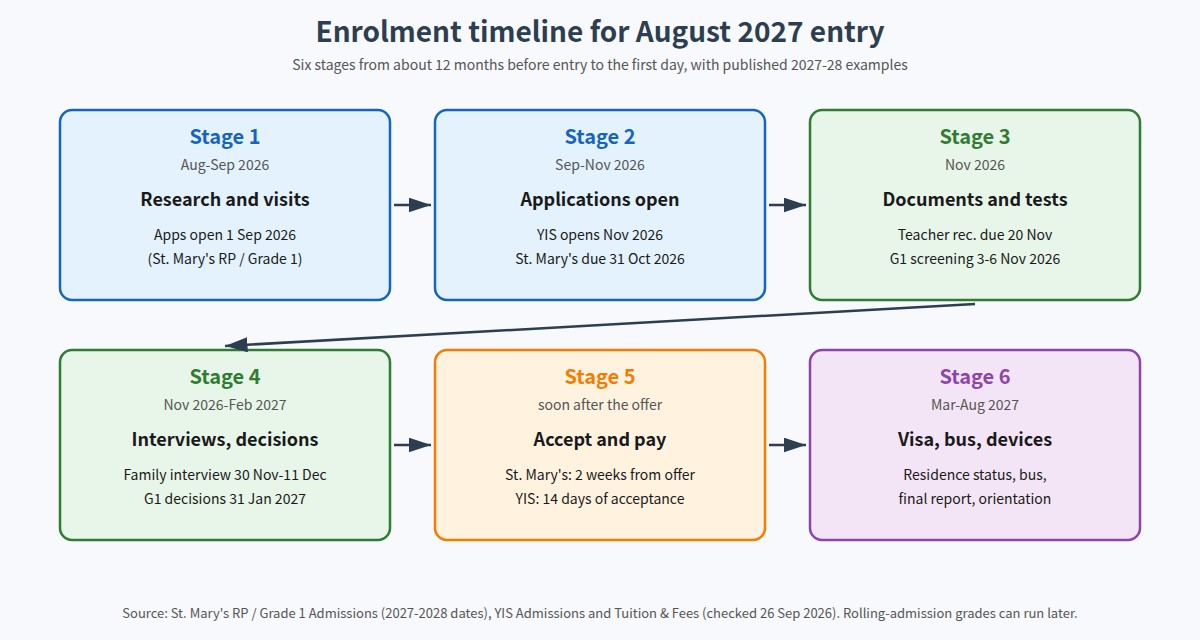
- International schools usually accept applications online through their own portal. YIS, for example, sets out eight steps, from reading its admissions policy and creating a portal account to paying the application fee, uploading documents, receiving a decision and completing enrolment. Its admissions page says applications for 2027-28 open in November 2026. Popular grades can fill up, so start early.
- Article 1 schools follow the Japanese system, typically with entrance examinations and application guidelines (boshu yoko) published by each school for each year. Returnee (kikokushijo) routes may also exist, so check each school’s current guidelines.
Some practical points from official pages. Visas: YIS’s FAQ says families must hold a visa that allows children to enrol in a school in Japan and that “Tourist visas do not allow children to enroll in a school.” Learning needs: be open about any support your child needs, because schools use this to plan, and some admit children “provided there are no other additional learning needs”.
Most of all, visit. Ask to see a lesson if you can, talk to the DP or PYP coordinator, and bring your child.
Questions parents often ask
We are Japanese nationals. Can our child go to an international IB school?
Many international schools accept Japanese nationals, but MEXT states that attending a non-Article-1 international school does not fulfil the legal duty of compulsory schooling, and that it can affect entry to a Japanese junior high school. Please read MEXT’s FAQ and talk to your local board of education before you decide.
My child does not speak English yet. Is IB still possible?
Often yes, especially for younger children, but it depends on the school and grade. At YIS, Early Learning Center and Elementary children are admitted regardless of English level (provided there are no other additional learning needs), while older students need academic English. Japanese-medium options include Article 1 schools with the Japanese DP.
Summary
- Four programmes: PYP (3 to 12), MYP (11 to 16), and the DP and CP (16 to 19), according to MEXT’s IB consortium.
- Two kinds of school: 95 Article 1 schools and 73 non-Article-1 schools are authorised in Japan, 168 in total (MEXT list, 30 June 2026).
- Japanese nationals: MEXT says attending a non-Article-1 international school does not fulfil compulsory schooling.
- Japanese DP: many subjects and the core can be taken in Japanese, but two of six subjects must be in English or another language.
- 45 points: six subjects at 7 points plus up to 3 for TOK and the EE; 24 points is the basic threshold, with other conditions too.
- Universities: the IB is an entrance qualification in Japan; UCAS deadlines for 2027 entry are 15 October 2026 and 13 January 2027.
- Costs: first-year totals in our two 2026-27 examples are ¥5,274,000 and ¥2,330,000; always ask what is not included.
Choosing a school in a new country is a big step, so take it one question at a time and visit as many schools as you can. You might also enjoy our parent’s guide to the IB Diploma Programme and our Yokohama International School guide.
Sources and references
- MEXT IB Education Promotion Consortium: IB authorised and candidate schools (as of 30 June 2026) (checked 26 September 2026)
- MEXT IB consortium: The PYP
- MEXT IB consortium: The MYP
- MEXT IB consortium: The DP and CP, including the Japanese DP
- MEXT IB consortium: University admissions using the IB (university table as of January 2025)
- MEXT: Compulsory schooling when school-age children attend international schools (FAQ 11)
- MEXT: University entrance eligibility
- MEXT: High School Tuition Support (2026 amendment)
- MEXT: Notice on the 2026 amendment of the High School Tuition Support Fund (31 March 2026)
- Tes: IB results: Diploma Programme scores rise once again (6 July 2026)
- UCAS: Dates and deadlines (2027 entry)
- Yokohama International School: Tuition and Fees 2026-2027
- Yokohama International School: Admissions FAQs and Admissions
- Tsukuba International School: 2026-27 School Fees
コメント