Yokohama International School (YIS) first opened its doors in Yokohama in October 1924, more than a century ago (it closed during the Second World War and reopened in 1955), and today teaches around 830 students from the Early Learning Center to Grade 12. If your family is moving to the Yokohama or Tokyo area, or you are simply comparing IB schools, you have probably come across its name. This guide brings together what the school publishes about its IB programmes, fees for the 2026-27 school year, admissions and recent Diploma results, so you can decide whether it is worth a visit.
Everything below is based on the school’s official website, its 2026-27 School Profile and the Japanese Ministry of Education (MEXT) IB consortium list, all checked on 26 September 2026. Fees and deadlines change every year, so please treat this as a starting point and confirm the details with the admissions office before you apply.
- YIS at a glance
- IB programmes at YIS: from early years to Grade 12
- High school pathways: the YIS Diploma and the IB Diploma
- IB Diploma results 2022 to 2026
- Tuition and fees for 2026-2027
- Admissions: who can apply and how it works
- Learning support and student life
- Getting to YIS
- Questions parents often ask
- Summary
- Sources and references
YIS at a glance
Here is the basic picture. YIS describes itself as an independent, co-educational, pre-K to Grade 12 day school with a non-selective admission policy, which means it does not choose students by academic ability. It has no boarding house and does not offer academic scholarships, although it does have a scholarship scheme for families whose employers take part in its Corporate Contribution Program (more on this below).
| Item | Details |
|---|---|
| School name | Yokohama International School (YIS) |
| Founded | Opened on 27 October 1924 |
| Campus | 2-100-1 Kominato-cho, Naka-ku, Yokohama (new Honmoku campus opened in January 2022, designed by Kengo Kuma & Associates) |
| Grades | Early Learning Center (ages 3 to 5) to Grade 12 |
| Students (2026-27) | 828 students, of whom 286 are in Grades 9 to 12; students of 50 nationalities |
| IB programmes | PYP, MYP and DP (no Career-related Programme), per the MEXT list as of 30 June 2026 |
| Accreditation | Earned dual ECIS and NEASC accreditation in 1991; today the school describes itself as CIS-accredited, and its High School Diploma is accredited by NEASC |
| Head of School | Carla Marschall (since 3 November 2025) |
A little history helps explain the school’s character. YIS reopened on its original Yamate site in 1955 and stayed there for decades before moving in January 2022 to its current campus in Honmoku. The move is recent, so older blog posts and reviews may still describe the Yamate buildings.
IB programmes at YIS: from early years to Grade 12
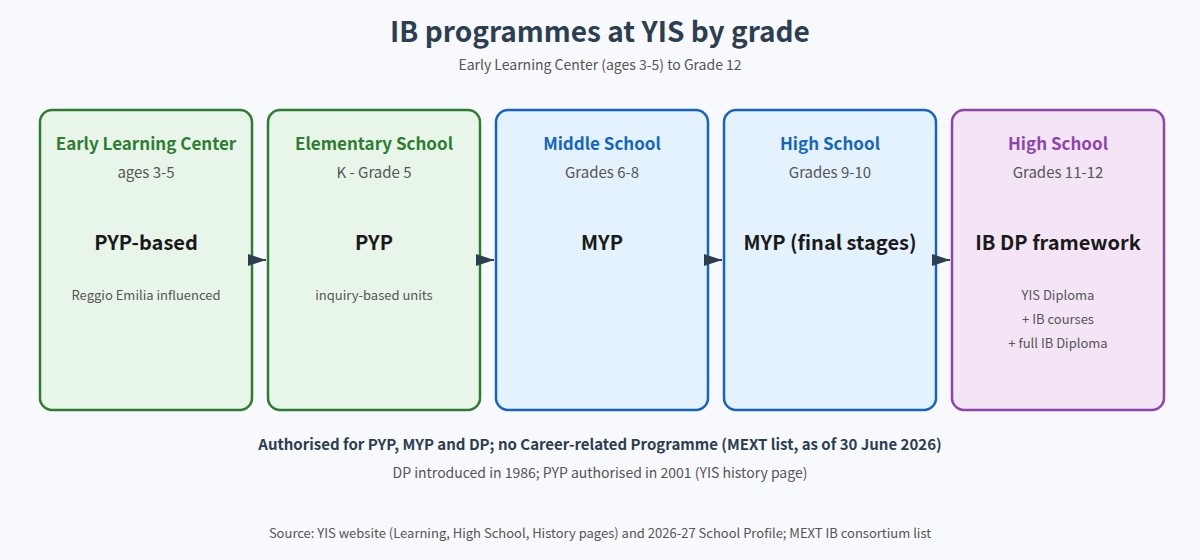
YIS is a full “IB continuum” school, meaning your child can follow IB frameworks from the early years right through to the end of high school. According to the MEXT IB consortium list (as of 30 June 2026), YIS is authorised for the Primary Years Programme (PYP), the Middle Years Programme (MYP) and the Diploma Programme (DP). It does not offer the Career-related Programme (CP).
The school’s own history page adds two useful dates: YIS introduced the IB Diploma Programme in 1986 and gained authorisation for the PYP in 2001. That means the school has been running the Diploma for about four decades. The school does not state the year it began the MYP on the pages we checked, so we have not included one here.
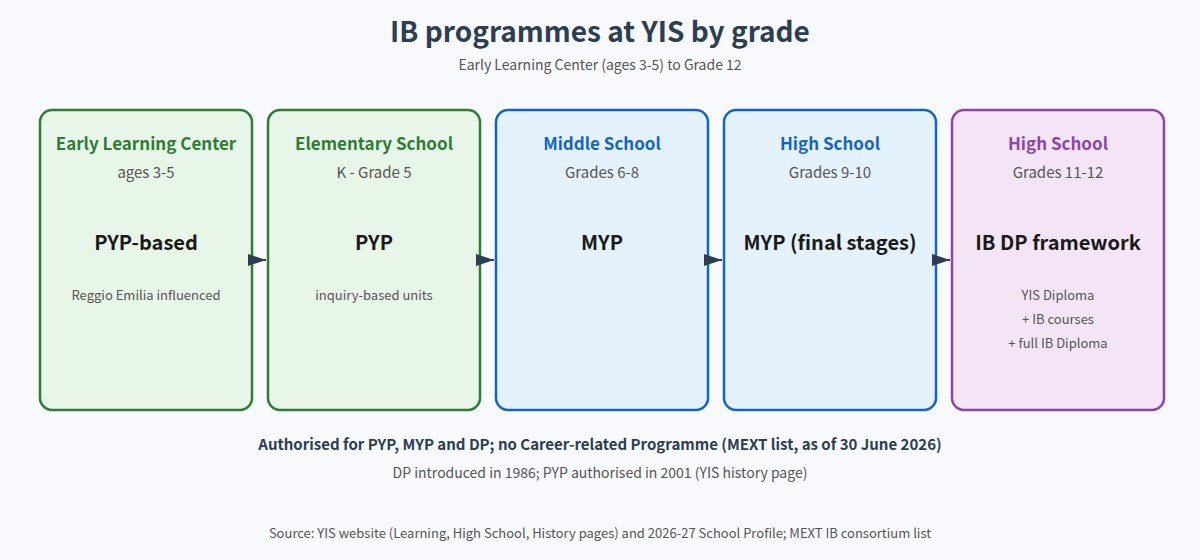
As Figure 1 shows, here is how the programmes line up with the grades:
- Early Learning Center (ages 3 to 5): based on the PYP and influenced by the Reggio Emilia approach, which puts children’s curiosity and play at the centre of learning.
- Elementary School: the PYP, with learning organised around inquiry units rather than separate subjects only.
- Middle School (Grades 6 to 8): the MYP.
- High School Grades 9 and 10: the final stages of the MYP.
- Grades 11 and 12: all classes use the IB Diploma Programme as their framework, including for students who are not taking the full Diploma.
High school pathways: the YIS Diploma and the IB Diploma
One point that often surprises parents is that the full IB Diploma is not the only route at YIS. The school’s 2026-27 School Profile describes three pathways in the last two years:
- the YIS High School Diploma on its own;
- the YIS High School Diploma plus individual IB courses (IB Certificates);
- the YIS High School Diploma plus the full IB Diploma.
The YIS High School Diploma requires 23 Carnegie units (a US-style credit count), a Senior Research Paper or the IB Extended Essay, and continued service learning in Grades 11 and 12. The school also mentions the Global Citizen Diploma, which recognises students’ service and global engagement alongside their academic work.
Why does this matter? If your child is strong in some subjects but you are unsure whether the whole Diploma is the right fit, it is reassuring to know that there is a recognised school diploma with IB courses. The school website also notes a NEASC-accredited pathway. On the other hand, if you are aiming for universities that expect the full Diploma, it is worth asking early how students are guided into each pathway.
IB Diploma results 2022 to 2026
YIS publishes five years of Diploma results in its School Profile. The numbers below are copied from the 2026-27 edition.
| Year | Candidates | Diplomas awarded | Pass rate | Average score | Highest score |
|---|---|---|---|---|---|
| 2026 | 62 | 61 | 98% | 36 | 45 |
| 2025 | 68 | 65 | 95% | 32.4 | 44 |
| 2024 | 63 | 61 | 97% | 34 | 42 |
| 2023 | 57 | 57 | 100% | 35 | 44 |
| 2022 | 60 | 59 | 98% | 35 | 45 |
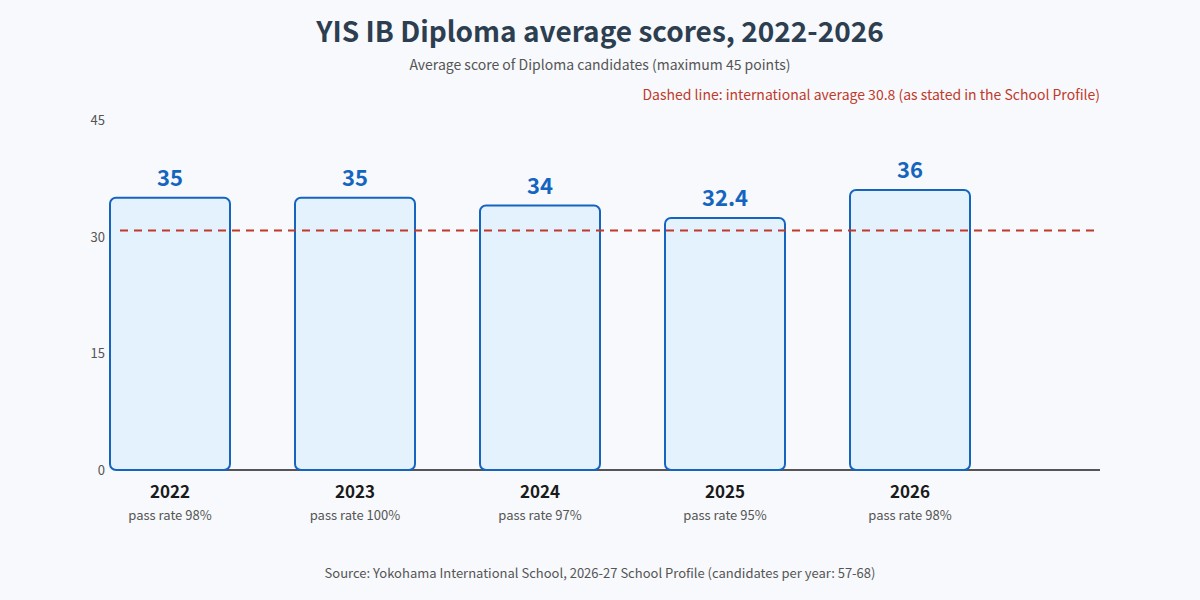
Pass rates are shown exactly as published by the school. Calculated from the candidate numbers, 2025 works out at about 95.6% (65 of 68) and 2024 at about 96.8% (61 of 63).
For context, the same School Profile states that the international average score is 30.8 points and the international pass rate averages about 82.6%, although it does not say which year those reference figures come from. In the school’s own announcement at the start of the 2026-27 year, YIS added that for the 2025-26 cohort 27% of Diploma candidates scored 40 or more and 33% received a Bilingual Diploma.
A gentle word of caution: averages move from year to year with each small cohort (around 60 candidates), as you can see from the dip to 32.4 in 2025. It is more useful to look at the trend over several years than at a single number.
Where do graduates go?
The School Profile lists university matriculation for the classes of 2022 to 2026 across many countries. In Japan the list includes Doshisha, Hosei, ICU, Keio, Ritsumeikan, Sophia, Temple University Japan, Waseda and Yamanashi Gakuin. Overseas it includes universities in the UK (for example Imperial College London, King’s College London and LSE), Canada (such as UBC and the University of Toronto), the United States (such as Cornell, NYU, Northwestern and Stanford) and many European and Asian countries. The profile does not give the number of students at each university, so please ask the counselling team if you want more detail.
Tuition and fees for 2026-2027
Let’s be honest: international school fees in Japan are a big commitment, and it helps to see the full picture before you fall in love with a campus. These are the figures on the YIS Tuition & Fees page for the 2026-2027 school year.
| Fee (2026-2027) | Amount (JPY) |
|---|---|
| Application Fee (one-time, non-refundable) | ¥50,000 |
| Registration Fee (one-time, non-refundable, due within 14 days of an offer) | ¥1,480,000 |
| Early Learning Center, half day (annual tuition) | ¥2,120,000 |
| Early Learning Center, full day (annual tuition) | ¥2,610,000 |
| Kindergarten to Grade 5 (annual tuition) | ¥3,210,000 |
| Grades 6 to 11 (annual tuition) | ¥3,345,000 |
| Grade 12 (annual tuition) | ¥3,440,000 |
| Campus Development Fee (every student, every year) | ¥399,000 |
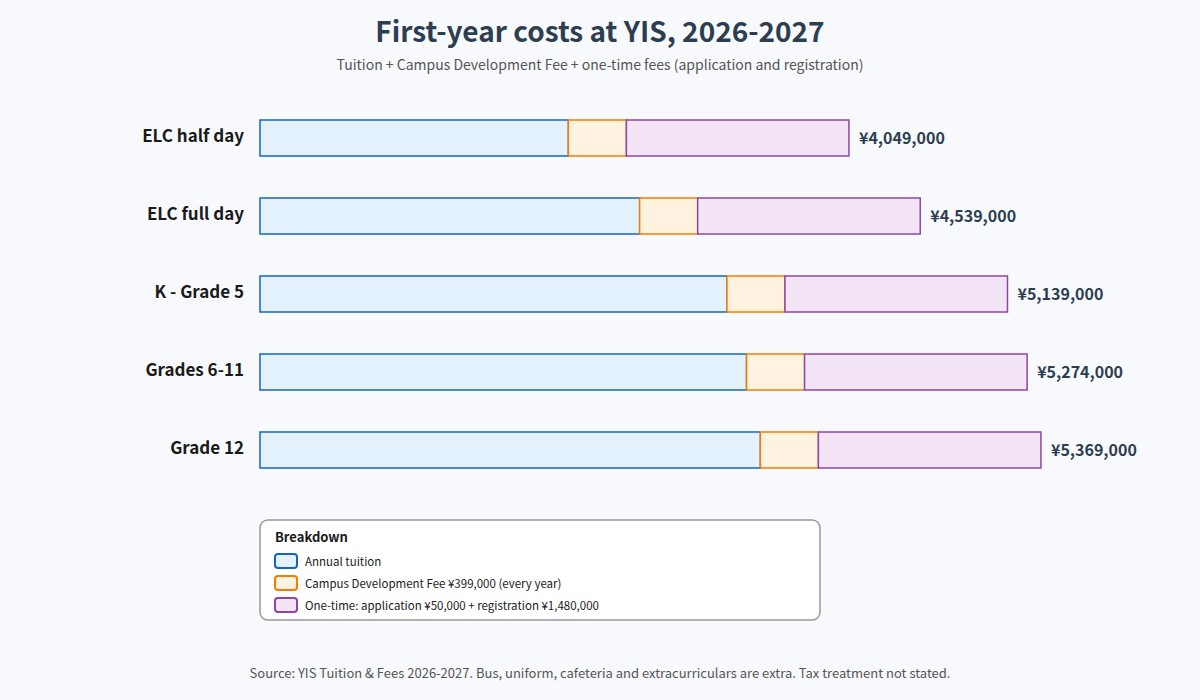
To put these together: for a new student joining Grades 6 to 11 in 2026-27, the first year adds up to ¥5,274,000 (¥50,000 application + ¥1,480,000 registration + ¥3,345,000 tuition + ¥399,000 Campus Development Fee). From the second year, the ongoing cost is tuition plus the Campus Development Fee, which is ¥3,744,000 for Grades 6 to 11 at 2026-27 rates. Figure 3 shows the first-year total for each grade band.
A few practical details from the same page:
- Tuition is billed in two equal instalments, due on 17 July and 7 December 2026.
- Tuition includes school technology, most expeditions and field trips, and exam fees for the IB Diploma, ISA and PSAT (retakes are not included).
- The school bus, uniform, cafeteria and extracurricular activities are extra. The admissions FAQ gives the bus from Tokyo as ¥395,000 a year including tax, without stating which school year that price applies to.
- Returning families pay a ¥300,000 re-enrolment deposit by 15 April to secure a place for the following year (the page does not say whether it is credited toward tuition). Payments overdue by 30 days incur a 2.5% monthly late charge.
- Students who join in the middle of the second semester have tuition prorated by quarters, but the Campus Development Fee is not prorated.
- The page does not say whether the amounts include consumption tax, and we found no mention of sibling discounts, so it is worth asking.
Many families at international schools have part or all of their fees covered by an employer. If that applies to you, check exactly which items your company pays, because the one-time registration fee and the annual Campus Development Fee are sometimes treated differently from tuition. The same page also mentions a Corporate Contribution Program: scholarships are available for students whose parents’ employers participate in it, and the school asks families to contact its Business Office for details.
Admissions: who can apply and how it works
Eligibility
YIS accepts students who are foreign nationals, and Japanese nationals who have been educated overseas or in international education. At least one parent living with the child must be fluent in spoken and written English, and the family must live within commuting distance with at least one parent. If both parents are Japanese nationals, the school asks for a letter from the parents explaining why they are choosing an international education.
English requirements
This is the question we hear most from parents, so here is exactly what the admissions FAQ says:
- Early Learning Center and Elementary: children are admitted regardless of English proficiency, provided there are no other additional learning needs.
- Middle School: students need sufficient competency in academic English.
- High School: a high degree of academic English proficiency is required.
- Grades 6 to 10: if the school has concerns about English, it may ask for an English assessment.
YIS does not run a separate ESL track. Instead, English as an Additional Language (EAL) specialists work alongside class teachers to give extra support.
Steps and timeline
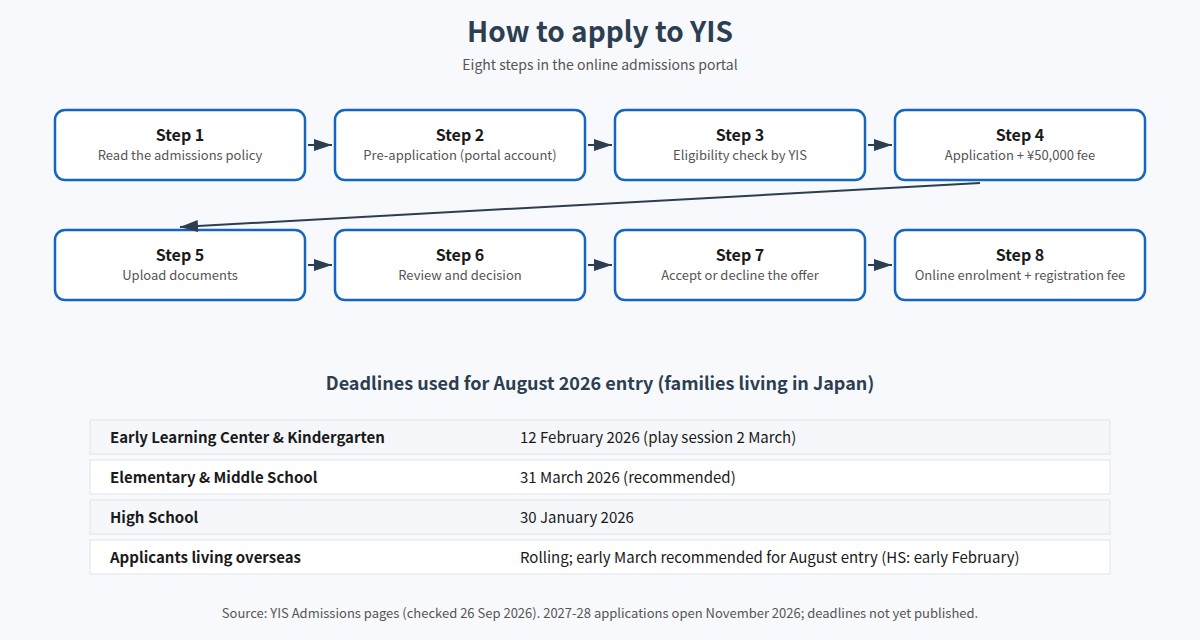
Applications run through an online portal in eight steps: read the admissions policy, complete a pre-application, wait for the school’s eligibility check, submit the application with the ¥50,000 fee, upload documents, receive the decision, accept or decline the offer, and finally complete online enrolment and pay the registration fee. Figure 4 summarises the steps.
For August 2026 entry, families living in Japan had these deadlines: 12 February 2026 for the Early Learning Center and Kindergarten (followed by a play session on 2 March), a recommended 31 March 2026 for Elementary and Middle School, and 30 January 2026 for High School. Applicants living overseas are considered on a rolling basis, with the school recommending early March (early February for High School) for August entry and early November for January entry. The school says applications for 2027-28 open in November 2026, and it has not yet published the 2027-28 deadlines, so please check the Admissions page when they appear.
Decisions can be an offer, a denial, a place in the wait pool, or a request for further screening. When there are more eligible applicants than places, the wait pool gives priority to siblings of current students, children of staff, alumni families, returning students and families in the school’s Corporate Contribution Program.
Documents and assessment
You will be asked for your child’s passport page, school reports from the last three years, an official transcript, confidential recommendations from an English teacher and one other teacher (plus a mathematics teacher for High School applicants), a medical form and any learning support plan such as an IEP. Younger children attend an informal play session with a parent interview. Grades 1 to 5 usually have no interview, although a trial day may be requested, and interviews are more common for Grades 11 and 12. Grade placement is based mainly on the child’s age on 1 September of the year of entry.
Learning support and student life
YIS uses an Inclusive Learning Framework that ranges from simple classroom accommodations to more intensive learning support for students with diagnosed learning differences. The school asks families to disclose any support needs at the application stage, so please be open about this; it helps the school plan the right support from day one. A counselling team supports students in the Elementary, Middle and High School.
The campus facilities listed on the school website include a 25-metre heated indoor pool, an artificial turf field (90 m by 46 m), a double gym with two full-size basketball courts, an outdoor basketball court and a dance studio. Sports run in three seasons, and clubs range from robotics and Model United Nations to a koto ensemble.
Two features stand out for families new to Japan. The Japanese Culture Program links Japanese arts and traditions to classroom learning from the early years to the Diploma, with activities such as printmaking, rice planting, calligraphy and a trip to Kamakura. And the expedition programme runs from Kindergarten to Grade 12: Kindergarten children have their first night away from home at school, and older grades travel further, from Okutama in Grade 3 to the Kumano Kodo or Okinawa in Grade 10. The school says the cost of most expeditions is included in tuition.
Getting to YIS
The campus is in Honmoku, and the school’s official directions all use a bus for the last part of the journey. From Motomachi-Chukagai Station (Minatomirai and Tokyu Toyoko lines) you take a bus from the Yamashita-cho stop to Kominato. From JR Negishi Station and from Sakuragicho or Ishikawacho stations there are also bus routes. The school also runs two school bus routes from Tokyo. Because the commute is by bus, it is a good idea to try the journey at school time before you choose where to live.
Questions parents often ask
My child speaks very little English. Can they still join?
For the Early Learning Center and Elementary School, yes: the admissions FAQ says younger children are admitted regardless of English proficiency, as long as there are no other additional learning needs. From Middle School upward, academic English becomes a requirement, so an older child with limited English may find it harder to be admitted.
We are a Japanese family. Can our child apply?
Japanese nationals can apply if the child has an overseas or international education background. If both parents are Japanese, you will also need to write a letter explaining why you are choosing an international education. At least one parent must be fluent in English.
Does my child have to take the full IB Diploma?
No. In Grades 11 and 12, students can graduate with the YIS High School Diploma, with or without individual IB courses, or combine it with the full IB Diploma. Ask the school how students and families decide between these pathways, especially if you have a particular university system in mind.
Are there scholarships?
Not academic ones: the School Profile states that YIS does not offer academic scholarships. However, the Tuition & Fees page says scholarships are available for students whose parents’ employers participate in the school’s Corporate Contribution Program, so it is worth asking your employer and the YIS Business Office. Families on corporate packages should also check which fees their employer covers.
Summary
- A long-established IB continuum school: opened in 1924, with the Diploma since 1986 and the PYP since 2001, and authorised for the PYP, MYP and DP (MEXT list, June 2026).
- Flexible high school pathways: the YIS High School Diploma, with IB courses or the full IB Diploma.
- Strong recent results: a 98% pass rate and an average of 36 points in 2026, against an international average of 30.8 stated in the School Profile.
- 2026-27 fees: tuition from ¥2,120,000 (ELC half day) to ¥3,440,000 (Grade 12), plus a ¥399,000 Campus Development Fee each year and ¥1,530,000 in one-time fees.
- English support for younger children: Early Learning Center and Elementary admit children regardless of English level, provided there are no other additional learning needs; older students need academic English.
If YIS sounds like a good fit, the next step is to book a campus visit (visits are by appointment) and check the 2027-28 admissions calendar when it opens in November 2026. Visiting on a school day, with your child if possible, is the best way to feel whether the atmosphere suits your family.
Sources and references
- Yokohama International School: official website (checked 26 September 2026)
- YIS: History & Legacy
- YIS: Tuition & Fees (2026-2027)
- YIS: Admissions
- YIS: Admissions FAQs
- YIS: Learning and High School
- YIS: Support Services
- YIS: 2026-27 School Profile (PDF)
- YIS news: Welcome to the 2026-27 school year (17 August 2026)
- YIS news: Honoring Our Past, Shaping Our Future (3 November 2025)
- MEXT IB Education Promotion Consortium: IB schools in Japan (as of 30 June 2026)
コメント