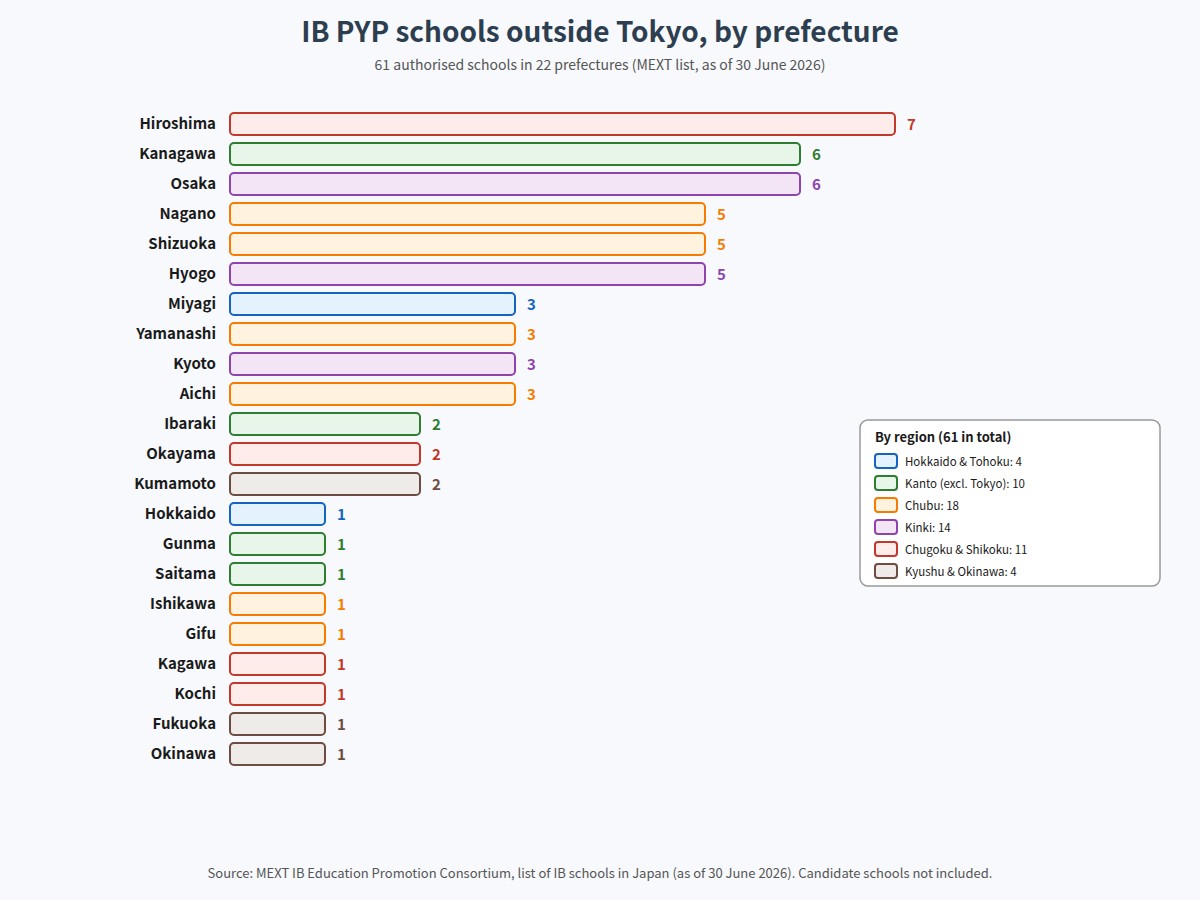
IB Primary Years Programme (PYP) schools outside Tokyo are easier to find than many parents expect. If you live in Sendai, Nagoya, Kobe, Hiroshima or Fukuoka, you may wonder whether an IB start for a young child is only realistic in the capital. It is not. According to the Japanese Ministry of Education (MEXT), 61 schools outside Tokyo are authorised to teach the PYP, spread across 22 prefectures.
This guide lists all of them by region, with the ages, main language and, where published, a tuition figure with its year from each school’s official website. The list follows the MEXT IB Education Promotion Consortium list as of 30 June 2026; school details were checked on 26 September 2026. Fees change every year, so please confirm with each school before you apply.
What is the PYP? A short guide for parents
The PYP is the International Baccalaureate’s programme for children aged 3 to 12. It is not a textbook but a framework for building a curriculum around inquiry, where children’s questions become the starting point for learning. According to the MEXT consortium’s PYP page, learning is organised around six transdisciplinary themes, such as “Who we are” and “Sharing the planet”, and children aged 3 to 5 explore at least four of them each year. The themes cover six subject areas, from language and mathematics to the arts and physical education.
The same MEXT material makes two useful points. First, the PYP can be offered in any language, so a PYP school in Japan may teach mainly in Japanese, mainly in English, or in both. Second, the MEXT list notes that a PYP school may cover only the early years (ages 3 to 5) or only the primary years (ages 6 to 12). So a “PYP school” can be a kindergarten, an elementary school or a full international school. If you would like a fuller introduction, our parent’s guide to the PYP explains the programme in more detail.
How many PYP schools are there outside Tokyo?
The MEXT list (as of 30 June 2026) counts 91 PYP-authorised schools in Japan, plus 36 candidate schools that are still working towards authorisation. This article covers authorised schools only. Of the 91, 61 are outside Tokyo. Hiroshima has the most with 7, followed by Kanagawa and Osaka with 6 each, and Nagano, Shizuoka and Hyogo with 5 each.
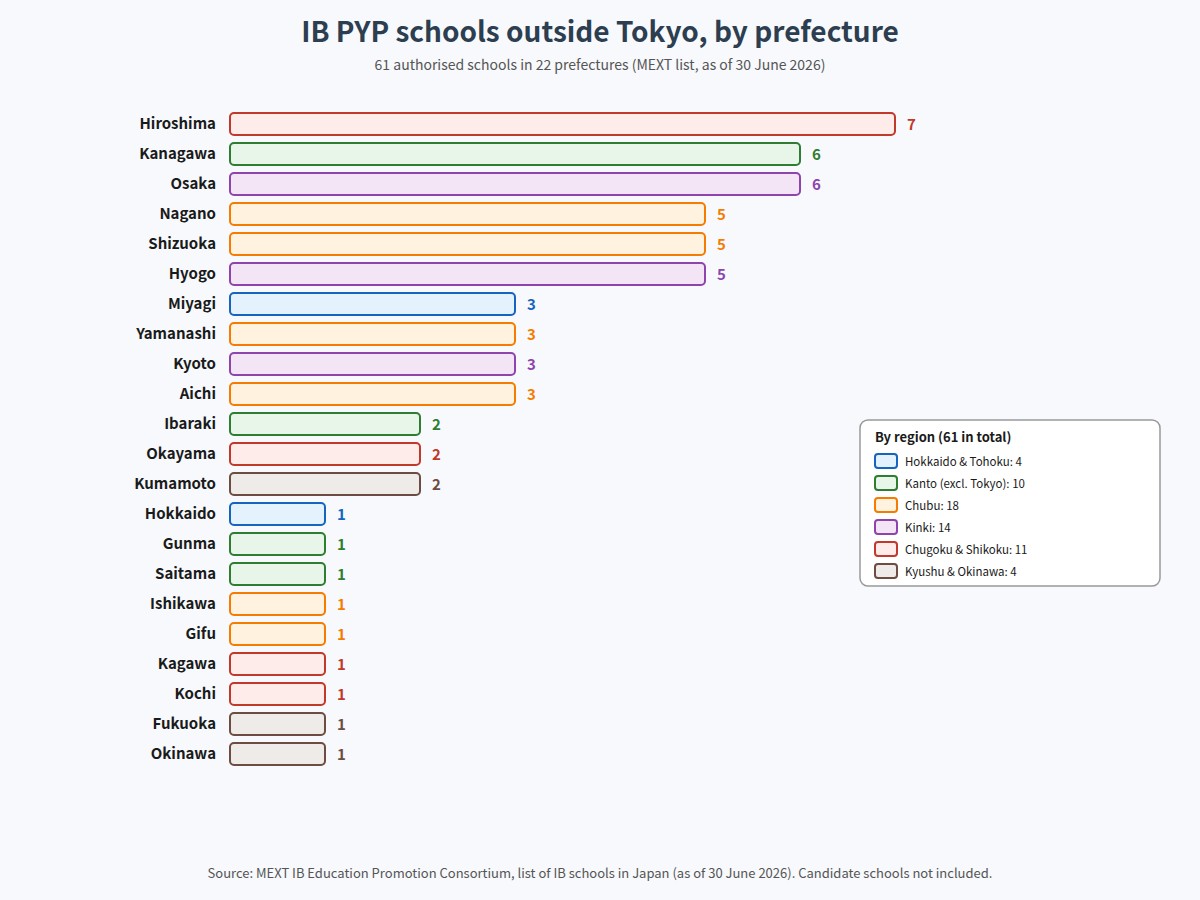
As Figure 1 shows, the schools cluster in a few areas. By region, Chubu has the most (18), then Kinki (14), Chugoku and Shikoku (11), Kanto outside Tokyo (10), and Hokkaido and Tohoku and Kyushu and Okinawa with 4 each. On the other hand, 24 prefectures outside Tokyo had no PYP-authorised school on that date, including Chiba, Nara, Niigata and Kagoshima.
MEXT splits its list into “Article 1 schools”, meaning schools recognised under Article 1 of Japan’s School Education Act (Japanese kindergartens and elementary schools), and all other schools, such as international schools, preschools and kodomo-en (certified childcare centres).
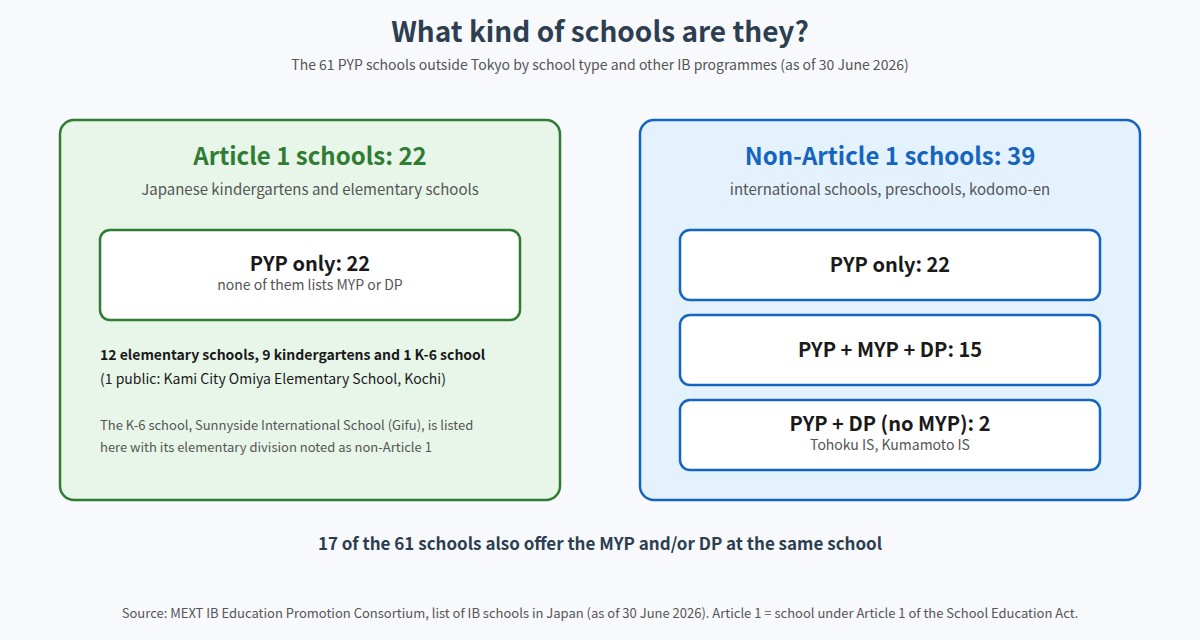
Figure 2 sums it up: 22 Article 1 schools and 39 non-Article 1 schools. None of the 22 Article 1 schools lists the Middle Years Programme (MYP) or Diploma Programme (DP). Among the non-Article 1 schools, 15 are authorised for the PYP, MYP and DP, and 2 (Tohoku International School and Kumamoto International School) for the PYP and DP. In other words, 17 of the 61 schools also offer an IB programme after the primary years: 15 continue straight into the MYP, and the other 2 offer the DP later without an MYP.
All 61 PYP schools outside Tokyo, region by region
The tables below follow the MEXT list (as of 30 June 2026). For Japanese schools we give a romanised name with the Japanese name, because not every school publishes an English name. “Other IB” shows programmes the school is authorised for besides the PYP. Tuition is the annual tuition for one representative grade for the year shown, or a monthly figure (marked “a month”) where the school publishes only that. It does not include enrolment fees, facility fees, buses or lunch. Where we could not find a current figure with its year on the official website, we write “see school”. For most kindergartens and kodomo-en, fees depend on Japan’s free early-childhood education scheme and your municipality, so we list a figure only where the school publishes a clear tuition amount.
Hokkaido and Tohoku (4 schools)
| School | City | Article 1? | Other IB | Ages / grades | Main language | Tuition (year) |
|---|---|---|---|---|---|---|
| Nintei Kodomo-en Ainosato (認定こども園あいの里) | Sapporo, Hokkaido | No | None | Kodomo-en (5 months to age 5) | Japanese, with English teachers | See school |
| Horizon Gakuen Sendai Elementary School (ホライゾン学園仙台小学校) | Sendai, Miyagi | Yes | None | Grades 1 to 6 | Japanese and English immersion | ¥960,000 (from April 2026) |
| Horizon Japan International School Sendai (kindergarten) | Sendai, Miyagi | No | None | Ages 3 to 5 | English | ¥890,000 (from April 2026) |
| Tohoku International School | Sendai, Miyagi | No | DP | Kindergarten (ages 4 to 5) to Grade 12 | English | ¥1,150,000, Grades 1 to 8 (2026-27) |
Sendai has three of the four schools. At Horizon’s Sendai campus the two MEXT categories sit side by side: the elementary school is an Article 1 school with Japanese-English immersion, while the kindergarten is listed as non-Article 1. Tohoku International School runs from kindergarten to Grade 12 and adds the DP, but not the MYP.
Kanto, outside Tokyo (10 schools)
| School | City | Article 1? | Other IB | Ages / grades | Main language | Tuition (year) |
|---|---|---|---|---|---|---|
| Kaichi Nozomi Elementary School (開智望小学校) | Moriya, Ibaraki | Yes | None | Grades 1 to 6 | Japanese, plus English | See school |
| Tsukuba International School | Tsukuba, Ibaraki | No | MYP, DP | Pre-Kindergarten (age 3) to Grade 12 | English | ¥1,560,000, all grades (2026-27) |
| Otone Ikuei Kodomo-en (大利根育英こども園) | Maebashi, Gunma | No | None | Kodomo-en (ages 0 to 5) | See school | See school |
| Karugamo English School | Saitama, Saitama | No | None | Preschool (kindergarten ages) | English | See school |
| St. Joseph Gakuen Elementary School (聖ヨゼフ学園小学校) | Yokohama, Kanagawa | Yes | None | Grades 1 to 6 | Japanese, plus English | See school |
| Beyondia International School Yamata Kindergarten (ビヨンディア・インターナショナルスクールやまた幼稚園) | Yokohama, Kanagawa | Yes | None | Kindergarten (from age 3) | See school | See school |
| CGK International School (preschool) | Yokohama, Kanagawa | No | None | Ages 2 to 5 | English and Japanese | See school (2027 figures published) |
| Horizon Japan International School | Yokohama, Kanagawa | No | MYP, DP | Preschool (from age 3) to Grade 12 | English | ¥2,790,000, Grades 1 to 5 (2026-27) |
| Yokohama International School | Yokohama, Kanagawa | No | MYP, DP | Early Learning Center (ages 3 to 5) to Grade 12 | English | ¥3,210,000, Kindergarten to Grade 5 (2026-27) |
| Kids Tairiku Frontown Ikuta (キッズ大陸フロンタウン生田園) | Kawasaki, Kanagawa | No | None | Nursery (ages 3 to 5) | See school | See school |
Yokohama is the centre of gravity in Kanto, with five of the ten schools, and it is also where the highest tuition listed on this page is found. Our Yokohama International School guide covers its fees, admissions and Diploma results in detail. In Ibaraki, Tsukuba International School charges the same tuition for every grade in 2026-27. CGK International School has already published 2027 fees (¥2,112,000 a year for ages 3 to 5, which it says also apply to children joining during 2026), so ask the school which figures apply to your start date.
Chubu (18 schools)
| School | City | Article 1? | Other IB | Ages / grades | Main language | Tuition (year) |
|---|---|---|---|---|---|---|
| Kanazawa Izumigaoka Kodomo-en (金沢泉丘こども園) | Kanazawa, Ishikawa | No | None | Kodomo-en (ages 0 to 5) | Japanese, with English activities | See school |
| Yamanashi Gakuin Kindergarten (山梨学院幼稚園) | Kofu, Yamanashi | Yes | None | Kindergarten (from age 2 class) | Japanese | See school |
| Yamanashi Gakuin Elementary School (山梨学院小学校) | Kofu, Yamanashi | Yes | None | Grades 1 to 6 | Japanese, plus English | See school |
| Torisawa Nintei Kodomo-en (学校法人鳥沢幼稚園 とりさわ認定こども園) | Otsuki, Yamanashi | No | None | Kodomo-en (ages 0 to 6) | See school | See school |
| Green Hills Elementary School (グリーン・ヒルズ小学校) | Nagano, Nagano | Yes | None | Grades 1 to 6 | Japanese | See school |
| Nagano Nihon University Kindergarten (長野日本大学幼稚園) | Nagano, Nagano | Yes | None | Kindergarten (from age 2 class) | Japanese | See school |
| Nagano Nihon University Elementary School (長野日本大学小学校) | Nagano, Nagano | Yes | None | Grades 1 to 6 | Japanese, plus English | See school |
| Wakakusa Kindergarten (若草幼稚園) | Nagano, Nagano | Yes | None | Kindergarten (from age 1 class) | See school | See school |
| International School of Nagano | Nagano, Nakano and Matsumoto, Nagano | No | None | Varies by campus; Nagano campus preschool ages 2 to 5 | English | ¥88,000 a month, ages 3 and up, Nagano campus preschool (2026-27) |
| Sunnyside International School (サニーサイドインターナショナルスクール) | Gifu, Gifu | Listed as Article 1; its elementary division is not | None | Kindergarten (ages 3 to 5) and Grades 1 to 6 | Japanese first, with English increasing step by step | See school |
| Angel Kindergarten (エンゼル幼稚園) | Nagaizumi, Shizuoka | Yes | None | Kindergarten (ages 3 to 5) | Japanese | See school |
| Shizuoka Salesio Kindergarten (静岡サレジオ幼稚園) | Shizuoka, Shizuoka | Yes | None | Kindergarten (ages 3 to 5) | Japanese | See school |
| Shizuoka Salesio Elementary School (静岡サレジオ小学校) | Shizuoka, Shizuoka | Yes | None | Grades 1 to 6 | Japanese, plus English | See school |
| Seirei Christopher Global School, Primary Division (聖隷クリストファーグローバルスクール 初等部) | Hamamatsu, Shizuoka | Yes | None | Grades 1 to 6 | Japanese and English immersion | ¥660,000 (published with 2027 admissions) |
| Seirei Christopher University Christopher Kodomo-en (聖隷クリストファー大学附属クリストファーこども園) | Hamamatsu, Shizuoka | No | None | Kodomo-en (ages 0 to 5) | See school | See school |
| Enishi International School | Nagoya, Aichi | No | MYP, DP | Early Learning Center (from age 1) to Grade 12 | English | ¥2,050,000, Grades 1 to 5 (2026-27) |
| Nagoya International School | Nagoya, Aichi | No | MYP, DP | Early Learning Center to Grade 12 | English | ¥2,700,000, Grades 1 to 5 (2026-27) |
| UPBEAT International School | Nagoya, Aichi | No | None | Preschool (from 57 days old) and elementary (ages 6 to 12) | English immersion | See school |
Chubu has the most PYP schools of any region, many of them Japanese kindergartens and elementary schools. Nagano alone has five, including Nagano Nihon University’s kindergarten and elementary school and the multi-campus International School of Nagano. Shizuoka stands out for Seirei Christopher Global School, a Japanese Article 1 elementary school that uses a Japanese-English immersion model. Families in Nagoya have the widest English-language choice, with Enishi and Nagoya International School both running from the early years to the DP.
Kinki (14 schools)
| School | City | Article 1? | Other IB | Ages / grades | Main language | Tuition (year) |
|---|---|---|---|---|---|---|
| Doshisha International Academy Elementary School (同志社国際学院初等部) | Kizugawa, Kyoto | Yes | None | Grades 1 to 6 | Japanese-English bilingual | ¥1,000,000, Grades 1 and 2 (2026) |
| AICJ International School Kyoto | Kyoto, Kyoto | No | None | Elementary (from Grade 1) | See school | See school |
| Kyoto International School | Kyoto, Kyoto | No | MYP, DP | Preschool (ages 3 to 4) to Grade 12 | English | ¥1,366,800, Preschool to Grade 5 (2026-27) |
| Sugahara Tenma Kindergarten (菅原天満幼稚園) | Osaka, Osaka | Yes | None | Kindergarten | See school | See school |
| Abroad International School Osaka | Osaka, Osaka | No | MYP, DP | Early Learning Center to Grade 12 | English | ¥1,800,000, primary (2026-27) |
| AICJ International School Osaka | Suita, Osaka | No | None | Elementary (from Grade 1) | See school | See school |
| Aiwin International School (Toyonaka) | Toyonaka, Osaka | No | None | Ages 0 to 5 | English | See school |
| Osaka International School of Kwansei Gakuin | Minoh, Osaka | No | MYP, DP | Kindergarten (age 4) to Grade 12 | English | ¥2,270,000, Kindergarten to Grade 5 (2026-27) |
| Osaka YMCA International School | Osaka, Osaka | No | MYP, DP | Preschool to Grade 12 | English | ¥1,830,000, Grades 1 to 6 (2026-27) |
| Awaji Island International School | Awaji Island, Hyogo | No | None | See school | Mainly English | See school |
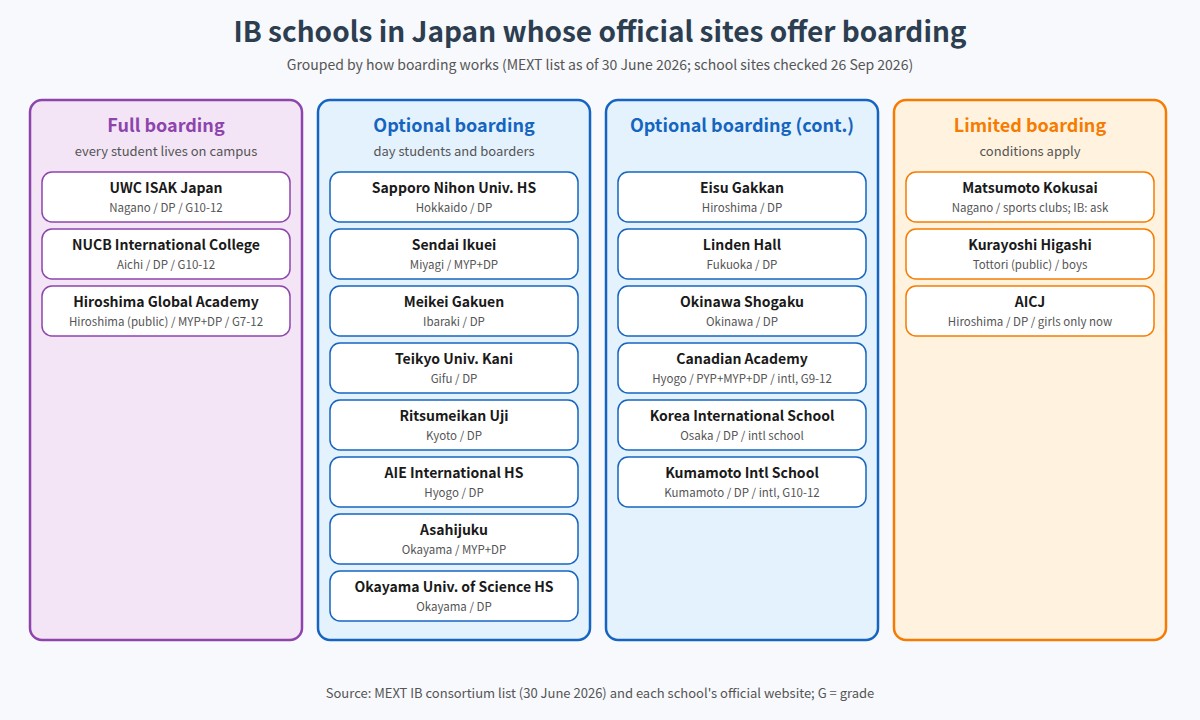
| Canadian Academy | Kobe, Hyogo | No | MYP, DP | Pre-Kindergarten to Grade 12 (day and boarding) | English | ¥2,710,000, Grades 1 to 5 (2026-27) |
| Deutsche Schule Kobe International | Kobe, Hyogo | No | None | Primary and secondary | English, with German and Japanese | See school |
| Kansai International Academy (関西国際学園) | Kobe, Hyogo | No | MYP, DP (marked by MEXT as a Japanese-language DP school) | From age 0 to secondary | Japanese-English bilingual | See school |
| Marist Brothers International School | Kobe, Hyogo | No | MYP, DP | Early Years (from age 3) to Grade 12 | English | ¥1,971,000, Grades 1 to 5 (2026-27) |
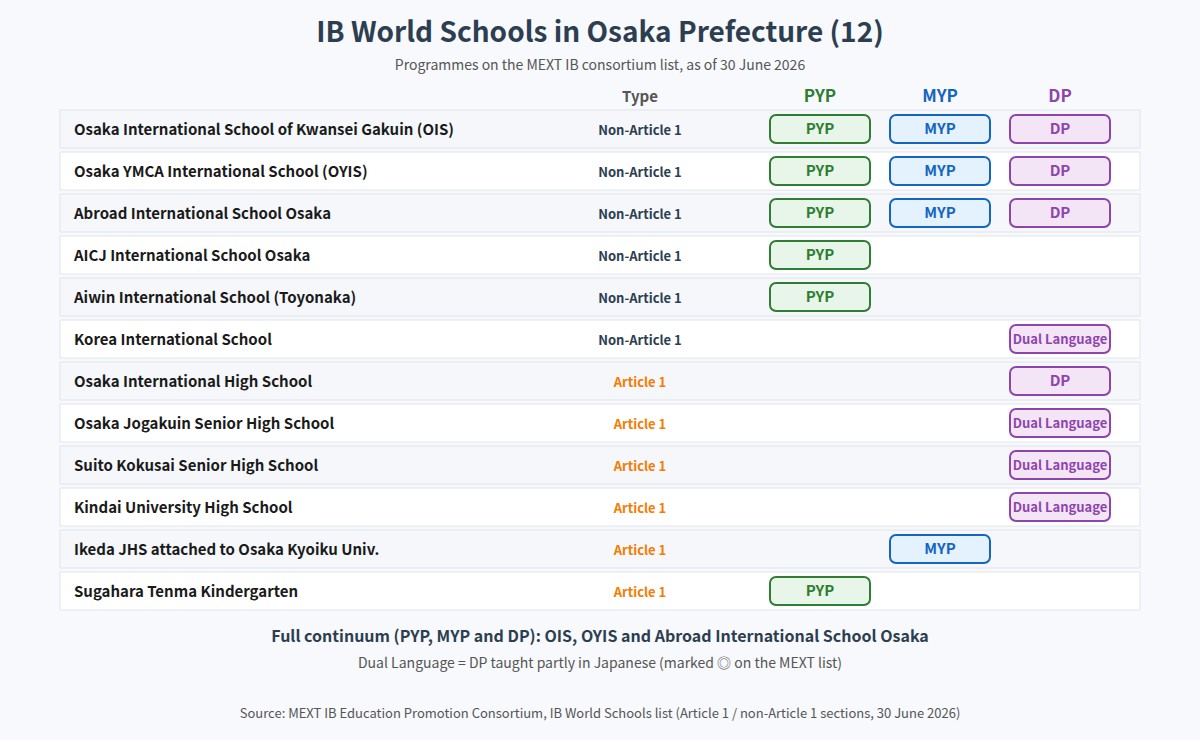
Kinki offers the widest mix of school types. Kobe alone has four PYP schools, including Canadian Academy, which takes boarders as well as day students, and Deutsche Schule Kobe International, which teaches in English and also teaches German and Japanese. In Osaka, three international schools run from the early years to the DP, with 2026-27 primary tuition between ¥1,800,000 and ¥2,270,000. AICJ runs PYP elementary schools in Kyoto, Suita (Osaka) and Hiroshima. For Japanese families, Doshisha International Academy Elementary School in Kizugawa is an Article 1 school that teaches bilingually; its 2026 transfer admissions guidelines list tuition of ¥1,000,000 for Grades 1 and 2 and ¥850,000 from Grade 3, plus an education enrichment fee of ¥150,000. For a wider look at the region, including Japanese high schools with the DP, see our guide to IB schools in Kansai.
Note that Kansai International Academy’s website now also uses the name “Sakura International School”.
Chugoku and Shikoku (11 schools)
| School | City | Article 1? | Other IB | Ages / grades | Main language | Tuition (year) |
|---|---|---|---|---|---|---|
| Asahijuku Elementary School (朝日塾小学校) | Okayama, Okayama | Yes | None | Grades 1 to 6 | Japanese, with English immersion subjects | ¥32,000 a month (2026) |
| Abroad International School Okayama | Okayama, Okayama | No | None | Ages 1 to 5 | English immersion | See school |
| Eisu Gakkan Elementary School (英数学館小学校) | Fukuyama, Hiroshima | Yes | None | Grades 1 to 6 | Immersion class | See school |
| Nintei Kodomo-en Nozomi Kindergarten (認定こども園のぞみ幼稚園) | Hiroshima, Hiroshima | Yes | None | Kindergarten | Japanese, with English activities | See school |
| AICJ International School Hiroshima | Hiroshima, Hiroshima | No | None | Elementary (from Grade 1) | See school | See school |
| Hiroshima International School | Hiroshima, Hiroshima | No | MYP, DP | EC3 (from age 3) to Grade 12 | English | ¥1,719,000, Grades 1 to 8 (2026-27) |
| Moonlight International Preschool | Hatsukaichi, Hiroshima | No | None | Ages 0 to 5 | English and Japanese | See school |
| Fullmoon International Kodomo-en Otake (フルムーンインターナショナルこども園おおたけ) | Otake, Hiroshima | No | None | Kodomo-en (ages 0 to 5) | English immersion | See school |
| Fullmoon International Kodomo-en Ono (フルムーンインターナショナルこども園おおの) | Hatsukaichi, Hiroshima | No | None | Kodomo-en (ages 0 to 5) | English immersion | See school |
| Rakuraku Terai Kindergarten (らく楽寺井幼稚園) | Kagawa Prefecture | Yes | None | Kindergarten | See school | See school |
| Kami City Omiya Elementary School (香美市立大宮小学校) | Kami, Kochi | Yes (public) | None | Grades 1 to 6 | Japanese | No tuition (public school) |
Hiroshima has more PYP schools than any other prefecture outside Tokyo (7). Most are for young children: Moonlight International Preschool and the two Fullmoon kodomo-en in Hatsukaichi and Otake, which describe English immersion or bilingual care, and Nozomi Kindergarten. The rest are Eisu Gakkan Elementary School in Fukuyama, an Article 1 school with an immersion class, AICJ’s elementary school, and Hiroshima International School, the one option in the region that continues to the MYP and DP. In Okayama, Asahijuku Elementary School is a Japanese Article 1 school that publishes a 2026 monthly tuition of ¥32,000 (other monthly charges bring the school’s stated monthly total to ¥63,300). And in Kochi, Kami City Omiya Elementary School is the only public school on this whole page.
Kyushu and Okinawa (4 schools)
| School | City | Article 1? | Other IB | Ages / grades | Main language | Tuition (year) |
|---|---|---|---|---|---|---|
| Fukuoka International School | Fukuoka, Fukuoka | No | MYP, DP | Early Years (ages 3 and 4) to Grade 12 | English | ¥1,891,000, Kindergarten to Grade 5 (2026-27) |
| Kumamoto International School | Kumamoto, Kumamoto | No | DP | Preschool (ages 2 to 5) to Grade 12 | English | See school (2027 figures published) |
| Daiichi Kindergarten (第一幼稚園) | Kumamoto Prefecture | No | None | Kindergarten | See school | See school |
| Okinawa International School | Naha and Nanjo, Okinawa | No | MYP, DP | Preschool (age 2) to Grade 12 | English | ¥1,197,900, elementary, tax included (2026 school year) |
Three of the four schools here run to Grade 12. Fukuoka International School and Okinawa International School offer the full PYP, MYP and DP sequence, and Kumamoto International School adds the DP after the PYP. Kumamoto International School’s admissions page shows fees from April 2027, with tuition of ¥83,000 a month.
What do PYP schools outside Tokyo cost?
Tuition ranges from nothing at all to more than ¥3 million a year, depending on the type of school. Figure 3 compares the annual tuition for the first grade of elementary school (or the nearest published band) at the schools whose published fees, with their year, we could confirm.
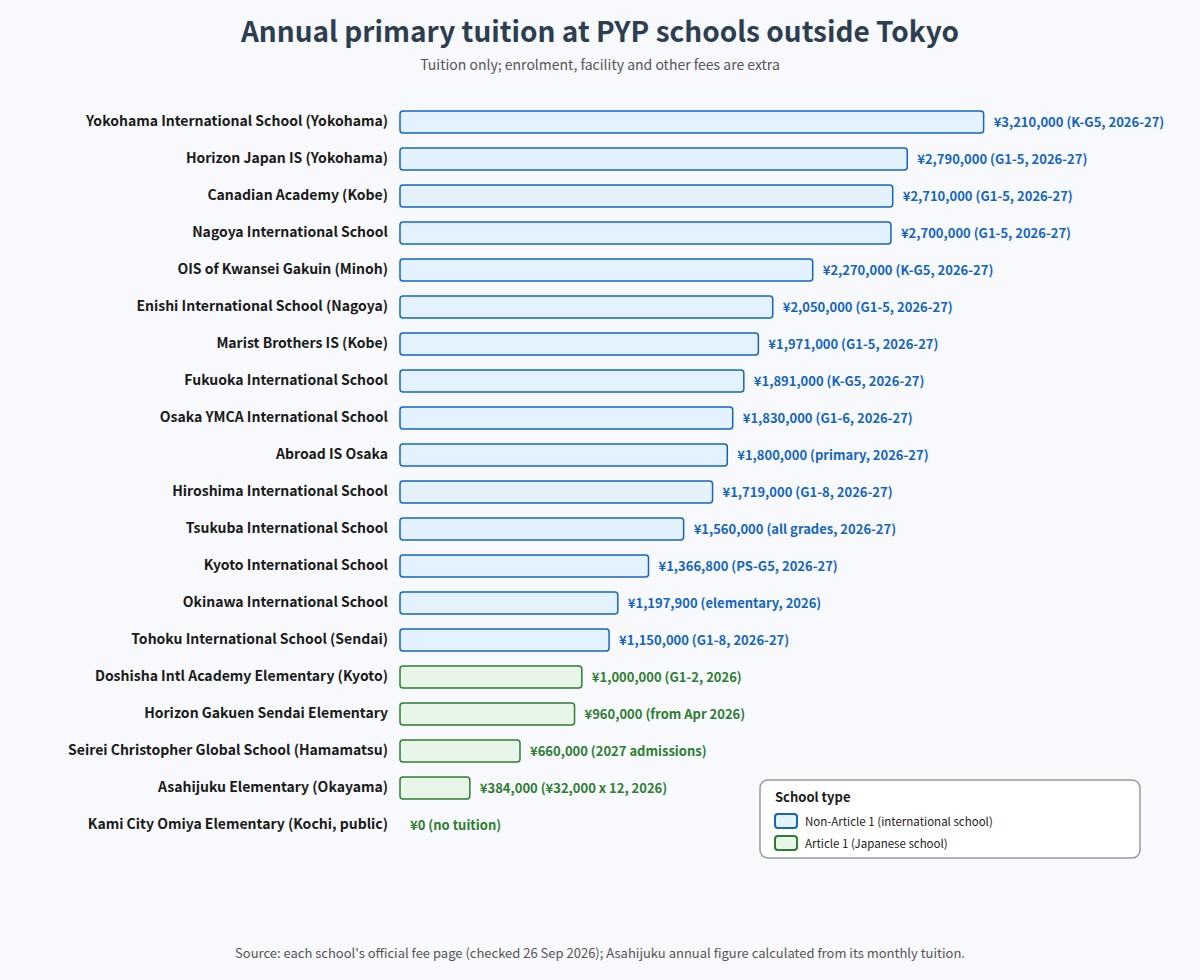
As Figure 3 shows, the Japanese Article 1 elementary schools that publish fees charge ¥1 million a year or less in tuition, and the public school charges none. The English-medium international schools are mostly between about ¥1.15 million and ¥2.8 million a year for primary grades in 2026-27, with Yokohama International School at ¥3,210,000. Three things to keep in mind:
- Tuition is only part of the bill. Most schools add enrolment fees in the first year and facility fees every year. At some international schools the one-time fees alone are over ¥1 million (for example, Yokohama International School’s ¥1,480,000 registration fee in 2026-27).
- The years differ slightly. Japanese schools run from April, most international schools from August, and Seirei Christopher Global School’s figure is the one published with its 2027 admissions information. Asahijuku’s annual figure is our own calculation (¥32,000 a month for 12 months, which the school says is how it spreads its annual fees).
- Kindergartens and kodomo-en are not in the chart. For ages 3 to 5, Japan’s free early-childhood education scheme can cover some or all of the basic fee at eligible settings, so costs depend on the setting and your municipality.
How to choose: Article 1 school or international school?
For most families, the bigger decision is which type of school, as Figure 4 shows.
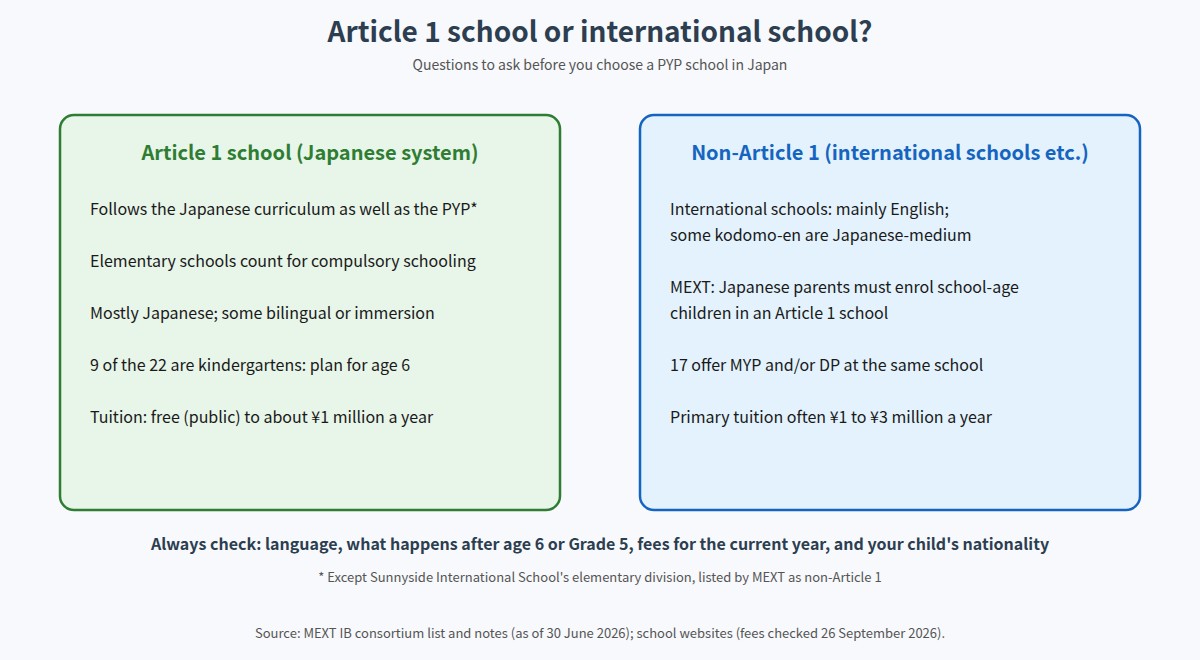
Article 1 schools are part of the Japanese school system. MEXT explains that an Article 1 school that becomes an IB school must meet both Japanese law, including the national curriculum guidelines, and the IB’s requirements, so these schools teach the Japanese curriculum and the PYP together. Most teach mainly in Japanese, though a few use Japanese-English immersion. Nine of the 22 Article 1 schools on this page are kindergartens, so if your child starts at one of them, you will need a plan for age 6.
Non-Article 1 schools include international schools, preschools and kodomo-en. MEXT describes them as schools that are not Article 1 schools and therefore do not meet the standards required of Article 1 schools. That is a legal category, not a quality rating. The practical point is compulsory schooling. The MEXT consortium page states: “Japanese parents are obliged to have their children of compulsory school age attend an Article 1 school” (our translation). If your child has Japanese nationality and will attend a non-Article 1 school from age 6, talk to your local board of education and to the school first.
Worth asking on a visit:
- Language: what share of the day is in English and in Japanese, and how does the school support children who are new to either language?
- What comes next: if it is a kindergarten or preschool, where do children usually go at age 6? If it stops at Grade 5 or 6, is there an MYP or DP school nearby?
- Fees for your start year: ask for the fee schedule for the year your child would join, including one-time fees and whether the national free early-childhood education scheme applies.
Questions parents often ask
Can my child do the PYP at a public school outside Tokyo?
Yes, but only at one school on the current list. According to the MEXT list (as of 30 June 2026), Kami City Omiya Elementary School in Kochi is the only public PYP-authorised school outside Tokyo. It is a municipal elementary school that teaches within the Japanese national system, so there is no tuition. If you are interested, contact Kami City’s board of education about admission.
If my child does the PYP at kindergarten, must they go to a PYP elementary school?
Not at all. Many children move on to an ordinary Japanese elementary school, and the habit of asking questions travels well. Visiting the new school early helps the change in teaching style feel less sudden.
There is no PYP school near us. What can we do?
You are not alone: 24 prefectures outside Tokyo had no PYP-authorised school on 30 June 2026. Some families look at a neighbouring prefecture; others aim for an MYP or DP school later, as many more Japanese junior high and high schools offer those. Candidate schools on the MEXT list are worth watching too, but they are not yet authorised.
Summary
- 61 PYP schools outside Tokyo: in 22 prefectures, according to the MEXT list as of 30 June 2026 (candidate schools not included).
- Two kinds of school: 22 Japanese Article 1 schools (12 elementary schools, 9 kindergartens and one kindergarten-plus-elementary school) and 39 international schools, preschools and kodomo-en.
- Continuing in the IB: 17 schools, all non-Article 1, also offer the MYP and/or DP.
- Where they are: Hiroshima (7), Kanagawa and Osaka (6 each) lead; 24 prefectures outside Tokyo have none.
- Costs vary widely: from no tuition at a public elementary school to over ¥3 million a year at the most expensive international school we checked (2026-27).
- Nationality matters: MEXT states that Japanese parents must have compulsory-age children attend an Article 1 school.
There really are PYP options beyond Tokyo. When a school catches your eye, visit with your child and see whether they light up in the classroom; that tells you more than any list.
Sources and references
- MEXT IB Education Promotion Consortium: IB schools and candidate schools in Japan (as of 30 June 2026) (checked 26 September 2026)
- MEXT IB Education Promotion Consortium: the PYP
- Horizon Gakuen Sendai: school fees (from April 2026)
- Doshisha International Academy Elementary School: transfer admissions guidelines (2026)
- Seirei Christopher Global School, Primary Division: admissions
- Asahijuku Elementary School: admissions and fees (2026)
- International School of Nagano: Nagano preschool fees (2026-2027)
- CGK International School: preschool admissions
- Osaka YMCA IS: 2026-2027 fees (PDF)
- Abroad IS Osaka: 2026-27 fees
- Canadian Academy: tuition and fees (2026-27)
- Yokohama International School: tuition and fees (2026-2027)
- Tsukuba International School: 2026-27 school fees
- Tohoku International School: tuition and fees
- Nagoya International School: tuition (2026-27)
- Enishi IS: Tuition & Fees 2026-2027
- Fukuoka IS
- Hiroshima IS: Financial Regulations 2026-2027
- Marist Brothers IS: Fee Schedule 2026-2027 (PDF)
- Kyoto IS: Tuition and Fees 2026-27 (PDF)
- OIS of Kwansei Gakuin: fees
- Horizon Japan IS
- Okinawa IS: elementary
- Moonlight International Preschool (つきのひかり国際保育園): about
- Kumamoto IS
- ibeducation.blog: IB World Schools in Japan 2026
コメント