Shinagawa International School (SIS) is a secular, co-educational international school in Shinagawa, Tokyo, teaching children from Preschool (age 3) through Grade 12. Its roots go back to 2007 in Shibuya, and it moved to Shinagawa Seaside in June 2018. According to the school’s FAQ page, it had more than 450 students from Preschool to Grade 12 in September 2025, with students from more than 40 countries. If you want the IB from the early years right through to the Diploma, SIS is likely to be on your list.
This guide brings together what the school publishes about its IB programmes, its three campuses, fees for the 2026-2027 school year and admissions, so you can quickly see whether it could suit your family. It is based on the SIS website and Admissions Policy and Handbook (ratified June 2026), the Japanese Ministry of Education (MEXT) IB consortium list, the Tokyo Metropolitan Government’s schools portal and CIS, all checked on 26 September 2026. Fees and procedures change every year, so please confirm the details with the school before you apply.
Shinagawa International School at a glance
| Item | Details |
|---|---|
| School name | Shinagawa International School (SIS) |
| Founded | 2007 in Shibuya; moved to Shinagawa Seaside in June 2018 |
| Type | Secular, co-educational international school; listed by MEXT as a non-Article-1 school |
| Grades | Preschool (age 3), Pre-K and Kindergarten, then Grades 1 to 12 |
| Students | More than 450, Preschool to Grade 12 (September 2025, school FAQ); students from more than 40 countries |
| IB programmes | PYP, MYP and DP; no CP (MEXT list, as of 30 June 2026) |
| Accreditation | CIS (accredited 4 December 2025) and WASC |
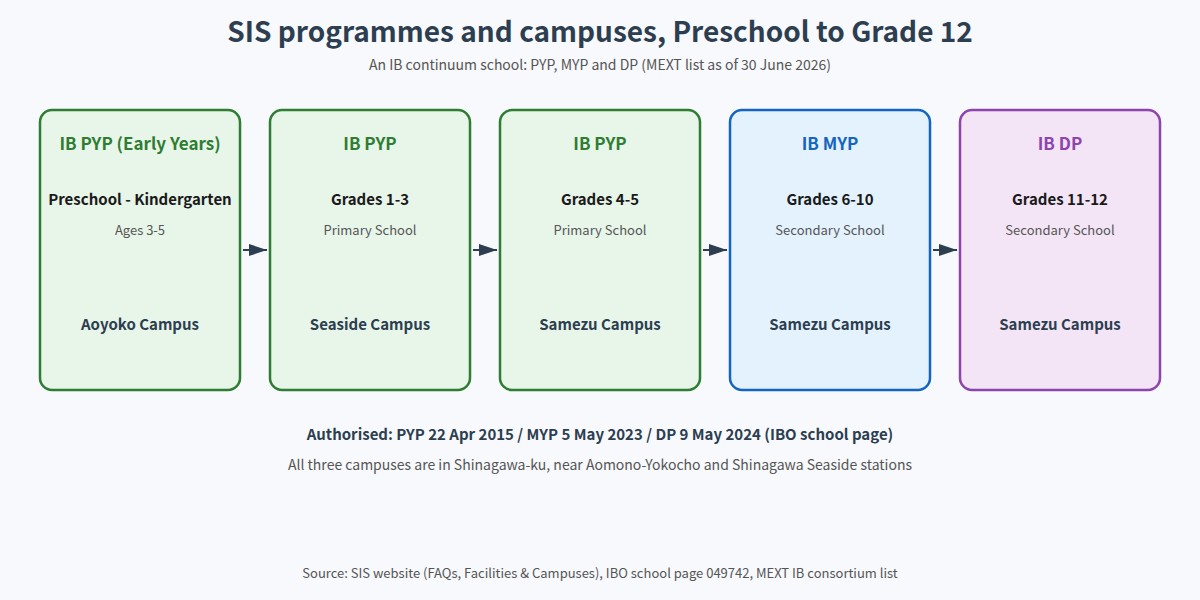
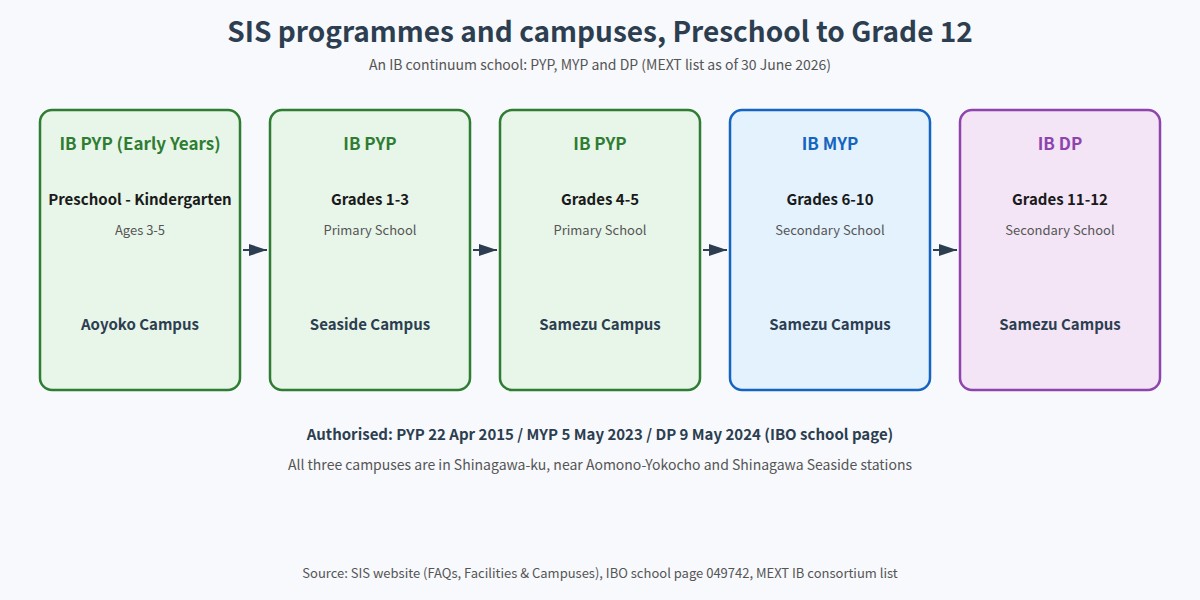
| Campuses | Aoyoko (Preschool to Kindergarten), Seaside (Grades 1 to 3), Samezu (Grades 4 to 12), all in Shinagawa-ku |
| Class size | 22 per class from Preschool to Grade 2, 24 from Grade 3 upwards (school FAQ) |
| School year | August to June |
SIS also publishes a 1:6 ratio (labelled “student-to-teacher ratio” on its About Us page and “teacher-student ratio” in its FAQ), so the direction is not stated consistently. The Tokyo portal’s figure of 584 students is the school’s capacity, not its current enrolment.
IB programmes: a full IB continuum
This is what makes SIS stand out on a shortlist. The school describes itself as an “IB Continuum School”, meaning it is authorised for all three of the main IB programmes, so a child can follow the IB from age 3 to graduation. The IB school page for SIS gives these authorisation dates:
- Primary Years Programme (PYP): authorised 22 April 2015. At SIS it runs from Preschool to Grade 5, including the PYP Early Years at the Aoyoko Campus.
- Middle Years Programme (MYP): authorised 5 May 2023, for Grades 6 to 10.
- Diploma Programme (DP): authorised 9 May 2024, for Grades 11 and 12. The school says it has offered the DP at Samezu since 2024-25.
The MEXT IB consortium list (as of 30 June 2026) also shows SIS with PYP, MYP and DP, and no Career-related Programme (CP).
PYP (Preschool to Grade 5)
In the PYP, children learn through “units of inquiry” organised around six transdisciplinary themes, such as “Who We Are” and “Sharing the Planet”. In plain terms, instead of learning each subject in a separate box, children explore a big question that pulls several subjects together. For the youngest children at Aoyoko, the school describes a play-based approach, introduced at that campus in 2025.
MYP (Grades 6 to 10)
The MYP at SIS covers the eight IB subject groups, including English and Japanese, design, and visual arts and music. In their final MYP year, students complete the Personal Project, an independent project on a topic of their choice, which the school’s admissions handbook describes as externally assessed by the IB.
DP (Grades 11 and 12)
For the 2026-27 school year, the SIS Diploma Programme page lists these courses:
- Group 1: English A: Language and Literature and Japanese A: Language and Literature (HL/SL)
- Group 2: Japanese B (HL/SL) and Japanese ab initio (SL)
- Group 3: Business Management and Environmental Systems and Societies (HL/SL)
- Group 4: Chemistry, Biology, Physics and Computer Science (HL/SL), plus Environmental Systems and Societies
- Group 5: Mathematics: Applications and Interpretation (SL) and Analysis and Approaches (HL)
No Group 6 (arts) course appears in this list, and the school adds that students can access “additional language and literature courses” through the Pamoja online platform. Check early that your child’s subject combination is available. College counselling starts as early as Grade 9, and the final IB exams are held in May of Grade 12.
Three pathways in Grades 11 and 12
One helpful detail for parents: the Admissions Policy and Handbook describes three post-16 pathways: the full IB Diploma, an “IB DP Courses Pathway” (a selected combination of DP courses), and an “SIS Certificate” (a modified two-year programme). All students who complete Grade 12 and meet the requirements of their pathway receive the Shinagawa International School High School Diploma. The handbook also sets out MYP grade criteria for internal students who want the full Diploma.
As of our check, the school had not published IB Diploma results (such as an average score) on its website, so please ask the admissions team if results matter to you.
Tuition and fees for 2026-2027
Let’s be honest about the costs, because they are a big part of the decision. These are the figures on the SIS Tuition and Fees page and in the Admissions Policy and Handbook for the 2026-2027 school year (August 2026 to June 2027); the Learning Support and PTA fees appear only on the fees page, not in the handbook’s fee table. The school says fees are reviewed each year by the school board, with any changes announced by the end of May.
| Fee (2026-2027) | Amount (JPY) |
|---|---|
| Application fee (one-time, non-refundable) | ¥40,000 |
| Enrollment fee (one-time, non-refundable, due within one week of admission being confirmed) | ¥1,000,000 |
| Maintenance fee (annual) | ¥250,000 |
| Supply fee (annual) | ¥50,000 |
| Tuition: Preschool to Kindergarten | ¥2,575,000 (¥925,000 + ¥825,000 + ¥825,000) |
| Tuition: Grades 1 to 5 | ¥2,675,000 (¥1,025,000 + ¥825,000 + ¥825,000) |
| Tuition: Grades 6 to 10 (Week Without Walls fee included) | ¥2,775,000 (¥1,025,000 + ¥875,000 + ¥875,000) |
| Tuition: Grades 11 to 12 | ¥2,900,000 (¥1,100,000 + ¥900,000 + ¥900,000) |
| EAL fee (if required) | ¥500,000 a year (¥200,000 + ¥150,000 + ¥150,000) |
| Learning Support fee (if required) | ¥500,000 a year, in three instalments |
| PTA annual fee | ¥6,000 |
Tuition is paid in three terms. The handbook gives due dates of 20 July, 20 November and 20 February, and the enrollment fee and first term’s tuition are paid when you enrol (the application fee is paid when you apply).
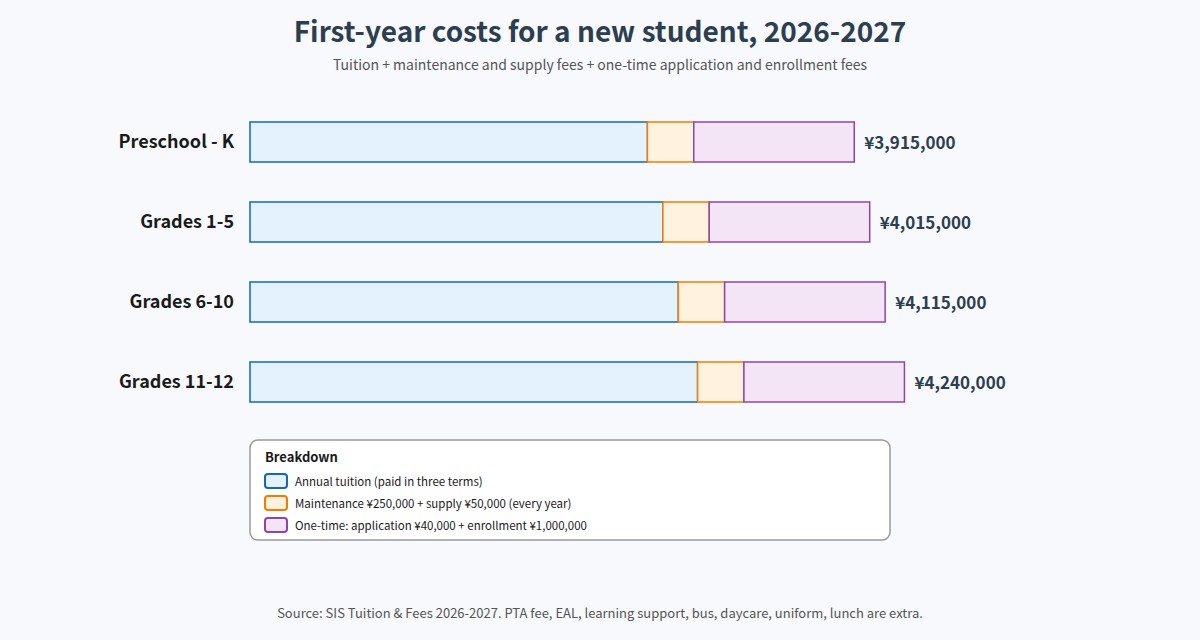
Adding these up, a new student pays ¥1,040,000 in one-time fees (application and enrollment). Together with tuition and the annual maintenance and supply fees, the first year at 2026-27 rates comes to ¥3,915,000 for Preschool to Kindergarten, ¥4,015,000 for Grades 1 to 5, ¥4,115,000 for Grades 6 to 10 and ¥4,240,000 for Grades 11 to 12, before the PTA fee and any optional or needs-based items. From the second year, the ongoing cost of tuition plus maintenance and supply fees is ¥2,875,000, ¥2,975,000, ¥3,075,000 and ¥3,200,000 respectively, if fees stay at 2026-27 levels.
Sibling discounts
The 2026-27 fee table has two sibling rules, depending on when the family joined. For parents who enrolled before the 2025-2026 school year, a 20% discount applies to the second child’s tuition only. For parents enrolled during and after 2025-2026 (fees page wording; the June 2026 handbook says “after 2025-2026”), a 10% discount applies to tuition for the second and any additional siblings. A note adds that “The 3rd child discount of 30% is only applicable to current students.” The FAQ page gives the 10% figure in general terms, so please check with the school which rule applies to your family.
What is not included
- Optional school lunches and the compulsory school uniform
- Non-curriculum residential and day trips, some exam fees, some sports events and tournaments, some after-school programmes, and swimming
- SEN support, the EAL fee and the Learning Support fee where required
- Daycare (charged at ¥2,000 an hour) and the school bus (fee not published on the fees page; ask the school)
All fees are non-refundable, a mid-year joiner pays for the full term, and withdrawal needs a full term’s written notice or a term’s fees.
Admissions: timing, age and English
When can you apply?
SIS accepts applications all year round and has no fixed deadline. The handbook says applications open one year before the preferred start date (for example, from August 2025 for entry in August 2026), and students can join mid-term if there is a vacancy. It also states that the school does not accept short-term or termly enrollment. The FAQ adds that the school may admit students in April, when the Japanese school year begins. One exception: students transferring from another IB Diploma school are welcome to enroll only until the middle of September each year.
Age and grade placement
Children are placed by age: a child who reaches the appropriate age for the grade before 1 September of that school year is eligible for standard admission. For 2026-27, for example, a Grade 1 student is one born between 1 September 2019 and 31 August 2020, and a Preschool child turns 3 by 31 August 2026. For Preschool and Pre-K, children must be fully toilet-trained to start school.
The admissions process
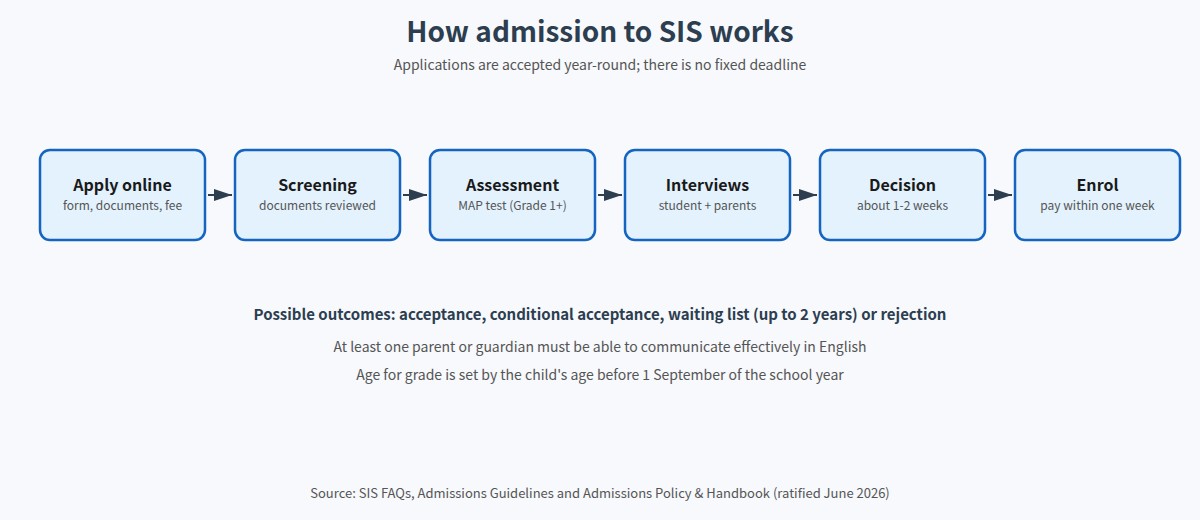
- Apply online through OpenApply, upload the documents and pay the application fee. A school visit is recommended but not required.
- Screening: the school reviews the documents first and decides whether to invite the applicant to assessment.
- Assessment: students in Grade 1 and above take the MAP Growth test in English language, reading and mathematics, and the MAP score decides whether they move on to the teacher interview.
- Interviews: eligible students go through a trial class or an individual interview, and all parents attend an enrollment interview. Overseas families are assessed and interviewed by Zoom.
- Decision: the FAQ says results come 1 to 2 weeks after the assessment, while the admissions page says “within a few weeks”. Outcomes can be acceptance, conditional acceptance, the waiting list (considered for up to 2 years) or rejection.
- Enrol: the handbook says the one-time payments and the first term’s tuition are due within one week of accepting the offer (the fees page words the enrollment fee deadline as one week from confirmation of admission, so confirm the exact date with the school).
Two more conditions from the handbook: students must live full-time with at least one parent or legal guardian, and at least one parent or guardian must be able to communicate effectively in English, because all school communication is in English.
English requirements and support
This is where planning ahead really matters. All subjects except Japanese are taught in English, and the school assesses English using WIDA standards at interview. The FAQ says EAL (English as an Additional Language) classes are offered for Grades 1 to 10. The handbook is quite specific about what to expect at each age:
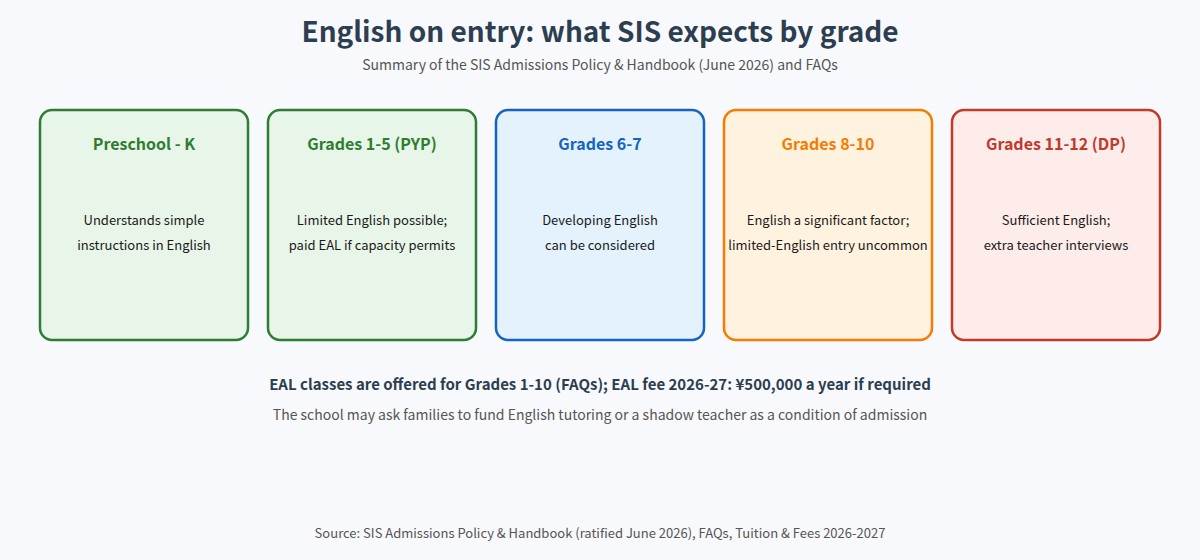
- Early years: the child can understand simple instructions and communicate their needs in English.
- Grades 1 to 5 (PYP): applicants may be admitted with limited English; if a child is not at grade level, paid EAL support is provided “if the capacity permits”.
- Grades 6 and 7: applicants with developing English may be considered.
- Grades 8 to 10: English is “a significant factor”, and admission of students with limited English into the upper MYP years is described as uncommon and typically dependent on continued external English support.
- Grades 11 and 12 (DP): students need sufficient English to succeed, and have additional interviews with DP teachers, including the DP maths teacher.
The school may also ask parents to arrange English tutoring or a shadow teacher at their own expense as a condition of admission, so joining earlier gives more room for support.
What you will need
According to the school’s admissions checklist and handbook, families submit the online application form; the past two years’ school reports in English for Grade 2 and above (translations must be done by an official translator, or stamped by the issuing school if translated unofficially), or progress reports for Grade 1 and below if available; a copy of the passport or birth certificate; a confidential recommendation from the current teacher (secondary applicants need one each from their maths and English teachers); and the application fee receipt. Families whose child has received learning support must share all relevant reports.
Learning support and student life
Learning support. SIS offers EAL, learning support, upper primary maths support and counselling, with Individual Educational Plans for formally assessed students. The handbook says capacity for intensive, highly individualised support is limited and a family-funded assistant may be required, so please discuss any needs frankly.
Japanese. The FAQ describes JAL (Japanese as an Additional Language) classes and a Kokugo programme for proficient Japanese speakers, which follows a modified version of the Japanese national curriculum.
After school. SIS runs more than 70 after-school programmes each week, Tuesday to Thursday, from robotics to ballet and Model United Nations. The school describes them as complimentary, although some specialist activities have material fees. PYP students (Preschool to Grade 5) also have weekly swimming lessons at a nearby Konami Sports Club pool, at extra cost.
Daily life. Hours are 8:30 to 14:30 for Preschool to Kindergarten and 8:30 to 15:00 for Grades 1 to 12, and uniform is compulsory. The FAQ says no single nationality may exceed 25% of students.
Getting there
All three campuses are close together in Shinagawa-ku, according to the school’s campus page:
- Aoyoko Campus (Preschool to Kindergarten): 5-12-4 Minamishinagawa. About 5 minutes from Aomono-Yokocho Station and 7 minutes from Oimachi Station.
- Seaside Campus (Grades 1 to 3): 4-8-8 Higashishinagawa. About 5 minutes from Shinagawa Seaside and Aomono-Yokocho stations. It has a gym, library and rooftop playground.
- Samezu Campus (Grades 4 to 12): 3-6-21 Minamishinagawa. About 3 minutes from Aomono-Yokocho Station and 7 minutes from Shinagawa Seaside Station. It has a gym, music, visual arts and design rooms, a science lab and a library and media centre, and uses the nearby Samezu Soccer Field for sport.
The school runs eight bus routes, mainly for preschool and primary students, with limited places for secondary students. If you have children in different grades, remember that they may be at different campuses.
Questions parents often ask
Can we apply if both parents are Japanese?
Possibly. The FAQ says SIS may accept students whose parents are both Japanese, provided they meet the eligibility criteria in the Admissions Policy. Note that MEXT lists SIS as a non-Article-1 school (not a school under Article 1 of the School Education Law), which matters for Japanese compulsory education.
My child has little English. Can they still join?
In the primary years, often yes, with paid EAL support if capacity permits. From Grade 8 onwards it becomes much harder, and EAL classes are listed only up to Grade 10, so earlier entry is the safer choice.
Can my child join in Grade 11 from another IB school?
The handbook says students from other IB Diploma schools are welcome to enroll until the middle of September each year (into Grade 12 only “on rare occasions”), depending on subject availability, assessments and interviews. Missing subjects may mean online courses or tutoring at extra cost.
Summary
- Full IB continuum: PYP (2015), MYP (2023) and DP (2024), from age 3 to Grade 12, across three campuses in Shinagawa.
- Size: more than 450 students in September 2025, from more than 40 countries, with 22 to 24 students per class.
- 2026-27 fees: tuition from ¥2,575,000 (Preschool to Kindergarten) to ¥2,900,000 (Grades 11 to 12), plus ¥300,000 a year in maintenance and supply fees and ¥1,040,000 in one-time fees.
- Rolling admissions: no fixed deadline, MAP testing from Grade 1, a trial class or interview for the student, and a parent interview.
- Plan ahead for English: limited English is possible in the primary years, EAL runs to Grade 10, and at least one parent must communicate in English.
If SIS sounds like a good fit, a school visit and a talk with the admissions team are the best next steps, especially about vacancies, DP subjects and support needs.
Sources and references
- Shinagawa International School: official website (checked 26 September 2026)
- SIS: Tuition and Fees for the 2026-2027 School Year
- SIS: Admissions Policy and Handbook (PDF, ratified June 2026)
- SIS: FAQs
- SIS: Admissions Guidelines and Admissions Checklist (PDF)
- SIS: Diploma Programme, Middle Years Programme and Primary Years Programme
- SIS: About Us and Facilities and Campuses
- SIS: Services and Extracurricular Activities
- International Baccalaureate: Shinagawa International School
- MEXT IB Education Promotion Consortium: IB schools in Japan (as of 30 June 2026)
- Council of International Schools: Newly accredited, Shinagawa International School
- Tokyo Metropolitan Government: Shinagawa International School
コメント