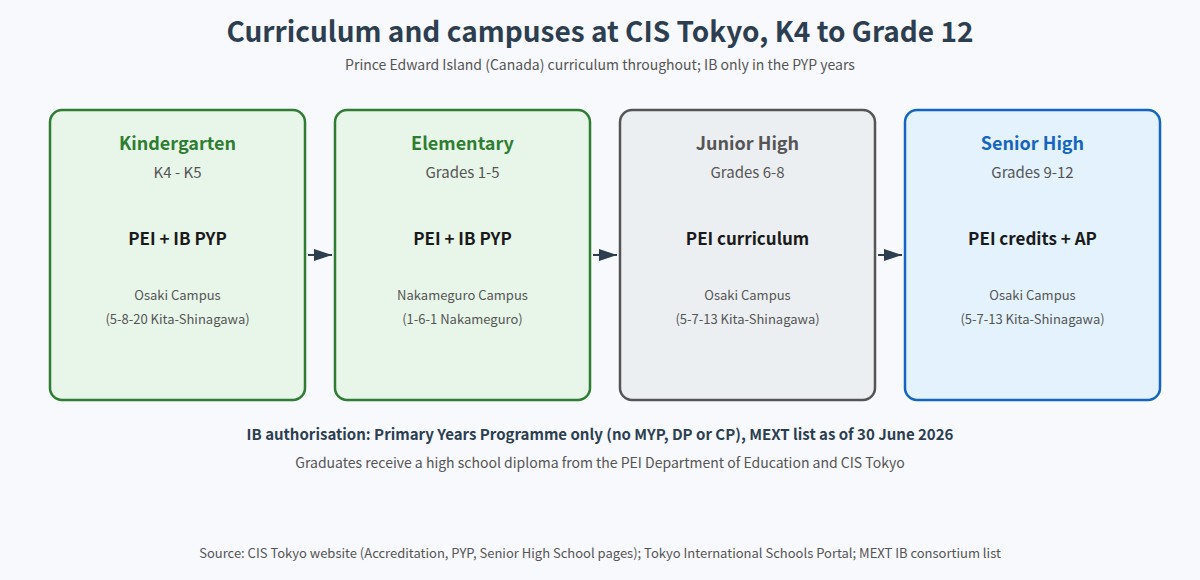
Canadian International School Tokyo (often shortened to CIS Tokyo) is a co-educational international school in Shinagawa and Meguro that teaches the curriculum of the Canadian province of Prince Edward Island (PEI), with the IB Primary Years Programme in the younger grades and Advanced Placement (AP) courses in high school. It was founded in 1999, and students who complete Grade 12 receive a high school diploma from the PEI Department of Education and CIS Tokyo. If you are considering a Canadian-style education in central Tokyo, it is likely to be on your list.
This guide is based on the school’s official website and 2026-2027 admission procedure documents, the Tokyo Metropolitan Government’s international schools portal and the Japanese Ministry of Education (MEXT) IB consortium list, all checked on 26 September 2026. Fees and procedures change, so please confirm the details with the school before you apply.
CIS Tokyo at a glance
| Item | Details |
|---|---|
| School name | Canadian International School Tokyo (CIS Tokyo) |
| Founded | 1999, by two of its present directors (school History page) |
| Type | Co-educational international school; not an “Article 1” school under Japan’s School Education Law (listed as a non-Article-1 school by MEXT) |
| Campuses | Osaki Campus, headquarters and kindergarten (5-8-20 Kita-Shinagawa, Shinagawa-ku); Osaki Campus, junior and senior high school (5-7-13 Kita-Shinagawa); Nakameguro Campus, elementary school (1-6-1 Nakameguro, Meguro-ku) |
| Grades (2026-27 admissions) | Kindergarten 4 and 5 (K4, K5) to Grade 12 |
| Capacity | 520 in total: kindergarten 40, elementary 260, junior high 120, high school 100 (Tokyo portal, updated 2026; this is capacity, not current enrolment) |
| IB programme | Primary Years Programme (PYP) only, Kindergarten to Grade 5; no MYP, DP or CP (MEXT list, as of 30 June 2026) |
| Other curriculum | Prince Edward Island (Canada) curriculum, Kindergarten to Grade 12; AP courses in high school |
| Accreditation | Province of Prince Edward Island and WASC (Kindergarten to Grade 12) |
| School year | September to June |
We do not give a student headcount because the school does not publish one. The Tokyo portal lists capacity, average class sizes (12 to 17 students) and the main nationalities: Japan, Korea, China, Canada and the United States, among others.
How the curriculum works: Canadian at its core, IB in the early years
This is the most important thing to understand about CIS Tokyo. It is a Canadian school first, and the IB is only part of the picture. From kindergarten to Grade 12, teachers follow the Prince Edward Island curriculum, and the school states that its teachers must be certified by the Province of PEI (the Tokyo portal adds: except Japanese language instructors). The History page says PEI officials inspect the school on site each year.
- Kindergarten (K4, K5): student-centred learning and play in English, with PYP units of inquiry.
- Elementary School (Grades 1 to 5): the IB PYP taught alongside Canadian curriculum outcomes, with six transdisciplinary themes each year and the Grade 5 Exhibition, a research-and-action project on a global issue.
- Junior High School (Grades 6 to 8): the Canadian curriculum, including Japanese and coding. This stage is not part of any IB programme.
- Senior High School (Grades 9 to 12): a PEI credit programme leading to a Canadian high school diploma, with AP courses.
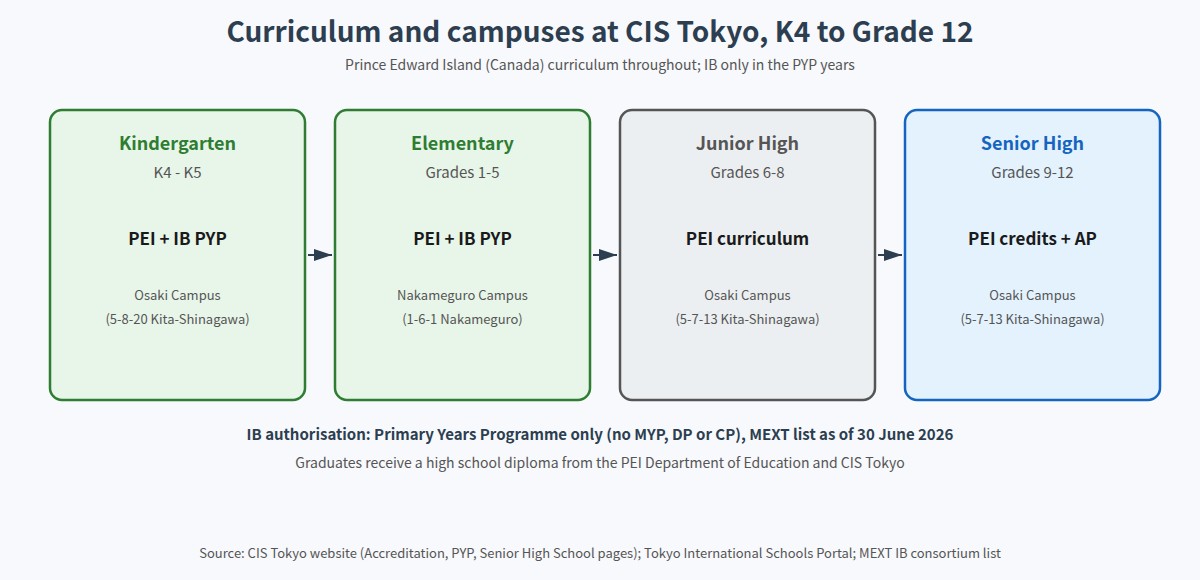
Why does this matter? If you want the IB Diploma, CIS Tokyo is not that school: the MEXT list shows only the PYP, which the school says received final authorisation in 2009. If you are thinking about universities in Canada or North America, though, a Canadian provincial diploma with AP courses is a well-understood route.
The PEI high school diploma
According to the Senior High School page, graduates receive a diploma from the Prince Edward Island Department of Education and CIS Tokyo. Each credit is 110 to 120 hours of teaching, the pass mark is 50 percent, and students need 20 credits, including:
- 5 credits at Grade 12 level (600 or 800 level)
- 2 credits each in mathematics, science and social studies (one with Canadian content)
- 3 English credits, including one at the 600 level
- 1 credit each in Innovation/Creativity, Career Exploration and Opportunity (CEO) and PE 401A
Note also that, according to the school’s age table, a student must have completed Grades 10, 11 and 12 in English-medium schooling to graduate from CIS.
Advanced Placement
The Advanced Placement page says CIS Tokyo “currently” offers AP courses in Calculus AB, English, World History, Chemistry and Physics B, with teaching support for other AP subjects. The College Board replaced AP Physics B with AP Physics 1 and AP Physics 2 in 2014, so this list may be out of date; the page is undated, so ask which courses run in 2026-27. Universities set their own rules for AP credit.
Where graduates go
CIS Tokyo does not publish AP results or graduate numbers. Its Academic Results page lists universities where graduates matriculated between 2020 and 2025, for example McGill, UBC, Toronto and Waterloo in Canada; the University of Tokyo, Waseda, Keio, Sophia and ICU in Japan; NYU, UCLA and Michigan in the US; and Imperial, King’s College London and Oxford in the UK. A list like this shows the range of possibilities rather than typical outcomes. University guidance is available in Grades 10 to 12, including PSAT and SAT preparation. The History page states that CIS graduation is recognised for applications to Japanese universities; please still check each university’s eligibility rules.
Tuition and fees for 2026-2027
Let’s look honestly at the costs. These figures are from the school’s 2026-2027 Fees page and match the four 2026-2027 admission procedures; the school states that fees are fixed for September 2026 to June 2027.
| Fee (2026-2027) | Kindergarten (K4, K5) | Grades 1 to 5 | Grades 6 to 8 | Grades 9 to 12 |
|---|---|---|---|---|
| Application fee (one-time, non-refundable) | ¥35,000 | ¥35,000 | ¥35,000 | ¥35,000 |
| Registration fee (one-time, non-refundable) | ¥300,000 | ¥300,000 | ¥300,000 | ¥300,000 |
| Building Development Fee (one-time, non-refundable) | Not listed | ¥600,000 | ¥600,000 | ¥600,000 |
| Tuition (annual) | ¥2,350,000 | ¥2,650,000 | ¥2,800,000 | ¥2,900,000 |
| Building Maintenance Fee (annual) | ¥250,000 | ¥250,000 | ¥250,000 | ¥250,000 |
| First-year total (our calculation) | ¥2,935,000 | ¥3,835,000 | ¥3,985,000 | ¥4,085,000 |
| From the second year (tuition + maintenance, at 2026-27 rates) | ¥2,600,000 | ¥2,900,000 | ¥3,050,000 | ¥3,150,000 |
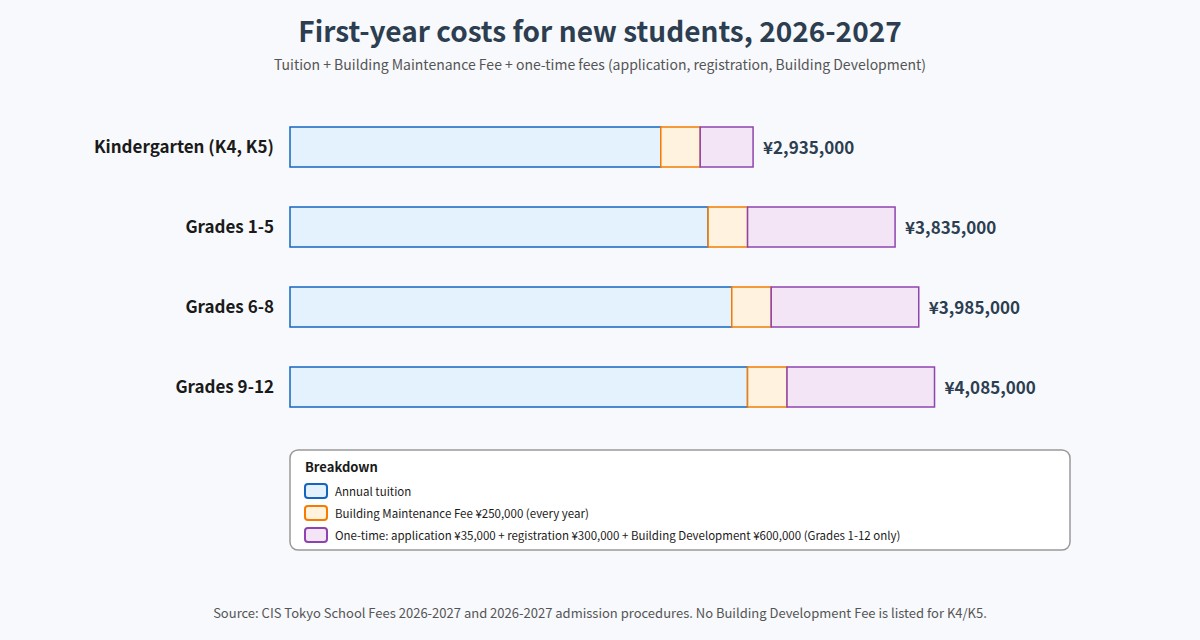
The ¥35,000 application fee appears in the 2026-2027 admission procedure documents rather than on the Fees page. For Grades 1 to 12, the one-time fees add up to ¥935,000 (application ¥35,000, registration ¥300,000 and Building Development Fee ¥600,000). For kindergarten they are ¥335,000, because no Building Development Fee is listed for K4 and K5; ask whether it becomes payable on moving up to Grade 1. Other points from the Fees page and the Tokyo portal:
- Payment in two instalments is possible, with a ¥35,000 handling charge.
- A sibling discount applies to annual tuition (amount not published; ask the office).
- A programme called “EIC” for K5 and Grade 1 is listed with tuition on inquiry.
- The Tokyo portal lists no school bus. Lunch, uniforms and trips are not priced on the Fees page.
Admissions: timing, age and English
When can you apply?
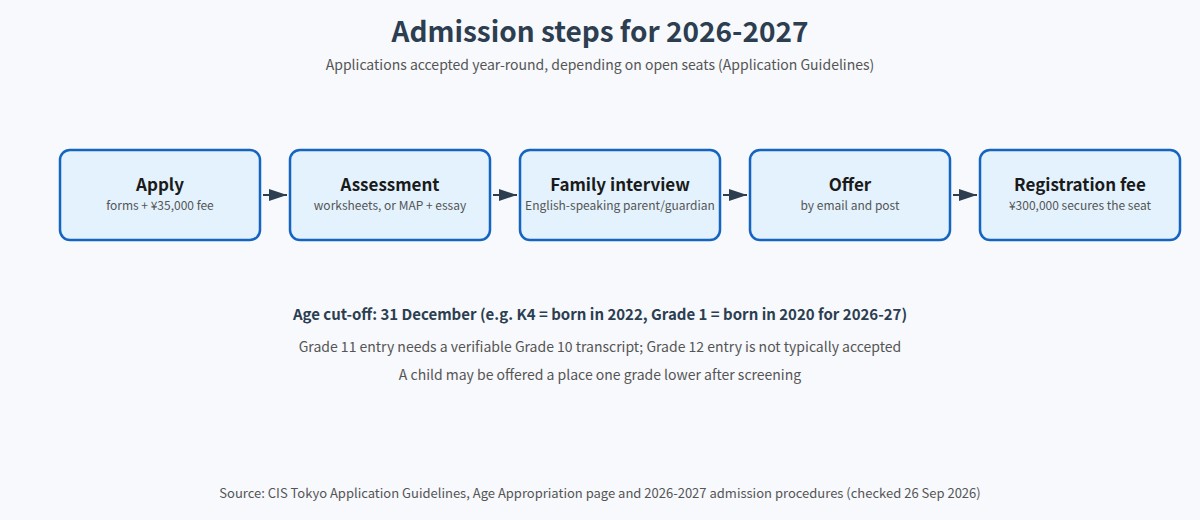
For 2026-2027, the Application Guidelines say there is no specific application period: applications are accepted year-round, depending on open seats in each grade. For high school, the 2026-2027 admission procedure adds that Grade 11 entrants need a verifiable Grade 10 transcript for transfer credits, and that CIS “cannot typically accept students entering the school in grade 12”, so contact the school first.
Age and grade placement
Children are placed by age, with a cut-off of 31 December. For 2026-2027, a K4 applicant must be 4 by 31 December 2026 (born in 2022) and a Grade 1 applicant 6 by that date (born in 2020), up to Grade 12 (born in 2009). Depending on the screening, a child may be offered a place one grade lower, at the discretion of the Head of School or Principal.
The steps and documents
- Apply: send the forms to the admissions office and pay the ¥35,000 application fee.
- Assessment: kindergarten applicants complete worksheets at home; Grades 1 to 12 take the MAP test in English and mathematics and write a short essay in English.
- Family interview: the applicant and at least one English-speaking parent or guardian meet a school administrator.
- Offer: the seat is guaranteed when the registration fee is paid; tuition follows once registration is confirmed.
You will need the application form, a confidential teacher recommendation, a health record form, a copy of the passport or birth certificate, one photo, proof of the fee payment and school reports from the last two years if available (all secondary transcripts for high school), with English translations where needed. Kindergarten applicants must be toilet trained.
English requirements and support
- Parents: at least one parent or guardian must communicate comfortably with teachers and staff in English, and parents must be able to access the school’s electronic communications consistently.
- Kindergarten: fluency is not expected, but a willingness to study in English is.
- Grades 1 to 5: children should communicate with teachers and classmates and read at or close to grade level.
- Grades 6 to 8: students should follow lessons, join discussions and read at grade level independently.
- Grades 9 to 12: students should be near fluent, and there is no language support.
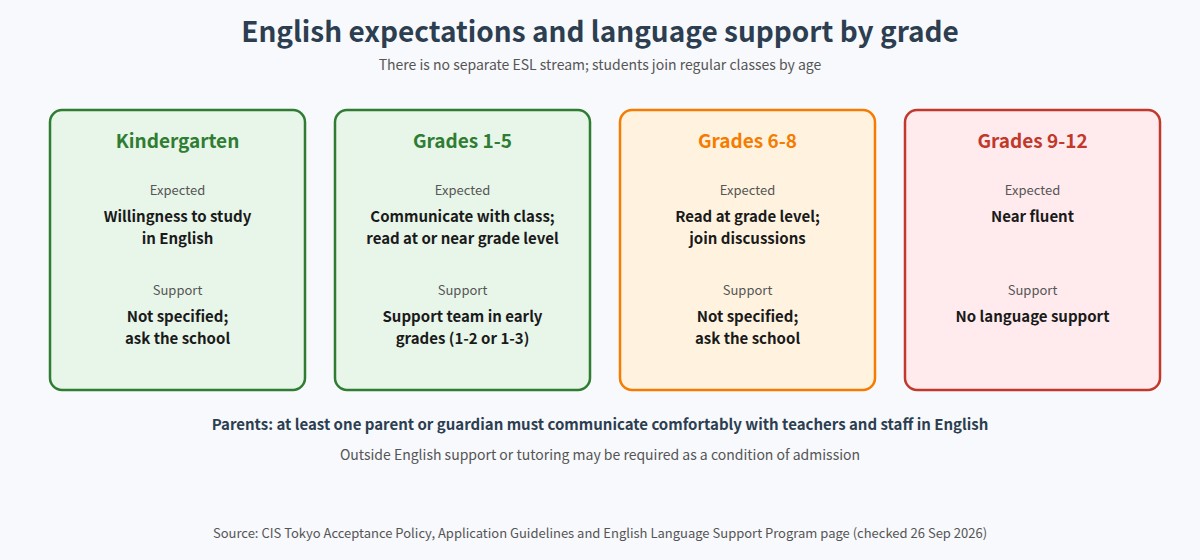
There is no separate ESL stream. The Acceptance Policy mentions a language support team for Grades 1, 2 and 3, while the English Language Support Program page describes school-year support for Grades 1 and 2 (small groups, one or two periods a week), so ask which grades are covered in 2026-27. Admission can also depend on families arranging outside English support if the school thinks it necessary. The school also describes an April intake with extra support from April to June, and a July summer school.
School life and learning support
Small classes and the school day. The Tokyo portal lists 50 teachers and average classes of 12 to 17. According to the school, students in Grades 1 to 12 must be in class by 8:30, and the day ends at 3:00 (kindergarten), 3:15 (Grades 1 to 5) or 3:20 (Grades 6 to 12), over 190 instructional days.
Counselling. A guidance counsellor works across both campuses, offering social-emotional and educational support from kindergarten to Grade 12 and recommending external providers for learning needs.
Facilities. The school lists technology labs, music and art areas, a science lab and a resource centre, and its School Tour photo page includes a photo captioned “Gym (Building C)”, the high school building. The Tokyo portal lists no sports field, gymnasium or pool, so ask to see the facilities if sport matters to your child.
Getting there
The two Osaki buildings (headquarters and kindergarten at 5-8-20 Kita-Shinagawa, and junior and senior high school at 5-7-13 Kita-Shinagawa) are, in the school’s words, “a short walk from Osaki station”; the school’s access map shows the route from JR Osaki Station. (Osaki Station is also served by the Rinkai Line.) The elementary school is at the Nakameguro Campus, 1-6-1 Nakameguro, Meguro-ku, which the school says is a 7-minute walk from Nakameguro Station on the Tokyu line and the Tokyo Metro Hibiya Line. If you have children in different divisions, remember that the elementary school is on a separate campus from the kindergarten and the secondary school.
Questions parents often ask
Does CIS Tokyo offer the IB Diploma?
No. It is authorised only for the IB PYP (Kindergarten to Grade 5), according to the MEXT list as of 30 June 2026 and the school’s Accreditation page. High school students earn a PEI diploma and can take AP courses.
My child is still learning English. Can they join?
The younger the child, the more realistic it is. Kindergarten needs only a willingness to study in English, and support exists in the early elementary grades; from Grade 9, students should be near fluent with no language support.
We are a Japanese family. Is there anything to consider?
Yes. CIS Tokyo is not an “Article 1” school, and the MEXT IB consortium page notes that Japanese parents are obliged to send children of compulsory school age to an Article 1 school, so consider the implications for Grades 1 to 9 before applying.
Summary
- A Canadian school with the IB PYP: the PEI curriculum from kindergarten to Grade 12, with the PYP from Kindergarten to Grade 5; no MYP or DP.
- Canadian diploma plus AP: a high school diploma from the PEI Department of Education and CIS Tokyo, with five AP courses listed.
- 2026-27 fees: tuition from ¥2,350,000 to ¥2,900,000 plus a ¥250,000 Building Maintenance Fee; first-year totals of ¥2,935,000 to ¥4,085,000.
- Flexible timing: year-round applications for 2026-27, a 31 December age cut-off, and Grade 12 entry not typically accepted.
- English for parents too: one parent or guardian must communicate comfortably with teachers and staff in English, and there is no language support from Grade 9.
If CIS Tokyo sounds like a good fit, contact the admissions office about seats in your child’s grade and visit both the Osaki and Nakameguro campuses.
Sources and references
- Canadian International School Tokyo: official website (checked 26 September 2026)
- CIS Tokyo: School Fees 2026-2027 School Year
- CIS Tokyo: Admission Procedure (2026-2027 PDFs for Kindergarten, Elementary, Junior High and Senior High)
- CIS Tokyo: Application Guidelines
- CIS Tokyo: Acceptance Policy
- CIS Tokyo: Age Appropriation, School Year 2026-2027
- CIS Tokyo: Accreditation and History
- CIS Tokyo: PYP – IB
- CIS Tokyo: Senior High School and Graduation Requirements
- CIS Tokyo: Advanced Placement
- CIS Tokyo: Academic Results (university matriculations 2020-2025)
- CIS Tokyo: English Language Support Program
- CIS Tokyo: Counseling and Student Support
- CIS Tokyo: School Tour (photos)
- CIS Tokyo: Campus Information
- Tokyo Metropolitan Government, Tokyo International Schools Portal: Canadian International School Tokyo
- MEXT IB Education Promotion Consortium: IB schools in Japan (as of 30 June 2026)
コメント