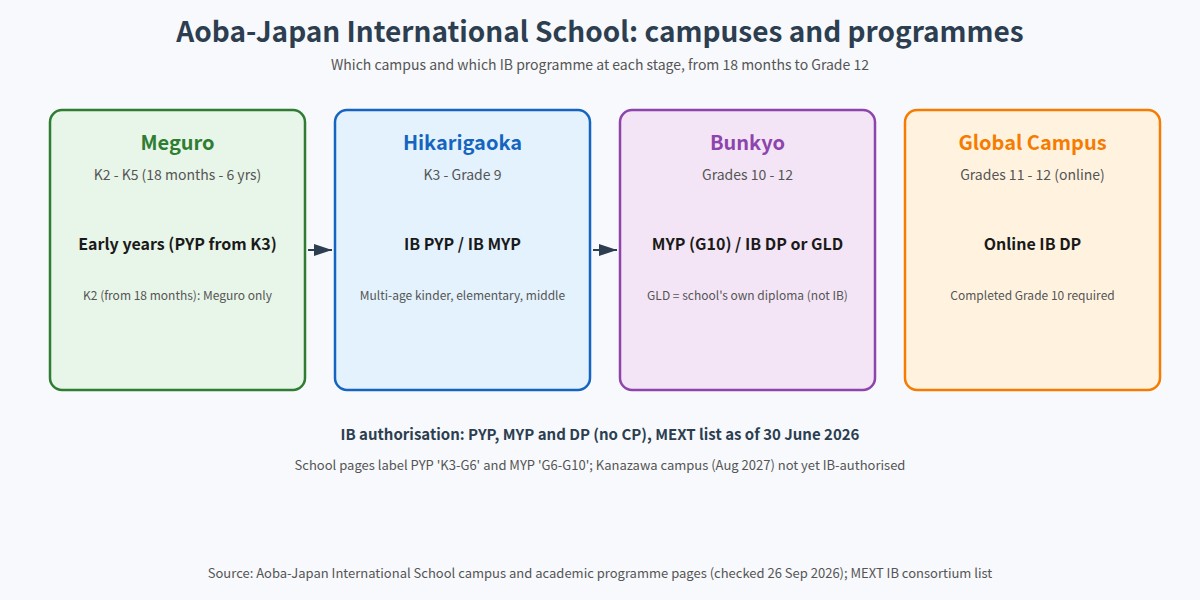
Aoba-Japan International School (A-JIS, often just “Aoba”) is a secular, co-educational international school in Tokyo for children from 18 months old to Grade 12, spread over three Tokyo campuses and an online campus. It is authorised for the IB Primary Years Programme (PYP), Middle Years Programme (MYP) and Diploma Programme (DP), and it marks its 50th anniversary in 2026. If you want an IB school where your child could stay from the toddler years to graduation, Aoba is likely to be on your list.
This guide is based on the school’s website, its official 2026-2027 fee schedules, its 2025-2026 School Profile, the Tokyo Metropolitan Government’s international schools portal and the MEXT IB consortium list, all checked on 26 September 2026. Fees and dates change every year, so please confirm details with the school before applying.
One note first: the Aoba group also runs Aoba-Japan Bilingual Preschool, a separate set of IB PYP preschools (for example in Harumi, Mitaka and Nakano) with their own admissions and fees. This article covers only Aoba-Japan International School.
Aoba at a glance
| Item | Details |
|---|---|
| Founded | 18 May 1976, as a small international preschool in Aobadai, Tokyo (school history page) |
| Type | Secular (school FAQ), co-educational day school; not an “Article 1” school under Japan’s School Education Law (MEXT list) |
| Campuses | Meguro (K2 to K5), Hikarigaoka (K3 to Grade 9), Bunkyo (Grades 10 to 12), online Global Campus (Grades 11 and 12) |
| Students (2025-26) | 810 (K2 to Grade 12), 164 of them in Grades 10 to 12, from 41 nationalities (2025-2026 School Profile) |
| IB programmes | PYP, MYP and DP; no Career-related Programme (MEXT list, as of 30 June 2026) |
| Accreditation | CIS and NEASC |
| Group Head of School | Jake Madden (school leadership page, 2026) |
The school’s FAQ mentions “over 45 nationalities” and says approximately half of students hold a Japanese passport. We use the School Profile figures above because they are tied to a specific school year.
Three Tokyo campuses and an online campus
Which campus would your child attend? At Aoba it depends on the grade, and children move between campuses as they grow.
- Meguro (K2 to K5, 18 months to 6 years): a kindergarten campus in Aobadai with two adjacent buildings, after care until 5:45 pm, a bus service and swimming lessons for K4 and K5. K2 is offered only here.
- Hikarigaoka (K3 to Grade 9): in Nerima-ku, with a multi-age kindergarten, elementary and middle school, a sports pitch, pool and gymnasium. The campus page describes “a student body of over 570”.
- Bunkyo (Grades 10 to 12): the high school campus in Honkomagome, with a black-box theatre and music studios. Grade 10 includes internships; in Grades 11 and 12 students choose the IB Diploma or the Global Leadership Diploma.
- Global Campus (online, Grades 11 and 12): a fully online IB Diploma. The school’s Bunkyo page states that Aoba “was selected by the IBO as the first school in Asia to pilot the Online IB Diploma Programme”.
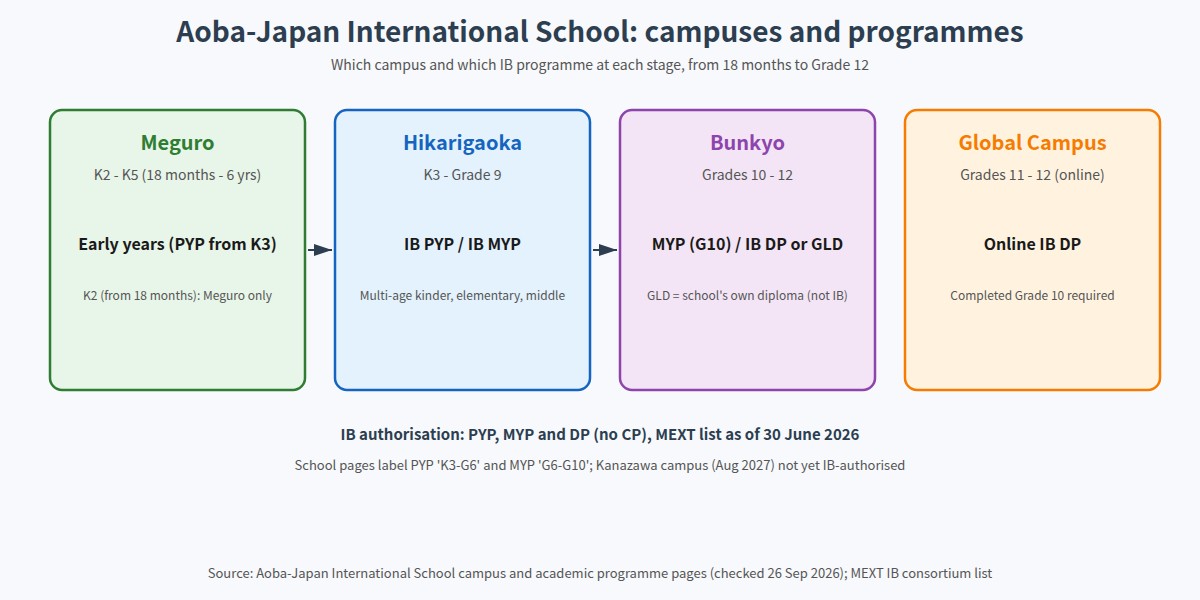
As Figure 1 shows, a child who starts at Meguro would usually move to Hikarigaoka for Grade 1 and to Bunkyo for Grade 10, so it is worth thinking about your commute for each stage. The school has also announced an A-JIS Kanazawa campus in Ishikawa, planned to open in August 2027 with K3 (age 3) to Grade 3 in its first year; the page says it “will be seeking authorisation” for the IB programmes, so it is not yet an authorised IB campus.
IB programmes: PYP, MYP and DP
The MEXT IB consortium list (as of 30 June 2026) shows Aoba authorised for the PYP, MYP and DP. The school’s history page says Aoba was “officially authorized as a full IB World School” offering the PYP, MYP and DP in 2016, while its 2025-2026 School Profile describes it as an “IB World school since 2015”.
- PYP: the school’s PYP page covers the early years (K2 to K5, learning through play) and the elementary grades, ending with the PYP Exhibition project. Note that the page labels the programme itself “K3-G6”, and the IB designs the PYP for ages 3 to 12, so K2 (for children from 18 months) is best thought of as the school’s early-years class rather than a formal PYP year.
- MYP: up to Grade 10, with eight subject groups including Design, English and Japanese options, a Grade 9 Community Project and a Grade 10 Personal Project.
- DP: Grades 11 and 12, six subjects plus Theory of Knowledge, the Extended Essay and service. The school says it offers more than 20 DP courses, mostly face-to-face but some online.
A detail to ask about: the programme pages label the MYP “G6-G10”, so Grade 6 appears under both the PYP and the MYP. If your child joins around Grade 6, ask how that year is organised.
IB Diploma or Global Leadership Diploma?
Not every Aoba student takes the IB Diploma. The school’s own Global Leadership Diploma (GLD) is a personalised Grade 11 and 12 pathway with a Leadership Coach, project work and internships, leading to the Aoba High School Diploma rather than the IB Diploma. In the Class of 2025, according to the School Profile, 35 of 53 graduates were in the IB Diploma Programme and 18 in the GLD. That flexibility can suit a project-minded teenager, but ask early which pathway the school would recommend for your child.
IB Diploma results (May 2025)
The 2025-2026 School Profile reproduces the school’s results summary for the May 2025 session, the most recent set published by the school as of September 2026.
| May 2025 session | Figure |
|---|---|
| Candidates registered | 41 |
| Diploma and retake candidates | 35 |
| Candidates who passed the diploma | 27 |
| Average points of candidates who passed | 31 |
| Highest diploma points | 39 |
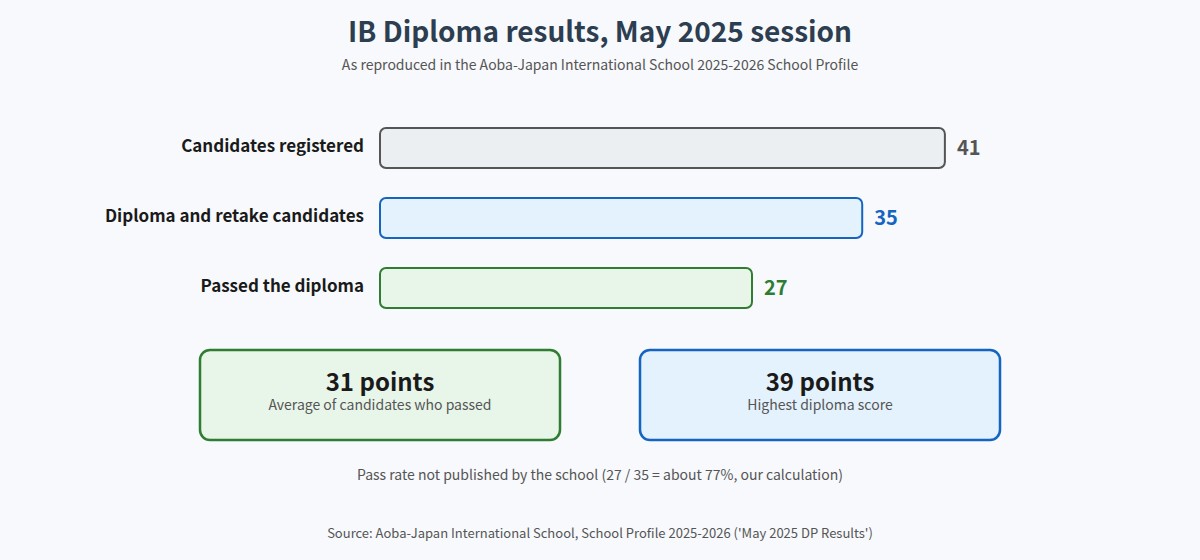
The profile does not state a pass rate. Dividing 27 by 35 gives about 77%, but that is our own calculation. Note too that the average of 31 covers only candidates who passed, and that small cohorts can vary a lot from year to year, so it is fair to ask for several years of results.
The profile also lists Class of 2025 university acceptances, including the University of Toronto, UBC, the University of Chicago, the University of Washington, Durham, the University of Manchester, the University of Sydney, Keio, Waseda and Sophia. These are offers, not necessarily enrolments, and the list does not separate IB Diploma and GLD students.
Tuition and fees for 2026-2027
Let’s look at costs honestly. These figures come from the school’s official “School Fees 2026-2027” schedule (August 2026 to June 2027, tax included). One schedule covers all three Tokyo campuses; fees depend on grade band, not campus.
| Fee (2026-2027, on campus) | Amount (JPY) |
|---|---|
| Application fee (one-time) | ¥30,000 |
| Registration fee (one-time) | ¥350,000 |
| Building Development Fee (one-time) | ¥350,000 |
| Building Maintenance Fee (annual) | ¥220,000 |
| Family Community Membership Fee (annual, per family) | ¥12,500 |
| Tuition: K2 / K3 to K5 | ¥2,098,000 / ¥2,332,000 |
| Tuition: Grades 1 to 5 / Grades 6 to 12 | ¥2,518,000 / ¥2,862,000 |
| Graduation fee: K5 / Grade 12 | ¥60,000 / ¥160,000 |
| Lunch (optional): K2 to K5 / Grades 1 to 9 | ¥175,000 / ¥200,000 |
| Bus (optional): one way / both ways | ¥257,000 / ¥418,000 |
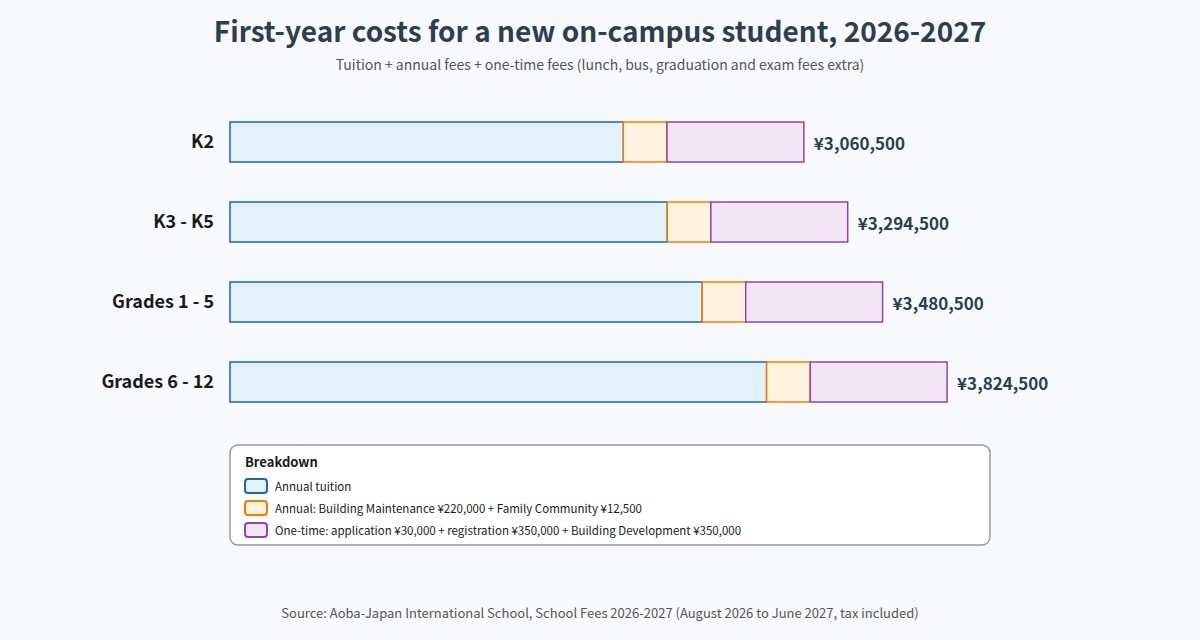
A new on-campus student pays ¥730,000 in one-time fees and ¥232,500 in annual fees (Building Maintenance plus the per-family Family Community fee). The first year therefore comes to ¥3,060,500 for K2, ¥3,294,500 for K3 to K5, ¥3,480,500 for Grades 1 to 5 and ¥3,824,500 for Grades 6 to 12, before lunch, bus and graduation fees. From the second year, at 2026-27 rates, it is ¥2,330,500, ¥2,564,500, ¥2,750,500 and ¥3,094,500 respectively.
- Tuition is paid in one payment (due 20 June) or two (20 June and 20 November); new students pay at registration.
- Grade 12 IB Diploma students pay the IB exam fee at actual cost (the schedule gives ¥120,000 last year as an example).
- Sibling discount: 10% off the second child’s tuition and 15% off each further child’s, for full-year students.
- The fee schedule’s refund policy states that the application, registration and Building Development fees are non-refundable, and the FAQ says there is currently no financial aid for newly enrolled students.
Online IB Diploma (2026-2027). A separate schedule lists an application fee of ¥25,000 and registration fee of ¥200,000 (one-time), tuition of ¥1,650,000, a Technology Fee of ¥70,000 a year, a Grade 12 graduation fee of ¥50,000 and exam fees at actual cost. For a student joining in Grade 11, that makes the first year ¥1,945,000 before exam fees.
Admissions: timing, age and English
When can you apply?
According to the FAQ, the first-round application period runs from mid-October to mid-December. The school’s admissions timeline shows an optional Open Day in October, interviews in February (online or in person), results in early March and the new school year in August. Applications are also accepted all year round, depending on vacancies, which helps relocating families.
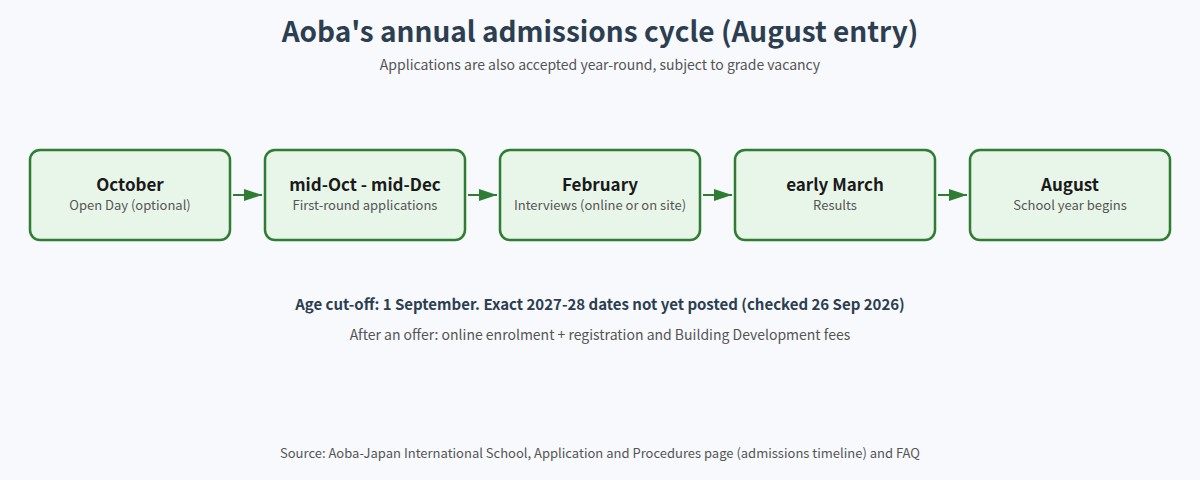
At the time of writing, the admissions page text still described the 2026-27 cycle, so exact dates for August 2027 entry were not yet posted. Banners on that page advertise an Open Day at Hikarigaoka on Saturday 3 October 2026 and an online Kinder Information Session on Wednesday 14 October 2026. Please confirm 2027-28 dates with admissions@aobajapan.jp.
Age, English and documents
The age cut-off is 1 September. Kindergarten to Grade 1 placement follows birth date; from Grade 2, children are placed by completed or current grade. K2 (Meguro only) accepts children from 18 months, and K3 children must be out of diapers.
English is the language of instruction in all grades. The FAQ says:
- Grades 1 to 9 have an inclusive in-class support programme for a limited number of students per grade whose English is not quite at grade level.
- In K to Grade 1, a small number of children with little or no English can be accepted if the home environment supports language development.
- Support is described only up to Grade 9, so for Grade 10 entry, ask about the expected English level.
- The FAQ says “it is essential that at least one parent can communicate in English”, and the Application and Procedures page adds that at least one parent or guardian should be able to communicate comfortably with school staff in English.
The online application (via the Veracross portal) asks for applicant and parent information, a questionnaire, school reports, teacher recommendations on Aoba’s form, medical and immunisation records and the application fee. An interview with child and parents follows, plus age-appropriate placement and language assessments. After acceptance, you pay the registration and Building Development fees to secure the seat. The school does not help with student visas and has no boarding.
Student life and getting there
The FAQ gives a 15:1 student-to-teacher ratio, no more than 16 children with two adults in kindergarten classes, 20 per class in Grades 1 and 2 and a cap of 25 from Grade 3. School runs 8:30 to 15:30 for K to Grade 9 and 9:30 to 15:30 for Grades 10 to 12, from late August to June. The Support Program page describes small-group help and a wellbeing team, but says support is given “within the resources available”, so discuss any learning needs frankly. Uniform is required, though daily wear is optional at Hikarigaoka and Bunkyo.
- Meguro: 2-11-5 Aobadai, Meguro-ku; near Nakameguro and Daikanyama (Tokyu Toyoko Line) and Shinsen (Keio Inokashira Line).
- Hikarigaoka: 7-5-1 Hikarigaoka, Nerima-ku; about a 15-minute walk from Hikarigaoka Station (Toei Oedo Line).
- Bunkyo: 6-18-23 Honkomagome, Bunkyo-ku; a short walk from Sugamo (JR Yamanote Line).
Buses serve Meguro and Hikarigaoka, with priority for kindergarten and primary students. The FAQ notes that Aoba students cannot use the student-discount commuter pass on JR and Metro lines.
Questions parents often ask
We are a Japanese family. Can our child apply?
Yes. The FAQ says the school welcomes students from all cultural and national backgrounds, including Japanese students; like all applicants, they are assessed on their capacity to access and benefit from Aoba’s programme. Note that MEXT lists Aoba as a non-Article 1 school, so for Japanese children of compulsory school age it is wise to check the implications with your local board of education. The FAQ also states: “The Japanese Ministry of Education also recognizes the school. This allows our graduates to apply to Japanese universities.”
My child doesn’t speak much English yet. Is that a problem?
It depends on age. Young children (K to Grade 1) may be considered in small numbers, Grades 1 to 9 have limited in-class support, and for high school you should ask directly.
Who is the Online IB Diploma for?
The Global Campus page requires completion of Grade 10, high-school-level English and living within a 3 to 4-hour time difference of Japan. Classes run 10:00 to 17:00 Japan time, and IB exams are taken in person at a centre near the student’s home.
Summary
- A full IB continuum: PYP, MYP and DP (MEXT list, 30 June 2026), with children accepted from 18 months (K2) to Grade 12, plus the non-IB Global Leadership Diploma in Grades 11 and 12.
- Several campuses: Meguro (K2 to K5), Hikarigaoka (K3 to Grade 9), Bunkyo (Grades 10 to 12) and an online campus.
- Results: in May 2025, 27 of 35 diploma and retake candidates passed, averaging 31 points, with a top score of 39.
- 2026-27 fees: tuition from ¥2,098,000 (K2) to ¥2,862,000 (Grades 6 to 12), plus ¥232,500 a year and ¥730,000 one-time.
- Plan ahead: apply mid-October to mid-December, note the 1 September age cut-off, and ask early about English support.
If Aoba sounds right for your family, an information session or the October Open Day is a good first step.
Sources and references
- A-JIS: Tuition Fees and Policies, Fees 2026-2027 (PDF), Online IBDP Fees 2026-2027 (PDF)
- A-JIS: Application and Procedures and FAQ
- A-JIS: School Profile 2025-2026 (PDF)
- Meguro, Hikarigaoka, Bunkyo, Global Campus, Kanazawa
- PYP, MYP, IBDP, GLD
- A-JIS: History, School Leadership, Support Program
- Tokyo Metropolitan Government: Aoba Japan International School
- IB: Aoba-Japan International School (049127)
- MEXT IB Consortium: IB schools in Japan (30 June 2026)
コメント