Applying to UK universities with the IB Diploma is a well-trodden path, and yet for families in Japan it can feel far away: the deadlines fall in the middle of the DP, the forms are in a system called UCAS, and the costs are in pounds. If your child is in the Diploma Programme (DP) at an international school or an IB school in Japan and is thinking about the UK, this guide walks you through the whole journey for September/October 2027 entry, step by step.
All dates, requirements and figures below come from official pages: UCAS, the universities themselves and GOV.UK. We checked each page on 26 September 2026 and give the year for every figure; where we add our own planning suggestions, we say so. Deadlines, offers and fees change every cycle, so please treat this as a map and always confirm the details on the course page your child is actually applying to.
- How the system works: one UCAS application, up to five choices
- UCAS deadlines and key dates for 2027 entry
- The personal statement: three questions from 2026 entry onwards
- The reference and predicted grades
- What IB scores do UK universities ask for?
- English language requirements for IB students
- How much does it cost? International tuition fee examples
- The UK Student visa: the basics
- A G10 to G12 timeline for a DP student in Japan
- Questions parents often ask
- Summary
- Sources and references
How the system works: one UCAS application, up to five choices
Almost all full-time undergraduate courses in the UK are applied for through UCAS (the Universities and Colleges Admissions Service). Your child completes one online application in the UCAS Hub with up to five choices (a choice is a course at a university), and the same personal statement and school reference go to all of them.
A few practical points are worth knowing from the start:
- Application fee: for the 2027 cycle, the undergraduate application fee is £34.50, and this single fee covers up to five choices (UCAS FAQ, 2027 cycle)
- Medicine, dentistry and veterinary courses: UCAS guidance refers to applicants who “only made four choices” because they applied for these subjects, so applicants in these fields can use at most four of the five choices for them. The fifth choice can be a different course
- Applying through the school: most students in Japan apply through their school, which has a UCAS centre account. The school sets its own internal deadline, reviews the application, and adds the reference and predicted grades before sending it on
One thing that surprises many families in Japan: there is no separate “IB entrance exam” at UK universities. The IB Diploma is simply one of the accepted qualifications, and IB applicants go through the same process as everyone else. Offers are usually conditional, meaning the place is confirmed once the final IB results meet the stated points and HL grades.
UCAS deadlines and key dates for 2027 entry
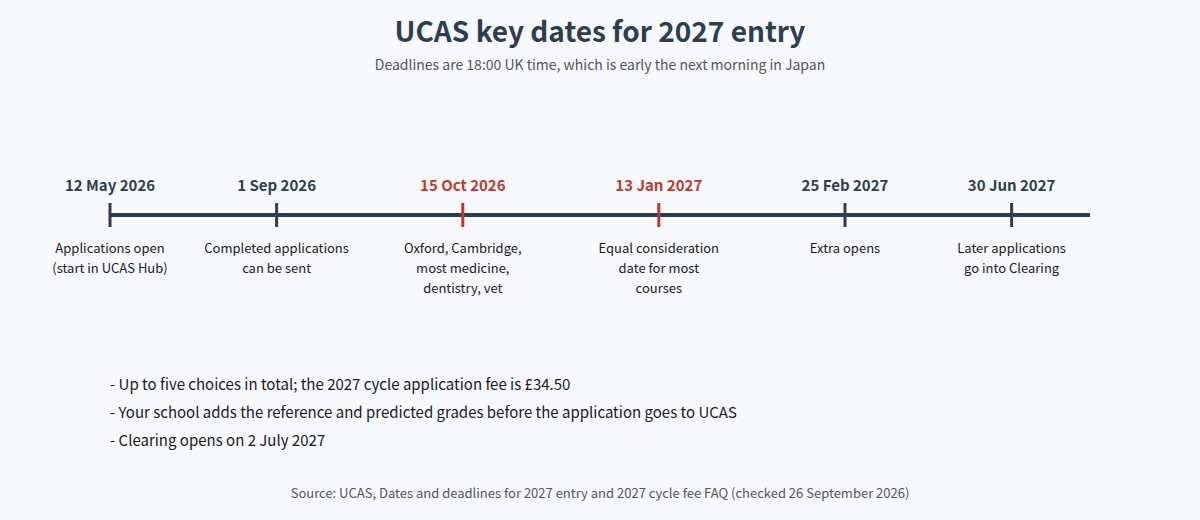
These are the dates UCAS publishes for courses starting in 2027. All deadline times are 18:00 UK time. Because Japan is ahead of the UK (by 8 hours in October during British Summer Time and 9 hours in January), 18:00 in London is already early the next morning in Tokyo, so please plan to submit at least a day early.
| Date | What happens (2027 entry) |
|---|---|
| 12 May 2026 | UCAS applications open: students can register and start the application in the UCAS Hub |
| 1 September 2026 | Completed applications can be submitted to UCAS (a reference is needed first) |
| 15 October 2026, 18:00 UK time | Equal consideration date for the universities of Oxford and Cambridge, and for most courses in medicine, dentistry and veterinary medicine/science |
| 13 January 2027, 18:00 UK time | Equal consideration date for most other undergraduate courses |
| 25 February 2027 | Extra opens (for applicants who have used all five choices and hold no offers) |
| 30 June 2027, 18:00 UK time | Applications received by this time are sent to universities; later applications go into Clearing |
| 2 July 2027 | Clearing opens |
Source: UCAS: Dates and deadlines (checked 26 September 2026).
What does “equal consideration” mean? UCAS says applications that arrive by this time are guaranteed equal consideration. Universities can still consider later applications if they have places, but they are not guaranteed to. For popular courses, applying after the deadline is a real risk, so it is best to treat these dates as the true deadlines.
Note the word “most” for medicine, dentistry and veterinary courses: check each course’s deadline in the UCAS search tool.
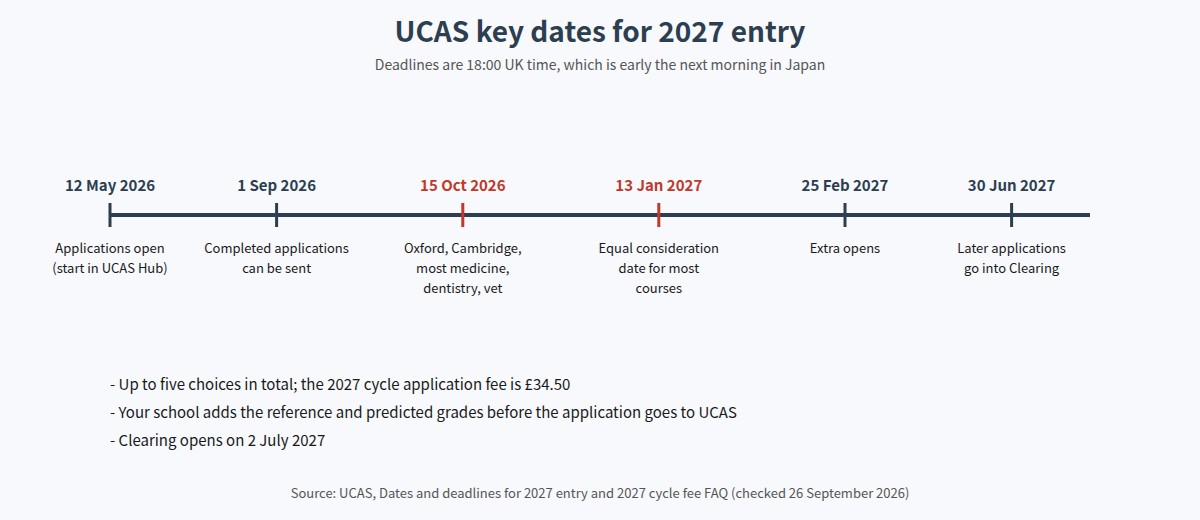
As Figure 1 shows, the two red dates matter most. If Oxford, Cambridge or medicine is on the list, the whole application, including the reference, has to be ready by mid-October of G12, only a few weeks into the final DP year.
The personal statement: three questions from 2026 entry onwards
The personal statement changed recently. Instead of one long essay, applicants for 2026 entry onwards (so 2027 entry too) answer three questions. UCAS lists them as:
- Question 1: “Why do you want to study this course or subject?”
- Question 2: “How have your qualifications and studies helped you to prepare for this course or subject?”
- Question 3: “What else have you done to prepare outside of education, and why are these experiences useful?”
The overall limit stays at 4,000 characters including spaces, and each answer needs at least 350 characters. The rest can be divided however your child likes (UCAS: How to write your personal statement, 2026 entry onwards).
For IB students, this format is quite friendly. Question 2 is a natural place to talk about what they learned in their HL subjects, an Internal Assessment or the Extended Essay, and Question 3 about activities outside school. This is our suggestion rather than UCAS wording, but CAS experiences can also give concrete material, as long as they are linked to the course. Remember that one statement goes to all five choices, which is one reason families often keep the five choices in a similar subject area.
The reference and predicted grades
Because IB students apply before they have their final results, UK universities rely heavily on the school reference and predicted grades. UCAS explains that if the referee is one of your child’s teachers, they can add predicted grades for the qualifications being studied now, and that the school adds the reference and predicted grades after reviewing the application.
For schools, UCAS now asks for the reference in three sections. The first is a general statement about the school, and UCAS notes that for students outside the UK school system it helps to include an overview of the qualifications offered. The other sections cover any circumstances that affected the student’s studies and information about the applicant relevant to the course. If your child attends a school in Japan with few UK applicants, a clear school description helps admissions tutors understand the context.
It is worth asking the DP coordinator or university counsellor early how and when predicted grades are set at your child’s school.
What IB scores do UK universities ask for?
UK universities state IB requirements as a total points score out of 45 plus grades in the three Higher Level (HL) subjects, often with a required grade in a specific subject. “766” means 7, 6 and 6 in the three HL subjects. Here are examples published for 2027 entry:
| University and course | Published IB requirement (2027 entry) | Other points |
|---|---|---|
| University of Cambridge (all courses) | Minimum offer levels are 41-42 points out of 45, with 776 at HL | Some Colleges may ask for 777 or a higher total; Churchill, Corpus Christi and Selwyn usually make offers above the minimum |
| Imperial College London: Mechanical Engineering MEng | Minimum 40 points with 6 in HL Mathematics and 6 in HL Physics; typical offer 40 points with 7 in both | Admissions test (ESAT) and interview; Mathematics: Analysis and Approaches preferred |
| University of Oxford: Economics and Management | 39 (including core points) with 766 at HL | Mathematics at HL (6 or 7) required; UCAS deadline 15 October 2026 |
| LSE: BSc Economics | 39 points overall, 766 at HL with 7 in Mathematics | TMUA (Test of Mathematics for University Admission) is mandatory; deadline 13 January 2027 |
| UCL: Economics BSc (Econ) | 39 points, with a total of 19 in three HL subjects including 7 in Mathematics and no HL score below 5 | TMUA required for the 2027 cycle; either HL Mathematics course accepted |
Sources: each university’s admissions or course page, 2027 entry (checked 26 September 2026). Links are listed at the end.
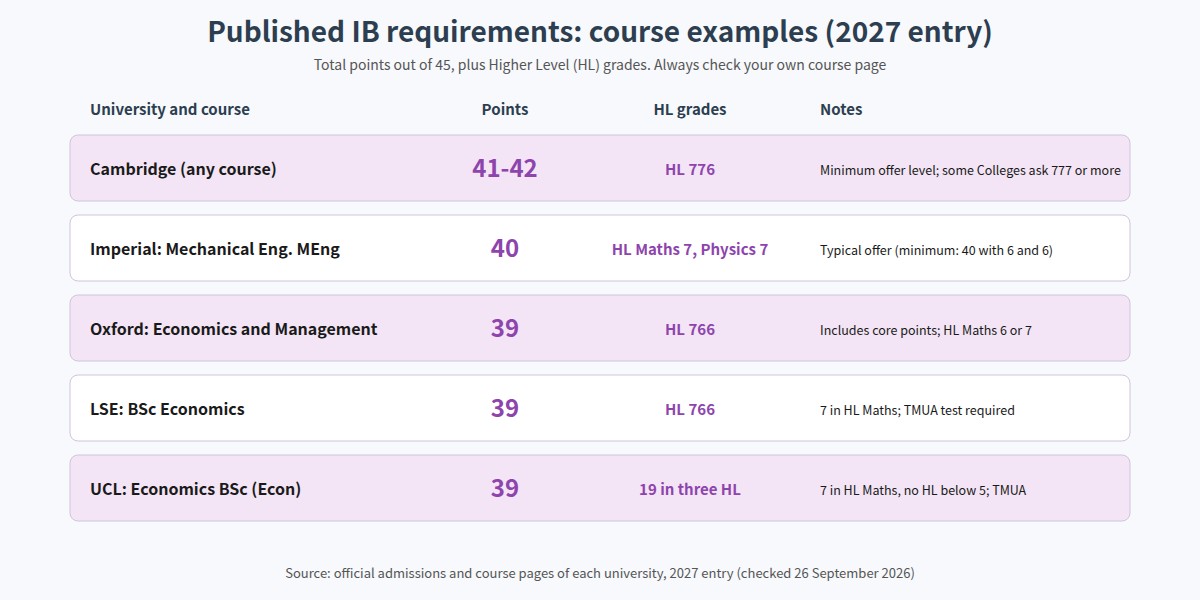
Figure 2 makes a few patterns visible. First, HL grades matter as much as the total: a 40 with the wrong HL profile may not meet an offer that a 39 with 766 would. Second, subject requirements are specific. All three economics courses here want HL Mathematics, and Imperial’s engineering course wants HL Mathematics and HL Physics. That is why the UK plan should start before your child chooses DP subjects in G10. Third, several courses add an admissions test (such as the TMUA or ESAT) with its own registration dates, so check these early.
Please read the table as examples, not as a ranking: requirements are set course by course and year by year.
English language requirements for IB students
If English is not your child’s first language, universities will usually ask for evidence of English. The good news for IB students is that IB English subjects are often accepted, so a separate IELTS test may not be needed. The accepted grades differ by university:
- Imperial: English A: Literature or English A: Language and Literature at grade 4 (SL or HL); English B at grade 6 (SL) or 5 (HL). The IELTS alternative is 6.5 overall with at least 6.0 in each element (standard requirement) or 7.0 with at least 6.5 (higher requirement)
- LSE: English A (Literature, Language and Literature, or Literature and Performance) at any grade at HL or at least 6 at SL; English B at 7 at HL. IELTS is 7.0 overall with 7.0 in each component, in one sitting
- UCL: requirements depend on the course’s English “level”. For Level 2 (the level for Economics BSc (Econ)), English A: Literature or Language and Literature at grade 5 (HL or SL) or English B at 6 (HL) or 7 (SL). The Level 2 IELTS score is 7.0 overall with at least 6.5 in each component
- Cambridge: if an offer includes an English language condition, the College that makes the offer decides what the condition will be. The minimum IELTS Academic requirement is normally 7.5 overall, usually with 7.0 or above in each element
- Oxford: the Economics and Management page states that evidence of English is not needed when applying through UCAS, and that “All courses now require the higher level of ability in English”. Check Oxford’s English language page for the accepted qualifications
For the Student visa, GOV.UK requires English at CEFR level B2 for degree-level study, and a university can assess this itself. In practice, meeting the university’s own requirement is what counts for the offer.
How much does it cost? International tuition fee examples
Whether you pay “Home” or “Overseas” fees depends on your child’s fee status, which universities assess from nationality, residence and immigration status, not just from where your child went to school. Families living in Japan should expect the Overseas fee to apply in many cases, but please check each university’s fee status guidance for your own situation. For comparison, the Home fee for 2027 entry is expected to be £10,050 per year.
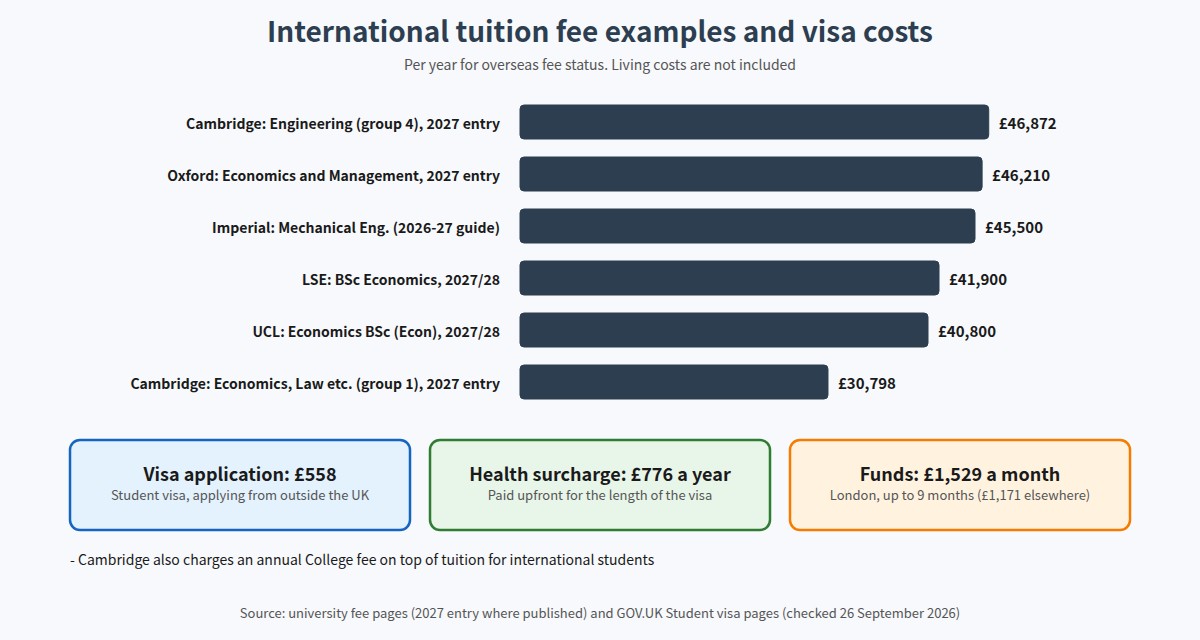
| University and course | Year | International / overseas tuition (per year) |
|---|---|---|
| Cambridge: fee group 4 (e.g. Engineering, Computer Science, Natural Sciences) | 2027 entry | £46,872, plus an annual College fee |
| Oxford: Economics and Management | 2027 entry | £46,210 |
| Imperial: Mechanical Engineering MEng | 2027 entry not set; 2026-27 shown as a guide | £45,500 (2026-27) |
| LSE: BSc Economics | 2027/28 entrants | £41,900 (stays the same for later years) |
| UCL: Economics BSc (Econ) | 2027/28 entrants | £40,800 |
| Cambridge: fee group 1 (e.g. Economics, English, Law, History) | 2027 entry | £30,798, plus an annual College fee |
Sources: Cambridge International fees and costs; Oxford, Imperial, LSE and UCL course pages (checked 26 September 2026).
Cambridge says its international tuition fees are fixed for the duration of the course, and that international students normally also pay an annual College fee, which varies by College. Oxford estimates living costs for 2027-28 at between £1,475 and £2,175 for each month in Oxford. Course length also matters: Oxford’s Economics and Management is a three-year course, while Imperial’s Mechanical Engineering MEng lasts four years, so multiply the yearly figures accordingly when you plan.
The UK Student visa: the basics
After your child accepts an offer and meets its conditions, the next step is the Student visa (the Student route). According to GOV.UK (checked 26 September 2026):
- Who can apply: students aged 16 or over with an unconditional offer from a licensed student sponsor, enough money, and the required English level. Applicants aged 16 or 17 also need parental consent
- CAS: the university issues a Confirmation of Acceptance for Studies, a reference number that is entered in the visa application
- When to apply: from outside the UK, the earliest is 6 months before the course starts; a decision usually comes within 3 weeks
- Application fee: £558 when applying from outside the UK
- Immigration Health Surcharge (IHS): £776 per year for students, paid with the application; the total depends on the length of the visa
- Money you need: the course fees for the first year still unpaid, plus living costs of £1,529 per month for courses in London or £1,171 per month elsewhere, for up to 9 months. The money must be held for at least 28 days in a row, ending within 31 days of the application date
- Arrival: for courses longer than 6 months, you can arrive up to 1 month before the course starts
Here is a simple worked example for a London course. For UCL Economics (2027/28), the first-year tuition is £40,800 and living costs are 9 months × £1,529 = £13,761, so the amount to show would be £54,561, minus any tuition already paid to the university. For a course outside London, the living cost part is 9 × £1,171 = £10,539. Your CAS will state the amounts the university has recorded.
One more point for later: GOV.UK says the Graduate visa after a degree will allow 18 months of stay for applications made on or after 1 January 2027 (it is 2 years for applications on or before 31 December 2026).
A G10 to G12 timeline for a DP student in Japan
Here is how the UCAS calendar fits onto the DP for a student who will sit the IB exams in the May 2027 session. School calendars in Japan differ (many international schools start in August, while Japanese Article 1 schools start in April), and some schools take the November exam session instead, so adjust the timing to your school.
- G10 (before the DP): look at UK course pages together and note required HL subjects (for example, HL Mathematics for economics, HL Mathematics and Physics for engineering). This is the moment when subject choices can still be adjusted
- G11 (DP year 1): shortlist courses, check whether an admissions test (such as the TMUA or ESAT) is required and when to register, and start drafting the three personal statement answers over the summer
- G12 autumn (September to January): school internal deadline, reference and predicted grades; submit by 15 October 2026 for Oxford, Cambridge or most medicine, otherwise by 13 January 2027; admissions tests and interviews where required
- G12 spring to summer: offers arrive and are answered in the UCAS Hub; IB exams in the May 2027 session; results in the summer confirm the place; then CAS, the visa application and travel
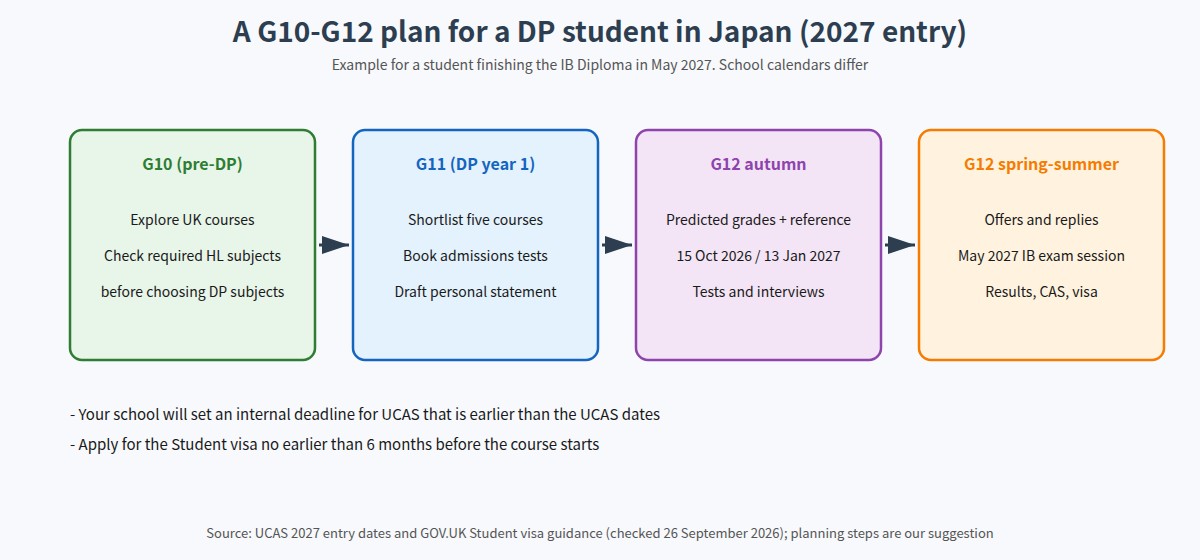
G12 autumn is the busiest stretch, because DP coursework such as the EE and Internal Assessments is often due around the same time. Starting the personal statement in the summer before G12 helps a lot.
Questions parents often ask
How many IB points does my child need for a UK university?
It depends on the course. The examples above for 2027 entry range from 39 points (Oxford Economics and Management, LSE Economics, UCL Economics) to 40 (Imperial Mechanical Engineering) and 41-42 (Cambridge’s minimum offer level), each with HL grade conditions. Many other UK courses publish lower requirements, so look at a range of course pages.
Can my child apply to both Oxford and Cambridge?
No. Cambridge’s UCAS application page states, “You cannot apply to Cambridge and Oxford in the same year”, and you can only submit one application to Cambridge in a year. Both use the 15 October 2026 UCAS deadline for 2027 entry, so this choice needs to be made in the summer before G12.
Does my child need IELTS if they take IB English?
Often not. Many universities accept IB English A or English B at a stated grade, as shown above. The required grade varies by university and course, so check the English language page for each one.
Is studying at an IB school in Japan a disadvantage?
The universities in this guide list the IB Diploma as an accepted qualification without a separate route for IB students, and UCAS invites schools outside the UK to describe their qualifications in the reference. What matters is meeting the course’s points, HL and subject requirements and presenting a strong application.
Summary
- One application, five choices: apply through UCAS; the 2027 cycle fee is £34.50
- Two key deadlines: 15 October 2026 (Oxford, Cambridge, most medicine, dentistry and veterinary courses) and 13 January 2027 (most other courses), both 18:00 UK time
- New personal statement: three questions, 4,000 characters in total, at least 350 characters each
- IB requirements: total points plus HL grades and specific subjects; for example 39 with 766 at HL (Oxford Economics and Management, 2027 entry) or 41-42 with 776 (Cambridge minimum)
- Costs: international tuition examples from £30,798 to £46,872 per year for 2027 entry, plus living costs and visa costs (£558 application fee, £776 a year health surcharge)
- Start early: DP subject choices in G10 shape which UK courses are open later
The UK is a natural next step for many IB students, because universities there read the IB Diploma directly. Sit down with your child, open two or three course pages together and look at the points, HL subjects and deadlines. That one conversation often makes the whole plan much clearer.
Sources and references
- UCAS: Dates and deadlines for uni applications
- UCAS: 2027 entry deadline for Oxford, Cambridge and most medicine, veterinary and dentistry courses
- UCAS: 2027 entry deadline for all other undergraduate courses
- UCAS: What is the application fee for the 2027 cycle?
- UCAS FAQ: choices for medicine, dentistry and veterinary courses
- UCAS: How to write your personal statement for 2026 entry onwards
- UCAS: How to get a UCAS reference
- UCAS: Undergraduate references (guidance for schools)
- University of Cambridge: Accepted qualifications
- University of Cambridge: Entry requirements (English language)
- University of Cambridge: Your UCAS application
- University of Cambridge: International fees and costs
- University of Oxford: Economics and Management
- University of Oxford: English language requirements
- Imperial College London: Mechanical Engineering MEng
- Imperial College London: English language requirements
- LSE: BSc Economics
- LSE: English language requirements
- UCL: Economics BSc (Econ)
- UCL: English language requirements
- GOV.UK: Student visa
- GOV.UK: Student visa, money you need
- GOV.UK: Student visa, knowledge of English
- GOV.UK: Immigration Health Surcharge, how much you have to pay
This article is based on official information checked on 26 September 2026. Deadlines, entry requirements, fees and visa rules can change, so please confirm the latest details with UCAS, each university and GOV.UK before applying.
コメント