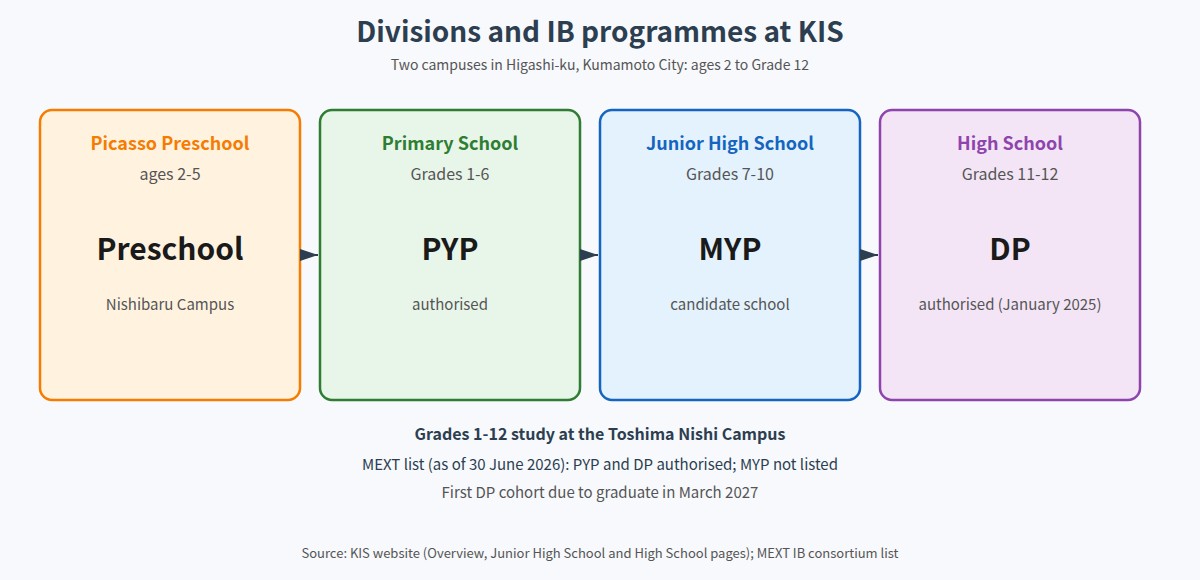
Kumamoto International School (KIS) is an IB World School in Higashi-ku, Kumamoto City, that takes children from age 2 in its Picasso Preschool through to Grade 12. If your family is moving to Kumamoto, perhaps for work in the region, or you live elsewhere in Kyushu and are looking for an IB school, you have probably come across its name. This guide brings together what the school publishes about its IB programmes, fees for the school year starting in April 2027, admissions and student life, so you can decide whether it is worth a visit.
Everything below comes from the school’s official website, its Application Guidelines for the 2027 Academic Year and the Japanese Ministry of Education (MEXT) IB consortium list, all checked on 26 September 2026. One thing to keep in mind from the start: KIS follows the Japanese school calendar, so its school year runs from April to March, not August to June. Fees and dates change every year, so please treat this as a starting point and confirm the details with the admissions office before you apply.
KIS at a glance
Here is the basic picture. The school says it was established in 2003 with 15 students in its Picasso Preschool, and it has grown step by step since then into a school that now runs up to Grade 12. The “KIS in numbers” section of its website gives 300 students from preschool to Grade 10, 19 countries represented and 60 staff, although the page does not say which year those figures refer to.
| Item | Details |
|---|---|
| School name | Kumamoto International School (KIS), 熊本インターナショナルスクール |
| Location | Higashi-ku, Kumamoto City: Nishibaru Campus (preschool) and Toshima Nishi Campus (Grades 1 to 12) |
| Ages and grades | Preschool (ages 2 to 5), Primary (Grades 1 to 6), Junior High (Grades 7 to 10), High School (Grades 11 and 12) |
| IB programmes | PYP and DP authorised (MEXT list, as of 30 June 2026); the school describes itself as an MYP candidate school |
| Legal status in Japan | Kakushu Gakko (miscellaneous school) approved by Kumamoto Prefecture on 10 March 2023; not an Article 1 school |
| Languages | IB programmes taught in English; Japanese and Mandarin Chinese classes |
| School year | April to March |
| Class size | Up to 35 per class in Grades 1 to 12; preschool capacity of 30 per class |
| Boarding | Dormitory for Grades 10 to 12, opened in April 2026 |
IB programmes at KIS
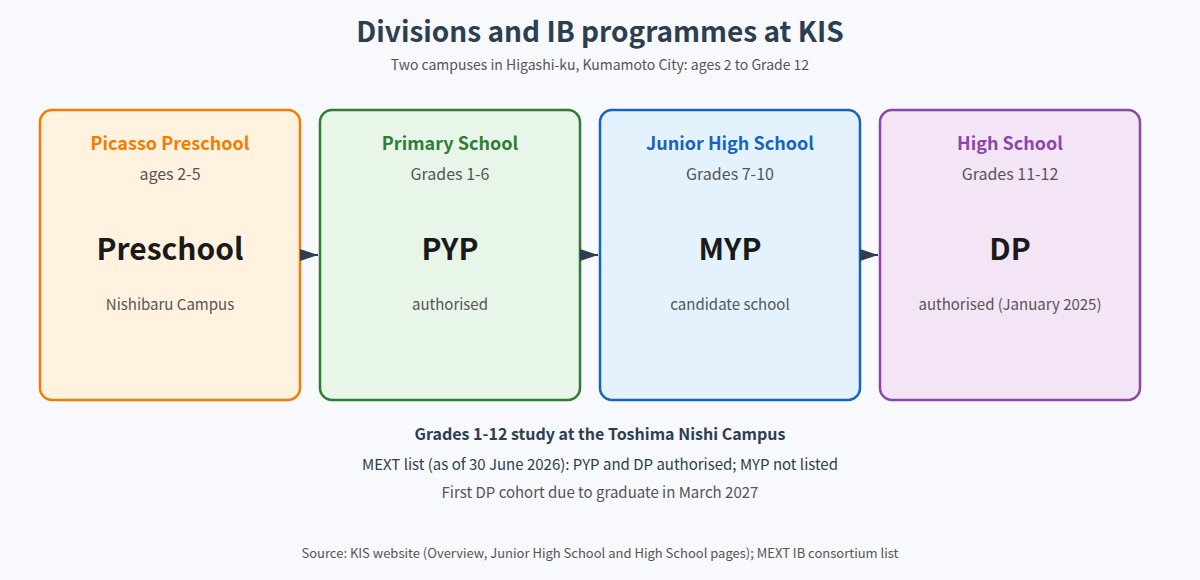
As Figure 1 shows, KIS is organised in four divisions. Not every division is at the same stage with the IB, so let’s go through them one by one.
Primary School: the PYP (Grades 1 to 6)
The Primary Years Programme (PYP) is authorised, and the MEXT list shows it as such. In the PYP, children learn through “units of inquiry” that cross subject boundaries. In the final year, Grade 6 students work on a year-long research project, the PYP Exhibition, and present it before they move up.
Junior High School: MYP candidate (Grades 7 to 10)
KIS runs a four-year Middle Years Programme curriculum for Grades 7 to 10 and states that it is “currently a candidate school for MYP”. Being a candidate is not the same as being authorised: the school’s own page notes that candidate status does not guarantee authorisation, and the MEXT list (as of 30 June 2026) does not show the MYP for KIS. The curriculum covers the eight MYP subject groups, with Language and Literature and Language Acquisition offered in English, Japanese and Mandarin, and a Design course built around digital design tools such as Photoshop and Illustrator.
High School: the IB Diploma (Grades 11 and 12)
The Diploma Programme (DP) is new at KIS. The High School page says the school became an authorised DP school in January 2025, and its first DP cohort is due to graduate in March 2027. No DP scores have been published yet, and we found no list of university destinations, so we cannot report any results in this guide.
The High School page lists this DP offering:
- Language A (Language and Literature): English, Japanese and Chinese.
- Language B: English and Japanese.
- Individuals and Societies: Business Management (SL/HL). Digital Society, Economics and Psychology are available through Pamoja online courses for an additional fee.
- Sciences: Biology, Chemistry and Physics (all SL/HL).
- Mathematics: Analysis and Approaches (SL/HL).
- Arts: Visual Arts (SL/HL).
Students choose between two tracks. Course A is for science and engineering and replaces the arts subject with a second science. Course B is for the humanities and arts and includes Visual Arts, which the school describes as a way to build a portfolio for art, design or architecture. All students also complete the DP core: the Extended Essay (up to 4,000 words), Theory of Knowledge and CAS (Creativity, Activity, Service). The school says dedicated counsellors support university applications in Japan and overseas.
Tuition and fees for the 2027 academic year
Now for the question every parent asks. On its Admissions page, KIS lists fees for Grades 1 to 12 that apply “from April 2027”, that is, the 2027 academic year (April 2027 to March 2028). We could not find a published fee table for the current 2026 academic year, so the figures below are the ones that apply to families applying now for April 2027 entry.
| Fee (2027 academic year) | Primary (Grades 1 to 6) | Junior High and High School (Grades 7 to 12) |
|---|---|---|
| Application fee (one-time, non-refundable) | ¥15,000 | ¥15,000 |
| Entrance fee (one-time, non-refundable) | ¥300,000 | ¥300,000 |
| Tuition | ¥83,000 a month | ¥83,000 a month |
| Facility maintenance fee | ¥340,000 a year | ¥340,000 a year |
| Curriculum and material fees | ¥70,000 a year | ¥200,000 a year (including textbooks) |
| DP programme fees (High School only) | Not applicable | About 1,258 US dollars in total over two years |
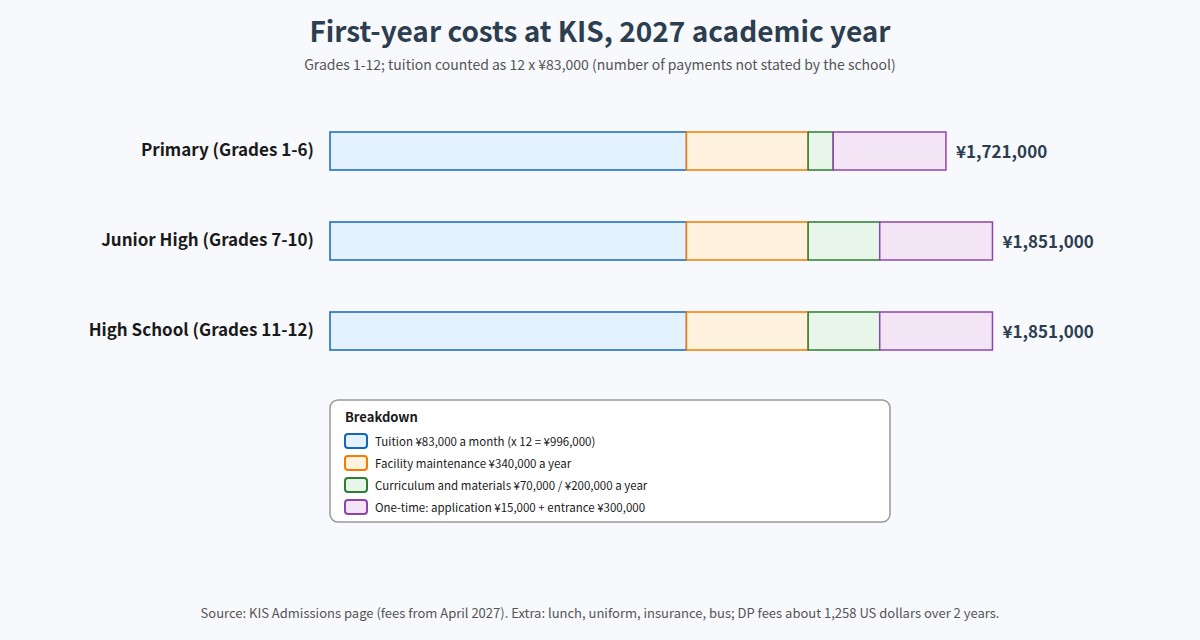
To put these together, we have assumed twelve monthly tuition payments (¥996,000 a year), because the page gives a monthly amount but does not say how many months are billed, so please confirm this with the school. On that basis, the first year for a new Primary student in the 2027 academic year adds up to ¥1,721,000 (¥15,000 application + ¥300,000 entrance + ¥996,000 tuition + ¥340,000 facility maintenance + ¥70,000 curriculum and materials). For Junior High and High School it is ¥1,851,000, because the curriculum and material fee is ¥200,000. From the second year, the ongoing cost would be ¥1,406,000 a year for Primary and ¥1,536,000 for Grades 7 to 12. Figure 2 shows the breakdown.
A few more details from the same page:
- Sibling discounts (as given on the Japanese Admissions page, since the English page has a typo here): tuition drops to ¥49,000 a month from the second child, and the facility maintenance fee drops to ¥210,000 a year from the third child.
- Not included: lunch, uniform, insurance, personal art supplies and school supplies.
- School bus: ¥13,000 a month per student at the current rate (see “Getting to KIS” below).
- Language support classes: the Application Guidelines say these carry an additional fee, but the amount is not published.
- The page does not say whether the amounts include consumption tax.
Preschool fees
For the Picasso Preschool, the Admissions page lists a one-time admission fee of ¥100,000, a childcare fee of ¥70,000 a month (¥56,000 from the second child), a facility fee of ¥45,000 a year, insurance of ¥1,150 a year, school lunch at ¥440 a day and a parent association fee of ¥300 a month. The fee table has no year label on either the English or Japanese Admissions page, though it sits below the 2027 preschool eligibility list, so please confirm which year it applies to.
Admissions: who can apply and how it works
Places and age
According to the 2027 Academic Year Application Guidelines, KIS plans to take about 35 new Grade 1 students, about 15 new Grade 7 students and about 20 new Grade 11 students, with limited places in other grades depending on class availability. Age is counted as of 1 April of the year your child will join. High School entry is normally into Grade 11 in April. KIS does not usually accept Grade 12 applicants, except students already enrolled in the IB Diploma at their current school whose subjects match those offered at KIS. KIS also accepts applications to join partway through the school year, so contact the admissions office if you are arriving mid-year.
English requirements
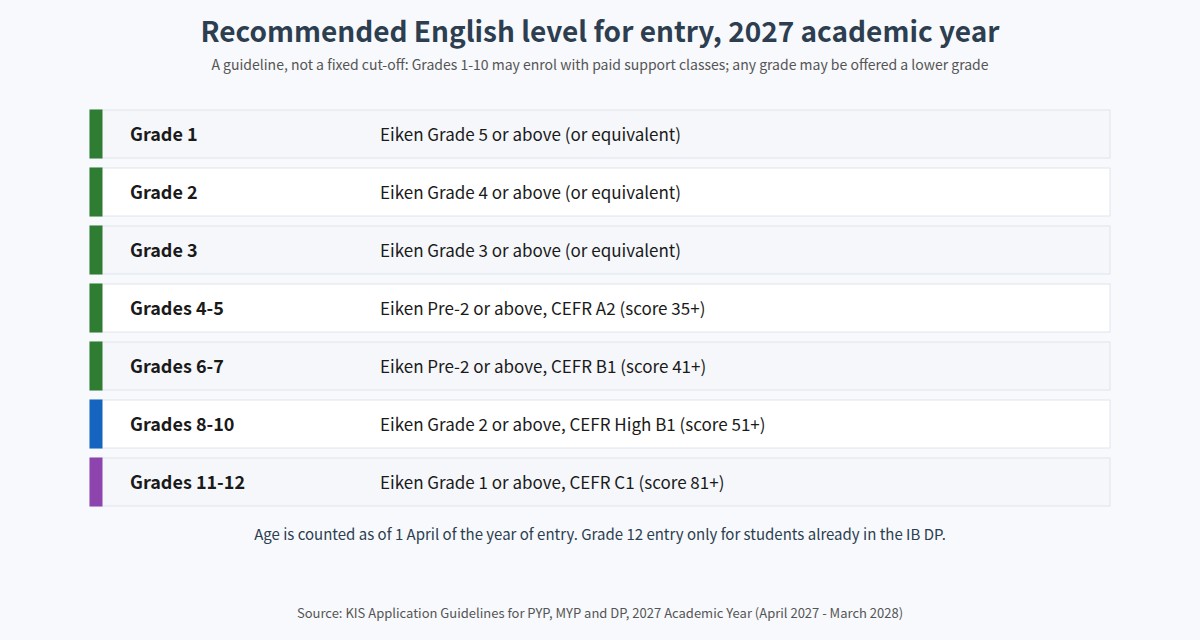
The Application Guidelines give a “recommended” English level for each grade, using Japan’s Eiken test and CEFR scores (Figure 3). It starts at Eiken Grade 5 for Grade 1 and rises to Eiken Grade 1 or CEFR C1 (score 81+) for Grades 11 and 12. These are recommendations rather than strict cut-offs:
- Primary and Junior High: a child below the recommended level may be allowed to enrol on the condition that they attend KIS language support classes until they reach the required level. These classes carry an additional fee.
- All divisions: an applicant below the recommended level may be offered a place in a lower grade instead.
- After admission (Primary and Junior High): teachers may also require language support if later assessment shows a need.
For the Diploma, the recommended level is high, and the DP guidelines do not mention the conditional language-support route, so if your teenager is still building their English, it is worth talking to the school early about the options.
Steps and timeline
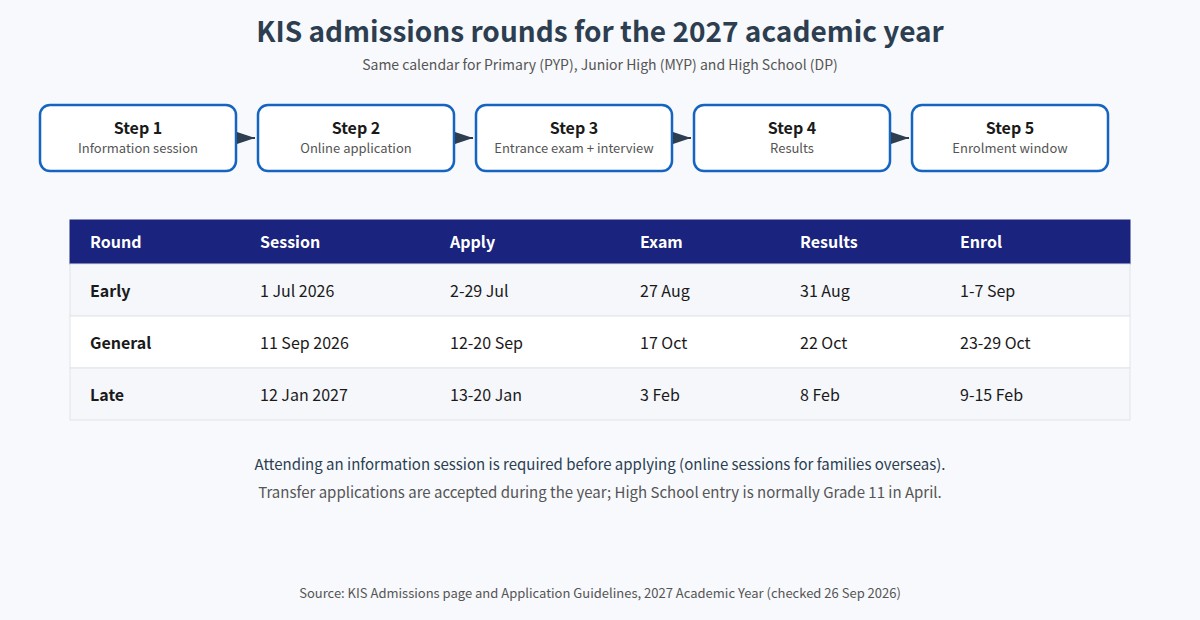
The process has five steps, and the first one matters most: KIS requires parents to attend an admissions information session before applying, and says it will not accept applications from families who have not attended one. The QR code for the online application is handed out at the session. Families overseas who cannot come in person may request an online session. After the session you apply online, your child sits the entrance examination and interview, results are announced, and you complete enrolment within a short window.
For April 2027 entry there are three rounds, with the same calendar for Primary, Junior High and High School (Figure 4). As of late September 2026, the Early round has finished and the General round’s application period (12 to 20 September 2026) has closed, with its exam on 17 October. The Late round is the next opportunity: information session on 12 January 2027, applications from 13 to 20 January, exam on 3 February, results on 8 February and enrolment from 9 to 15 February 2027.
Documents and assessment
You upload the application form, a passport-size photo, a family and health questionnaire, Eiken or other English test results (if you have them) and your child’s current school contact details, and pay the ¥15,000 application fee. Your child’s current school must send the most recent report card and a School Recommendation Form directly to KIS, in English, and the application is not complete until it arrives. Junior High applicants also write an English essay of about 500 words on the topic “What is one skill you believe every student should learn before finishing school, and why?”
The exam depends on the division:
- Primary: English and Mathematics, plus Japanese for children whose native language is Japanese, and an interview of about five minutes with the child and one parent.
- Junior High: the same subjects, plus an interview of about ten minutes with the student alone, who should be ready to talk about their essay.
- High School: English (including an essay, 90 minutes), Mathematics (70 minutes) and Science covering Biology, Chemistry and Physics (90 minutes), plus an interview of about ten minutes with the student alone.
To secure a place, you register for automatic bank transfer, pay the ¥300,000 entrance fee by credit card and submit a signed pledge by the end of the enrolment window. The school states that the entrance fee cannot be refunded and that admissions decisions cannot be appealed.
An important note for Japanese families
KIS is a Kakushu Gakko, not an Article 1 school under Japanese law. Its Application Guidelines explain that attending KIS alone does not meet Japan’s compulsory education requirements, so Japanese nationals need to stay registered at their local public elementary or junior high school while attending KIS.
Learning support, languages and student life
KIS describes itself as a multilingual school: the IB programmes are taught in English, with Japanese classes for both native and non-native speakers (taught separately). The FAQ describes the Mandarin classes as being for native Chinese speakers, and Mandarin is also offered as an MYP Language Acquisition option. The school’s FAQ page says that many of the children who enrol at KIS are Japanese, and that communication between parents and the school is in Japanese. If your family does not speak Japanese, it is a good idea to ask the admissions office how English-speaking parents are supported.
Students in Grade 5 and above can join clubs; the FAQ listed science, art, music, debate, mathematics, volleyball and basketball as of autumn 2024. After-school care runs until 6 p.m. for an extra fee. For lunch, students in Grades 1 to 12 can bring their own or order school meals.
The Toshima Nishi Campus (5,940 square metres) has a gymnasium, a science room, a library with books in English, Japanese and Chinese, music and art rooms and a university guidance room.
The new dormitory for Grades 10 to 12
In April 2026 KIS opened a student dormitory for Grades 10 to 12, run in partnership with Kyoritsu Maintenance Co., Ltd. It is near Suizenji Station, with live-in dorm parents, private rooms (each with a desk, mini-kitchen, washing machine, shower and Wi-Fi) and breakfast and dinner included. The dormitory page lists a monthly fee of ¥95,000 and a one-time entry fee of ¥100,000, without stating a school year. It is aimed at students who live too far to commute, families relocating out of Kumamoto and students from overseas. KIS offers student visa support only to students who will live in the dormitory or who already have accommodation arranged with family or another guardian, and it notes that visa issuance is not guaranteed.
Getting to KIS
The Toshima Nishi Campus (Grades 1 to 12) is at 4-2-61 Toshimanishi, Higashi-ku, one minute on foot from the Ikejiri bus stop. The preschool is at the Nishibaru Campus, 1-22-24 Nishibaru, Higashi-ku.
KIS runs two paid school buses for students in Grade 1 and above (there is no bus for preschool children). One route serves central Kumamoto, with stops including the Harutake-machi stop in Minami-Kumamoto and Suizenji Station North Exit; the other serves Kikuyo, with stops including Hikarinomori Station North Exit and Kusunoki-danchi. The first morning pick-ups on the published timetable are at 6:52 (city route) and 7:03 (Kikuyo route). The current fee is ¥13,000 a month per student, and the school asks families to check availability directly because routes and times can change.
Questions parents often ask
My child speaks very little English. Can they still join?
For Primary and Junior High, yes, possibly: the Application Guidelines say a child below the recommended level may be admitted on condition of attending paid language support classes, or may be offered a lower grade. For the Diploma Programme, the recommended level is high (Eiken Grade 1 or CEFR C1), so an older student with limited English will find entry harder.
We are a Japanese family. Is there anything we should know?
Yes. Because KIS is not an Article 1 school, Japanese nationals of compulsory school age need to stay registered at their local public school while attending KIS. The FAQ explains that KIS reports attendance and shares report cards with that school.
Are there IB Diploma results yet?
Not yet. The DP was authorised in January 2025 and the first cohort is due to graduate in March 2027, so the first results should come after that.
Summary
- An IB school in Kumamoto from age 2 to Grade 12: PYP and DP authorised (MEXT list, June 2026), with the MYP at candidate stage.
- A new Diploma Programme: authorised in January 2025, with Language A in English, Japanese and Chinese; the first cohort graduates in March 2027, so no results yet.
- Fees for the 2027 academic year: ¥83,000 a month in tuition, plus ¥340,000 a year for facility maintenance and ¥70,000 or ¥200,000 for materials; first-year totals of about ¥1.72 million (Primary) and ¥1.85 million (Grades 7 to 12), assuming twelve monthly payments.
- Admissions: an information session is required first; the next round is the Late round in January and February 2027.
- Things to check: parent communication is in Japanese according to the FAQ, and Japanese nationals of compulsory school age must keep a local public school registration.
If KIS sounds like a good fit, the next step is to register for an information session and, if you can, visit the campus on a school day to see whether the atmosphere suits your child.
Sources and references
- Kumamoto International School: official website (checked 26 September 2026)
- KIS: School Overview
- KIS: Admissions (fees from April 2027 and 2027-2028 calendar) and the Japanese Admissions page (sibling discount figures)
- KIS: Application Guidelines for Primary Years Program, 2027 Academic Year (PDF)
- KIS: Application Guidelines for Middle Years Program, 2027 Academic Year (PDF)
- KIS: Application Guidelines for Diploma Program, 2027 Academic Year (PDF)
- KIS: Junior High School Division and High School Division
- KIS: Dormitory (Grades 10 to 12)
- KIS: FAQ
- KIS: School Bus and Toshima Nishi Campus
- KIS news: Kakushu Gakko approval (10 March 2023)
- MEXT IB Education Promotion Consortium: IB schools in Japan (as of 30 June 2026)
コメント