Tokyo’s IB Primary Years Programme (PYP) schools now number 30, from bilingual preschools that take toddlers to international schools that run all the way to Grade 12. If you are looking for an inquiry-based start for a young child, that is a lot of choice, and the schools are very different from one another. This guide lists every PYP-authorised school in Tokyo, explains what the PYP actually looks like day to day, and suggests what to ask when you visit.
The list is based on the Japanese Ministry of Education (MEXT) IB Education Promotion Consortium list as of 30 June 2026. Authorisation dates come from each school’s page on the International Baccalaureate (IB) website, and ages and grades come from each school’s official website, all checked on 26 September 2026. Ages, class structures and even campus locations change often, so please treat this as a starting point and confirm the details with the school.
If you would like the wider picture of all IB schools in Tokyo, including the Japanese high schools that offer the Diploma Programme, see our guide to IB schools in Tokyo in 2026. This article stays with the youngest learners.
- Tokyo’s PYP schools at a glance
- What is the PYP? A quick guide for parents
- Early-years PYP schools in Tokyo (16 schools)
- PYP schools with primary grades (14 schools)
- What comes after the PYP?
- How preschool PYP differs from primary PYP
- How to choose: questions to ask when you visit
- Questions parents often ask
- Summary
- Sources and references
Tokyo’s PYP schools at a glance
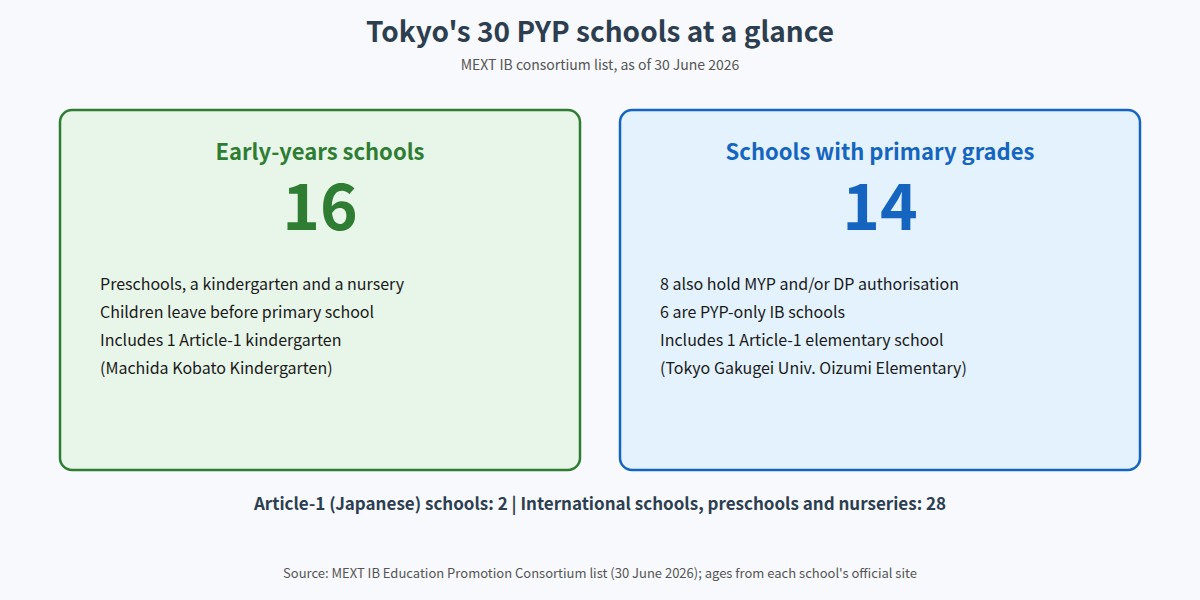
According to the MEXT consortium list (as of 30 June 2026), 30 schools in Tokyo are authorised for the PYP. Only two are Japanese “Article 1” schools, meaning schools recognised under Article 1 of the School Education Act: Tokyo Gakugei University Oizumi Elementary School and Machida Kobato Kindergarten. The other 28 are international schools, preschools and a nursery.
When we sort the 30 schools by the ages they serve, a clear split appears:
- 16 early-years schools: preschools, one kindergarten and one nursery. Children leave before primary school.
- 14 schools with primary grades: children can stay for the primary years, and 8 of these schools are also authorised for the Middle Years Programme (MYP), the Diploma Programme (DP) or both.
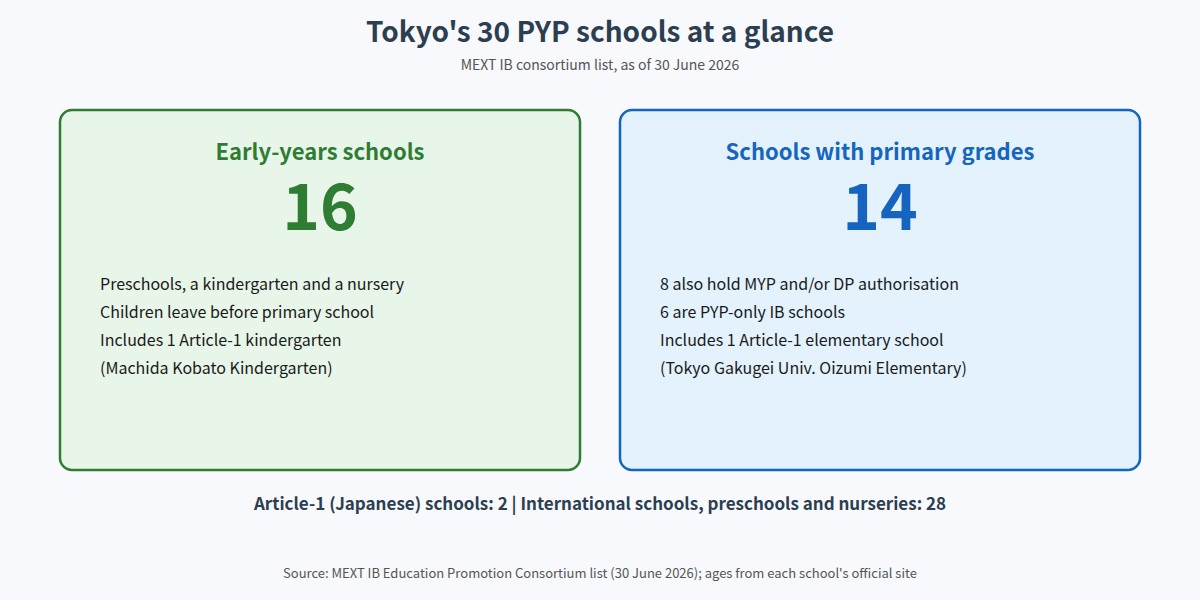
As Figure 1 shows, more than half of Tokyo’s PYP schools are for the early years only. That matters for planning: if your child starts at one of them, you will need to choose a primary school later, which may or may not be a PYP school.
What is the PYP? A quick guide for parents
The PYP is the IB’s programme for children aged 3 to 12. It is not a textbook or a set list of content. Instead, it is a framework that a school uses to design its own curriculum around inquiry, which simply means that children’s questions (“Why do leaves fall?”, “Where does our rubbish go?”) become the starting point for learning. The MEXT consortium page also notes that the PYP can be taught in any language, which is why you will find it in English, Japanese, bilingual and French-English settings in Tokyo.
Six themes instead of separate subjects only
Learning in the PYP is organised into “units of inquiry” built around six transdisciplinary themes. “Transdisciplinary” means a single unit can draw on science, language, maths, art and social studies at the same time. The IB’s six themes are:
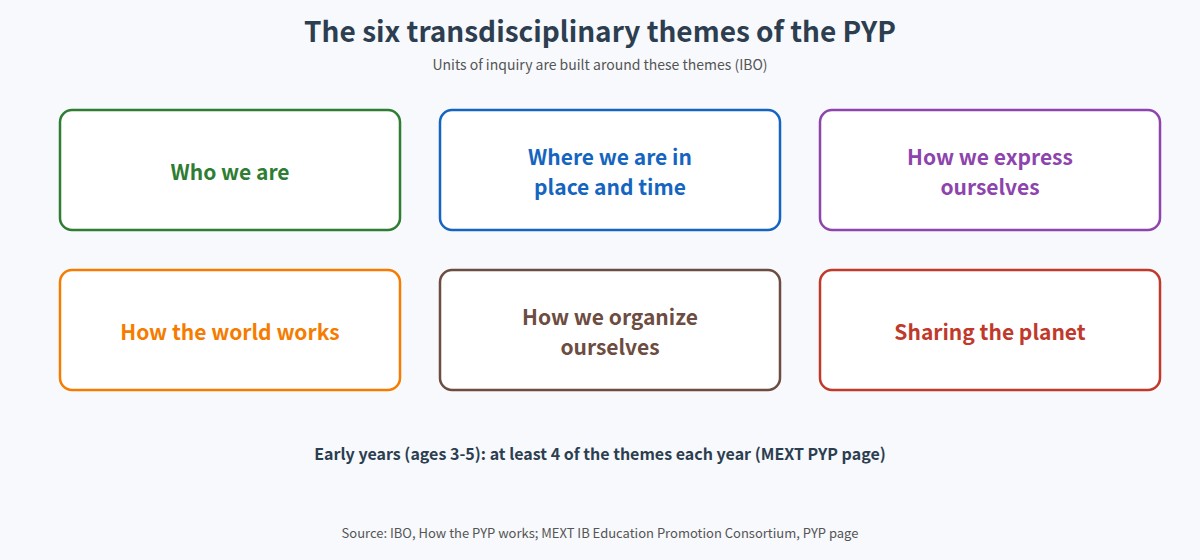
- Who we are
- Where we are in place and time
- How we express ourselves
- How the world works
- How we organize ourselves
- Sharing the planet
As Figure 2 notes, the MEXT consortium’s PYP page explains that the curriculum works through these six themes, and that in the early years (ages 3 to 5) children cover at least four of them each year. You can see this in practice at Aoba-Japan Bilingual Preschool’s Waseda campus, which says children explore four units each year starting in the K3 class.
No external exams, and an exhibition at the end
Many parents ask whether the PYP has tests. The IB does not set or mark any external exam in the PYP. Assessment is designed by each school, and its main purpose is to give children feedback on their learning. In the final year of the PYP, students complete the PYP exhibition, an extended inquiry into an issue that matters to them, which they share with the school community. Early-years-only schools do not have a final primary year, so you will usually only see the exhibition at schools that run to Grade 5 or 6.
Children as active learners
The IB also talks about “learner agency”: children having a voice and a choice in what and how they learn, with teachers acting as partners. In a real classroom this might look like a class voting on which question to investigate next, or a child choosing how to show what they learned, perhaps with a model, a drawing or a short talk.
Early-years PYP schools in Tokyo (16 schools)
These schools serve babies, toddlers and preschoolers. Ages below are what each school states on its official site. Please remember that a school’s youngest classes are not always part of its PYP: Aoba-Japan Bilingual Preschool, for example, states that 1 to 2 year olds are not eligible for the PYP, and Summerhill describes its PYP classes as starting at age 3.
| School | Area | Ages (school website) | PYP authorised (year) |
|---|---|---|---|
| Machida Kobato Kindergarten (Article 1 kindergarten, Japanese) | Machida | Kindergarten classes, plus a class for 2-year-olds | 2019 |
| Aloha International Preschool | Adachi (Kita-Senju) | Courses from 9 months, all in English | 2025 |
| Aoba-Japan Bilingual Preschool Harumi | Chuo | 1 to 6 (K1 to K5) | 2017 |
| Aoba-Japan Bilingual Preschool Waseda | Shinjuku | 1 to 6 (K1 to K5) | 2019 |
| Aoba-Japan Bilingual Preschool Mitaka | Mitaka | 1 to 6 (K1 to K5) | 2021 |
| Aoba-Japan Bilingual Preschool Nakano | Nakano | Contact the campus (becomes an Aoba-Japan International School campus on 1 April 2027) | 2022 |
| Aoba-Japan Bilingual Preschool Shimomeguro | Meguro | 2 to 6 (campus page) | 2024 |
| Aoba-Japan Bilingual Preschool Yoga | Setagaya | 1 to 6 (K1 to K5) | 2026 |
| Beyondia International School Ikebukuro | Toshima | 1 year 6 months to 5 (preschool age) | 2024 |
| Beyondia International School Meguro | Meguro | 1 year 5 months to 6 (preschool age) | 2025 |
| Keiki Intercultural Preschool | Setagaya | Early Years (ages 1 to 3); PYP for ages 3 to 6 | 2024 |
| Mizuho School | Nerima | Classes for 1-year-olds, 2-year-olds and 3 to 5 | 2016 |
| Seven Seas International School | Minato | Eligibility 18 months to 5 (new places from age 2) | 2026 |
| Summerhill International School | Minato (Moto-Azabu) | 15 months to 6; PYP classes from age 3 | 2018 |
| Willowbrook International School | Minato | About 18 months to 5 (English programme); 2 to 5 (English-Japanese dual immersion) | 2017 |
| Tokyo Aiseikai Apple Ikegami Hoikuen (nursery, Japanese) | Ota | 1-year-olds to preschool age | 2025 |
Years as shown on the IB’s school pages (checked via research on 26 Sep 2026) and, where available, the schools’ own announcements; please confirm on the IB’s Find an IB World School page.
A few points worth knowing about this group:
- Legal status varies. Machida Kobato is an Article 1 kindergarten and Apple Ikegami describes itself as a nursery school (hoikusho). Beyondia (both campuses), Aloha and Aoba-Japan Bilingual Preschool’s Waseda campus state on their official pages that they are unlicensed childcare facilities (ninkagai hoiku shisetsu), a category under Japan’s Child Welfare Act. For the other schools we could not find an official statement, so please ask. The status can affect things like childcare subsidies from your local city office.
- Japanese school-year age bands are common. Aoba-Japan Bilingual Preschool, for example, groups children by birth dates from 2 April to 1 April, following the Japanese school year, while Summerhill uses 31 August as its cut-off. If your child’s birthday falls near either date, check which class they would join.
- Keiki‘s admissions page also mentions a Keiki Primary School. However, the school says that although the PYP serves ages 3 to 12, its own PYP focuses on early learners aged 3 to 6, so we list it with the early-years schools.
- Language. Machida Kobato and Apple Ikegami teach in Japanese. Aoba-Japan Bilingual Preschool and Willowbrook’s dual immersion course are bilingual, and schools such as Aloha and Beyondia Meguro describe themselves as all-English.
PYP schools with primary grades (14 schools)
These schools take children into the primary years, and many start earlier with a preschool or kindergarten class. The “PYP grades” column shows where each school says the PYP is taught.
| School | Area | PYP grades / ages (school website) | PYP authorised (year) | Other IB (MEXT list) |
|---|---|---|---|---|
| K. International School Tokyo | Koto | K1 to Grade 5 | 2002 | DP |
| Tokyo International School | Minato (new campus at Takanawa Gateway City from the 2026-27 school year) | Kindergarten to Grade 5 | 2005 | MYP, DP |
| Seisen International School (girls) | Setagaya | Kindergarten to Grade 5 | 2007 | MYP, DP |
| Canadian International School Tokyo | Shinagawa, Meguro | Kindergarten to Grade 5 | 2009 | None |
| Shinagawa International School | Shinagawa | Preschool to Grade 5 | 2015 | MYP, DP |
| Aoba-Japan International School | Nerima (Hikarigaoka) | Ages 3 to 12 | 2015 | MYP, DP |
| Global Indian International School Tokyo | Edogawa | Grades 1 to 5 | 2020 | DP |
| Yoyogi International School | Shibuya | Grades 1 to 5 (Secondary School runs Grades 6 to 9) | 2021 | None |
| Tokyo Gakugei University Oizumi Elementary School (Article 1, national) | Nerima | Japanese elementary school, Grades 1 to 6 | 2022 | None |
| Tokyo West International School | Hachioji | Ages 3 to 12 | 2022 | None |
| Capital Tokyo International School | Minato (Minami-Azabu) | Primary years | 2025 | MYP |
| Malvern College Tokyo | Kodaira | Prep years | 2025 | MYP, DP |
| Sakura International School | Minato (Minami-Azabu) | Elementary school, opened in 2021 (run by Kansai Kokusai Gakuen) | 2025 | None |
| Ecole Internationale Franco-Japonaise | Kita | Primary, ages 6 to 11 | 2026 | None |
Years as shown on the IB’s school pages (checked via research on 26 Sep 2026) and, where available, the schools’ own announcements; please confirm on the IB’s Find an IB World School page.
The earliest PYP authorisation in Tokyo belongs to K. International School Tokyo, in 2002. At the other end, several schools are very new to the programme: Ecole Internationale Franco-Japonaise, Seven Seas International School and Aoba-Japan Bilingual Preschool’s Yoga campus were all authorised in 2026.
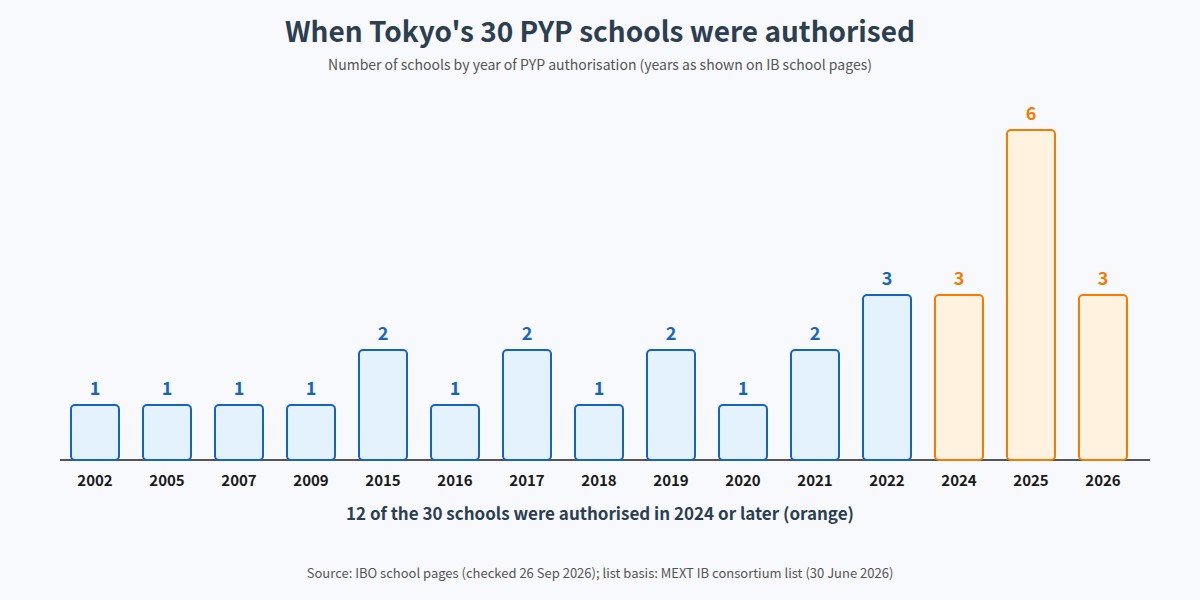
Figure 3 shows how fast the list has grown: 12 of the 30 schools were authorised in 2024 or later. A newer authorisation does not mean a weaker programme, and an older one does not guarantee a better fit. Every IB school goes through regular evaluation after authorisation. It does, however, mean that some schools are still settling into the programme, so it is fair to ask how long the current PYP coordinator and teachers have worked with it.
What comes after the PYP?
This is the question that shapes a family’s plans most. Among the 14 schools with primary grades, what happens after Grade 5 or 6 differs a great deal.
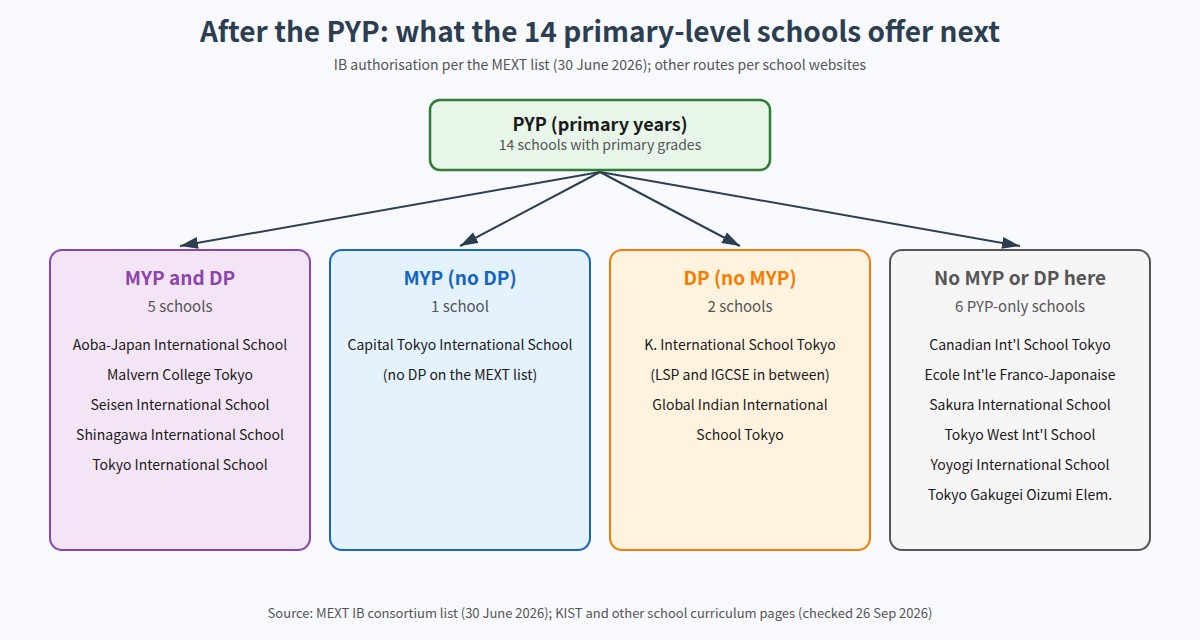
- MYP and DP at the same school (5 schools): Aoba-Japan International School, Malvern College Tokyo, Seisen International School, Shinagawa International School and Tokyo International School are all authorised for the PYP, MYP and DP on the MEXT list. A child could, in principle, follow IB programmes from the early years to the end of high school. Two of these DPs are recent: Malvern College Tokyo describes itself as an “IB World School (PYP, MYP and DP)” on its homepage, and its DP authorisation is recent (on the MEXT list as of 30 June 2026); Tokyo International School’s DP was authorised in 2025.
- MYP but no DP (1 school): Capital Tokyo International School is authorised for the PYP and MYP but not the DP on the MEXT list, so ask what it plans for the high school years.
- DP but no MYP (2 schools): K. International School Tokyo teaches its own Lower Secondary Programme (Grades 6 to 8) and IGCSE (Grades 9 and 10) before the DP. Global Indian International School Tokyo offers a Cambridge and IGCSE route before the DP, and also runs a separate CBSE (Indian curriculum) track.
- No MYP or DP at the school (6 schools): Canadian International School Tokyo continues with a Canadian (Prince Edward Island) curriculum after the PYP. Tokyo West International School continues to Grade 12 with its own programme, and Yoyogi International School’s Secondary School covers Grades 6 to 9; it is not authorised for the MYP on the MEXT list. Ecole Internationale Franco-Japonaise continues with a French-based curriculum and says it is a candidate school for the MYP (candidate status does not guarantee authorisation). Oizumi Elementary is a six-year Japanese elementary school, so children move on to a junior high school. For Sakura International School, please ask what it offers after the primary years.
None of this makes one route better than another. It simply means that if your child joins at age 3, you should ask on day one what the school offers at age 11 or 12.
How preschool PYP differs from primary PYP
The PYP is a single programme for ages 3 to 12, but it looks quite different at each end. As Keiki’s website puts it, quoting the IB, the PYP “acknowledges the unique needs of early learners, aged 3 to 6 years”, with play as a key way of inquiring.
- Play and routines at the preschool end. For 3 to 6 year olds, an inquiry often grows out of play: building, digging, role play, stories and outdoor time. Keiki, for example, describes its PYP for ages 3 to 6 as play-based. Expect fewer units a year (MEXT: at least four for ages 3 to 5) and a strong focus on social skills and language.
- More structure in the primary years. From around Grade 1, units cover all six themes over the year, alongside maths and language lessons that follow the school’s scope and sequence. Projects become longer and more independent, leading up to the PYP exhibition.
- The youngest classes may sit outside the PYP. Several preschools accept children from about 9 to 18 months, but their PYP typically starts at age 3. That is not a problem, but it is good to know what you are paying for.
- Legal category. Preschools in Tokyo can be Article 1 kindergartens, licensed nurseries or unlicensed childcare facilities, while primary-level international schools are usually outside the Article 1 system (see the questions below).
How to choose: questions to ask when you visit
Because every PYP school designs its own curriculum, visits really are the best way to compare. Here are questions parents find useful:
- “Which classes are part of the PYP?” Ask which age groups are included in the school’s IB authorisation, especially at preschools that accept 1 and 2 year olds.
- “Can we see the programme of inquiry?” This is the school’s map of units across the year. Seisen, for instance, publishes a Program of Inquiry for 2025-2026 on its website.
- “What language will my child learn in, and when does a second language start?” Ask how much of the day is in English, Japanese or another language, and what support is offered if your child is new to it.
- “How do you assess and report progress?” Since there are no IB exams in the PYP, ask to see a sample report or portfolio.
- “Where do children go next?” At early-years schools, ask where graduates typically go for primary school. At primary schools, ask about the path after Grade 5 or 6.
- “What is your legal status in Japan?” This matters for childcare subsidies at preschool age and for compulsory schooling from age 6.
- “What are the fees for the year we would join?” Fees vary widely and not every school publishes them online, so ask for the fee schedule for the school year your child would join, including one-time fees.
Questions parents often ask
Is there a Japanese elementary school in Tokyo that offers the PYP?
Yes, one. According to the MEXT list (as of 30 June 2026), Tokyo Gakugei University Oizumi Elementary School in Nerima is the only Article 1 elementary school in Tokyo authorised for the PYP. It is a national school and became an IB World School in August 2022. It teaches within the Japanese elementary school system, so admissions follow the school’s own entrance procedures.
Does attending an international school count as compulsory education in Japan?
This mainly concerns families with Japanese nationality. MEXT explains that Japanese parents are obliged to have their compulsory-age children attend an Article 1 school, and it states on the consortium page that Article 1 schools have legal systems in place to ensure the quality of education. Of the 14 primary-level PYP schools in Tokyo, only Oizumi Elementary is an Article 1 school. If your child has Japanese nationality and will attend an international school from age 6, it is wise to talk to your local board of education and the school beforehand.
Can my toddler start the PYP at 1 or 2?
Many Tokyo preschools accept children that young, but the PYP itself is for ages 3 to 12. Aoba-Japan Bilingual Preschool states that 1 to 2 year olds are not eligible for the PYP, and Summerhill’s PYP classes start at age 3. Younger children usually follow the school’s own programme based on the same values, which can make the move into the PYP smoother.
Do we need to speak English at home?
Not necessarily, and this varies by school. Some PYP schools teach in Japanese (Machida Kobato Kindergarten, Apple Ikegami Hoikuen and Oizumi Elementary), some are bilingual, and some are all-English. For English-medium schools, ask what English level they expect at your child’s age and whether they offer language support.
Summary
- 30 PYP schools in Tokyo: per the MEXT list as of 30 June 2026, including only two Article 1 schools, Machida Kobato Kindergarten and Tokyo Gakugei University Oizumi Elementary School.
- 16 early-years schools and 14 schools with primary grades: 8 of the 14 also hold MYP and/or DP authorisation.
- Fast growth: 12 of the 30 schools were authorised in 2024 or later; the earliest, K. International School Tokyo, dates from 2002.
- What the PYP looks like: ages 3 to 12, six transdisciplinary themes, no IB exams, and a PYP exhibition in the final year.
- Check the details: which ages are in the PYP, the language of instruction, the school’s legal status in Japan, the route after the PYP, and the fees for the year you would join.
Every PYP school has its own character, even when the framework is the same. If a few schools on this list catch your eye, book a visit, bring your child if you can, and watch how the children talk about what they are learning. That will tell you more than any list.
Sources and references
- MEXT IB Education Promotion Consortium: IB authorised and candidate schools (as of 30 June 2026) (checked 26 September 2026)
- MEXT IB Education Promotion Consortium: PYP
- IBO: Primary Years Programme
- IBO: How the PYP works
- IBO: PYP, The learner
- IBO: About assessment
- IBO: Find an IB World School (school pages for authorisation dates)
- Tokyo Gakugei University Oizumi Elementary School: IB PYP
- Machida Kobato Kindergarten: Admissions
- Aoba-Japan Bilingual Preschool: Admission guidelines and Waseda Campus
- Beyondia International School Ikebukuro: Facility overview and Beyondia Meguro
- Keiki Intercultural Preschool: IB Program and Admissions
- Summerhill International School: Admissions
- Seven Seas International School: Admissions
- K. International School Tokyo: About KIST
- Tokyo International School: Admissions
- Seisen International School: International Baccalaureate
- Shinagawa International School: Admissions FAQs
- Canadian International School Tokyo: History
- Global Indian International School Tokyo: Curriculum pathways
- Yoyogi International School: Primary Years Programme and Secondary School Programme
- Sakura International School (Kansai Kokusai Gakuen): History
- Ecole Internationale Franco-Japonaise: official website
- Malvern College Tokyo: official website and Curriculum
コメント