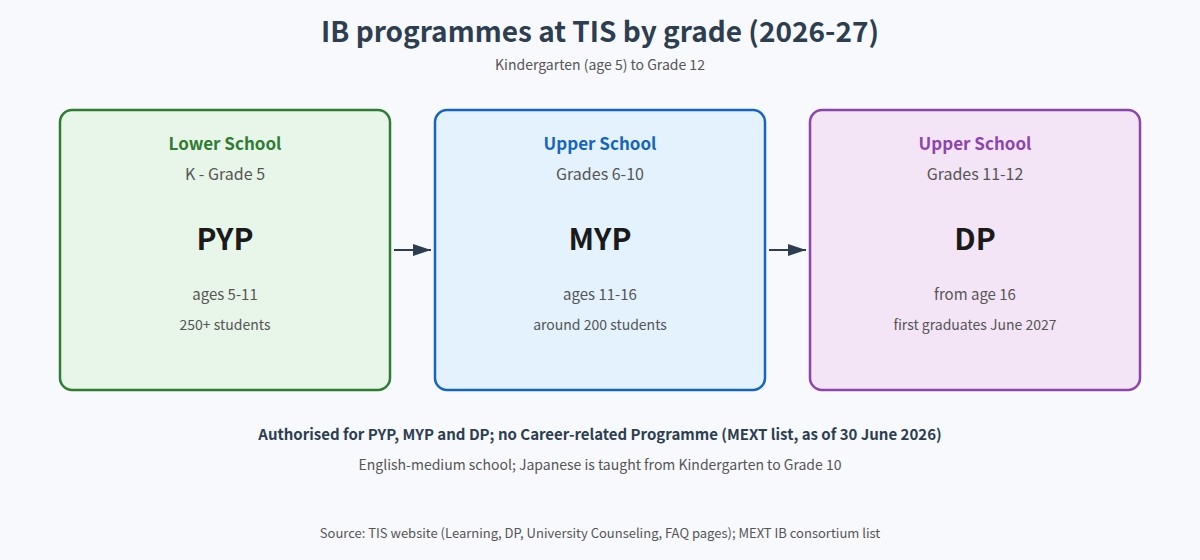
Tokyo International School (TIS) began in 1994 as a small preschool with just five students, and in the 2026-27 school year it teaches around 500 students from Kindergarten to Grade 12. If you remember it as “the school in Minami Azabu”, you are not alone, but a lot has changed recently: in August 2026 TIS moved to a new campus in TAKANAWA GATEWAY CITY, opened Grade 12, and now offers all three core IB programmes, from the Primary Years Programme to the Diploma. This guide brings together what the school publishes about its programmes, fees and admissions.
Everything below comes from the TIS website, the CIS website, the MEXT IB consortium list and Tokyo Metropolitan Government pages, checked on 26 September 2026. Fees and rules change every year, so please confirm details with the school before you apply.
- TIS at a glance
- IB programmes at TIS: PYP, MYP and now the Diploma
- Diploma results and university destinations: not yet available
- Tuition and fees for 2026-2027
- Admissions: who can apply and how it works
- Learning support and student life
- Getting to TIS
- Questions parents often ask
- Summary
- Sources and references
TIS at a glance
TIS describes itself as a non-profit, English-medium IB World School serving Tokyo’s expatriate community, with students of more than 70 nationalities and “no dominant nationality or culture”.
| Item | Details |
|---|---|
| School name | Tokyo International School (TIS) |
| Founded | 1994, as Tokyo International School Pre School (five students) |
| Campus (from August 2026) | TAKANAWA GATEWAY CITY RESIDENCE, 3-15-2 Mita, Minato-ku, Tokyo 108-0073 |
| Grades | Kindergarten (age 5) to Grade 12; Grade 12 opened in 2026-27 |
| Students | “500+” from over 70 nationalities (school website, 2026); about 500 (Tokyo portal, updated 2026) |
| IB programmes | PYP, MYP and DP (no Career-related Programme), per the MEXT list as of 30 June 2026 |
| Accreditation | Council of International Schools (CIS): first accredited in 2004, re-accredited on 8 January 2025 |
| Status in Japan | Miscellaneous school (kakushu gakko), not an “Article 1” Japanese school |
| Class size | Maximum 22 students (Admissions Guidelines 2026-27) |
One point that matters for some families: TIS is registered in Tokyo as a kakushu gakko (miscellaneous school), not one of the “Article 1” schools under Japan’s School Education Act. The school says it gained Gakko-Hojin (incorporated educational institution) and not-for-profit status in 2017; Tokyo’s records list its operator as a jun-gakko hojin, the legal form for miscellaneous schools. In June 2026 the Tokyo Metropolitan Private School Council found appropriate a change raising total capacity from 380 to 572 students; that is capacity, not enrolment.
From a five-student preschool to a K-12 school
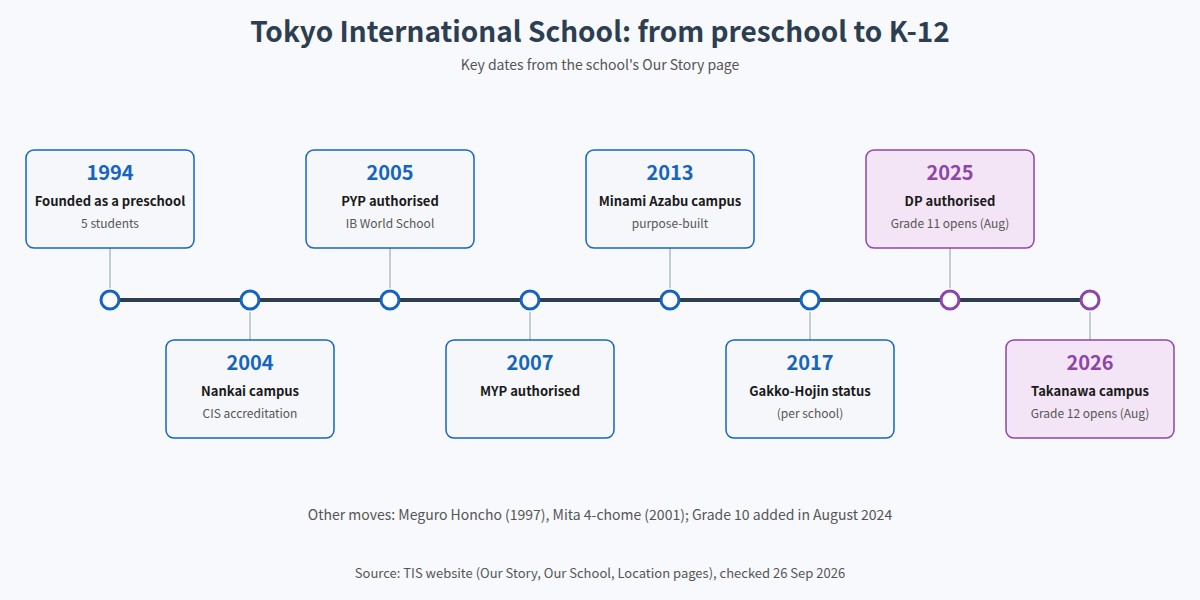
As Figure 1 shows, TIS has grown step by step: a campus rented from Minato City in 2004 (the year of its CIS accreditation), PYP authorisation in 2005, MYP in 2007, a purpose-built campus in Minami Azabu in 2013, Grade 10 in 2024, Grade 11 in 2025, and in August 2026 the move to Takanawa with Grade 12. Because the move is so recent, older reviews and directories may still show the Minami Azabu address, so please use the school’s Location page when you plan a visit.
IB programmes at TIS: PYP, MYP and now the Diploma
TIS is now a full “IB continuum” school, which simply means your child can follow IB frameworks all the way from Kindergarten to the end of high school. The MEXT IB consortium list (as of 30 June 2026) shows TIS as authorised for the Primary Years Programme (PYP), the Middle Years Programme (MYP) and the Diploma Programme (DP). It does not offer the Career-related Programme (CP).
TIS was authorised for the PYP in 2005, the MYP in 2007 and the DP in 2025 (school website; MEXT list as of 30 June 2026), so while the PYP and MYP have run for around two decades, the Diploma is brand new.
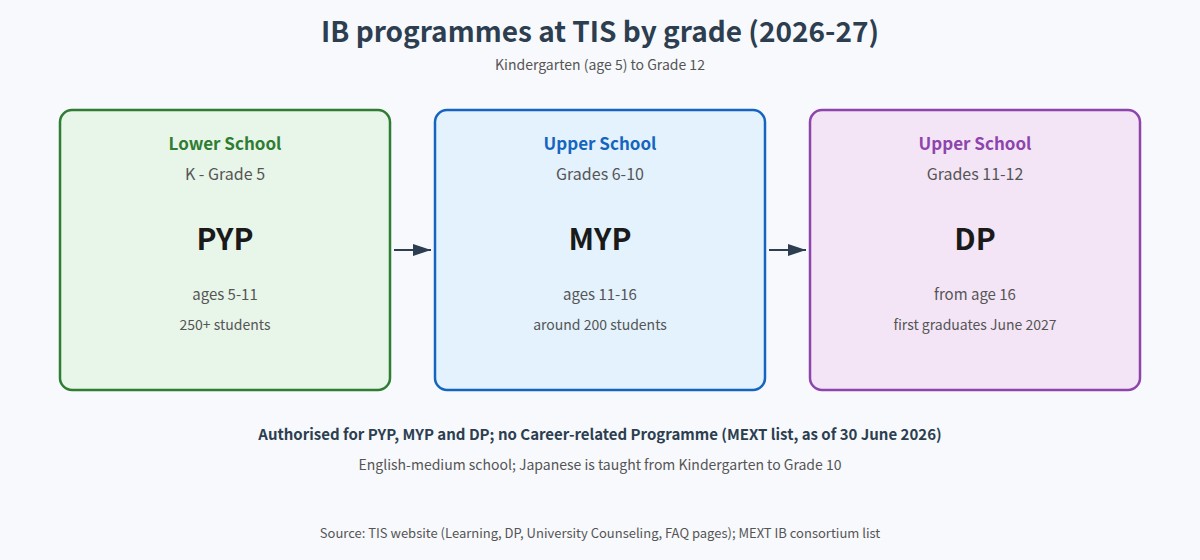
As Figure 2 shows, the programmes line up with the grades like this:
- Lower School, Kindergarten to Grade 5 (ages 5 to 11): the PYP, which the school says serves more than 250 children, with learning organised around inquiry.
- Upper School, Grades 6 to 10 (ages 11 to 16): the MYP, serving around 200 students. Since Grade 10 opened in August 2024, TIS can offer all five years of the MYP.
- Grades 11 and 12 (from age 16): the two-year IB Diploma Programme; Grade 12 opened in 2026-27.
Lessons are in English, and according to the school FAQ students also learn Japanese from Kindergarten to Grade 10.
Diploma results and university destinations: not yet available
This is an important point to be clear about. Because the Diploma is so new, TIS has not yet had a graduating class. Its University Counseling page says the school is preparing for its “first graduating class in June 2027”. As of 26 September 2026 we found no published IB Diploma averages, pass rates or university destination lists for TIS, so we have not included any.
What the school does describe is its counselling programme. Guidance starts in Grade 9, moves in Grade 10 to choosing Diploma subjects at Standard and Higher Level with university requirements in mind, and continues in Grades 11 and 12 with applications and essays, managed through the MaiaLearning platform. The school says it also supports students choosing a gap year or employment. We could not find a published list of DP subjects, so it is worth asking the school directly.
Tuition and fees for 2026-2027
Let’s be honest: international school fees in Tokyo are a big commitment. These are the figures on the TIS School Fees page for 2026-27.
One-time fees for new students (non-refundable)
| Fee (2026-27) | Amount (JPY) |
|---|---|
| Application Fee | ¥30,000 |
| Registration Fee | ¥400,000 |
| Development Fee | ¥1,000,000 |
| One-time total | ¥1,430,000 |
Annual fees by grade (2026-27)
| Grades | Building Fee | Tuition (three terms) | Total annual fee |
|---|---|---|---|
| Kindergarten to Grade 2 | ¥200,000 | ¥3,100,000 (¥1,240,000 + ¥930,000 + ¥930,000) | ¥3,300,000 |
| Grades 3 to 5 | ¥200,000 | ¥3,200,000 (¥1,280,000 + ¥960,000 + ¥960,000) | ¥3,400,000 |
| Grades 6 to 9 | ¥200,000 | ¥3,300,000 (¥1,320,000 + ¥990,000 + ¥990,000) | ¥3,500,000 |
| Grades 10 to 12 | ¥200,000 | ¥3,400,000 (¥1,360,000 + ¥1,020,000 + ¥1,020,000) | ¥3,600,000 |
The three tuition payments are listed as due by 15 May, 31 October and 31 January, but the same page says returning students pay the annual fees in full by 15 May 2026 and new students pay in full by the dates in their acceptance letter. In 2025-26 term payments were limited to personal accounts and mid-year entry, so ask the Business Office whether paying by term is open to you.
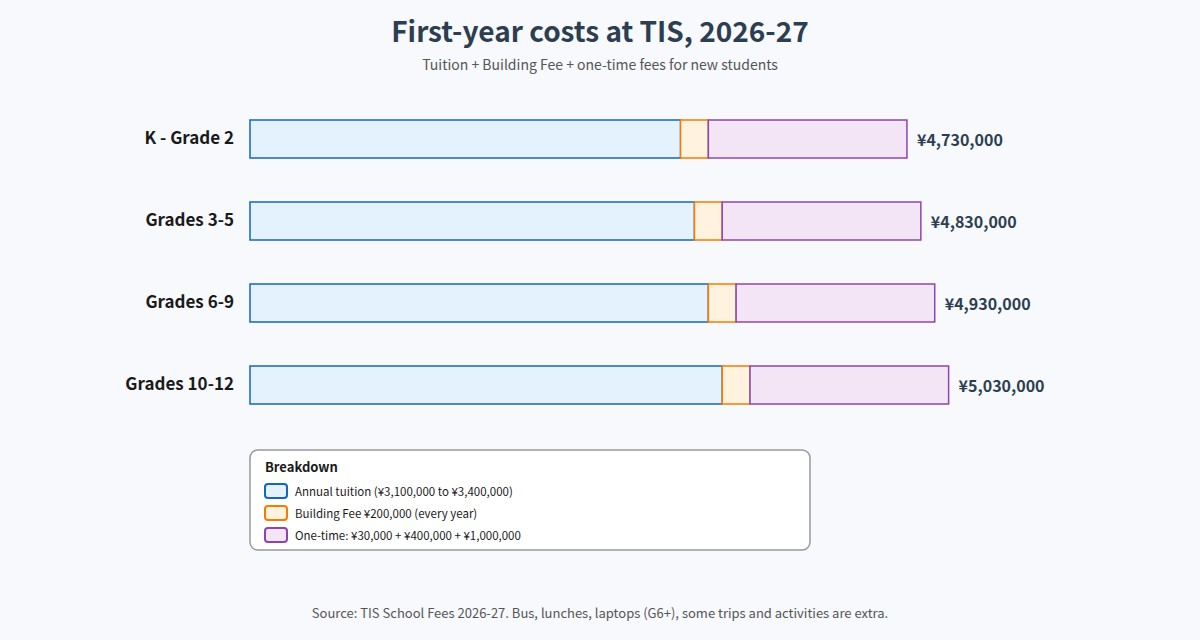
Putting it together: a new Kindergarten student joining in 2026-27 would pay ¥4,730,000 in the first year (¥1,430,000 one-time fees + ¥200,000 Building Fee + ¥3,100,000 tuition). For Grades 3 to 5 the first year comes to ¥4,830,000, for Grades 6 to 9 ¥4,930,000, and for Grades 10 to 12 ¥5,030,000. From the second year, you pay only the annual fee, from ¥3,300,000 to ¥3,600,000 at 2026-27 rates. Figure 3 shows each band.
Fees have also risen: on the same page, the 2025-26 annual fee for Kindergarten to Grade 2 was ¥3,000,000 and the one-time fees totalled ¥1,230,000.
What is not included
- School bus: ¥280,000 one way or ¥380,000 round trip per year (2026-27).
- Beyond the Bell after-school care (Kindergarten to Grade 5, by reservation, until 6:00 pm): ¥260,000 for the annual plan or ¥2,000 per session, at promotional rates for the move.
- Laptops for Grades 6 to 12, uniforms (TIS has no formal uniform, but PYP and MYP students need a house kit), lunches, some school activities, some social events and private instrumental lessons.
- Some residential trips may carry an extra charge such as transport, according to the fees page (the Experiential Education page says trips are included in fees, so ask which applies).
Scholarships and company support
The school FAQ states that “TIS does not provide any financial assistance of any kind.” TIS does offer the Corporate Contribution Program (CCP), through which employers contribute on behalf of employees’ children; contact the Business Office for details. If your company pays, check whether it covers the one-time fees and Building Fee too. We found no mention of a sibling discount, although siblings are given admissions priority once they meet the admissions criteria.
Admissions: who can apply and how it works
Grade placement and entry points
TIS places children by age, with a birthday cut-off of 31 August. For 2026-27, Kindergarten is for children who are 5 by 31 August 2026 (born 1 September 2020 to 31 August 2021), and Grade 11 is for students born between 1 September 2009 and 31 August 2010.
- Kindergarten: informal screening sessions, “more like playdates”, in January and February for the following year’s intake; the FAQ says overseas applicants can take part even if they cannot attend in person.
- Grades 1 to 10: rolling admission, subject to space. For Grades 1 to 11, assessments are “only given when deemed necessary, at our discretion and when a seat has been identified” (FAQ).
- Grades 11 and 12 (Diploma Programme): not part of rolling admission, according to the FAQ.
- Grade 12: the Admissions Guidelines for both 2026-27 and 2027-28 state “Entry into G12 is not accepted”.
Besides age, the school weighs cultural, language, learning and gender diversity, English-proficient parents, space and class size. There is no numbered waitlist, only a “wait pool”.
English requirements
This is the question we hear most, and TIS’s wording needs careful reading, so here it is as the school states it:
- For students in general: the Admissions page says “English language proficiency is a factor for admissions, not a requirement.” The school offers English as an Additional Language (EAL) support, with help in regular classes and extra English lessons while other students study Japanese, but admission of new English learners depends on the language makeup of the current class.
- For parents: at least one parent must speak English fluently and be proficient in reading and writing it. The school communicates with parents in English only.
- For Japanese nationals: the FAQ says the school welcomes “a limited number of Japanese students”, who must be peer-competitive in English at admission. It states that it does not accept Japanese students who require EAL support, explaining that Japanese students have more schooling options in Tokyo than overseas families.
In short, a non-Japanese child with little English may be offered a place if the class can support them, but a Japanese child must already work at grade level in English.
Steps and documents
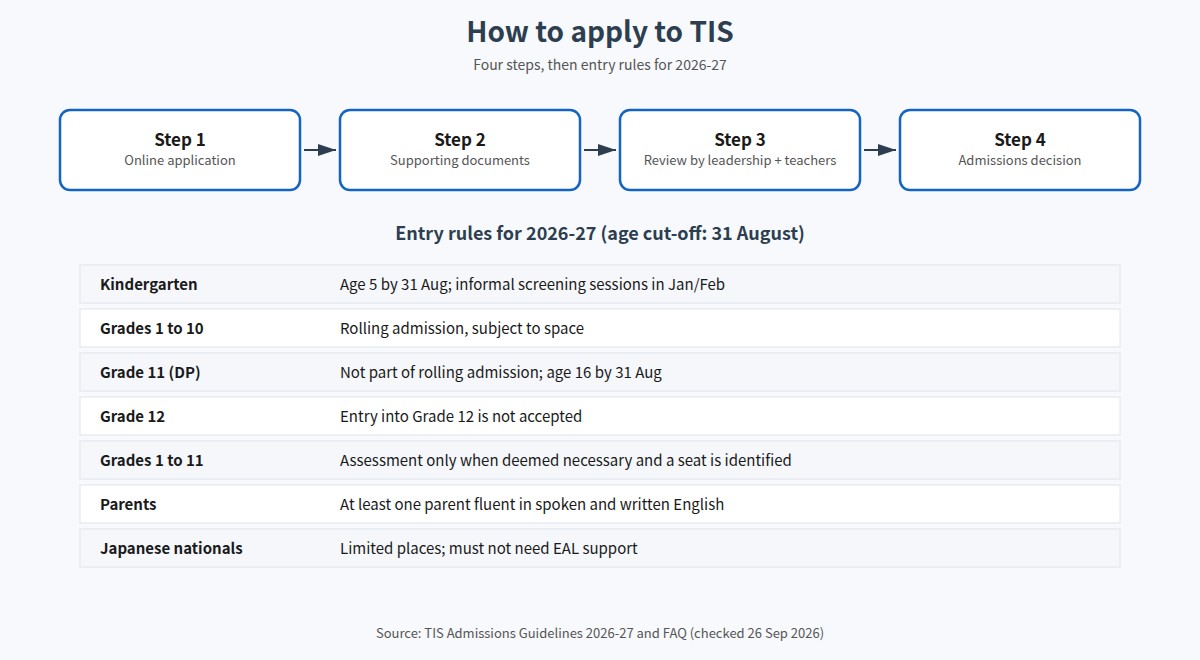
As Figure 4 summarises, the process has four steps: submit the online application (the non-refundable application fee is valid for one academic year), upload the supporting documents on the checklist in the online system, have the completed file reviewed by the Leadership Team and relevant teachers, and receive the admissions decision. The Admissions page says the document checklist is in the online system, and the FAQ says Kindergarten applicants without school reports can use a Pre-School Assessment Form.
If your child has learning support needs, share this early: the school says it admits students only when it has the support and resources to help them succeed.
Learning support and student life
TIS describes an inclusive learning framework with in-class support, small-group teaching and one-to-one sessions, plus accommodations such as extended time. There is also EAL support, a counselling team and a qualified nurse on duty during school hours.
Classes run from 8:10 am to 3:20 pm, Monday to Friday; the school’s calendar lists 25 August 2026 as the first day of 2026-27. Co-curricular activities run from 3:30 to 5:30 pm, and the FAQ says most carry no extra cost except those with outside instructors. Upper School teams compete through the Kanto Plain Association of Secondary Schools (KPASS). According to the FAQ, residential trips start from Grade 3, there is an annual snow trip from Grade 6, and Grade 10 travels to Thailand. There is no formal uniform (a dress code applies), and no cafeteria: lunch comes from home or a catering service.
Getting to TIS
The school’s Location page gives two nearest stations for the new campus: Sengakuji Station on the Toei Asakusa Line (6 minutes) and Takanawa Gateway Station on the JR Yamanote Line (9 minutes). Because the campus is new, try the journey at school time before choosing where to live.
Questions parents often ask
My child speaks very little English. Can they still join?
Possibly, if your child is not a Japanese national: it depends on the language makeup of the class at the time. Japanese students who need EAL support are not accepted, and in all cases at least one parent must be fluent in English.
Can my child join TIS for the last year of high school?
No. The Admissions Guidelines for 2026-27 and 2027-28 both say “Entry into G12 is not accepted”. Entry to the Diploma years is also outside the usual rolling admissions, so if your child will be 16 around the time you move, contact the school as early as you can.
Does TIS have IB Diploma results yet?
Not yet. The first class is expected to graduate in June 2027, and as of 26 September 2026 we found no published Diploma scores or university destinations.
Summary
- A newly completed IB continuum: authorised for the PYP in 2005, the MYP in 2007 and the DP in 2025 (school website; MEXT list as of 30 June 2026).
- A brand-new campus: TIS moved from Minami Azabu to TAKANAWA GATEWAY CITY in August 2026, near Sengakuji and Takanawa Gateway stations.
- No graduates yet: Grade 12 opened in 2026-27 and the first class graduates in June 2027, so there are no Diploma results to compare.
- 2026-27 fees: annual fees of ¥3,300,000 to ¥3,600,000, plus ¥1,430,000 in one-time fees for new students; no financial assistance.
- Clear English rules: English is a factor rather than a requirement for most students, but at least one parent must be fluent and Japanese students must not need EAL support.
If TIS sounds like a good fit, send an inquiry and book a tour of the new campus, with your child if possible.
Sources and references
- Tokyo International School: official website (checked 26 September 2026)
- TIS: Our Story
- TIS: Location, Access and Contact
- TIS: Learning and Diploma Programme
- TIS: University and Career Support
- TIS: Student Support
- TIS: School Fees (2026-27)
- TIS: Admissions Guidelines (2026-27 and 2027-28)
- TIS: FAQs
- TIS: Beyond the Bell and Experiential Education
- MEXT IB Education Promotion Consortium: IB schools in Japan (as of 30 June 2026)
- CIS: Re-accredited, Tokyo International School, Japan (8 January 2025)
- Tokyo Metropolitan Government, International Schools Portal: Tokyo International School
- Tokyo Metropolitan Government: Private School Council report (18 June 2026, in Japanese)
コメント