Horizon Japan International School (HJIS) is an IB World School a short walk from Yokohama Station, teaching children from Preschool to Grade 12. It was established in 2003, moved into its purpose-built campus in 2019, and now offers all three core IB programmes. If you are moving to Yokohama or Tokyo, this guide gathers what the school publishes about its programmes, 2026-27 fees, admissions and Diploma results.
Everything below comes from the school’s official website, its 2026-27 fee schedule, its 2025-2026 School Profile and the MEXT IB consortium list, all checked on 26 September 2026. Details change yearly, so confirm with the school.
- HJIS at a glance
- IB programmes at HJIS: from Preschool to Grade 12
- Grades 11 and 12: full Diploma or DP courses
- IB Diploma results
- Tuition and fees for 2026-2027
- Admissions: who can apply and how it works
- Learning support and student life
- Getting to HJIS
- Questions parents often ask
- Summary
- Sources and references
HJIS at a glance
Here is the basic picture. HJIS has one campus, in Yokohama. In Sendai, the MEXT list shows two separate PYP schools of the Horizon group: “Horizon Japan International School Sendai” (early learning, not an Article 1 school) and Horizon Sendai Primary School (ホライゾン学園仙台小学校, an Article 1 school).
| Item | Details |
|---|---|
| School name | Horizon Japan International School (HJIS) |
| Established | 2003; current campus completed in 2019 |
| Campus | 1-24 Ono-cho, Kanagawa-ku, Yokohama, Kanagawa 221-0055 |
| Grades | Preschool (from age 3) to Grade 12 |
| Students | “500+” students and “50+” nationalities (2025-2026 School Profile); about 51% Japanese nationals |
| IB programmes | PYP, MYP and DP (no Career-related Programme), per the MEXT list as of 30 June 2026 |
| Accreditation | CIS (since 2018) and WASC (since 2019); member of ECIS and, since 2024, the Japan Council of International Schools (JCIS) |
| Legal status in Japan | School corporation (gakko hojin) recognised by Kanagawa Prefecture since 2004; not an “Article 1” school under Japan’s School Education Act |
| Head of School | Mehmet Deniz |
| Student-teacher ratio | About 6:1; general classroom capacity of 22 students (Admissions FAQ) |
A small note on numbers: the 2025-2026 School Profile says 50+ nationalities, while the undated Admissions FAQ says “37+”, so ask for current figures when you visit. The School Profile also shows the nationality mix for 2025-26: Japanese 51%, American 8%, Chinese 7%, Indian 6%, South Korean 5% and other nationalities 23%.
IB programmes at HJIS: from Preschool to Grade 12
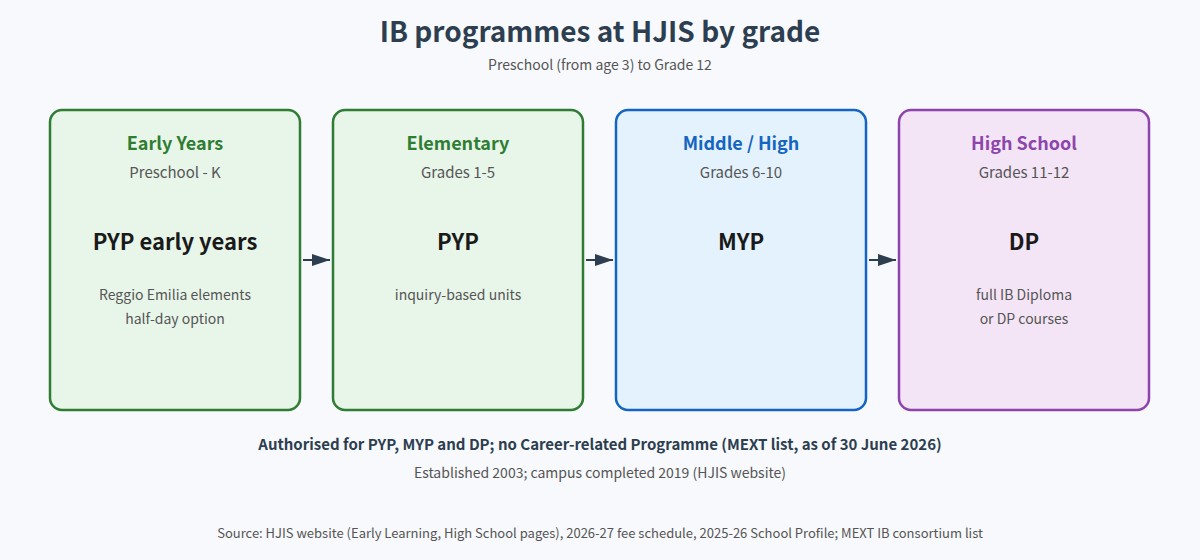
HJIS calls itself an “IB Continuum World School”: your child can stay within IB frameworks from the early years to graduation. The MEXT IB consortium list (as of 30 June 2026) confirms that HJIS is authorised for the Primary Years Programme (PYP), the Middle Years Programme (MYP) and the Diploma Programme (DP). HJIS started with the DP and later added the MYP and PYP to become an IB continuum school. The school also says it follows the IB framework and implements the US Common Core.
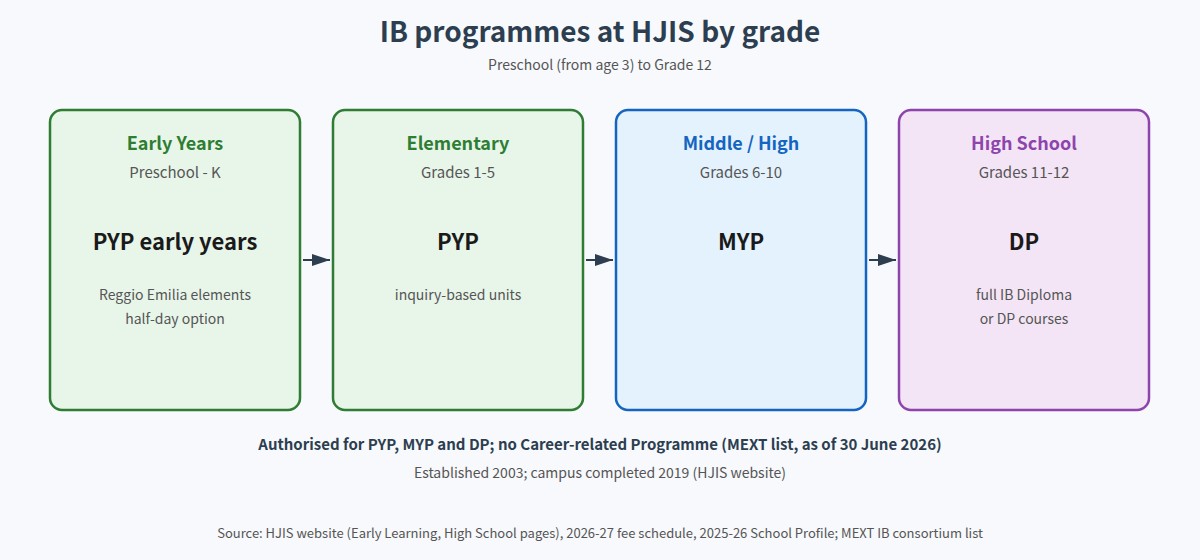
As Figure 1 shows, the programmes line up with the grades like this:
- Early Years Programme (Preschool, Pre-Kinder, Kindergarten): children can join the Preschool once they turn three. The school uses the PYP early years framework with elements of the Reggio Emilia approach, which builds learning around play, projects and children’s curiosity. A half-day option (8:30 to 11:45) is available for Preschool all year and for Pre-Kinder in Term 1 only.
- Elementary School (Grades 1 to 5): the PYP, with inquiry-based units that connect subjects to real life.
- Middle School and early High School (Grades 6 to 10): the MYP.
- Grades 11 and 12: the IB Diploma Programme.
English is the language of instruction. Japanese is supported at every grade, and secondary students can also study Spanish.
Grades 11 and 12: full Diploma or DP courses
According to the 2025-2026 School Profile, every student in Grades 11 and 12 is enrolled in DP subjects, and there are two pathways. Students on the full IB Diploma take three Higher Level and three Standard Level subjects plus the three core elements: Creativity, Activity, Service (CAS), the Extended Essay (EE) and Theory of Knowledge (TOK). Students on the DP course candidate pathway complete six subjects plus CAS and TOK, but not the full Diploma.
Why does this matter? If your child is new to the IB, the course pathway can be a gentler option; if you are aiming for universities that expect the full Diploma, ask early how students are guided into each pathway. High school students also have a college counsellor and Saturday tutoring.
IB Diploma results
HJIS publishes one year of Diploma data in its 2025-2026 School Profile, labelled “Yearly Data (2024 – 2025)”. We read these from the PDF page:
- DP award rate: 90%
- HJIS average score: 32.5 points, against a global average of 30.6 (as stated in the profile)
- Highest score: 41 out of 45
- Bilingual Diploma: the profile states “1 in 4 IBDP graduates receive the Bilingual Diploma”
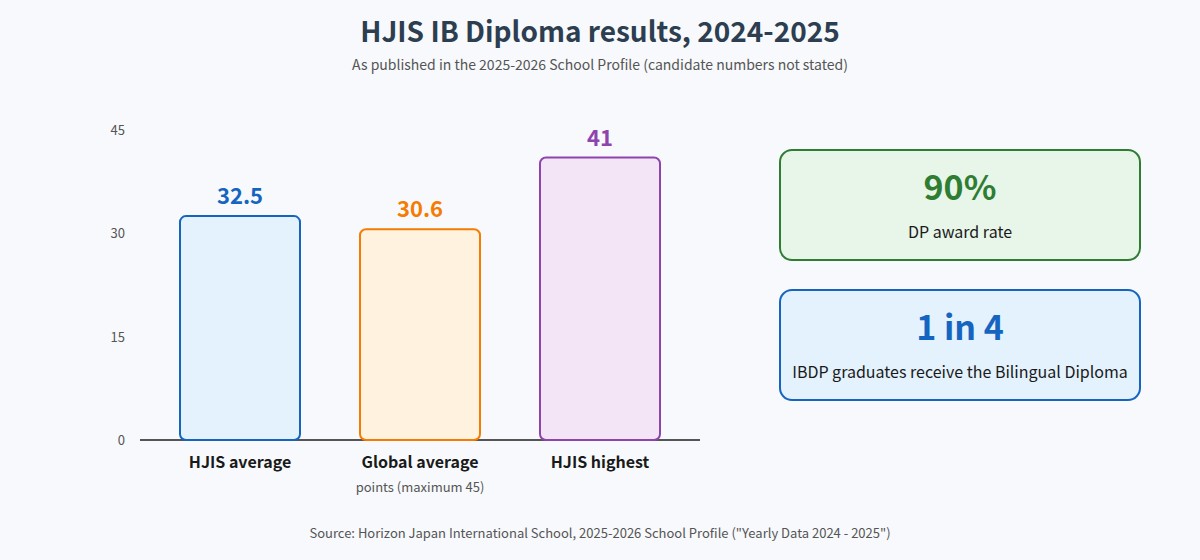
A word of caution: the profile does not state how many candidates sat the exams, and we found no published results summary for 2026. In a small cohort one or two students can move the average, so ask the school for several years of results and candidate numbers.
Where do graduates go?
The school has published a “Class of 2026 University Offers” list. In Japan it includes Sophia, Waseda, Keio (PEARL / GIGA) and the University of Tsukuba. Overseas it includes, for example, Imperial College London, King’s College London and the University of Edinburgh in the UK, the University of Toronto and UBC in Canada, the University of Melbourne, KU Leuven and Leiden, and UC San Diego and Purdue in the United States. These are offers, not enrolments, and no student numbers are given.
Tuition and fees for 2026-2027
Let’s be honest: international school fees are a big commitment. These are the amounts in the official HJIS fee schedule for the 2026-27 school year.
| Fee (2026-2027) | Amount (JPY) |
|---|---|
| Application Fee (one-time, non-refundable) | ¥45,000 |
| Registration Fee (one-time, non-refundable) | ¥500,000 |
| Building Fund (one-time, non-refundable) | ¥750,000 |
| EYP: Preschool, Pre-Kinder, Kindergarten (annual tuition) | ¥2,440,000 |
| Half-day EYP (Preschool full year; Pre-Kinder Term 1 only) | ¥1,680,000 |
| PYP, Grades 1 to 5 (annual tuition) | ¥2,790,000 |
| MYP, Grades 6 to 10 (annual tuition) | ¥2,890,000 |
| DP, Grades 11 and 12 (annual tuition) | ¥3,040,000 |
| Maintenance Fee (every student, every year) | ¥250,000 |
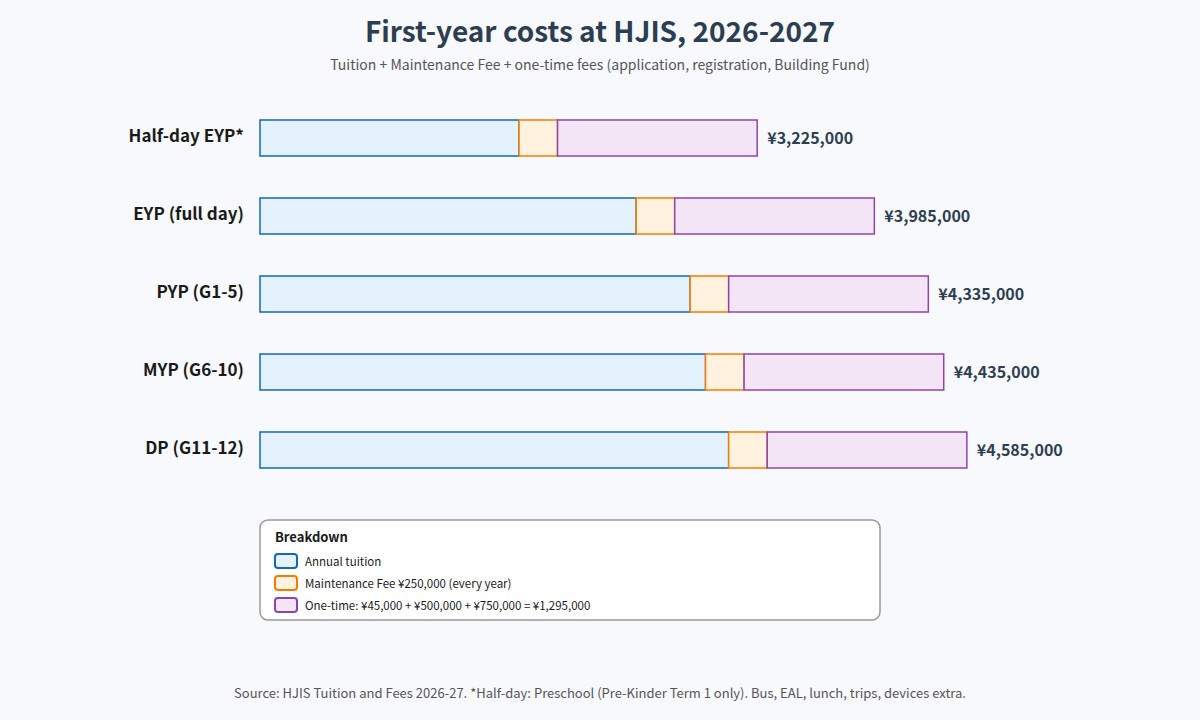
Putting these together, the one-time fees for a new student come to ¥1,295,000 (¥45,000 + ¥500,000 + ¥750,000). For a new student joining the MYP in 2026-27, the first year adds up to ¥4,435,000 (¥1,295,000 one-time + ¥2,890,000 tuition + ¥250,000 Maintenance Fee). Figure 3 shows the first-year total for each programme: ¥3,225,000 for half-day EYP, ¥3,985,000 for full-day EYP, ¥4,335,000 for the PYP and ¥4,585,000 for the DP. From the second year, the ongoing cost at 2026-27 rates is tuition plus the Maintenance Fee, for example ¥3,140,000 in the MYP and ¥3,290,000 in the DP.
A few practical details from the same fee schedule:
- Tuition and the Maintenance Fee are paid in three terms, due on 5 June, 5 October and 20 February, by automatic bank withdrawal. For the MYP, tuition is ¥1,156,000 in the first term and ¥867,000 in each of the next two, plus a Maintenance Fee of ¥100,000, ¥75,000 and ¥75,000.
- New students pay the Registration Fee, Building Fund and first tuition instalment within one week of receiving the admission notification. Cash and credit cards are not accepted for tuition and fees; the application fee can be paid by card through the admissions portal or by bank transfer.
- Siblings: a 20% tuition discount applies to the second child and 30% to the third child.
- Extra fees if needed: EAL support ¥500,000 a year, school bus ¥300,000 a year round trip or ¥215,000 one way (¥2,500 per single ride), a Grade 1 Technology Fee of ¥25,000, and a PTA fee of ¥5,000 per family per year.
- Not included in tuition: PE uniforms, supplies, lunches, the bus, after-school programmes and trips. Expedition week is mandatory and charged separately. Grades 2 to 4 need their own iPad and Grades 5 to 12 a MacBook.
- Attending any part of a term means paying for the whole term, and the schedule states that tuition and fees are non-refundable. It does not say whether amounts include consumption tax, so it is worth asking.
If your employer pays school fees, check which items it covers; the fee schedule notes that parents remain liable for all payments even when a company pays. It also says scholarships are granted to students whose parents work for companies in the school’s Corporate Contribution Plan, so ask the Business Office.
Admissions: who can apply and how it works
Eligibility and English requirements
HJIS welcomes applications from all backgrounds and runs rolling admissions, so you can apply throughout the year when there is space in your child’s grade. Upon enrolment, students must be Japanese permanent residents or hold a valid visa such as a dependent or student visa; the school does not sponsor visas. We did not find a separate rule for Japanese nationals, and about half of current students are Japanese according to the School Profile.
English is the question parents ask most, so here is what the Eligibility Requirements page says:
- Preschool and Pre-K: children can be admitted regardless of their level of English. Early learners must also be able to use the toilet independently.
- Elementary School: students should generally have enough English to benefit from the programme, but “may also be admitted regardless of their level of English proficiency”, with EAL (English as an Additional Language) classes to help them catch up.
- Middle and High School: students “must have a fairly high degree of competency in English”.
EAL support costs ¥500,000 a year in 2026-27; if a student still needs it after one year, it continues without payment.
Steps and timeline
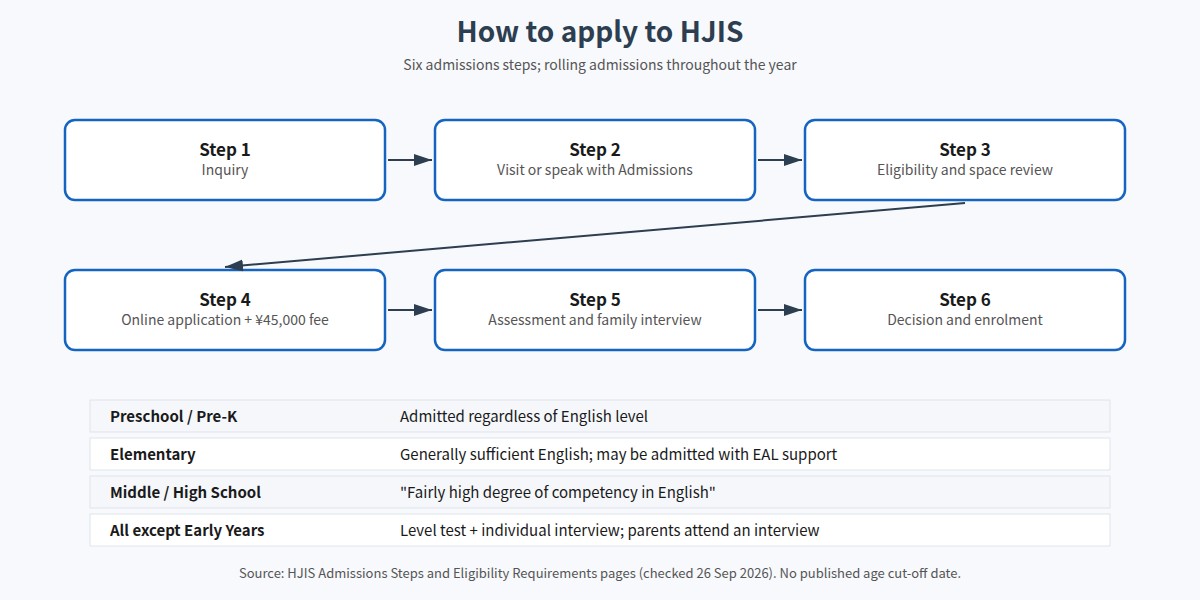
The school describes six steps, shown in Figure 4: start with an inquiry, visit or speak with Admissions, a review of eligibility and available space, the online application with documents and the ¥45,000 fee, an assessment and family interview, and finally the decision and enrolment. All students except those in the Early Years take a level test and an individual interview, and parents attend an enrolment interview to make sure the school’s philosophy matches their expectations. The FAQ says the process usually takes two to six weeks, and applications are not reviewed until every document has arrived. Outcomes can be admission, conditional admission, the wait pool, a request for more information, or no place available.
Documents
Be ready to provide school reports, a passport or birth certificate, a Japanese residence card or Japanese passport, photos, teacher recommendations for older students, health records, any learning support documents and, if your company pays, a company guarantee letter. We could not find a published age cut-off date for grade placement, so ask Admissions how your child’s birthday maps to a grade.
Learning support and student life
HJIS describes a layered support model, from universal support in every classroom to targeted and individualised support planned with families. There are learning support coordinators in Primary and Secondary, a counselling department and college counselling. Please be open about any learning needs when you apply; it helps the school plan the right support from the start.
Beyond the classroom there are sports, arts, service learning, expeditions, after-school clubs, a daycare service (“for eligible younger students”, per the Admissions FAQ) and an active PTA. Optional Cezars Kitchen lunches are ordered in advance each term; packed lunches are fine.
Getting to HJIS
HJIS says it is a short walk from Yokohama Station and about 30 minutes by train from central Tokyo. The official walking route starts from Yokohama Station’s Northeast Exit A toward Bay Quarter; no walking time is given. Kanagawa and Shin-Takashima stations are nearby too. A paid school bus, run by a private company, currently lists Hiyoshi, Kohoku, Yokohama and Kawasaki routes; routes are revised every year and waitlists are created when a bus is full, so check availability before you choose where to live.
Questions parents often ask
My child speaks very little English. Can they still join?
For Preschool and Pre-K, yes: the school admits children regardless of English level. In Elementary School children may also be admitted with EAL support (a paid service). From Middle School upward, a fairly high level of English is required.
We are a Japanese family. Is HJIS a regular Japanese school?
No. HJIS is a school corporation recognised by Kanagawa Prefecture, but MEXT lists it among schools that are not “Article 1” schools. Japanese families should check what this means for compulsory education and later options in Japan.
Does my child have to take the full IB Diploma?
No. All Grade 11 and 12 students take DP subjects, but they can choose the full Diploma or the DP course pathway. Talk to the DP Coordinator early about your university plans.
Summary
- A full IB continuum school in central Yokohama: authorised for the PYP, MYP and DP (MEXT list, June 2026), established in 2003, with a campus completed in 2019.
- Two high school pathways: the full IB Diploma or DP courses, according to the 2025-2026 School Profile.
- Published results: a 90% award rate and an average of 32.5 points in 2024-2025, against a global average of 30.6 stated in the profile; candidate numbers are not given.
- 2026-27 fees: tuition from ¥1,680,000 (half-day EYP) to ¥3,040,000 (DP), plus a ¥250,000 Maintenance Fee each year and ¥1,295,000 in one-time fees, with sibling discounts of 20% and 30%.
- Rolling admissions: Preschool and Pre-K children are admitted regardless of English, Elementary may admit with EAL support; Middle and High School need a fairly high level of English.
If HJIS sounds like a good fit, book a campus visit or an online meeting with Admissions; seeing a normal school day tells you more than any brochure.
Sources and references
- Horizon Japan International School: official website (checked 26 September 2026)
- HJIS: Message from the Head of School
- HJIS: Accreditations and IB Continuum
- HJIS: Tuition and Fees 2026-2027 and the official 2026-27 fee schedule
- HJIS: Admissions, Admissions Steps and Eligibility Requirements
- HJIS: Early Learning (EYP) and High School (DP)
- HJIS: 2025-2026 School Profile (PDF)
- HJIS: Class of 2026 University Offers (PDF)
- HJIS: Support and Guidance
- HJIS: Contact and Directions and School Buses
- HJIS: Food Services
- Horizon Sendai (sister schools)
- MEXT IB Education Promotion Consortium: IB schools in Japan (as of 30 June 2026)
コメント