Marist Brothers International School (MBIS) is a co-educational, English-medium international school in Suma, Kobe, teaching children from Early Years (Pre-Kindergarten) to Grade 12. It opened in 1951, was founded by Brothers of the Marist order, and has 530 students according to its 2026-2027 School Profile. If you are settling in Kansai and want IB education from preschool to the Diploma, MBIS will likely be on your list.
This guide explains, in plain terms, what the school publishes about its IB programmes, results, 2026-2027 fees and admissions. Everything was checked on 26 September 2026 against the school’s website, its 2026-2027 School Profile, Fee Schedule and Admissions Policy, and the MEXT IB consortium list. Fees change each year, so please confirm details with the school.
MBIS at a glance
| Item | Details |
|---|---|
| School name | Marist Brothers International School (MBIS), formerly Marist Brothers School |
| Opened | 1951 in Kobe, founded by Brother Charles Fojoucyk and Brother Stephan Weber |
| Type | Co-educational international school with Marist (Catholic) roots, now governed by a Board of Directors and Trustees; welcomes students of all faiths |
| Campus | 1-2-1 Chimori-cho, Suma-ku, Kobe, Hyogo 654-0072 (3-minute walk from JR and Sanyo Suma Stations) |
| Grades | Early Years (from age 3) to Grade 12 |
| Students (2026-27) | 530 students, 173 of them in Grades 9 to 12; 70 full-time faculty (2026-2027 School Profile) |
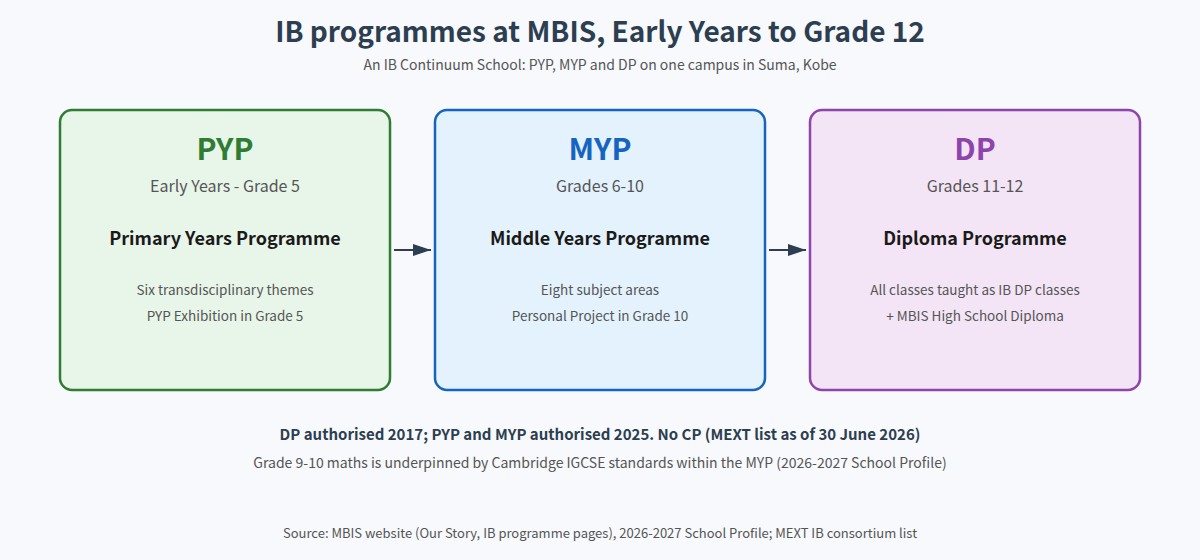
| IB programmes | PYP, MYP and DP (an “IB Continuum School”); no CP (MEXT list, as of 30 June 2026) |
| Accreditation and memberships | WASC accredited since 1972; member of EARCOS, JCIS and SENIA |
| Head of School | Shawn Hutchinson (2026-2027 School Profile) |
A long history in Suma
According to the school’s history page, MBIS opened in 1951 on the slopes of Higashi Suma and moved in 1952 to a former property of Viscount Kuki. It was first accredited by WASC in 1972, and after the Great Hanshin earthquake severely damaged the campus in 1995, it reopened within five weeks. Although it was founded by the Marist Brothers, the admissions FAQ explains that the school “is now governed by a Board of Directors and Trustees” and welcomes students “from all faiths, religions, and belief systems”.
IB programmes: a full continuum from age 3 to 18
This is the headline for many parents. MBIS is authorised for all three core IB programmes: the Primary Years Programme (PYP), the Middle Years Programme (MYP) and the Diploma Programme (DP). The MEXT IB consortium list (as of 30 June 2026) marks MBIS for PYP, MYP and DP, and not for the Career-related Programme (CP). The DP came first: the school became an IB World School in 2017. The PYP and MYP were added more recently, and the school states that it has been “an authorised IB Continuum School for both the PYP and MYP programmes as of 2025”.
- PYP (Early Years to Grade 5): inquiry-based units built around six transdisciplinary themes, ending with the PYP Exhibition in Grade 5.
- MYP (Grades 6 to 10): eight subject areas, including Japanese as the additional language and Design, finishing with the Personal Project in Grade 10.
- DP (Grades 11 and 12): the two-year IB Diploma with six subjects plus the core (Theory of Knowledge, the Extended Essay and CAS).
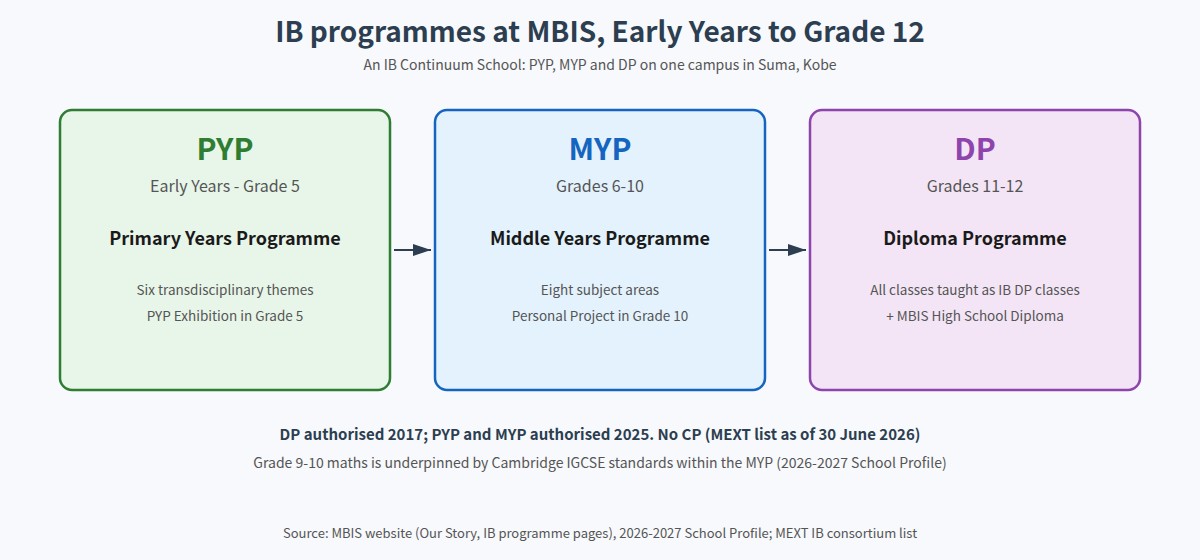
In practice, “continuum” means one inquiry-based IB approach from preschool to the Diploma. The 2026-2027 School Profile adds that Grade 9 and 10 MYP classes are underpinned by outside standards: AERO in Individuals and Societies, NGSS in science, Cambridge International Education IGCSE in mathematics, and California Common Core in other subjects. So Cambridge appears only as the basis for Grade 9 and 10 maths; MBIS does not offer a full Cambridge pathway.
Diploma pathways in Grades 11 and 12
In Grades 11 and 12 all classes are taught as IB DP classes, even for students not taking the full Diploma. Every graduate who meets the requirements receives the WASC-accredited MBIS High School Diploma (at least 22 credit units for the Class of 2026, plus CAS), combined with one of these pathways:
- MBIS Diploma plus the full IB Diploma (three Higher Level and three Standard Level subjects plus the core)
- MBIS Diploma plus the IB Bilingual Diploma (as above, with both English A and Japanese A)
- MBIS Diploma plus one or more IB Subject Certificates (1 to 6 subjects)
- MBIS Diploma only
DP subjects in the 2026-2027 School Profile include English A, Japanese A, Japanese B, Japanese ab initio, Psychology, Geography, History, Business Management, Visual Arts, Biology, Physics, Chemistry, ESS and both maths courses, plus online courses through Pamoja. For bilingual families the Japanese offer is a real plus: the school says “many of our students undertake the IB Bilingual Diploma”.
IB Diploma results 2023 to 2026
The 2026-2027 School Profile publishes four years of results. The average score is, in the school’s words, “based on awarded IB diplomas”, and the profile’s chart compares it with the IB worldwide average for each year.
| Year | MBIS average (out of 45) | IB worldwide average | Highest score | Bilingual Diplomas (as shown) |
|---|---|---|---|---|
| 2026 | 32 | 30.88 | 42 | 8/28 |
| 2025 | 31 | 30.58 | 38 | 10/26 |
| 2024 | 32 | 30.32 | 39 | 13/26 |
| 2023 | 31 | 30.24 | 37 | 10/26 |
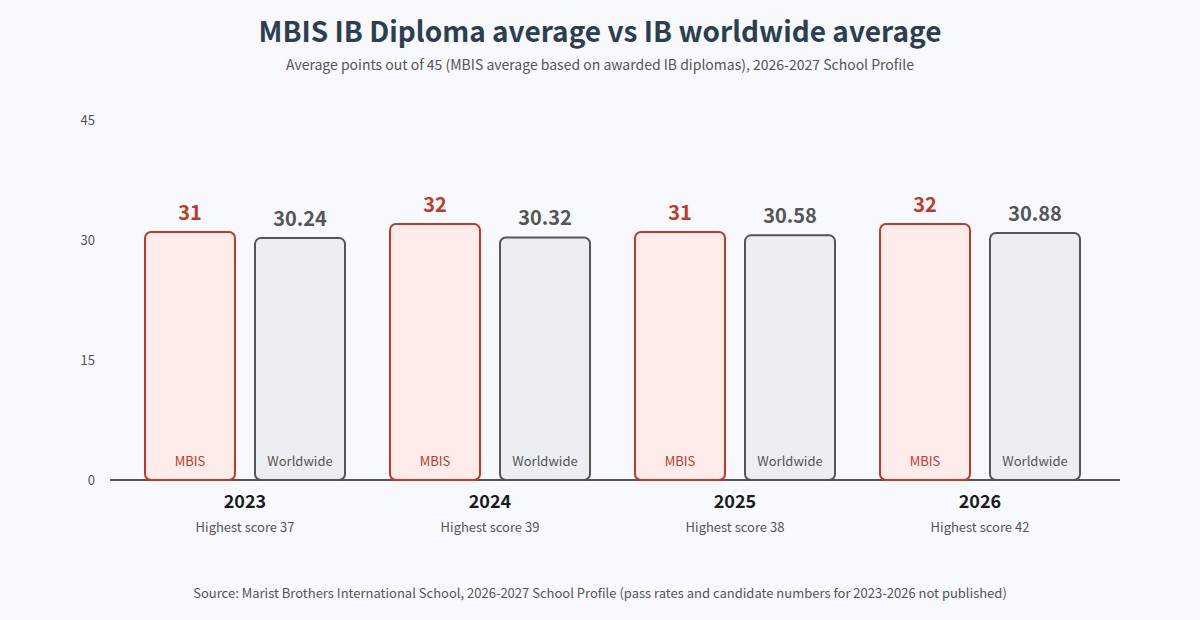
Some notes for reading these numbers: the profile’s table prints the 2023 average as “31/35”, apparently a typo, and its chart shows 31. The profile does not define the second number in the Bilingual Diploma column and does not publish a pass rate, so we do not quote one. With classes of around 25 to 30, results can move noticeably from year to year.
For the current Class of 2027, the profile lists 33 students from 11 nationalities, of whom 25 are full IB Diploma candidates and 9 are Bilingual Diploma candidates.
University destinations
The School Life FAQ says that “typically, 95% of our graduating class pursue tertiary education immediately after graduating from MBIS”. The 2026-2027 School Profile lists universities that have offered places to MBIS graduates over several years (offers, not enrolments), including Osaka, Waseda, Keio, Sophia and ICU in Japan; UC Berkeley, Cornell and NYU in the US; Toronto and UBC in Canada; UCL and King’s College London in the UK; and Melbourne and the University of Hong Kong.
Tuition and fees for 2026-2027
Let’s look at costs openly. These figures are from the MBIS 2026-2027 Fee Schedule (updated 1 March 2026).
| Fee (2026-2027) | Amount (JPY) |
|---|---|
| Application (new students, one-time, non-refundable) | ¥70,000 |
| Registration (new students, one-time, non-refundable) | ¥650,000 |
| Maintenance (annual mandatory fee, all students) | ¥200,000 |
| Tuition: PYP Early Years | ¥1,716,000 |
| Tuition: PYP Grades 1 to 5 | ¥1,971,000 |
| Tuition: MYP Grades 6 to 10 | ¥2,107,000 |
| Tuition: DP Grades 11 and 12 | ¥2,117,000 |
| School bus (optional, per year) | Ashiya ¥320,000; Settsu Motoyama, Mikage, Rokkomichi ¥300,000; Sannomiya ¥200,000; Shioya route ¥90,000 |
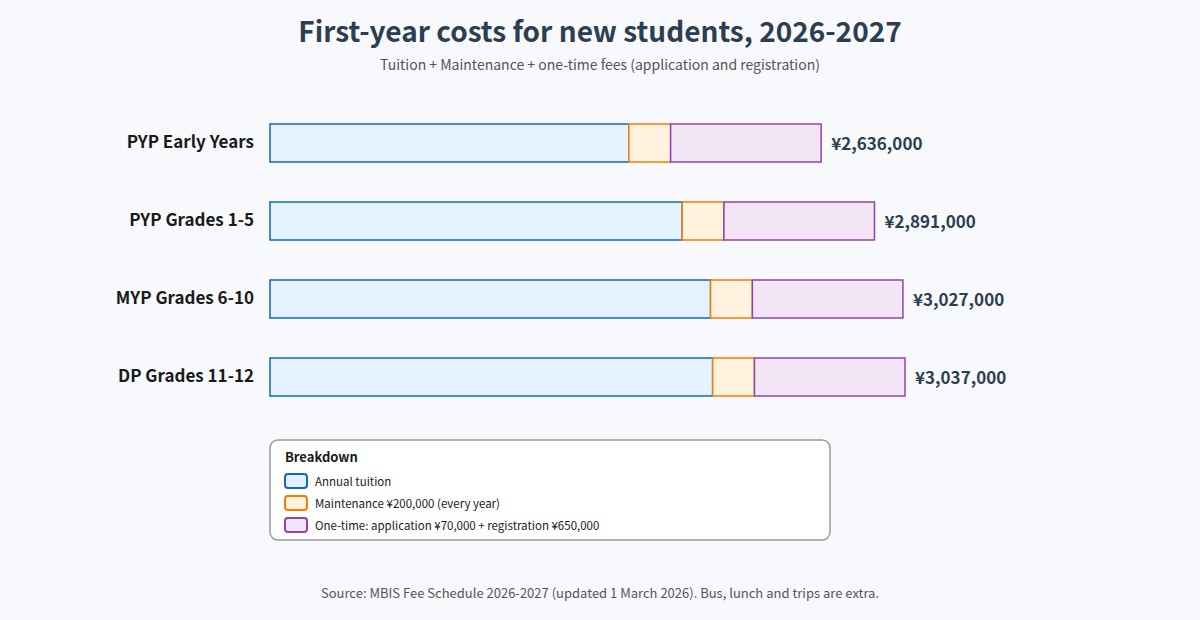
Adding it up, a new student pays ¥720,000 in one-time fees (application ¥70,000 plus registration ¥650,000). The first year therefore comes to ¥2,636,000 in Early Years, ¥2,891,000 in Grades 1 to 5, ¥3,027,000 in Grades 6 to 10 and ¥3,037,000 in Grades 11 and 12, before the bus, lunch and other extras. From the second year, the ongoing cost is tuition plus Maintenance: ¥1,916,000, ¥2,171,000, ¥2,307,000 and ¥2,317,000 respectively at 2026-27 rates.
Practical points from the Fee Schedule and Admissions Policy:
- Annual fees are due by 29 July 2026; on the semester plan, Semester 2 is due 11 January 2027. Mid-year joiners receive a prorated tuition invoice.
- Credit card payments carry a 5% surcharge.
- Withdrawal needs six school weeks’ written notice, or the school may charge 25% of annual tuition in lieu.
- The school bus is open to students from Early Years to Grade 5 (Admissions Policy). Cafeteria lunch costs 400 to 800 yen a day.
Discounts, scholarships and subsidies
The 2026-2027 Scholarships and Tuition Assistance Policy describes a 10% tuition discount for the second and later children attending at the same time, Diversity scholarships of up to 20% of tuition for selected expatriate families, Academic scholarships, and hardship assistance for current families (applications 1 January to 1 March). It also says families of Grade 10 to 12 students can apply for Japanese government and Hyogo Prefecture support; ask the Finance Office about eligibility.
Admissions: rolling entry, English and age
MBIS operates on rolling admissions, so you can apply and start at any time of year if there is space, with priority for the start of the school year. For an August start, applications open on 1 September of the previous year. If a grade is full, your child can join a “wait pool”, which is not first-come, first-served. The FAQ says testing, interviews and a decision typically take about two weeks once all documents are in.
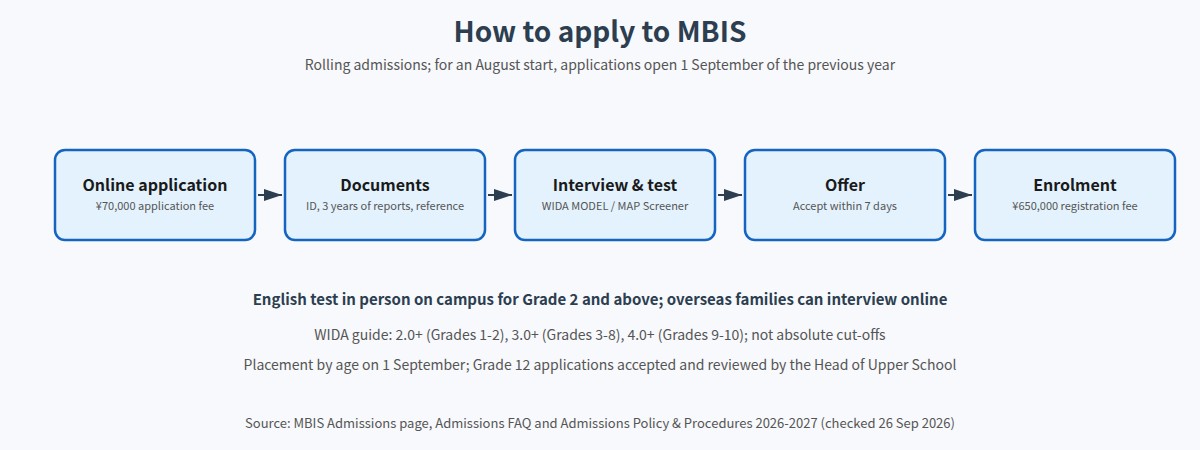
- Step 1: Online application and the ¥70,000 application fee.
- Step 2: Documents: passport or ID, school reports from the past three years, and a confidential recommendation from the homeroom teacher or principal.
- Step 3: Interview and assessment: Early Years children join a trial morning; Grades 1 to 12 have an interview and, where needed, the WIDA MODEL English test and/or MAP Screener. Applicants to Grade 2 and above take the English test in person on campus; families overseas can interview online.
- Step 4: Offer and enrolment: accept within 7 days and pay the ¥650,000 registration fee by the invoice date.
English requirements
MBIS accepts students who are still developing their English, but the FAQ says “students in grades 2-12 must meet the minimum academic English standards for admission”. The 2026-2027 Admissions Policy gives WIDA benchmarks of 2.0 or above for Grades 1 and 2, 3.0 for Grades 3 to 8 and 4.0 for Grades 9 and 10, and adds that they “are not absolute cut-off points”. Applicants must be able to access the programme with the EAL and Learning Support available, so the younger your child joins, the easier the transition usually is.
Grade 11 and 12, age and residence
- Late entry: Grade 12 applications are accepted and reviewed by the Head of Upper School. Grade 11 applications after the fourth week of the year are reviewed by the Head of Upper School and the IB DP Coordinator, and are possible only if the student’s course choices match what MBIS offers.
- Age cut-off: placement is by age on 1 September. For 2026-2027, Grade 1 is for children born 1 September 2019 to 31 August 2020. Early Years children must be fully toilet trained.
- Residence: students must live with a parent or guardian in the Kansai region; there is no boarding and the school does not sponsor student visas.
- Japanese nationals: the policy says Japanese citizens “are eligible to apply and enroll directly”. Note that MEXT lists MBIS as a non-“Article 1” school under the School Education Law, which matters for compulsory education in Japan.
- Additional needs: decided case by case; the FAQ notes the campus currently lacks ramps and elevators.
Student life and getting there
The Admissions Policy sets a target of 25 students per class in Grades 1 to 12. The school day runs from 8:30 am to 3:25 pm (2:40 pm on Wednesdays), and an Extended Day Program with Pasona Group runs until 5:30 pm for Early Years to Grade 10. Middle School and Varsity teams play volleyball, soccer, basketball, baseball and softball in the Western Japan Athletics Association.
The campus is a 3-minute walk from JR and Sanyo Suma Stations, and the school says downtown Kobe is about 10 minutes away by JR and Osaka about 30 minutes. School buses for younger children run east towards Ashiya and west towards Shioya.
Questions parents often ask
Do we need to be Catholic?
No. Asked whether non-Catholic families can apply, the admissions FAQ answers “Yes, absolutely”, and the Admissions Policy states that MBIS does not discriminate on the basis of religion.
My child’s English is still developing. Can they apply?
Yes, especially in the younger grades. From Grade 2, minimum academic English standards apply, with WIDA benchmarks used as a guide. Ask admissions what EAL support is available for your child’s grade.
How much will the first year cost?
At 2026-27 rates, a new student’s first year comes to between ¥2,636,000 (Early Years) and ¥3,037,000 (Grades 11 and 12), including tuition, the ¥200,000 Maintenance fee and ¥720,000 in one-time fees. The bus, lunch and trips are extra. Siblings attending at the same time can receive a 10% tuition discount.
Can we move from overseas mid-year?
Yes. Admissions are rolling, interviews can be held online, and the Admissions Policy says applicants from overseas are tested once they arrive in Kobe.
Summary
- A Kobe school since 1951: co-educational, English-medium, founded by the Marist Brothers and welcoming all faiths, with 530 students in 2026-27.
- Full IB continuum: PYP (Early Years to Grade 5), MYP (Grades 6 to 10) and DP (Grades 11 and 12), with the PYP and MYP authorised in 2025 and the DP since 2017.
- Results: an IB Diploma average of 32 in 2026 against a worldwide average of 30.88, with a strong Japanese A and Bilingual Diploma offer.
- 2026-27 fees: tuition from ¥1,716,000 (Early Years) to ¥2,117,000 (Grades 11 and 12), plus ¥200,000 Maintenance each year and ¥720,000 in one-time fees for new students.
- Flexible admissions: rolling entry, age cut-off on 1 September, WIDA English benchmarks, and late entry possible: Grade 12 applications are reviewed by the Head of Upper School, and Grade 11 applications after week four depend on course fit.
If MBIS sounds like a good fit, book a campus tour (the school says tours are offered almost every day) and ask about space in your child’s grade.
Sources and references
- Marist Brothers International School: official website (checked 26 September 2026)
- MBIS: School Profile 2026-2027 (PDF)
- MBIS: Tuition and Fees and Fee Schedule 2026-2027 (PDF)
- MBIS: Scholarships and Tuition Assistance Policy 2026-2027 (PDF)
- MBIS: Admissions and Admissions Policy & Procedures 2026-2027 (PDF)
- MBIS: Admissions FAQ and School Life FAQ
- MBIS: IB Primary Years Programme, IB Middle Years Programme and IB Diploma Programme
- MBIS: Our Story and Accreditations and Memberships
- MBIS: Bus Service, Student Services and Extended Day Program
- MBIS: Athletics, Visit Us and Model United Nations (venue and access)
- MEXT IB Education Promotion Consortium: IB schools in Japan (as of 30 June 2026)
コメント