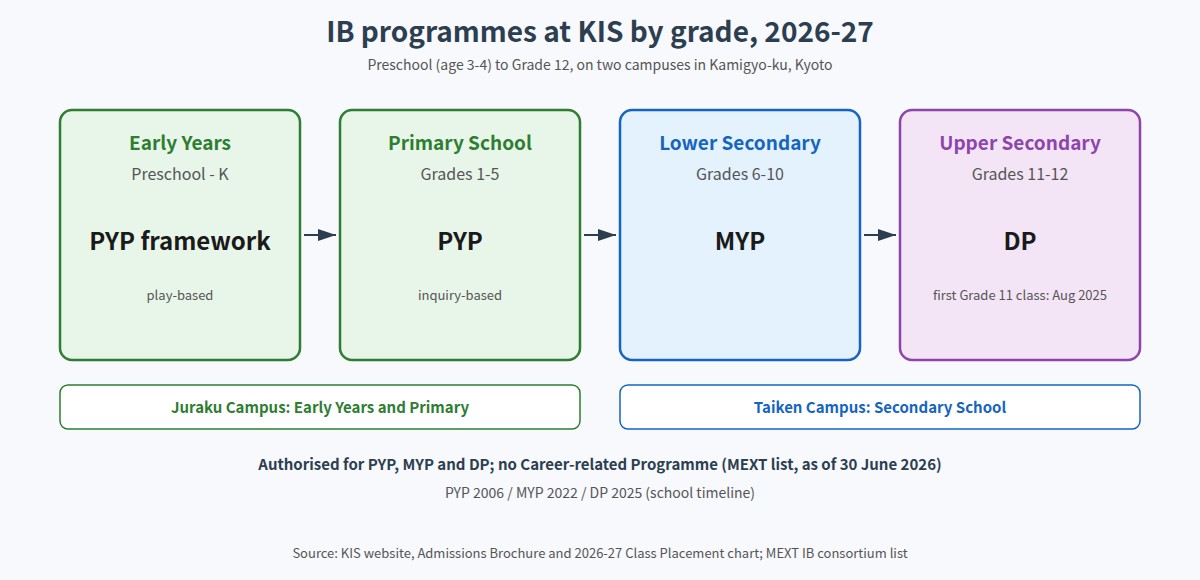
Kyoto International School (KIS) has been teaching children in Kyoto since 1957, when it started as a tiny classroom in a family home. Today it is a small, not-for-profit IB World School in Kamigyo-ku that takes children from Preschool (age 3 to 4) up to the IB Diploma Programme. If your family is moving to Kyoto for work or research, or you are simply comparing international schools in the Kansai region, this guide pulls together what the school publishes about its IB programmes, fees for the 2026-27 school year, admissions and daily life, so you can decide whether it is worth a visit.
Everything below comes from the school’s official website and documents (its 2026-27 fee schedule, payment plans, class placement chart and admissions brochure), the Japanese Ministry of Education (MEXT) IB consortium list and the Kyoto Prefecture list of private schools, all checked on 26 September 2026. Fees and deadlines change every year, so please confirm the details with the admissions office before you apply.
KIS at a glance
KIS is a day school on two campuses: Juraku for the Early Years and Primary School, and Taiken for the Secondary School.
| Item | Details |
|---|---|
| School name | Kyoto International School (KIS) |
| Founded | 1957; named Kyoto International School in 1966 |
| Campuses | Juraku Campus: 317 Kitatawara-cho, Kamigyo-ku, Kyoto (Early Years and Primary). Taiken Campus: 536-1 Waraya-cho, Kamigyo-ku, Kyoto (Secondary) |
| Grades (2026-27) | Preschool (ages 3 to 4) to Grade 12, per the school’s 2026-27 Class Placement chart |
| Students | 180 students, according to the “KIS at a glance” counter on the school homepage (checked September 2026); the admissions brochure gives 30 nationalities |
| IB programmes | PYP, MYP and DP (no Career-related Programme), per the MEXT list as of 30 June 2026 |
| Accreditation | WASC (since 1992); the school describes its COBIS accreditation as coming through its WASC accreditation |
| Status in Japan | Approved by Kyoto Prefecture as a miscellaneous school (kakushu gakko) run by a jun-gakko hojin (quasi-school corporation); not an “Article 1” Japanese school |
| Principal | Matt Topliss |
The website says small class sizes let teachers “truly know each student and family”, and the admissions brochure gives a teacher-student ratio of 1:6 and says around 70% of students are international students (the brochure is undated).
A short history
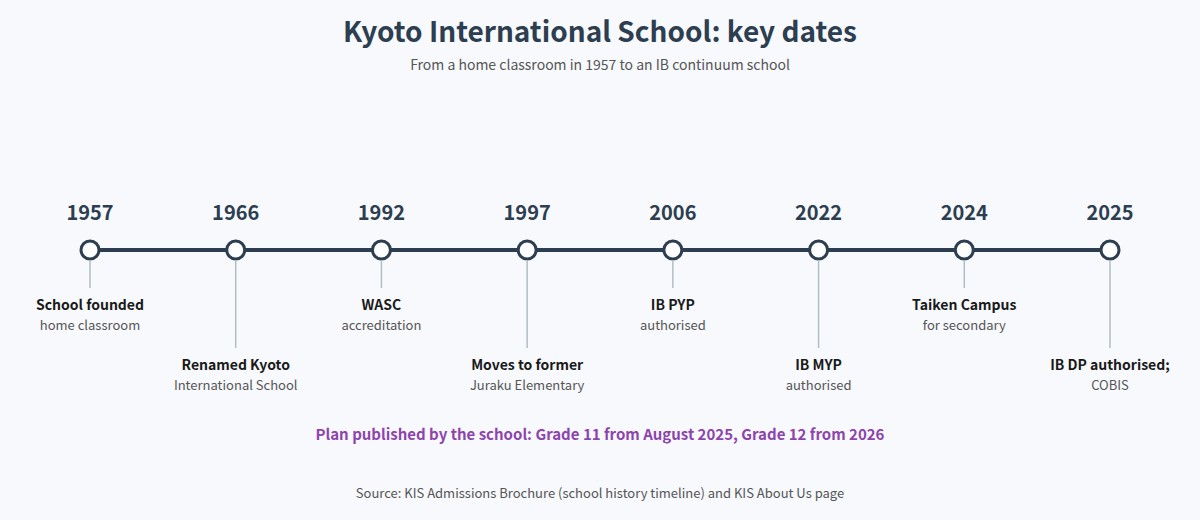
According to the school’s history, the school began late in 1957 with lessons in a spare bedroom of a missionary family’s home; the next year it became the Kyoto Christian Day School, with 28 students in 1958-59, and in 1966 it took its current name. As Figure 1 shows, the brochure timeline then lists WASC accreditation in 1992, a move to the former Juraku Elementary School in 1997, IB PYP authorisation in 2006, approval in 2007 by Kyoto Prefecture as a miscellaneous school run by a jun-gakko hojin (quasi-school corporation; the prefecture’s list gives 23 March 2007), MYP authorisation in 2022, use of the former Taiken Elementary School for the Secondary School from 2024, and DP authorisation and COBIS accreditation in 2025.
IB programmes at KIS: from Preschool to the Diploma
KIS is what is often called an “IB continuum” school, meaning your child can follow IB frameworks from the early years to the end of high school. The MEXT IB consortium list (as of 30 June 2026) shows Kyoto International School with the Primary Years Programme (PYP), the Middle Years Programme (MYP) and the Diploma Programme (DP), and no Career-related Programme (CP). It appears in the list’s section for schools that are not Article 1 schools.
The school’s own timeline gives the years of authorisation as 2006 for the PYP, 2022 for the MYP and 2025 for the DP. In other words, the PYP has nearly twenty years of history here, while the MYP and DP are much newer.
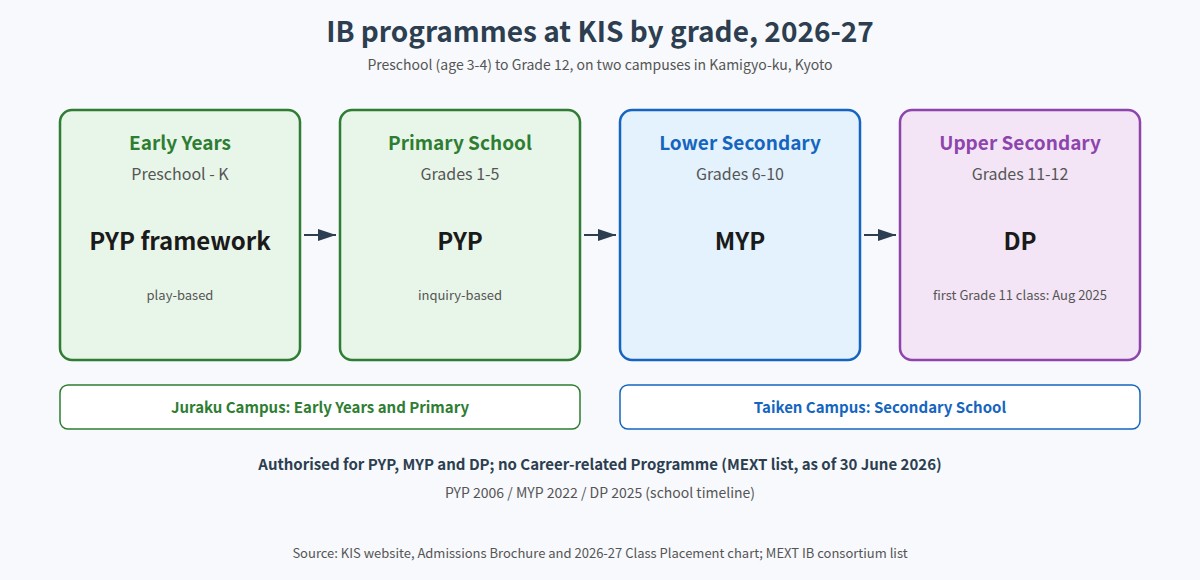
As Figure 2 shows, the programmes line up like this:
- Early Years (Preschool, Pre-Kindergarten and Kindergarten): the school uses the PYP to frame a play-based programme. The 2026-27 placement chart includes a Preschool class for ages 3 to 4.
- Primary School (Grades 1 to 5): the PYP, with learning built around guided inquiry.
- Lower Secondary (Grades 6 to 10): the MYP. (The fee schedule groups Grades 6 to 11 in one column labelled “MYP&DP (G6 – G11)”.)
- Upper Secondary (Grades 11 and 12): the DP, which the school describes as its framework for students aged 16 to 19.
Is there really a Grade 12 now?
This is a fair question, because until recently KIS finished at Grade 10. The school announced that it would open its first Grade 11 class in August 2025 and add Grade 12 in 2026. Some pages on the website still carry older wording (“Kindergarten through Grade 10, with plans to expand to Grade 12 by 2026”), which can be confusing. The school’s 2026-27 documents, however, do include Grade 12: the fee schedule has a separate “DP (G12)” column, and the 2026-27 Class Placement chart lists Grade 12 for children born between 1 September 2008 and 31 August 2009. We could not find a school announcement giving the number of students in Grade 12 this year, so if you are thinking of the final two years, it is worth asking how large the DP classes are.
Diploma Programme subjects
DP students take six subjects, usually three at Standard Level (150 teaching hours) and three at Higher Level (240 hours), together with the DP core: Theory of Knowledge (TOK), the 4,000-word Extended Essay and CAS (creativity, activity, service). The DP subject options listed on the school’s Secondary School page are Language & Literature, Language Acquisition, Global Politics, Chemistry, Mathematics and Visual Arts. As the Diploma Programme is new, the range of subjects may still be developing. If your child has a particular subject in mind, ask which courses will run in their year.
IB Diploma results and university counselling
KIS does not yet publish IB Diploma results or a list of university destinations, which is not surprising: the school’s plan was to open its first Grade 11 class in August 2025, so no DP cohort can have finished the programme yet.
The school’s University Counseling page says counselling begins in Grade 10 and increases through Grades 11 and 12, with a “personalized approach” and visits from universities around the world. If your child may apply to Japanese universities, it helps to know that MEXT recognises holders of the IB Diploma, and graduates of the 12-year course at schools accredited by bodies such as WASC or COBIS, as eligible to apply for university entrance in Japan. Each university and faculty sets its own requirements, though, so always check the specific admissions guide.
Tuition and fees for 2026-27
Let’s talk honestly about money, because it matters. The good news for many families is that KIS’s fees are published in full. These are the figures in the school’s “Tuition and Fees at a Glance 2026-27” document.
| Fee (2026-27) | Preschool to Grade 5 | Grades 6 to 11 | Grade 12 |
|---|---|---|---|
| Tuition (annual) | ¥1,366,800 | ¥1,761,000 | ¥1,761,000 |
| Building & Facilities Fees (annual) | ¥190,000 | ¥190,000 | ¥190,000 |
| PTA dues (annual, per family) | ¥3,000 | ¥3,000 | ¥3,000 |
| IB Diploma Fee (annual) | ¥0 | ¥0 | ¥144,000 |
| EAL Support Fee (only for students who need it) | Up to ¥100,000 a year | ¥0 | ¥0 |
| Application Fee (one-time) | ¥31,500 | ||
| Registration Fee (one-time) | ¥220,000 | ||
| Emergency Kit Fee (one-time) | ¥7,150 | ||
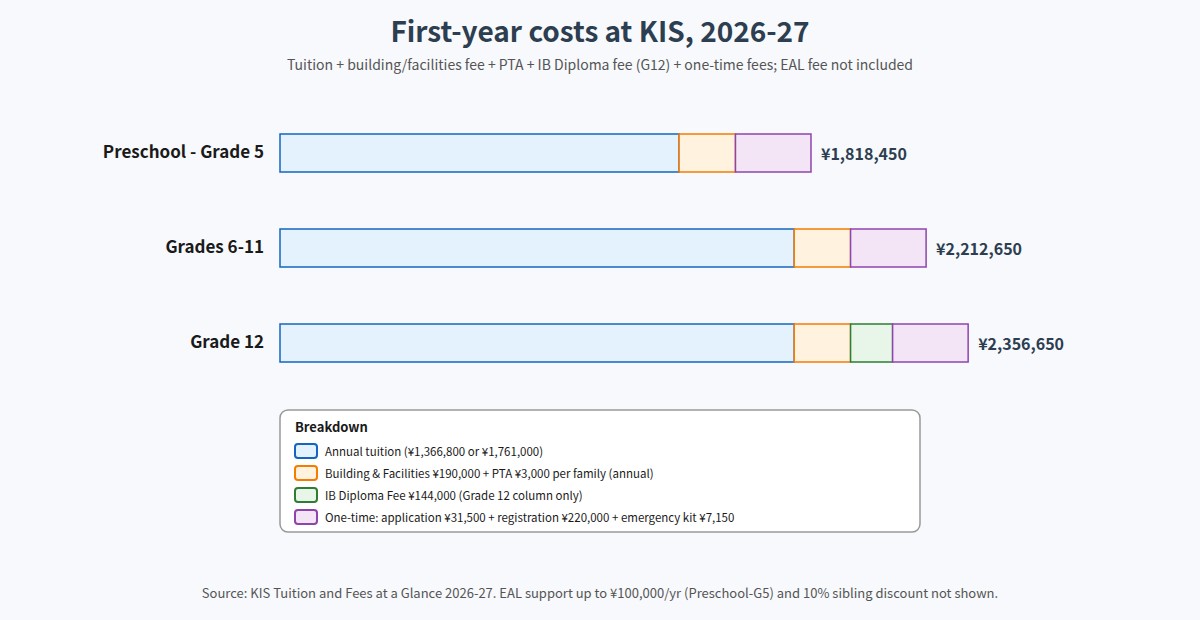
Putting these together, the one-time fees for a new student add up to ¥258,650 (¥31,500 + ¥220,000 + ¥7,150). The annual fees (tuition, Building & Facilities and PTA) come to ¥1,559,800 for Preschool to Grade 5, ¥1,954,000 for Grades 6 to 11 and ¥2,098,000 for Grade 12 (including the ¥144,000 IB Diploma Fee). So, as Figure 3 shows, a new student’s first year at 2026-27 rates works out at ¥1,818,450 for Preschool to Grade 5, ¥2,212,650 for Grades 6 to 11 and ¥2,356,650 for Grade 12. For a younger child who needs the full English support, add up to ¥100,000, making up to ¥1,918,450.
A few practical details from the same documents:
- Sibling discount: 10% off the tuition of the second and each subsequent child.
- EAL fee: billed each semester only to students who need English as an Additional Language support, up to ¥100,000 a year; the school decides the level of support from WIDA English assessment results. It appears only in the Preschool to Grade 5 column.
- Mid-year entry: tuition and the Building & Facilities Fees can be prorated for mid-year admission or short-term enrolment and are non-refundable; the PTA fee is not prorated.
- Payment plans: three options are offered (“some restrictions apply”), and families choose one by 20 June 2026. Paying everything by 30 June 2026 earns a 2% discount on tuition (for Preschool to Grade 5 the payment plan document lists ¥1,529,500 instead of ¥1,556,800, excluding PTA dues; the discounted tuition is shown rounded to ¥1,339,500). The standard plan splits the year into three instalments due 31 July 2026, 15 December 2026 and 15 March 2027. A ten-month plan is also available with a 3% administration surcharge.
- Fee increase: a school letter dated 10 April 2026 explains that tuition rose by 2% for 2026-27.
The summary price boxes in the fee table on the admissions web page show slightly different headline totals and application fee from the 2026-27 fee document. We have used the dated 2026-27 document, but it is a good idea to confirm the final amounts on your invoice with the school office.
Scholarships are also worth knowing about. The school’s application form says incoming IB Diploma students can receive up to a 100% tuition discount based on performance in a scholarship exam, with conditions, and that scholarships are limited and competitive. The dedicated scholarship page still describes the 2025-26 round, and we could not find dates for the next round, so please ask admissions if your child is aiming to join in Grade 11.
Admissions: who can apply and how it works
Steps
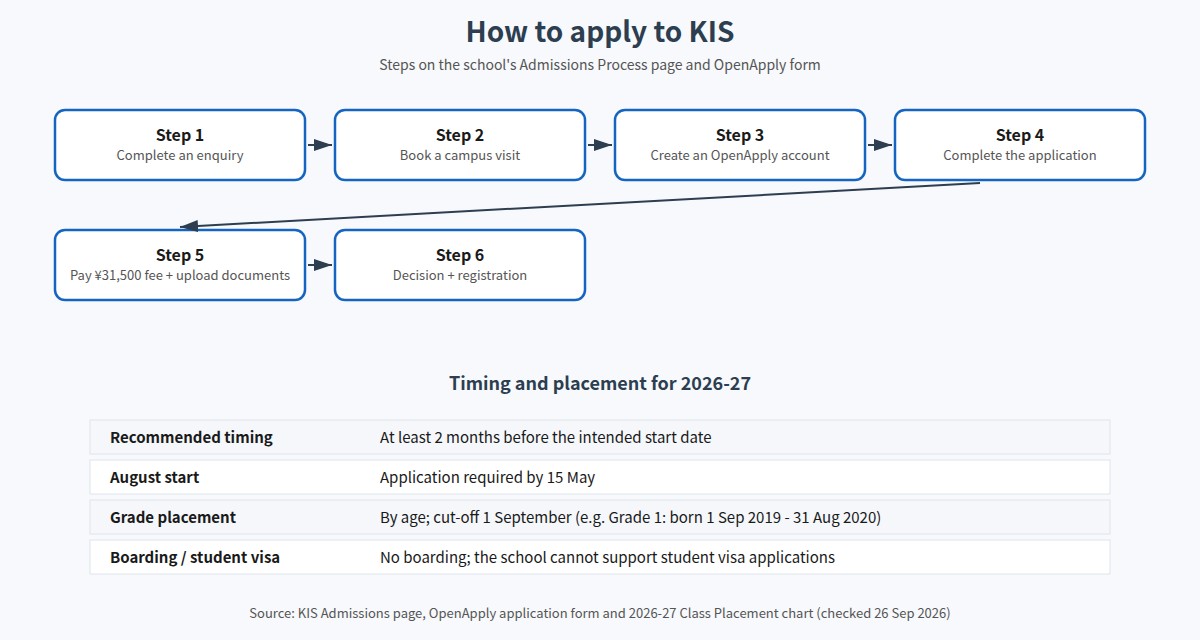
The school’s Admissions Process page sets out the steps, summarised in Figure 4: complete an online enquiry, book a campus visit, create an account on the OpenApply portal, fill in the application (student details, family and emergency contacts, education history), pay the non-refundable ¥31,500 application fee and upload the supporting documents, and then wait for the decision. The form notes that an application is only reviewed after the fee has been paid. The Principal reviews each application, and the brochure explains that the decision is based on the application and review, the space available and school policies. If your child is accepted, you receive an acceptance letter and complete registration by returning a parental agreement form and paying the registration fee.
Timing
KIS admits students during the year, but the application form recommends applying at least two months before the intended start date, and states that for an August start, the school requires the application by 15 May. According to the school calendar, the 2026-27 year began on 24 August 2026.
Documents
- A scanned ID (passport, birth certificate or health insurance card) and a recent photo
- School records for the previous two years
- Your child’s health record and immunisation records, plus a physician’s health form
- A teacher recommendation form (for Grade 1 and above)
Age and grade placement
KIS places children by age, with a 1 September cut-off. For 2026-27, for example, Grade 1 is for children born between 1 September 2019 and 31 August 2020, and Preschool (ages 3 to 4) is for children born between 1 September 2022 and 31 August 2023. For a birthday within about a month of the cut-off, the chart says placement is at the school’s discretion.
English and other conditions
For the Diploma years there is a clear rule: the OpenApply form asks for evidence of English proficiency for Grades 11 and 12 only, and says that applicants for DP “are required to submit a copy of their standardized test score records, or a record of having at least six years of formal education conducted entirely in English.” No minimum score is published. For other grades we found no published minimum English level and no description of an entrance test, so please ask how your child’s English will be assessed. What the documents do tell us is that EAL support (with a fee) is set out for Preschool to Grade 5, and that the Secondary School offers English conversational sessions for students who are new to English. Also, KIS has no boarding facilities and cannot support student visa applications, so your child needs to live locally with the family.
Japanese families should also know that KIS is a miscellaneous school (kakushu gakko) rather than an Article 1 school. If your child is of compulsory school age and has Japanese nationality, it is sensible to check with your local education board how attending a non-Article 1 school is treated before you enrol.
Learning support and student life
The admissions brochure says KIS offers targeted assessments and exam accommodations, such as extended time, separate testing rooms and assistive technology, and the Secondary School runs a Social and Emotional Learning wellbeing programme. If your child has a diagnosed learning need, share this early.
Daily life has a lovely Kyoto flavour: every student joins a House named after one of the four guardians of the ancient capital. Free after-school clubs called Bukatsu, run by KIS teachers, meet from 3:30 to 4:30 pm on Mondays, Tuesdays, Thursdays and Fridays for 12 weeks each semester, with activities such as calligraphy, gardening, sports and STEM. Paid lessons include aikido, coding, basketball, ikebana and piano.
KIS also runs a Saturday School, an English immersion programme for children aged 3 to 12. For 2026-27 its published term fees are ¥130,000 for the autumn term (13 sessions), ¥100,000 for winter (10 sessions) and ¥130,000 for spring (13 sessions), plus a ¥20,000 registration fee, which is waived for current KIS students and alumni.
Getting to KIS
According to the admissions brochure, the Juraku Campus is in the heart of Kyoto’s Nishijin textile district. The school’s directions page gives Horikawa Nakadachiuri as the nearest bus stop, served by Kyoto City Bus routes 9, 12 and 50. The brochure also describes the Secondary School’s Taiken Campus as “situated right next to” Nijo Castle. We found no school bus service on the official pages, so try the journey at school time before choosing where to live.
Questions parents often ask
My child speaks little English. Can they still join?
For Grades 11 and 12, applicants must show evidence of English proficiency (standardized test scores, or at least six years of education entirely in English), although no minimum score is published. For younger children, the fee schedule sets out a paid EAL support programme up to Grade 5, and the Secondary School offers English conversational sessions for newcomers. Ask the school frankly how an older beginner would be supported.
Can my child stay at KIS right through to graduation?
That is the school’s plan. Its 2026-27 fee schedule and placement chart both include Grade 12, but no DP class has graduated yet and no results have been published. Ask how many students are in Grades 11 and 12 and which DP subjects will run.
Are there scholarships?
Yes, for the Diploma years: incoming IB Diploma students can receive up to a 100% tuition discount through a competitive exam, with conditions. Dates for the next round were not published when we checked.
Summary
- A small, long-standing Kyoto school: founded in 1957, with 180 students according to the school homepage and 30 nationalities according to its brochure.
- A full IB continuum: PYP, MYP and DP on the MEXT list as of 30 June 2026, authorised in 2006, 2022 and 2025 respectively according to the school’s timeline.
- A new Diploma Programme: the school planned Grade 11 from August 2025 and Grade 12 from 2026, and Grade 12 appears in the 2026-27 fee schedule, but there are no published DP results yet.
- 2026-27 fees: tuition ¥1,366,800 (Preschool to Grade 5) or ¥1,761,000 (Grades 6 to 12), plus ¥190,000 Building & Facilities, ¥3,000 PTA, ¥144,000 IB Diploma Fee in Grade 12 and ¥258,650 in one-time fees.
- Straightforward admissions: apply on OpenApply at least two months ahead (by 15 May for August), with placement by age on a 1 September cut-off; no boarding or student visa support.
If KIS sounds like a good fit, book a campus tour through the school website and bring your questions about English support, class sizes and Diploma subjects. Visiting with your child is the best way to feel whether it suits your family.
Sources and references
- Kyoto International School: official website (checked 26 September 2026)
- KIS: About Us
- KIS: Admissions (process, documents, tuition and fees)
- KIS: Tuition and Fees at a Glance 2026-27 (PDF)
- KIS: Payment Plans 2026-27 (PDF)
- KIS: Fees Announcement, 10 April 2026 (PDF)
- KIS: Class Placement chart 2026-27 (PDF)
- KIS: Admissions Brochure (PDF)
- KIS: School Calendar 2026-2027 (PDF)
- KIS: online application form (OpenApply)
- KIS: Early Years, Primary School and Secondary School
- KIS: University Counseling
- KIS: IBDP Scholarship Exam
- KIS: Student Life
- KIS: Saturday School fees 2026-27
- KIS: Directions (Japanese)
- MEXT IB Education Promotion Consortium: IB schools in Japan (as of 30 June 2026)
- Kyoto Prefecture: list of private miscellaneous schools, FY2026 (PDF, Japanese)
- MEXT: University entrance eligibility (Japanese)
コメント