Nagoya International School (NIS) is a non-profit, co-educational international school in Moriyama-ku, Nagoya, teaching children from preschool through Grade 12 in English. It was founded in 1964, and its 2025-26 School Profile reports 475 students from 38 nationalities as of 1 September 2025. If your family is moving to Nagoya and looking for an English-medium IB school, NIS will almost certainly be on your list.
The facts below were checked on the school’s official website, its 2025-26 School Profile and the Japanese Ministry of Education (MEXT) IB consortium list on 26 September 2026. Fees and policies change, so please confirm the details with the Admissions Office before you apply.
NIS at a glance
| Item | Details |
|---|---|
| School name | Nagoya International School (NIS) |
| Founded | 1964 |
| Type | Independent, non-profit, co-educational day school; operated as an educational foundation (gakko hojin); not an “Article 1” school under Japan’s School Education Law |
| Campus | 2686 Minamihara, Nakashidami, Moriyama-ku, Nagoya (nearest JR station: Kozoji) |
| Grades | Early Learning Center (Preschool and Kindergarten) to Grade 12 |
| Students (2025-26) | 475 as of 1 September 2025: ELC 32, Elementary 193, Middle School 114, High School 136; 38 nationalities |
| IB programmes | PYP, MYP and DP (no CP), MEXT list as of 30 June 2026 |
| Accreditation | CIS and WASC |
| Head of School | Matthew Parr |
A quick note on numbers: the NIS home page currently shows 440 students and 37 nationalities, without a date. We have used the School Profile figures above because they are tied to a specific date.
The IB programmes at NIS
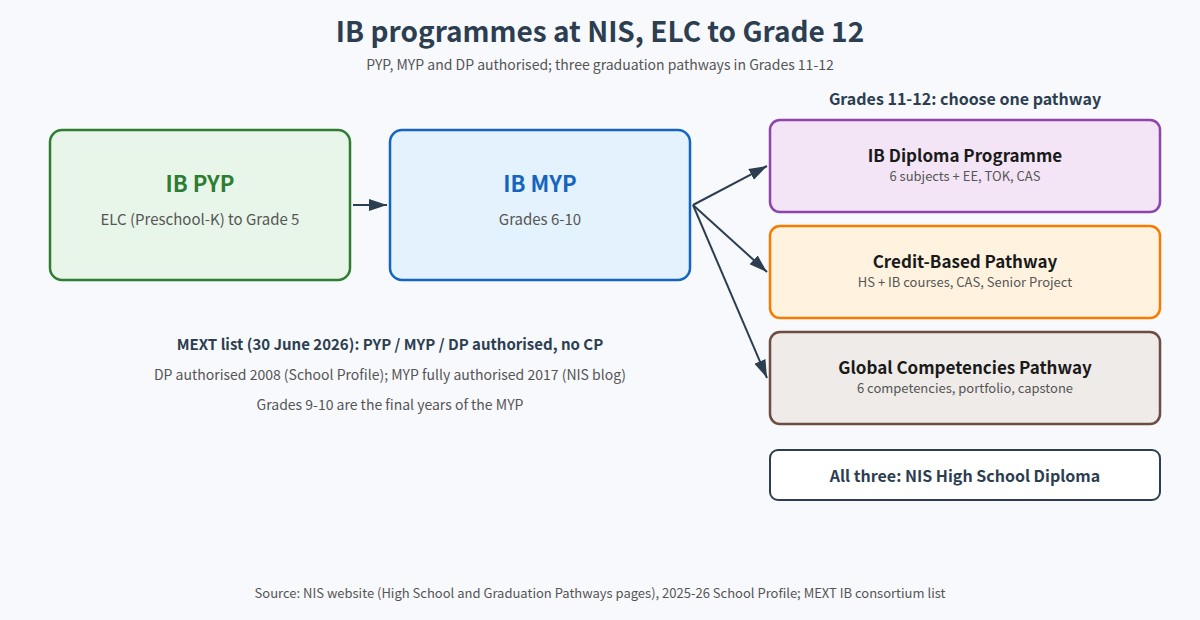
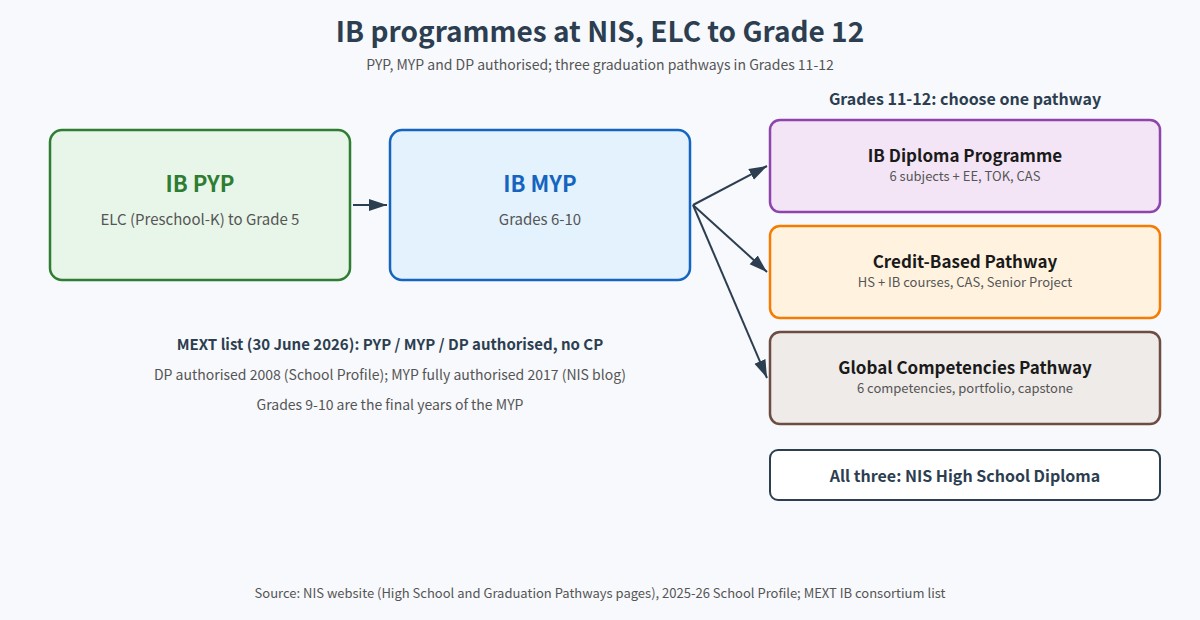
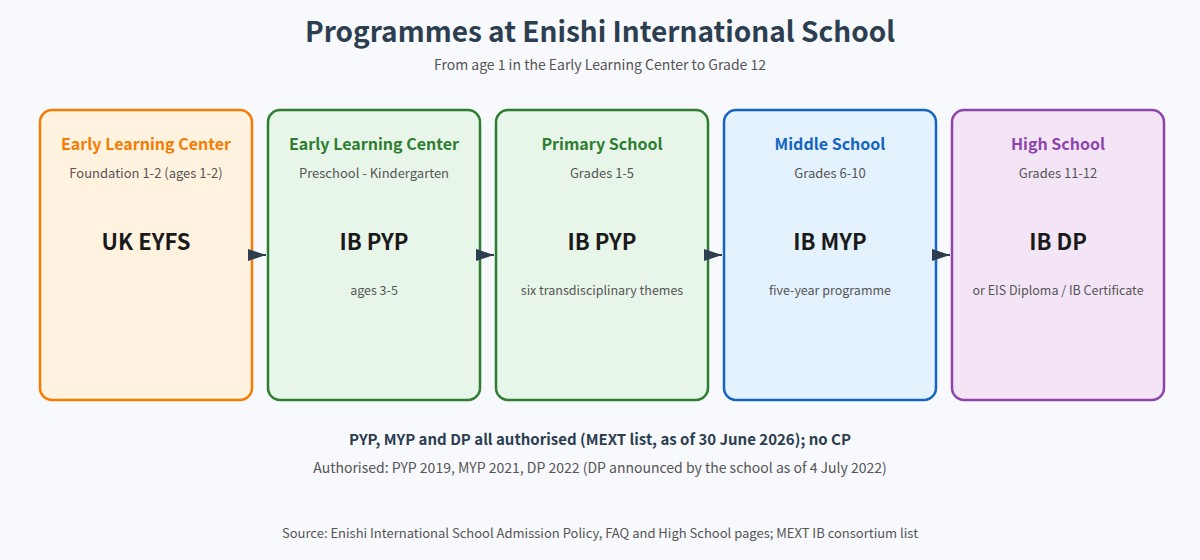
NIS’s Accreditations page says “NIS offers the full IB”, and the MEXT list (as of 30 June 2026) confirms it is authorised for all three of the main IB programmes: the Primary Years Programme (PYP), the Middle Years Programme (MYP) and the Diploma Programme (DP). It is not listed for the Career-related Programme (CP).
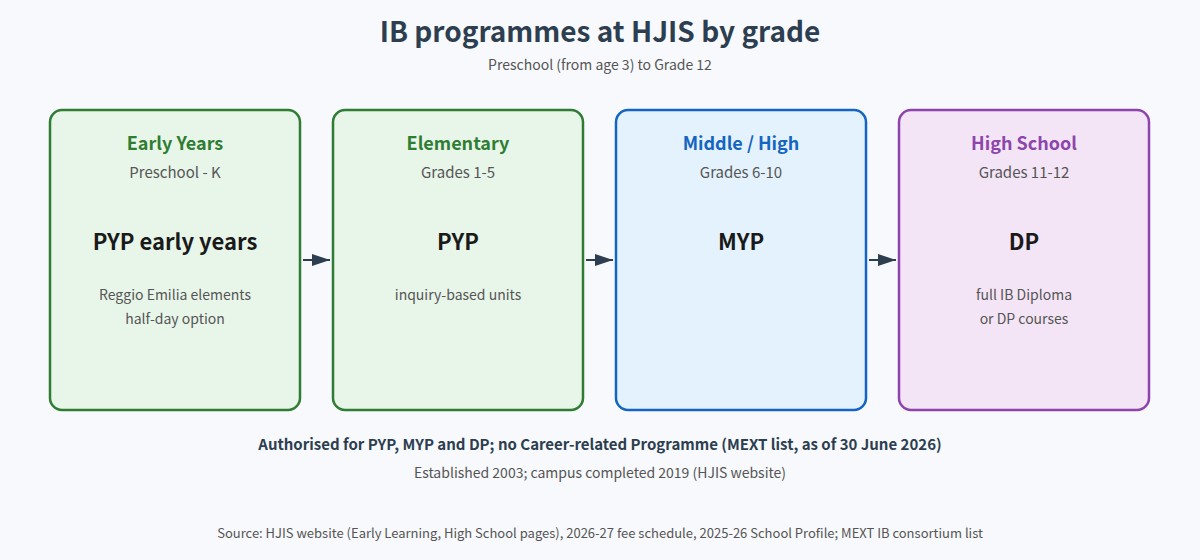
- Early Learning Center (Preschool and Kindergarten): a play-based, inquiry-driven approach inspired by Reggio Emilia and guided by the PYP. The school states that “Children do not need to speak English before starting in the ELC.”
- Elementary School (Grades 1 to 5): the PYP, built around units of inquiry.
- Middle School (Grades 6 to 8) and High School Grades 9 to 10: the MYP. The high school page explains that Grades 9 and 10 are the final years of the MYP. NIS’s own blog says the MYP gained full authorisation in 2017 after a five-year candidate period.
- Grades 11 and 12: the IB Diploma Programme, or one of two other graduation pathways (see below). The School Profile says NIS was authorised to teach the Diploma in 2008.
For families who move often, this is a real plus: a child from another PYP or MYP school continues in a familiar framework.
Grades 11 and 12: three graduation pathways
This is what makes NIS a little different. Instead of assuming every student takes the full IB Diploma, the school offers three pathways in the last two years, and states that all three lead to the NIS High School Diploma.
- IB Diploma Programme (IBDP): six subjects plus the core of the Extended Essay, Theory of Knowledge (TOK) and Creativity, Activity, Service (CAS). The School Profile describes the IBDP at NIS as “non-selective”, and the school’s web page calls it “open to all students who are prepared to embrace its challenges”.
- Credit-Based (Hybrid) Pathway: a structured route to the NIS High School Diploma combining High School and IB courses. Students complete the required graduation credits, CAS and a Senior Project.
- Global Competencies Pathway: a two-year, full-time, competency-based route. Rather than collecting subject credits, students show growth in six competencies (Inquiry, Literacy and Communication, Numeracy, Creative Problem-Solving, Social Impact and Personal Responsibility), complete CAS, build a portfolio, and in Grade 12 finish a Capstone Portfolio, with an internship or mentor-supported project where appropriate. It ends with a Final Gateway Review and a Viva Voce or Final Exhibition.
The 2025-26 School Profile lists DP subjects including English and Japanese (Language A, Japanese B and ab initio), Biology, Chemistry, Physics, Environmental Systems and Societies, Economics, History, both mathematics courses, Music, Theatre and Visual Arts. Extra IB courses can be taken online through Pamoja. NIS does not rank students or calculate a GPA.
IB Diploma results
Results for 2022-2026 come from the Graduation Pathways page (with the 2026 global average from the School Profile page):
| Class | Graduates | IBDP students | Diplomas obtained | NIS average | Global average | Highest score |
|---|---|---|---|---|---|---|
| 2026 | 32 | 25 | 22 | 33 | 30.88 (see note) | 43 |
| 2025 | 35 | 25 | 22 | 31 | 30.5 (as published by the school) | 41 |
| 2024 | 28 | 23 | 23 | 31.5 | 30.3 | 38 |
| 2023 | 23 | 19 | 16 | 33.9 | 30.2 | 42 |
| 2022 | 31 | 26 | 24 | 34 | 31.9 | 43 |
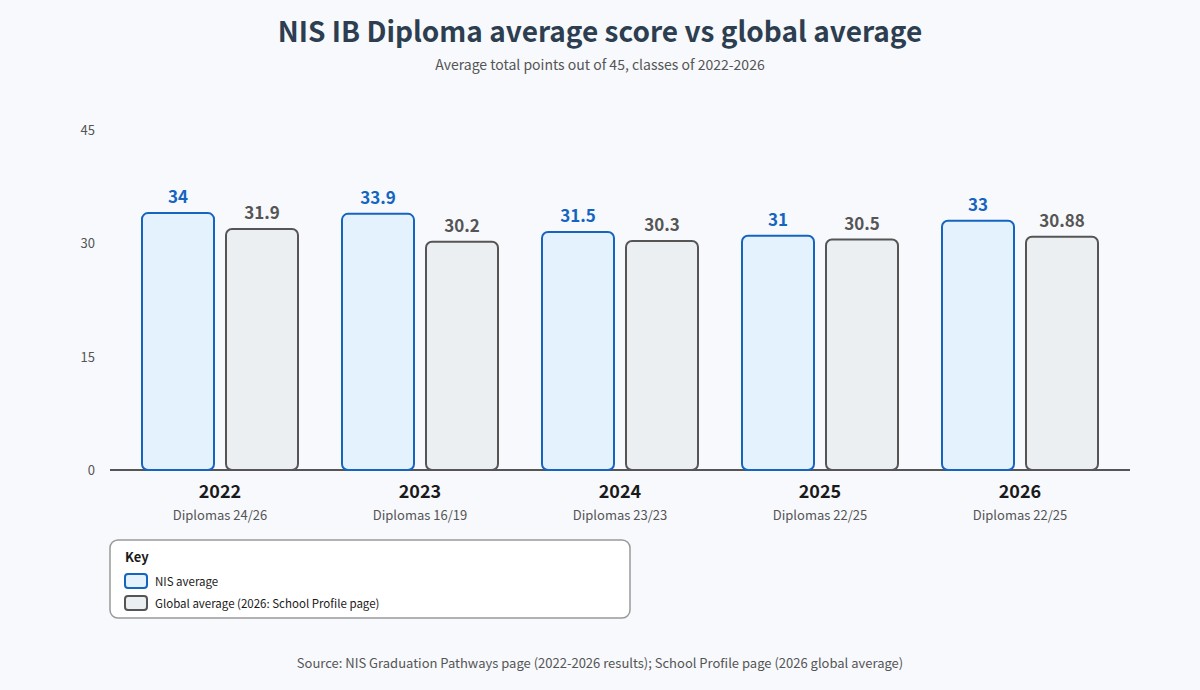
Working from these published counts, the share of Diploma candidates who earned the Diploma was 88% in 2026 (22 of 25), 88% in 2025 (22 of 25), 100% in 2024 (23 of 23), about 84% in 2023 (16 of 19) and about 92% in 2022 (24 of 26); these are our calculations. For 2026, the Graduation Pathways table shows the global average as “NA”, while the School Profile page gives 30.88.
Classes are small (19 to 26 candidates a year), so one or two students can move the percentages, and because the Diploma is non-selective, averages reflect a broad range of students. In 2026, 25 of 32 graduates (about 78%) took the full Diploma; the 2025-26 profile gives 71% for the Class of 2025.
University acceptances
For the Class of 2026, the School Profile page lists university acceptances (offers, not final enrolments) in the United States (23), Japan (17), the United Kingdom (16), Canada (16), the Netherlands (6) and other countries (9). Examples include the University of Tokyo, Keio, Waseda, UCLA, University College London, McGill and the University of Toronto. College guidance begins in Grade 9.
Tuition and fees for 2026-27
Let’s look honestly at costs. These are the amounts on the NIS Tuition and Fees page for the 2026-27 school year.
| Fee (2026-27) | Amount (JPY) | When charged |
|---|---|---|
| Application fee | ¥50,000 | Once per applicant, non-refundable |
| Registration fee | ¥1,000,000 | One-time, on acceptance |
| Campus Development Fee | ¥250,000 | Every year |
| Tuition: Early Learning Center (Preschool to Kindergarten) | ¥2,190,000 | Every year |
| Tuition: Elementary School (Grades 1-5) | ¥2,700,000 | Every year |
| Tuition: Middle School (listed as Grades 6-10) | ¥3,120,000 | Every year |
| Tuition: High School (listed as Grades 9-12) | ¥3,180,000 | Every year |
| School bus (optional): Neighborhood Pickup, buses 1-5 / Kozoji Shuttle | ¥500,000 / ¥195,000 | Every year, for registered riders |
| 1:1 support from an additional adult (only where required) | ¥2,750,000 | Every year |
One detail to check: the page lists the Middle School rate for Grades 6-10 and the High School rate for Grades 9-12, so Grades 9 and 10 appear in both bands. Please ask the Business Office which rate applies if your child will be in Grade 9 or 10.
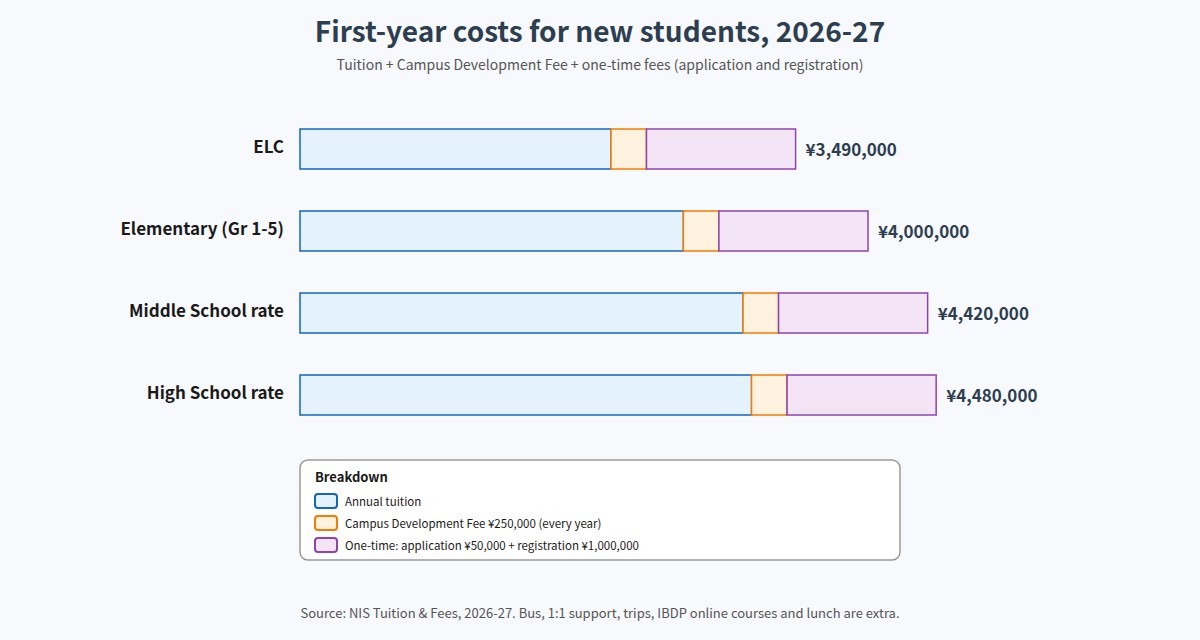
So a new student pays ¥1,050,000 in one-time fees (application ¥50,000 plus registration ¥1,000,000). The first year therefore comes to ¥3,490,000 in the ELC, ¥4,000,000 in Elementary School, ¥4,420,000 at the Middle School rate and ¥4,480,000 at the High School rate, before the bus and other extras. From the second year, tuition plus the Campus Development Fee comes to ¥2,440,000, ¥2,950,000, ¥3,370,000 and ¥3,430,000 respectively at 2026-27 rates.
Other points from the same page:
- Optional sports trips (EAISAC or WJAA) cost up to ¥80,000 per trip, and optional IBDP online courses cost ¥50,000 to ¥60,000 per course.
- Tuition and the Campus Development Fee can be paid in 10 monthly instalments for a one-time ¥20,000 administration fee per family.
- Students joining mid-year pay tuition quarterly, but the one-time fees and the Campus Development Fee are charged in full.
- Returning families pay a non-refundable ¥100,000 re-enrolment deposit by 30 January.
- School lunches are provided by Cezars Kitchen, which manages its own fees; no lunch price is listed on the tuition page.
NIS also runs a need-based Financial Aid Program with limited funds.
Admissions: steps, age and English
The six steps
The Applying to NIS page sets out six steps:
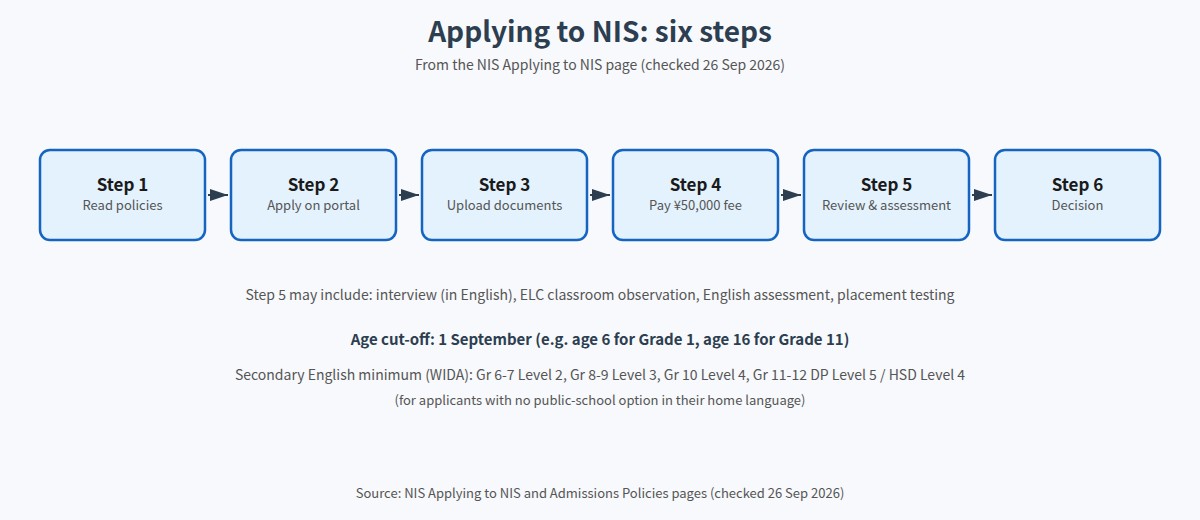
- Step 1: read the admissions policies and criteria.
- Step 2: apply through the NIS Admissions Portal (there is one form for ELC Preschool and Kindergarten and one for Grades 1-12).
- Step 3: upload documents: reports from the past two years, a confidential teacher recommendation, a passport or Japanese residence documentation, photographs and a short video introduction.
- Step 4: pay the non-refundable ¥50,000 application fee by credit card; review starts only after payment.
- Step 5: review and assessment, which begins once all materials have been received and may include an interview (the Interview policy says interviews are in English and families may bring a translator), ELC classroom observation, an English assessment and placement testing.
- Step 6: the admissions decision. The Admissions Policies describe both full and conditional acceptances.
When can you apply?
NIS does not publish a single application deadline. Instead, its Tuition and Fees page explains registration windows: for Grades 2-12, registration typically opens on the first school day of the previous semester, and for ELC, Kindergarten and Grade 1 it opens about 10 months before the school year starts. According to the Wait Pool policy, when a class is full, qualified applicants go into a wait pool ordered by priority category rather than date (current students and siblings first, new expatriate students ahead of new local students).
Age cut-off
The cut-off date is 1 September. For example, a child must be 3 by 1 September for ELC-3, 6 for Grade 1 and 16 for Grade 11.
English requirements
This is the part to read carefully. The English Language Proficiency policy distinguishes between children who could attend a local public school in Japan and those who have no public school option in their home language:
- Applicants for Grades 1-11 who have a local public school option are expected to have grade-level equivalent English.
- Primary applicants with no public school option have no English requirement, but they are assessed and must be able to access the curriculum with extra support; the school may refuse an application if resources in that grade are full.
- Secondary applicants with no public school option must meet minimum WIDA levels: Level 2 for Grades 6-7, Level 3 for Grades 8-9, Level 4 for Grade 10, and for Grades 11-12, Level 5 for the DP or Level 4 for the High School Diploma.
Parents should be able to communicate with teachers in English or arrange their own language support. The earlier your child joins, the more flexibility there is.
Learning support and student life
English as an Additional Language (EAL). EAL runs from Grade 1 to Grade 12 at two levels, EAL Support and EAL Intensive.
Learning support. The team offers classroom, targeted and intensive support. NIS is open about its limits: each grade may have no more than 20% of students with a documented learning difficulty, no more than two with severe difficulties, and no more than 20% needing Tier 3 support from an EAL teacher. Please discuss any additional needs early.
Activities. The School Profile lists activities such as Model United Nations, Robotics and musicals, and sports from basketball to softball, with teams competing in EAISAC events.
Getting there
The closest station is Kozoji on the JR Chuo Line, about 20-25 minutes from Nagoya Station and a 40-45 minute walk from campus. For a first visit, the school suggests that families unfamiliar with driving in Japan take the train to Kozoji and a taxi from there (about 10-15 minutes, roughly ¥1,600). Most students use the school buses: NIS runs eight routes with 33 stops, plus a late bus to Issha Station after activities; ask Admissions about stops near your home.
Questions parents often ask
Does my child have to take the full IB Diploma?
No. In Grades 11 and 12 students choose the IB Diploma, the Credit-Based Pathway or the Global Competencies Pathway, and all three lead to the NIS High School Diploma.
My child speaks very little English. Can they still join?
It depends on age and your situation. The ELC does not require English, and Primary applicants who have no public school option in their home language have no English requirement, subject to assessment and available support. Secondary applicants with no such public school option must meet minimum WIDA levels (Level 5 for DP entry); those who could attend a local public school need grade-level English.
We are a Japanese family. Can our child attend?
The School Profile says NIS serves Japanese nationals as well as international families. However, NIS is not an “Article 1” school, and MEXT states that sending a child of Japanese nationality who is of compulsory school age to an international school that is not an Article 1 school does not fulfil the parents’ legal schooling obligation. Please consider this and discuss it with the school before applying.
Summary
- Established in 1964: 475 students from 38 nationalities (1 September 2025).
- Full IB continuum: PYP, MYP and DP authorised (MEXT list, 30 June 2026), with English as the language of instruction.
- Three pathways in Grades 11-12: IB Diploma, Credit-Based and Global Competencies, all leading to the NIS High School Diploma.
- Results: a 2026 average of 33 points, with 22 of 25 candidates earning the Diploma and a highest score of 43.
- 2026-27 fees: tuition from ¥2,190,000 (ELC) to ¥3,180,000 (High School), plus ¥250,000 a year for campus development and ¥1,050,000 in one-time fees.
- Plan ahead for English: secondary entry has English minimums (WIDA levels or grade-level English).
Sources and references
- Nagoya International School: official website (checked 26 September 2026)
- NIS: Tuition and Fees, 2026-27
- NIS: Applying to NIS
- NIS: Admissions Policies and Criteria
- NIS: Graduation Pathways and IB Diploma results
- NIS: School Profile page (Class of 2026)
- NIS: 2025-2026 School Profile (PDF)
- NIS: English Language Support and Learning Support
- NIS: Accreditations and Leadership and Governance
- NIS: Contact and Location and Bus Service
- NIS blog: The MYP at NIS
- MEXT: schooling obligation and international schools (Q&A 11)
- MEXT IB Education Promotion Consortium: IB schools in Japan (as of 30 June 2026)
コメント