Saint Maur International School is a co-educational, Catholic-founded international school in Yamate, Yokohama, teaching children from age two and a half through Grade 12. It was founded in 1872 and still stands on its original hilltop site, and the school describes itself as the oldest international school in Japan. If your family is moving to Yokohama and wants a small English-medium school with a route to the IB Diploma, it is likely to be on your list.
This guide is based on the school’s official website (including its 2026-2027 fee schedule and “Examination Results – Summer 2026” report), the Japanese Ministry of Education (MEXT) IB consortium list and the Council of International Schools (CIS), all checked on 26 September 2026. Fees and policies change, so please confirm details with the school before you apply.
- Saint Maur at a glance
- A short history on the Yamate hill
- How the curriculum works: Montessori, IPC, IGCSE, then the IB
- Exam results 2026
- Tuition and fees for 2026-2027
- Admissions: who can apply, English, and the steps
- Faith, learning support and student life
- Getting there
- Questions parents often ask
- Summary
- Sources and references
Saint Maur at a glance
| Item | Details |
|---|---|
| School name | Saint Maur International School |
| Founded | 1872, by Mère Mathilde Raclot and the Sisters of the Infant Jesus; co-educational since 1982 |
| Type | Co-educational, Catholic-founded day school; welcomes families of all faiths and nationalities |
| Campus | 83 Yamate-cho, Naka-ku, Yokohama, Kanagawa |
| Ages and grades | Age 2.5 (Montessori Pre-school) to Grade 12 |
| Size | Policy of never enrolling more than 500 students (history page); average class size 10 and a student-teacher ratio of generally 7:1 (school FAQ) |
| IB programme | Diploma Programme (DP) only; no PYP, MYP or CP (MEXT list, as of 30 June 2026) |
| Other curricula | Montessori (age 2½ to 5+), International Primary Curriculum (IPC) in Elementary, Cambridge IGCSE in Grades 9 and 10 |
| Accreditation | CIS (re-accredited on 16 May 2025) |
| School Head | Mrs Levy (School Head since August 2023) |
A note on numbers: the FAQ says about 35 nationalities are represented among students, while the history page speaks of “over 40” and gives a ratio of 8:1. The school does not publish a dated enrolment figure, so we have not quoted one.
A short history on the Yamate hill
According to the school’s history page, Mère Mathilde Raclot and four French and Irish sisters arrived in Yokohama on 23 May 1872, at the request of Western families who had no school for their daughters. Classes continued through the Great Kanto Earthquake of 1923 and, during the Second World War, at an evacuation site in Karuizawa. Boys joined in 1982, and the school states that it pioneered international Montessori education in Japan in 1973.
How the curriculum works: Montessori, IPC, IGCSE, then the IB
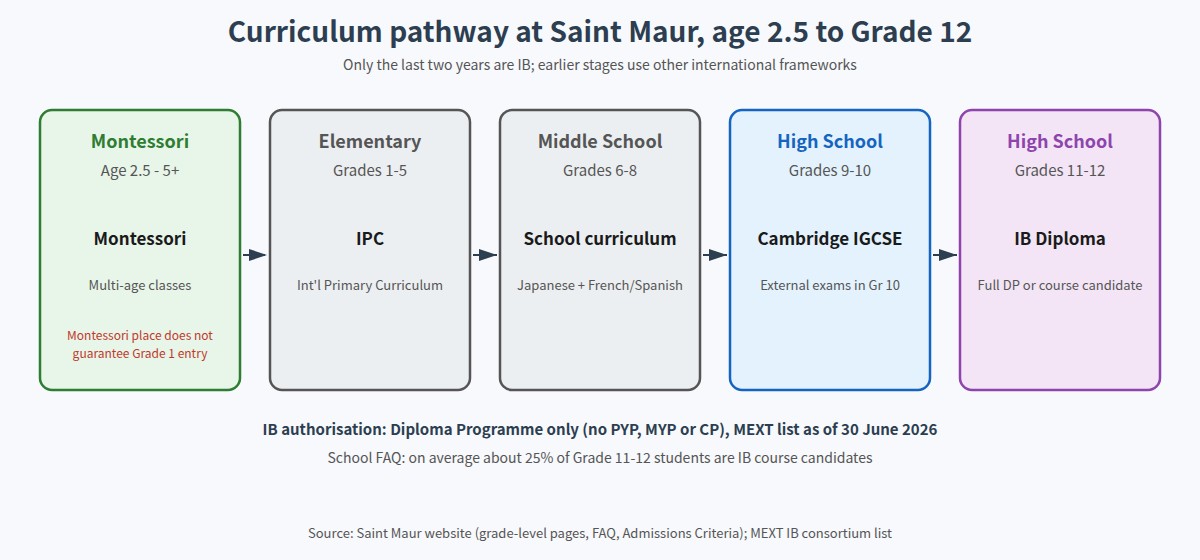
Here is the first thing to understand about Saint Maur. The school is authorised only for the IB Diploma Programme. Before Grade 11, children learn through a mix of other well-known international frameworks, one after another:
- Montessori Pre-school and Kindergarten (age 2½ to 5+): multi-age classes using hands-on Montessori materials.
- Elementary School (Grades 1 to 5): the International Primary Curriculum (IPC) is the base for history, science, social studies and geography; maths uses the Investigations curriculum, which the school says is aligned with the US Common Core.
- Middle School (Grades 6 to 8): the school’s own curriculum, including Japanese plus French or Spanish.
- Grades 9 and 10: the Cambridge IGCSE, with external exams at the end of Grade 10. Saint Maur appears on Cambridge International’s official list of Cambridge schools in Japan.
- Grades 11 and 12: the IB Diploma Programme.
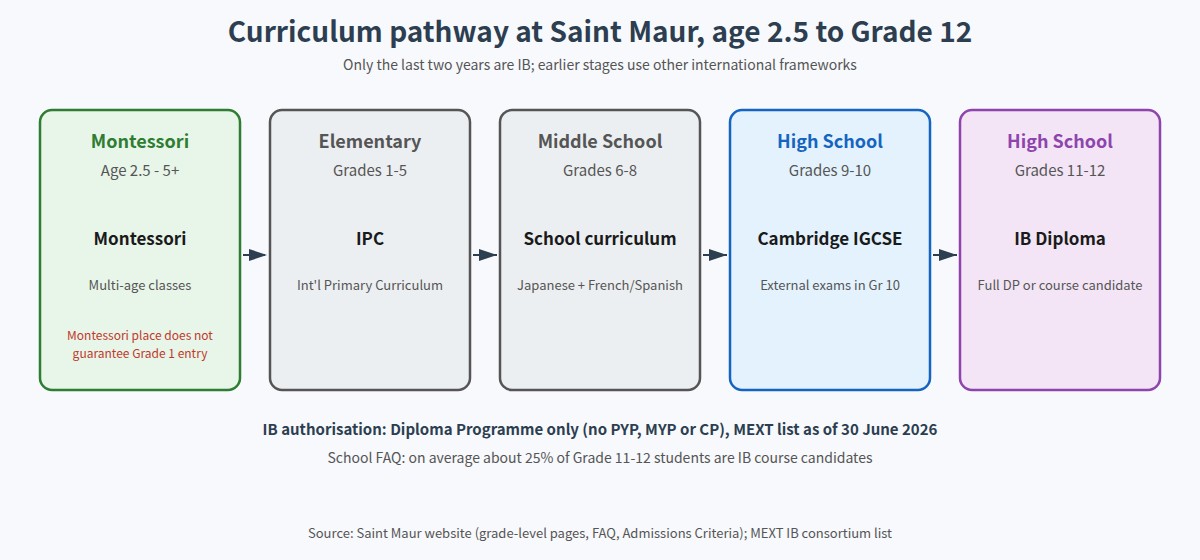
Why does this matter? Children from PYP or MYP schools will find units and assessment different until Grade 11. On the other hand, the two-year IGCSE course ends with externally marked exams at the end of Grade 10, good practice before the Diploma begins.
Full Diploma or IB courses?
In Grade 11, all students enter the IB programme. The FAQ says that, except for two courses, all Grade 11 and 12 courses are IB courses (the High School page says “with one exception”), and that students do not have to be full Diploma candidates: “On average, 25% of the student population in Grade 11 – 12 are Course Candidates.” According to the Admissions Criteria page, course candidates may register for CAS and the Extended Essay, and “All students are registered for the Theory of Knowledge (ToK) class.”
Saint Maur does not teach AP courses, but the FAQ says students can take AP exams; the Japanese department page mentions the AP Japanese exam at the end of Grade 10.
Exam results 2026
On 3 September 2026 the school published its “Examination Results – Summer 2026” report. In May 2026, 34 Grade 12 students sat IB exams, 28 of whom were full IB Diploma candidates.
| IB Diploma, May 2026 | Saint Maur | Worldwide |
|---|---|---|
| Diploma pass rate | 96% | 82.6% |
| Mean total points (out of 45) | 35.3 | 30.8 |
| Average subject grade, out of 7 (Saint Maur: Diploma passers; worldwide: mean subject grade) | 5.53 | 4.9 |
| Candidates with 40 points or more | 4 (14% of the cohort) | not given |
| Bilingual Diplomas | 9 (32% of the cohort) | not given |
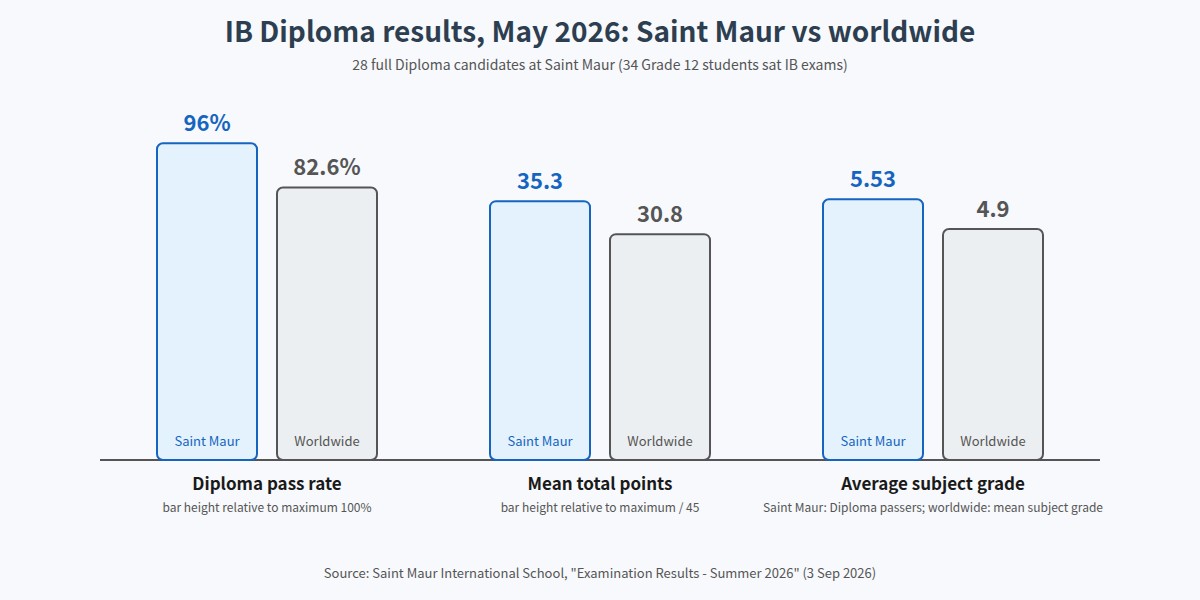
With 28 full candidates, one student moves the percentages by several points.
The same report says that in the 2026 IGCSE exams, taken by all Grade 10 students, 64.77% of all grades were A* or A and 98.7% were C or above.
University guidance and destinations
Counselling starts in Grade 10 with the Unifrog platform and the PSAT, followed by bi-weekly sessions in Grades 11 and 12. The school states a “100% matriculation rate into four-year universities and colleges” to date. Its College Guidance page lists “a selection” of universities graduates have entered, such as Keio, Waseda and ICU in Japan, the University of Melbourne, the University of Cambridge, King’s College London, McGill, the University of Toronto and the University of Pennsylvania. It gives no years or student numbers, so treat these as examples rather than statistics.
Tuition and fees for 2026-2027
Let’s talk about costs honestly, because they are a big part of the decision. These are the figures in the “2026 – 2027 Tuition and Fees” schedule on the school’s Tuition Fees page. A welcome detail: the school states that textbooks, external exams (such as IB, IGCSE and PSAT) and school medical examinations are covered by tuition.
| Fee (2026-2027) | Amount (JPY) |
|---|---|
| Application Fee (per child, non-refundable) | ¥35,000 |
| Registration Fee (new students, per child, non-refundable) | ¥950,000 |
| Tuition: Montessori Half-Day / Full-Day | ¥1,780,000 / ¥2,736,000 |
| Tuition: Pre 1st Grade | ¥2,945,000 |
| Tuition: Elementary, Grades 1 to 5 | ¥3,288,000 |
| Tuition: Middle School, Grades 6 to 8 | ¥3,362,000 |
| Tuition: High School, Grade 9 / Grades 10 and 11 / Grade 12 | ¥3,362,000 / ¥3,374,000 / ¥3,559,000 |
| Campus Development and Maintenance Fund (annual, per child) | ¥300,000 |
| PSG (Parent Support Group) dues (annual, per family) | ¥2,000 |
| Student Council Fee (annual, per child): Middle School / High School | ¥1,000 / ¥2,000 |
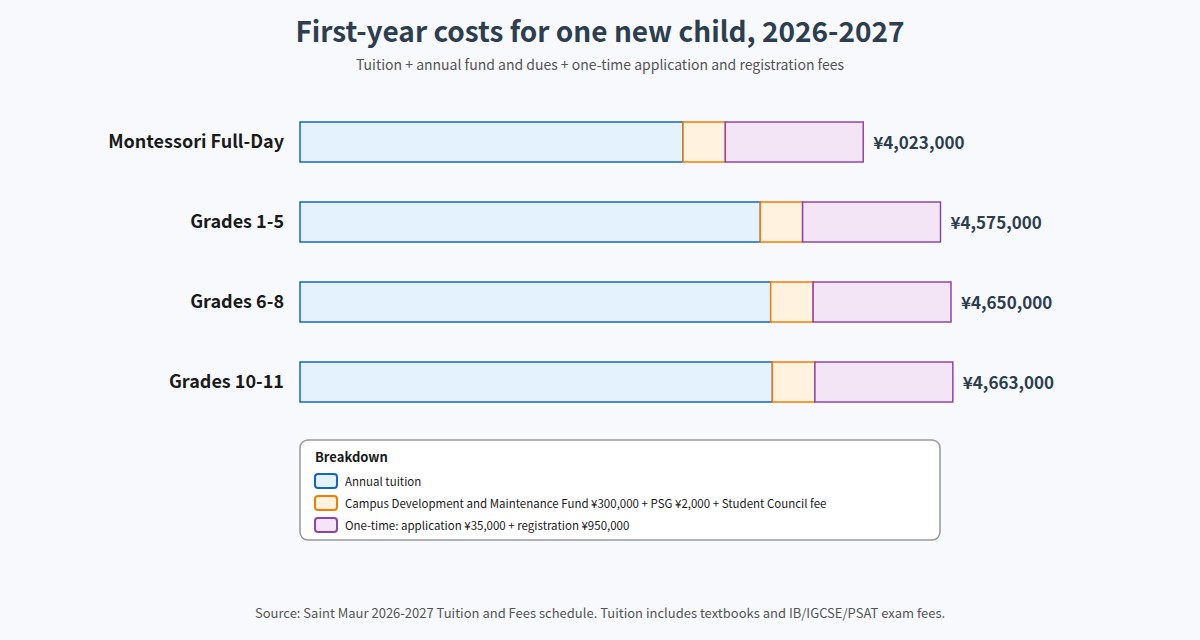
Adding these up for one new child, the one-time fees come to ¥985,000 (application plus registration). With the ¥300,000 fund and the small dues, the first year totals about ¥4,023,000 for Montessori Full-Day, ¥4,575,000 in Grades 1 to 5, ¥4,650,000 in Grades 6 to 8 and ¥4,663,000 in Grades 10 and 11. From the second year, the annual cost at 2026-27 rates is, for example, ¥3,590,000 in Elementary, ¥3,665,000 in Middle School and ¥3,863,000 in Grade 12. PSG dues are per family, so a second child’s figures are ¥2,000 lower.
A few practical points from the same page:
- Tuition can be paid in two instalments (end of May and end of November).
- The Registration Fee must be paid within 5 working days of acceptance for families in Japan, or 10 working days for families abroad.
- For mid-year entry, tuition may be prorated by academic quarter, and a full quarter is charged for attendance during any part of it.
- No refunds are given for withdrawals during the half-year payment periods (August to December and January to June).
- Returning families pay a ¥300,000 Reservation Fee, which is credited toward tuition once re-enrolment is completed.
- A Corporate Contribution Plan is available if your employer supports school fees.
Admissions: who can apply, English, and the steps
Who is eligible?
As a day school, Saint Maur considers only applicants who live in Japan with one or both parents (or, in some cases, a legal guardian). Non-Japanese students need a proper residential visa, and at least one parent must speak and read English well enough to work in partnership with the school.
For Japanese nationals, the guidelines accept applications from students who are recent returnees from abroad, students transferring from full-time English-medium international schools in Japan, or students for whom, because of family background, a local Japanese school would not be beneficial. Japanese dual nationals are eligible if one parent or guardian is a proficient speaker and reader of English. Please also note that Saint Maur is listed as a non-Article-1 school on the MEXT list, meaning it is not a school under Article 1 of Japan’s School Education Law; Japanese families should check what this means for compulsory education before applying.
Age and English requirements
- Montessori Pre-school: children aged 2.5 to 5 who are fully toilet trained. Children aged 2.5 to 3 can attend a half-day or extended-day programme; from age 4, full-time attendance is expected. There is no evaluation, and a Montessori place does not automatically lead to Grade 1.
- Grade 1: children who turn six by 30 October may be considered.
- Grades 1 to 8: English proficiency is “desired, but not required”, and English as an Additional Language (EAL) support is provided as necessary.
- Grades 6 to 9: students of all English language abilities are considered.
- Grade 10 and above: academic English is “assumed, required and essential”.
- Grade 12: the school “does not usually accept” Grade 12 students, because the IB programme starts in Grade 11.
So if your child is still building their English, joining by Grade 9 keeps far more doors open.
The application steps
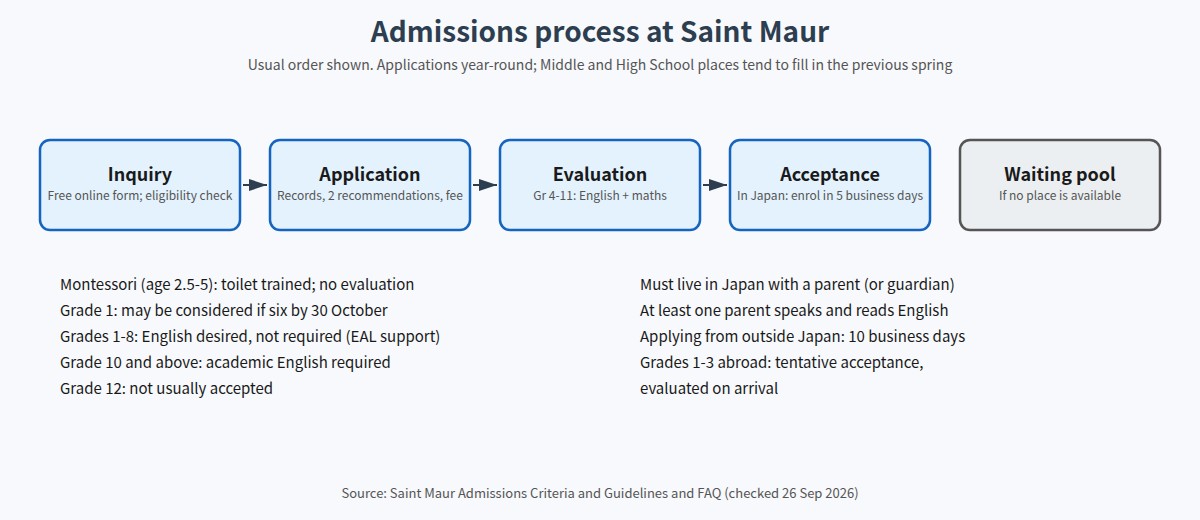
- Inquiry: the free online Inquiry Form lets the school confirm eligibility.
- Application: passport copies, two years of academic records in English and contacts for two confidential teacher recommendations; the application fee is paid by credit card.
- Evaluation: Grades 4 to 11 are evaluated in English and mathematics (remotely if needed). Grades 1 to 3 are evaluated in person, so families abroad receive a “tentative” acceptance and the evaluation on arrival.
- Enrolment: families in Japan have five business days to enrol (ten from abroad). If no place is free, the student joins a waiting pool, which is not first-come, first-served.
When should you apply? The FAQ says applications are accepted year-round and most students start in August, but Middle and High School classes “tend to fill up early in the previous spring”, so contact the school early.
Faith, learning support and student life
Catholic heritage, open to all. The school says it does not pressure students to convert, and it respects its multi-faith, multi-national community. The history page says students, “regardless of their faith, are required to participate in Religious Studies together”, and Catholic students are prepared for First Communion and Confirmation separately at their parents’ request.
Learning support. There is after-school academic support, a Learning Support programme, EAL and a bilingual (English and Japanese) counsellor. The school is candid that its support is limited: it can offer some accommodations but cannot modify the curriculum or assessments, and extra fees apply to some support. The campus is not barrier-free. Please share any needs openly during admissions.
Activities. Fine arts and athletics practise on different days so students can do both, and popular activities include debate, music, drama, robotics, volleyball, soccer and basketball. Students wear a uniform, and an outside caterer runs the cafeteria.
Getting there
There is no school bus; the FAQ says “Many students use local transportation or ride bicycles to campus.” The access page lists these routes:
- From Ishikawa-cho Station (JR Keihin-Tohoku and Yokohama Lines, as the school lists them): walk.
- From Yamate Station (same JR lines): walk, or take the number 20 bus to the Myoukouji Mae stop.
- From Motomachi-Chukagai Station (Minatomirai Line): use the Motomachi Exit, go up to America-Yama Park and walk to school.
Questions parents often ask
Do we need to be Catholic?
No. The school states that it does not discriminate on the basis of religious belief and does not pressure students to convert. Religious Studies is part of the curriculum for students of all faiths, so it is worth thinking about how your family feels about that.
Can my child join for the IB Diploma in Grade 11?
Yes. Incoming Grade 11 students join the IB as a full Diploma candidate or a course candidate, depending on whether their subject choices and workload are manageable. Grade 12 entry is not usually accepted.
Summary
- Founded in 1872 in Yamate, Yokohama: a small, co-educational, Catholic-founded school from age 2.5 to Grade 12.
- IB Diploma only: Montessori, IPC and Cambridge IGCSE come first, and all students enter the IB in Grade 11, as full Diploma or course candidates.
- 2026 results: 96% of 28 full candidates earned the Diploma, with a mean of 35.3 points against a worldwide 30.8.
- 2026-27 fees: tuition from ¥1,780,000 (Montessori half-day) to ¥3,559,000 (Grade 12), plus a ¥300,000 annual fund and ¥985,000 in one-time fees; IB and IGCSE exam fees are included.
- Plan ahead: families must live in Japan, English is required from Grade 10, Grade 12 entry is not usually accepted, and Middle and High School places tend to fill in spring.
If Saint Maur sounds right, send an inquiry and book a visit.
Sources and references
- Saint Maur International School: official website (checked 26 September 2026)
- Saint Maur: Tuition Fees (2026-2027 Tuition and Fees schedule)
- Saint Maur: Admissions Criteria and Guidelines
- Saint Maur: Frequently Asked Questions
- Saint Maur: Examination Results – Summer 2026
- Saint Maur: History of Saint Maur International School
- Saint Maur: Elementary School, Middle School and High School
- Saint Maur: College Guidance Program
- Saint Maur: Leadership Team
- Saint Maur: Contact and School Access
- Council of International Schools: Re-accredited Saint Maur International School, Japan
- Cambridge International: List of Cambridge schools in Japan
- MEXT IB Education Promotion Consortium: IB schools in Japan (as of 30 June 2026)
コメント