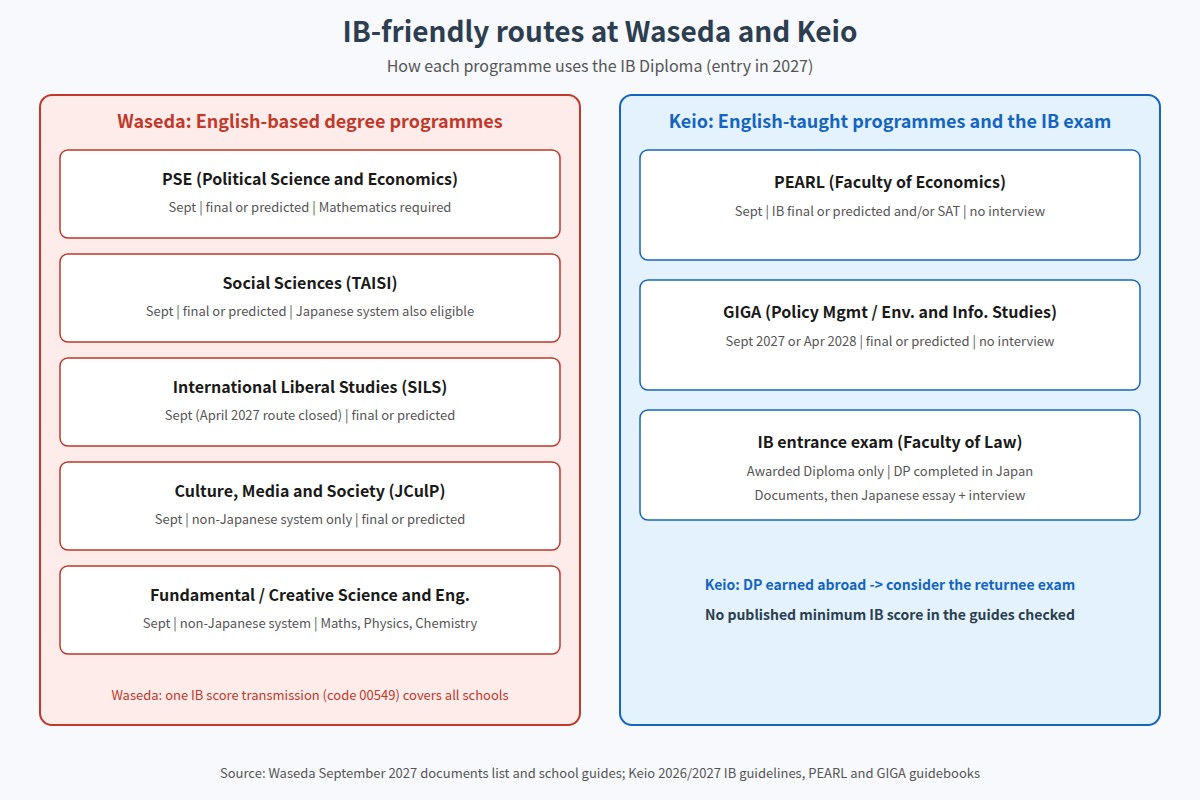
Waseda University and Keio University both have admission routes that welcome IB Diploma students, but they work in very different ways. Waseda has no separate “IB exam”; its English-based degree programmes accept IB Diploma grades, including predicted grades, as the standardised test in an online application. Keio does run a dedicated IB entrance examination, but only for its Faculty of Law and only for students who completed the Diploma in Japan. It also offers two English-taught programmes, PEARL and GIGA, that accept IB scores.
This guide is for families in Japan and overseas with a child in, or about to start, the IB Diploma Programme (DP). We set out who can apply, how the IB is used, which English tests are needed, when to apply for 2027 entry, how applicants are selected and what the first year costs. Everything comes from the universities’ own websites and PDF guides, checked on 26 September 2026, and we flag what is not yet published. Please read the current guide yourself before applying.
- The big picture: three kinds of route
- Waseda University: the English-based degree programmes
- Keio University: the IB entrance exam, PEARL and GIGA
- Waseda and Keio side by side
- What IB scores do successful applicants have?
- Timeline: when to apply for 2027 entry
- Tuition and fees
- Questions parents often ask
- Summary
- Sources and references
The big picture: three kinds of route
- English-taught degrees that accept IB grades: Waseda’s English-based programmes at six schools, plus Keio’s PEARL (Faculty of Economics) and GIGA (Faculties of Policy Management and Environment and Information Studies). The IB Diploma is one of the accepted standardised tests, and predicted grades can be used.
- Keio’s IB entrance examination: officially the 国際バカロレア資格取得者(日本国内)対象入学試験, an exam for IB Diploma holders who earned the Diploma in Japan. It is run by the Faculty of Law, needs an awarded Diploma, and includes an essay and an interview.
- Other routes, such as returnee (kikokusei) and general exams, not covered here.
One reassuring point: we found no published minimum IB score for any of these routes. Waseda says it has “neither a minimum standardized test score nor a certain score that would guarantee your admission”, and PEARL states there are no cut-off scores.
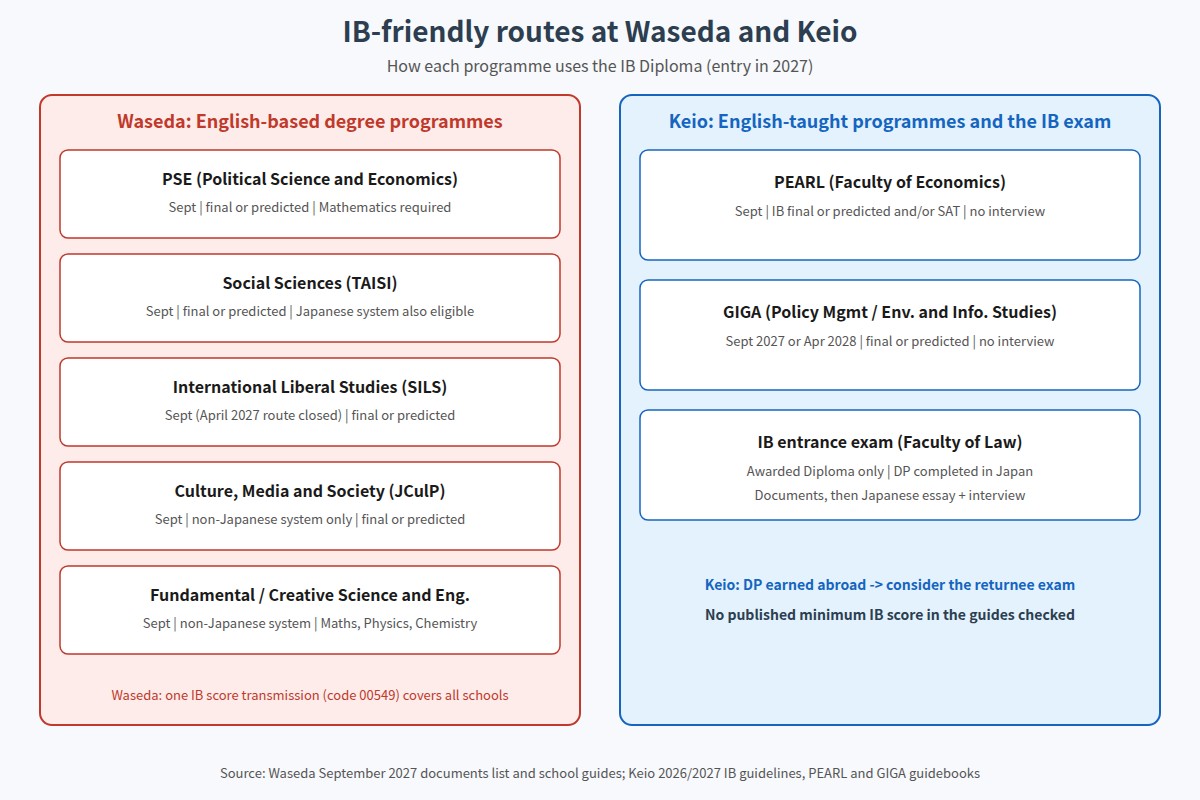
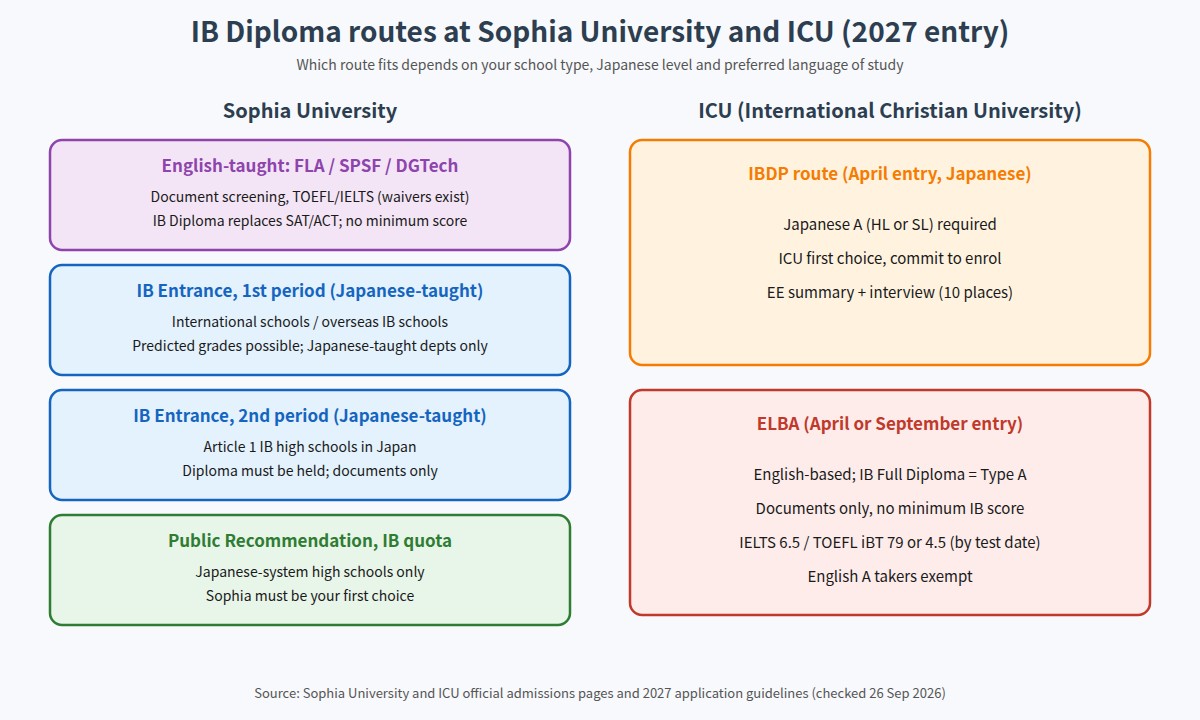
Figure 1 shows all eight options. Two questions narrow the list: English or Japanese study, and final or predicted IB results at the time of applying?
Waseda University: the English-based degree programmes
Waseda’s International Admissions Office lists English-based degree programmes at six schools, and Japanese is not required to apply:
- Political Science and Economics (PSE): September entry; Political Science, Economics or Global Political Economy.
- Social Sciences: September entry; the TAISI programme (Transnational and Interdisciplinary Studies in Social Innovation).
- International Liberal Studies (SILS): September and April entry.
- Culture, Media and Society: the Global Studies in Japanese Cultures Program (JCulP), September entry for graduates of non-Japanese education systems and April entry for graduates of the Japanese system.
- Fundamental Science and Engineering (Mathematical Sciences; Computer Science and Communications Engineering) and Creative Science and Engineering (Mechanical Engineering; Civil and Environmental Engineering): September entry.
How Waseda uses the IB Diploma
Waseda’s “List of Application Documents by Education System” for September 2027 entry sets the IB rules for all six schools:
- Submit final or predicted IBDP grades in at least six subjects, three or more at Higher Level.
- You must be in the Diploma Programme; results “will not be accepted if you are in the Certificate Program”.
- If final grades already exist when you apply, predicted grades are not accepted.
- Final results are sent by the IB using Waseda’s code 00549; one transmission covers every Waseda school you apply to.
- Subjects: PSE requires Mathematics; the science and engineering schools require Mathematics, Physics and Chemistry (Standard or Higher Level). The other schools list no required subjects.
English test rules at Waseda
- TAISI, JCulP and Science and Engineering: no English test is needed if the IBDP was “taught entirely in English”. One is required for a DP taught in French, Spanish or Japanese, or a Dual Language Diploma.
- PSE and SILS: the exemption is narrower. At PSE it covers only applicants whose first language is English, or who will have studied full-time for at least three of the most recent four years (up to enrolment) where English is the sole language of instruction. At SILS only the “three of four years” condition applies. PSE has announced that from 2028 admissions, applicants who submit only scores that include predicted grades must also submit an English test.
- Tests: TOEFL iBT and IELTS Academic everywhere; JCulP also accepts Cambridge English, TEAP, Eiken and GTEC CBT, and Science and Engineering also accepts TOEIC Listening and Reading.
- Minimums: only JCulP publishes one: TOEFL iBT 95 (old scale, tests taken on or before 20 January 2026) or 5 (new scale), or IELTS 7.0. SILS has no minimum but says “Competitive applicants score 95 or above (out of 120), 5.0 or above (out of 6) on TOEFL, 7 or above on IELTS.”
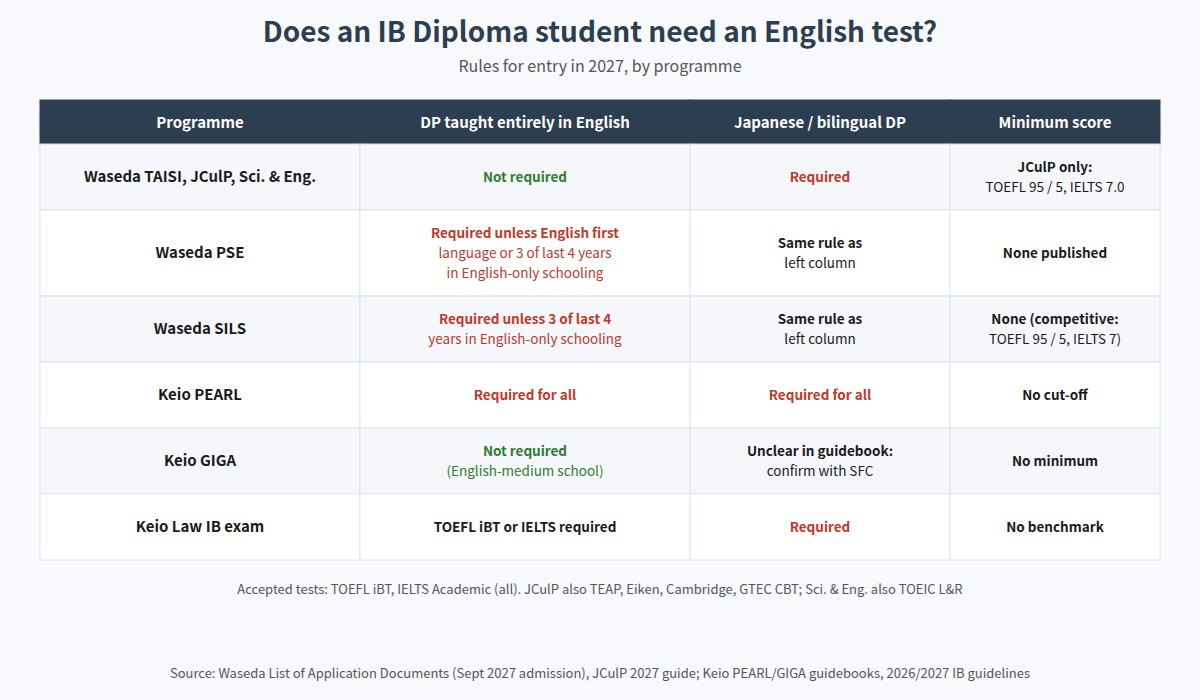
As Figure 2 shows, a DP taught in Japanese or a Dual Language DP means an English test at TAISI, JCulP and Science and Engineering, while at PSE and SILS the exemption depends on first language (PSE only) and English-medium schooling rather than on the DP language.
Capacity, windows and selection for 2027
SILS: 150 places for September 2027, for applicants completing 12 years of education by 21 September 2027. Early Admission runs from 7 to 12 January 2027 and Regular Admission from 13 to 28 January 2027; early decisions come on 9 March and regular results on 13 April, with interviews only if required. The April 2027 route for students educated outside the Japanese system (100 places) closed on 8 September 2026.
PSE: September entry only, by “a holistic screening of application documents” with an interview only if needed. PSE uploads each year’s guide in September; on 26 September 2026 only the September 2026 guide was online, so 2027 dates were not yet published. The 2026 window was 8 January to 10 February 2026.
TAISI: about 60 places, in three rounds: 7 to 12 January 2027 (results 5 March), 13 to 28 January (results 14 April) and 28 April to 6 May (results 11 June). The third round may be cancelled if the places are filled. TAISI accepts graduates of both non-Japanese and Japanese education systems.
JCulP: 15 places. The guide, published 24 September 2026, says applicants from the Japanese educational system are not eligible for this September route. The window is 7 to 28 January 2027 and results come on 15 April; applicants write an English essay of around 800 words.
Science and Engineering: about 30 places per school, and again not open to applicants from the Japanese educational system. The window is 7 to 28 January 2027. On 9 April each applicant is admitted on documents, invited to an online interview in English (17 or 18 April), or unsuccessful. A recommendation letter is required.
If your child attends a Japanese Article 1 high school (one recognised under the School Education Act) that offers the DP, check eligibility early using the Individual Review form in each guide. The three guides we read in full (TAISI, JCulP and Science and Engineering) set a screening fee of JPY 10,000 for applicants living outside Japan and JPY 35,000 for those in Japan.
Keio University: the IB entrance exam, PEARL and GIGA
Keio’s IB entrance examination (Faculty of Law)
The 2026/2027 guidelines require applicants to meet all of these conditions:
- the IB Diploma was awarded on or after 1 January 2024; predicted grades are not accepted;
- the DP was completed at a high school or an international school in Japan;
- the applicant graduates by 21 September (September entry) or 31 March (April entry);
- the applicant can submit TOEFL iBT or IELTS Academic results (no benchmark score is set);
- the applicant has not applied to this exam in a previous year.
It covers the Departments of Law and Political Science, with 20 places (10 each) shared with the Faculty of Law’s returnee exam. You apply to one department only and cannot also sit the Faculty of Law’s returnee or international-student exams in the same year. Stage one is document screening; stage two is a written essay (論述試験) and an interview. The previous year’s essay question in the guide was set in Japanese with a 1,000-character limit, so this route assumes strong Japanese.
In the 2026/2027 round, web entry and payment ran from 3 to 14 July 2026 with documents due by 15 July, and final results came on 3 September 2026. Applicants chose September 2026 or April 2027 entry, and the fee was JPY 35,000. Because the Diploma must already be awarded, a May candidate applies in July, right after results. On 26 September 2026 the guidelines for the next round had not been posted.
PEARL (Faculty of Economics, September 2027 entry)
- An English-taught BA in Economics; about 100 places over three periods; entry on 22 September 2027.
- Everyone submits an IB Diploma (final or predicted) and/or SAT scores, and nothing else can replace them. There are no cut-offs and no IB subject requirements “as long as you are an IB Diploma candidate or an IB Diploma holder”.
- Everyone, including native English speakers, submits TOEFL iBT and/or IELTS Academic scores; no cut-offs.
- Selection is based solely on submitted materials, with no interview; a two-minute video is compulsory.
- Periods: 21 October to 2 December 2026 (results 25 January 2027), 4 December 2026 to 27 January 2027 (results 4 March), and 24 February to 7 April 2027 (results 24 May). JPY 35,000 per application; unsuccessful applicants may reapply later.
- November 2026 IB candidates may use predicted grades only in the first period; May 2027 candidates may use them in all three.
GIGA (Policy Management / Environment and Information Studies)
Keio’s SFC website describes GIGA as an “English-based BA Degree Program” at the Shonan Fujisawa Campus. Its Winter AO guidebook for September 2027 and April 2028 entry was published on 11 September 2026:
- About 50 places, 25 per faculty; you cannot apply to both.
- Documents only, no interview; applications are submitted online via TAO (the personal statement and three-minute presentation video are in English).
- Eligibility includes holding, or being on track to obtain, an IB Diploma; predicted grades are uploaded by the school.
- Standardised tests are “strongly encouraged”, and required for graduates of Japanese-medium schools in Japan.
- No English test is needed if English is the applicant’s first language or the school’s main language of instruction; there is no minimum band score. The guidebook’s eligibility table also marks English tests as “Not required” for IB Diploma applicants, so Japanese-medium DP students should confirm with the SFC Admissions Office.
- Application from 8 December 2026 to 22 January 2027; results on 12 March 2027; fee JPY 35,000.
- Entry is in September 2027 or April 2028; only September entrants can apply for the scholarships listed in the guide when applying.
Waseda and Keio side by side
The table below compares the key rules for 2027 entry. “Not published” means the official page did not yet show that information on 26 September 2026.
| Programme | Entry | IB grades | English test | Application window | Selection |
|---|---|---|---|---|---|
| Waseda PSE | September | Final or predicted; Mathematics required | Exempt only for English first language or 3 of last 4 years in English-only schooling | 2027 dates not published (2026: 8 Jan to 10 Feb) | Documents; interview if needed |
| Waseda TAISI | September | Final or predicted | Exempt if DP taught entirely in English | 7-12 Jan, 13-28 Jan, 28 Apr-6 May 2027 | Documents; interview if required |
| Waseda SILS | September (April route closed for 2027) | Final or predicted | Exempt only for 3 of last 4 years in English-only schooling | 7-12 Jan (early), 13-28 Jan 2027 | Documents; interview if required |
| Waseda JCulP | September (non-Japanese system) | Final or predicted | Exempt if DP taught entirely in English; otherwise TOEFL iBT 95 / 5 or IELTS 7.0 | 7-28 Jan 2027 | Documents; interview if required |
| Waseda Science and Engineering | September (non-Japanese system) | Final or predicted; Mathematics, Physics, Chemistry | Exempt if DP taught entirely in English | 7-28 Jan 2027 | Documents; online interview for some |
| Keio Law IB exam | Last round: September 2026 or April 2027 | Awarded Diploma only (DP completed in Japan) | TOEFL iBT or IELTS required; no benchmark | Next round not published (2026/27: web entry 3-14 Jul, documents by 15 Jul 2026) | Documents, then essay and interview |
| Keio PEARL | September | Final or predicted (or SAT) | TOEFL iBT and/or IELTS required for all; no cut-off | 21 Oct-2 Dec 2026, 4 Dec 2026-27 Jan 2027, 24 Feb-7 Apr 2027 | Documents and video; no interview |
| Keio GIGA (Winter AO) | September 2027 or April 2028 | Final or predicted | Not needed if English is first language or school’s main language; Japanese-medium DP: confirm with SFC | 8 Dec 2026-22 Jan 2027 | Documents; no interview |
What IB scores do successful applicants have?
Waseda publishes the average scores of successful applicants in its English-based programmes. The figures below are for September 2026 admissions, and the IB column includes predicted grades:
| Waseda school | IBDP average (September 2026 admissions) |
|---|---|
| Political Science and Economics | 38.9/42 |
| Social Sciences (TAISI) | 36.8/42 |
| International Liberal Studies | 37.5/42 |
| Culture, Media and Society | 36.4/42 |
| Fundamental and Creative Science and Engineering | 37.7/42 |
Why “out of 42”? The Diploma is scored out of 45: six subjects at up to 7 points each (42) plus up to 3 bonus points from Theory of Knowledge and the Extended Essay; the School of Social Sciences labels its figure “without bonus”. Keio does not publish IB averages for PEARL or GIGA. These are past averages, not pass marks.
Timeline: when to apply for 2027 entry
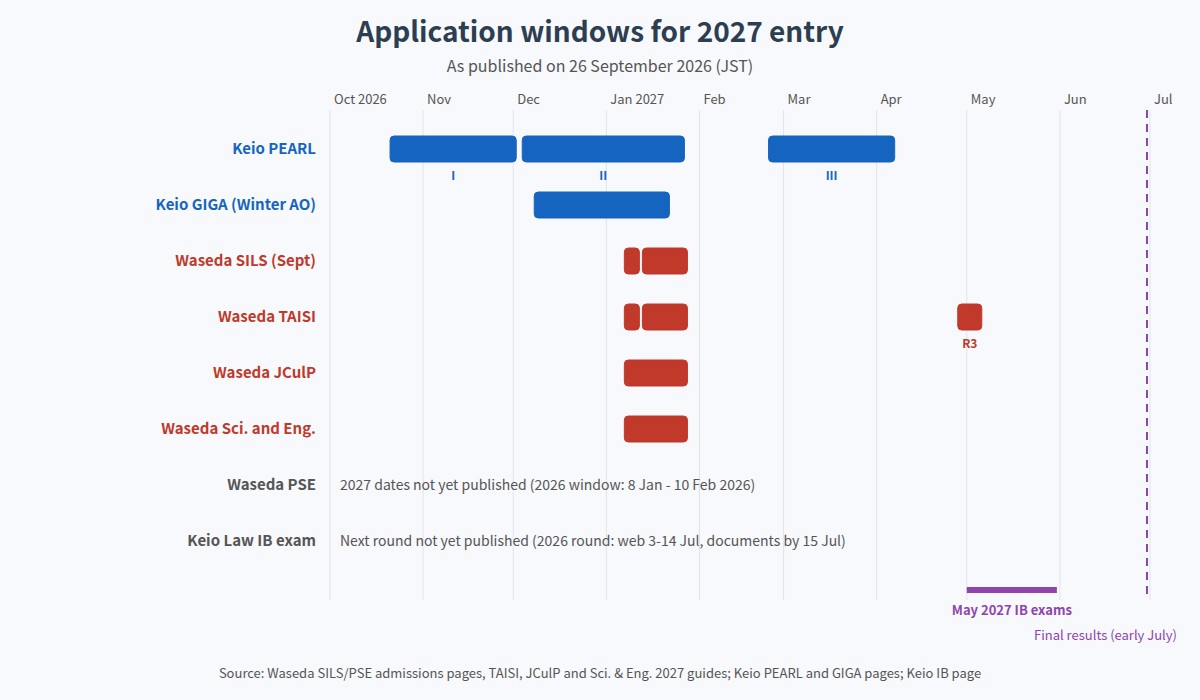
As Figure 3 shows, for a student in the May 2027 exam session:
- October to December 2026: PEARL’s first period (21 October to 2 December); GIGA opens on 8 December.
- January 2027: the main Waseda window (7 to 28 January), while GIGA closes on 22 January and PEARL’s second period on 27 January.
- February to May 2027: PEARL’s third period and TAISI’s third round (if held).
- July 2027: final IB results. Keio’s 2026 IB exam took applications in early July; 2027 dates are not yet published.
Tuition and fees
Here are the official first-year totals. Waseda has published its figures for the 2027 academic year; Keio’s 2027 figures will only be set in late November 2026, so we show its 2026 figures for reference.
| Programme | First-year total | Tuition from Year 2 (per year) | Year of figures |
|---|---|---|---|
| Waseda PSE | ¥1,288,000 | ¥1,281,000 | AY2027 |
| Waseda Social Sciences (TAISI) | ¥1,256,800 | ¥1,251,000 | AY2027 |
| Waseda SILS | ¥1,693,000 | ¥1,690,000 | AY2027 |
| Waseda Culture, Media and Society (JCulP) | ¥1,295,000 | ¥1,291,000 | AY2027 |
| Waseda Fundamental Science and Engineering | ¥1,859,000 | ¥1,784,000 | AY2027 |
| Waseda Creative Science and Engineering | ¥1,889,000 to ¥1,891,000 | ¥1,784,000 | AY2027 |
| Keio Faculty of Law | ¥1,513,350 | Not shown here (sliding scale) | AY2026 (reference) |
| Keio Faculty of Economics (PEARL) | ¥1,508,350 | Not shown here (sliding scale) | AY2026 (reference) |
| Keio Policy Management / Environment and Information Studies (GIGA) | ¥1,781,350 | Not shown here (sliding scale) | AY2026 (reference) |
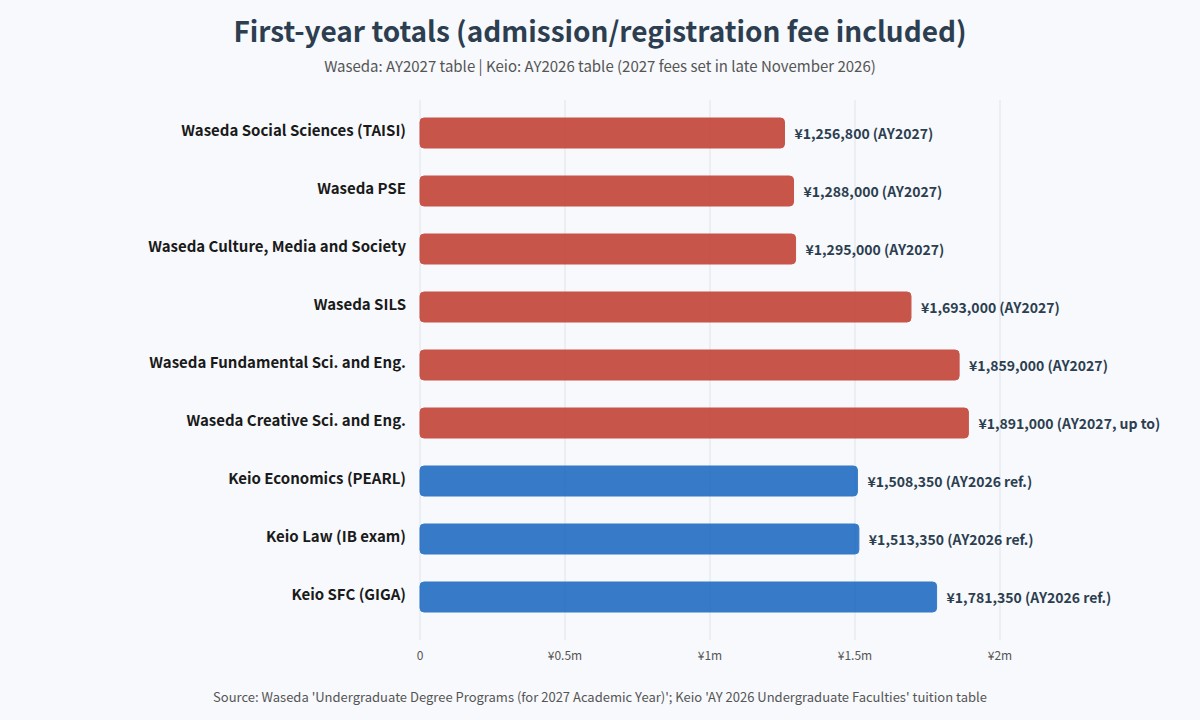
Notes on Figure 4:
- Waseda (AY2027): each total includes a ¥200,000 registration fee. Laboratory, library and association fees for AY2027 were undecided, so the table uses AY2026 amounts for those items. A ¥40,000 alumni fee is added in the fourth year.
- Keio (AY2026): totals include a ¥200,000 admission fee, and tuition-related fees follow a sliding scale. The PEARL guidebook shows September 2026 entrants paid ¥854,225 at enrolment, with AY2026 annual fees of ¥1,308,350; Keio’s September 2027 fees will be set in late November 2026.
- Scholarships: Waseda offers merit-based pre-enrolment scholarships to selected successful applicants without a separate application, and says all its scholarships are partial. Every scholarship has its own screening.
Questions parents often ask
My child studied the DP overseas. Can they take Keio’s IB exam?
No. It is for students who completed the DP at a high school or international school in Japan; Keio points those who earned the Diploma abroad to its returnee exam. PEARL and GIGA are open to IB students wherever they studied, subject to each guide’s eligibility rules.
Can my child apply before final IB results come out?
For Waseda’s English-based programmes, PEARL and GIGA, yes: predicted grades are accepted (though Waseda will not take predicted grades if final grades already exist). For Keio’s IB exam, no: the Diploma must already be awarded.
We are at a Japanese high school with a Japanese-language DP. Which routes are realistic?
Check eligibility first: Waseda’s JCulP (September) and Science and Engineering guides exclude applicants from the Japanese educational system, while TAISI accepts both systems. A Japanese-language DP means an English test at TAISI, and at PSE and SILS unless your child qualifies through first language (PSE only) or English-medium schooling; confirm GIGA’s English rule with SFC; GIGA requires standardised test scores from graduates of Japanese-medium schools. The Keio Law IB exam is designed for DP graduates in Japan, provided the Diploma has been awarded.
Summary
- Two different models: Waseda’s English-based schools, PEARL and GIGA take IB grades (including predicted) in document-based applications; Keio’s Law IB exam needs an awarded Diploma earned in Japan, plus a Japanese essay and an interview.
- Key 2027 windows: PEARL from 21 October 2026, GIGA 8 December 2026 to 22 January 2027, most Waseda schools 7 to 28 January 2027. Waseda PSE and the next Keio IB exam had not published dates on 26 September 2026.
- English tests: required for all at PEARL and the Keio IB exam; at Waseda, an English-taught DP exempts you at TAISI, JCulP and Science and Engineering, but not automatically at PSE and SILS.
- Subjects: Mathematics for Waseda PSE; Mathematics, Physics and Chemistry for Waseda Science and Engineering; none for PEARL.
- First-year costs: ¥1,256,800 to ¥1,891,000 at Waseda (AY2027); ¥1,508,350 to ¥1,781,350 at Keio (AY2026, for reference).
If a route fits, share its current guide with your DP coordinator early in Year 1.
Sources and references
- Waseda University International Admissions Office: English-based Undergraduate Programs (checked 26 September 2026)
- Waseda: List of Application Documents by Education System, September 2027 (PDF)
- Waseda: Average Scores of Successful Applicants, 2026 September Admissions (PDF)
- Waseda: Undergraduate Degree Programs tuition, 2027 Academic Year (PDF)
- Waseda SILS: Admissions Guide and SILS: Data
- Waseda PSE: English-based Degree Program Admissions
- Waseda School of Social Sciences: TAISI Application Guide, September 2027 Entry (PDF)
- Waseda School of Culture, Media and Society: JCulP 2027 Application Guide for Overseas Students (PDF)
- Waseda Faculty of Science and Engineering: AO Admission for September 2027 Entry (PDF)
- Keio University: 国際バカロレア(IB)入試 (IB entrance examination page)
- Keio University: 2026/2027 IB entrance examination guidelines (PDF, Japanese)
- Keio University: Admissions Procedures for the PEARL (September 2027 entry) and PEARL FAQ
- Keio University: PEARL Application Guidebook for September 2027 Entry (PDF)
- Keio University: Admissions Procedures for Winter AO 2026 (the GIGA Program)
- Keio University: Winter AO Application Guidebook for September 2027 and April 2028 Entry (PDF)
- Keio University: AY2026 Undergraduate Faculties tuition table (PDF)
コメント