Can an IB Diploma student get into a Japanese medical school? Yes. A number of Japanese universities run admission routes for the medical course that use IB Diploma results instead of the usual Japanese entrance exams. For April 2027 entry, we confirmed IB routes into medicine at nine national and public universities and at several private ones. Places are small (often two to five) and subject rules strict, but the door is open. That includes students at international schools and at Japanese schools that offer the Diploma.
This guide sets out the routes, each university’s requirements, the timeline, the Japanese-language question and the very different costs of national and private medical schools. Admission rules come from each university’s official guidelines (募集要項, boshu yoko) for April 2027 entry, and costs from MEXT and fee pages (fee year shown), all checked on 26 September 2026. Where the 2027 guide is not out yet, we say so. Rules change yearly, so check the latest guide before applying.
- How IB students can enter a Japanese medical faculty
- Medical schools with IB routes: requirements for 2027 entry
- Scores: the total matters, but the subjects matter more
- Predicted grades or final results?
- Timeline: selections run from August to February
- Japanese language: how much is needed?
- Costs: national vs private medical schools
- Questions parents often ask
- Summary
- Sources and references
How IB students can enter a Japanese medical faculty
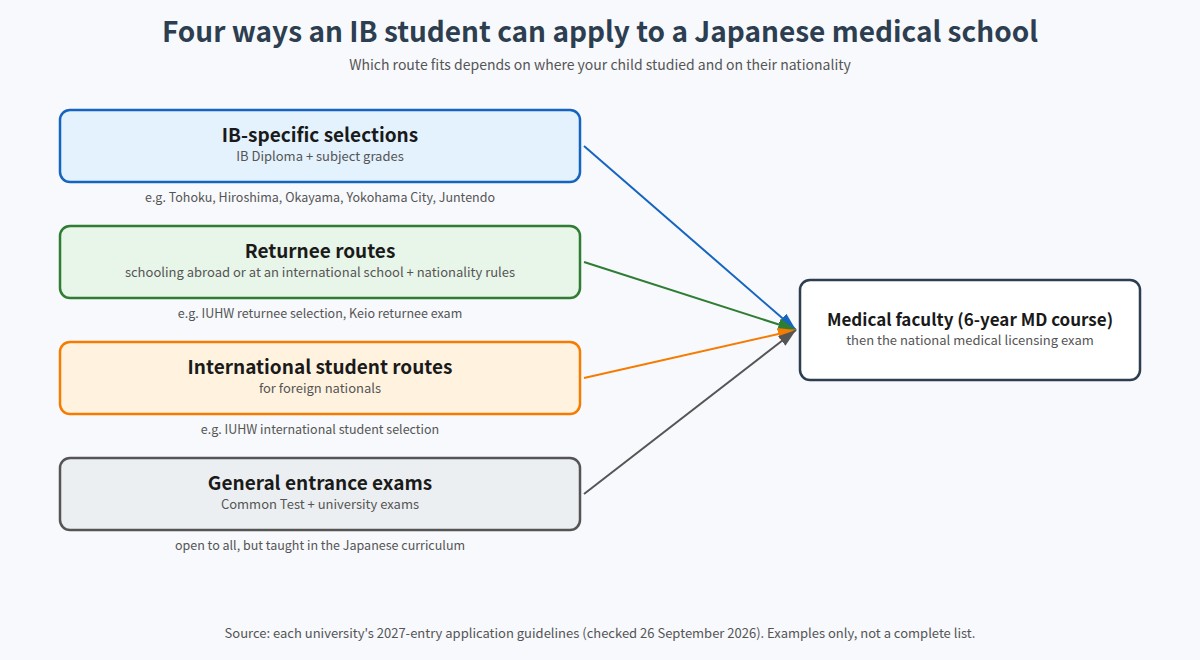
In Japan, medicine is a six-year undergraduate course that you enter straight from high school. Graduates then sit the national medical licensing exam. According to the Ministry of Education’s IB consortium, the IB Diploma counts as a qualification for entering Japanese universities, but each university sets its own application conditions. In practice, an IB student has four possible routes, shown in Figure 1.
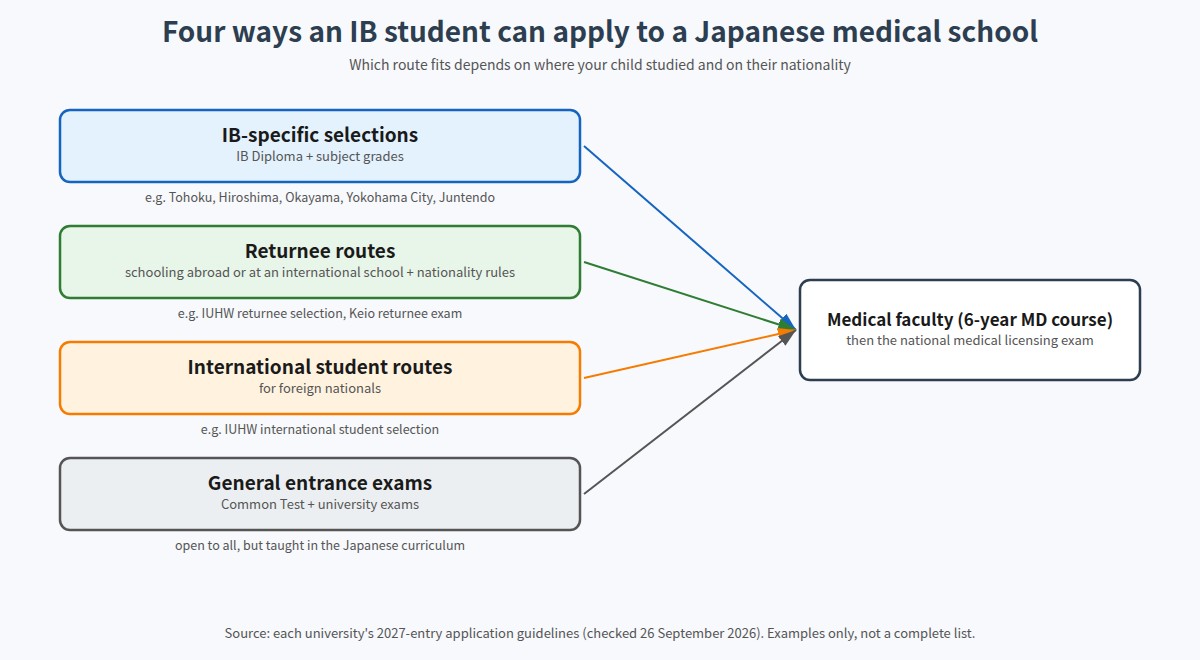
- IB-specific selections (for example 国際バカロレア選抜, “IB selection”): your child applies with the Diploma, the total score and set subject grades, plus documents and an interview. This is the main route covered in this guide.
- Returnee routes (帰国生入試, kikokusei): for students who studied at overseas schools. These often require Japanese nationality or permanent residency and a minimum period of schooling abroad, and some accept the IB Diploma as the exam result.
- International student routes (留学生選抜): for foreign nationals, usually with the EJU (Examination for Japanese University Admission for International Students) or the university’s own tests.
- General entrance exams: open to everyone, but based on the Japanese curriculum (the Common Test plus each university’s own exams), which is hard to combine with the DP.
Medical schools with IB routes: requirements for 2027 entry
Here are the national and public universities where we could confirm an IB selection for the medical course (医学科) for April 2027 entry. We did not find an official, complete national list for 2027, so there may be others. “Predicted OK” means your child can apply with predicted grades before the final results are out.
| University (route) | Places (2027) | IB total and subjects | Japanese, English and selection | Predicted or final |
|---|---|---|---|---|
| Institute of Science Tokyo (IB selection) | 2 | No total minimum stated. Maths HL; two of physics, chemistry and biology (one at HL) | Japanese A (HL or SL) or Japanese B HL. TOEFL iBT or IELTS only if English was not taken. Documents, essay, interview | Predicted OK; conditional offer, final results by 29 January 2027 |
| University of Tsukuba (IB special entrance, July and October rounds) | 3 (both rounds combined) | No total minimum stated. Maths: Analysis and Approaches HL only; two of physics, chemistry and biology at HL | Japanese as first language, Japanese A or Japanese B HL (EJU Japanese if not available). English test results if English was not taken. July: documents and interview. October: documents, essay, a 60-minute written aptitude test and interview | July: Diploma holders only. October: holders or expected |
| Tohoku University (IB entrance exam) | 3, shared with the returnee and international student exams | 38+. Maths HL grade 6+; two of biology, chemistry and physics at HL, each 6+ | Japanese native, Japanese A, or Japanese B HL 6+/SL 7. English A, or English B HL 5+/SL 6+. Written test, then interview | Diploma awarded April 2026 to March 2027 only; predicted gives a conditional offer |
| Hiroshima University (IB-type selection) | 5 | 38+. Maths SL 5+ or HL 4+; two of biology, chemistry and physics at HL | Japanese native or Japanese A/B (or proof of level). One of seven listed English tests required. Documents and interview, no written exam | Expected OK; November 2026 candidates submit results by 12 January 2027 |
| Okayama University (IB selection, August and October rounds) | August 3, October 2 | 39+. Maths and two of physics, chemistry and biology: one at HL 4+, the other two SL 5+ or HL 3+ | Japanese A 4+ or Japanese B HL 6+. Documents and interview | August: 2025 holders and May 2026 candidates. October: also November 2026 candidates |
| Kagawa University (IB selection) | A few (若干人) | 38+. Maths HL or SL; two of physics, chemistry and biology (one at HL) | Japanese A 4+ or Japanese B HL 6+/SL 7. Written test (maths, English, two sciences) and interview. Must commit to enrol if admitted | November 2026 candidates: final grades must arrive by the end of the application period (3 February 2027) |
| Kochi University (IB selection) | 2 (the university says it is “adjusting” this to 4) | 35+. Two of physics, chemistry and biology (one at HL); any maths at HL or SL | Japanese A 4+ or Japanese B HL 6+/SL 7 (or EJU Japanese if not offered). Documents 150 points and interview 150 points. Must commit to enrol | Expected OK; November 2026 candidates must submit results by 1 February 2027 |
| Kagoshima University (IB selection) | 2 | 38+. Maths HL; two of physics, chemistry and biology (one at HL) | Japanese A 4+ or Japanese B HL 6+/SL 7. Documents and an interview in Japanese | Checked with predicted grades at application, then with the final transcript |
| Yokohama City University (IB special selection, public) | 2 (within the general quota) | 40+. Maths and two of physics, chemistry and biology: one at HL 5+, the other two SL 6+ or HL 5+ | Japanese A 4+ or Japanese B HL 6+; if no Japanese in the DP, JLPT N1 or Nihongo Kentei level 3+. TOEFL iBT 80+ or IELTS Academic 6.0+. Multiple Mini Interview (MMI). Must commit to enrol | Expected OK; grades must be final before the third stage |
Source: each university’s April 2027 guidelines (Yokohama City: its 2027-entry IB selection page, as the printed guide was not yet out). Checked 26 September 2026.
And here are the private universities with a route IB students can use. They vary much more, so read each one carefully.
| University (route) | Places | Main IB conditions | Exams and language |
|---|---|---|---|
| International University of Health and Welfare, IUHW (returnee and international-school graduate selection, 2027) | A few (two rounds combined) | Japanese nationality or permanent residency. Full Diploma held or expected by 31 March 2027, 32+; two sciences and maths, two of them HL 5+ and the third HL 5+ or SL 7 | Written tests all in English (two sciences, maths, English, essay); interview in English with some questions in Japanese |
| IUHW (international student selection, 2027) | 20 (two rounds combined) | For foreign nationals without Japanese permanent residency who have lived in Japan for six years or less in total; 12 years of foreign schooling (the IB Diploma counts) | Maths, science and essay in English or Japanese, plus an English test; TOEFL iBT 80 or IELTS 6.0 “desirable” |
| Juntendo University (IB/Cambridge International selection, 2027) | 2 (IB and Cambridge combined) | Diploma held or expected by 31 March 2027; at least one of physics, chemistry and biology plus maths (SL or HL). No total minimum. English test, for example IELTS 5.5+ or TOEFL iBT 72+ (old scale) | Essay answered in Japanese plus an English composition; interview in Japanese; second stage uses the EJU or the Common Test (two sciences and maths) |
| Aichi Medical University (IB selection, 2027) | A few (若干名) | Japanese A 4+; maths and two of physics, chemistry and biology, at least one at HL and all three at 5+ | Essay in Japanese (60 minutes) and individual interview; an IELTS, TOEIC or TOEFL iBT score report is required |
| Hyogo Medical University (IB quota, 2027) | About 2 | Japanese A (HL or SL), or Japanese B HL 6+; Japanese or English DP both accepted; a contact address in Japan is needed | First stage: English, two sciences, essay. Second stage: a presentation on a mathematical task and an individual interview |
| Keio University School of Medicine (returnee exam) | A few | Japanese nationality, permanent residency or special permanent residency; at least two years, including the final year, at a foreign-system high school abroad; Diploma already awarded (predicted grades not accepted); maths and another natural science among the six subjects | TOEFL iBT or IELTS Academic required; second stage has a general test, a mock lecture and an interview. Applications for the 2026/2027 cycle closed in July 2026 |
Fujita Health University also lists a “returnee and IB” (帰国生・国際バカロレア) route for medicine, but its 2027 guide is due in October 2026, so we have not listed its 2027 conditions here. Keio’s own IB entrance exam for applicants in Japan is for its Faculty of Law, not medicine.
Scores: the total matters, but the subjects matter more
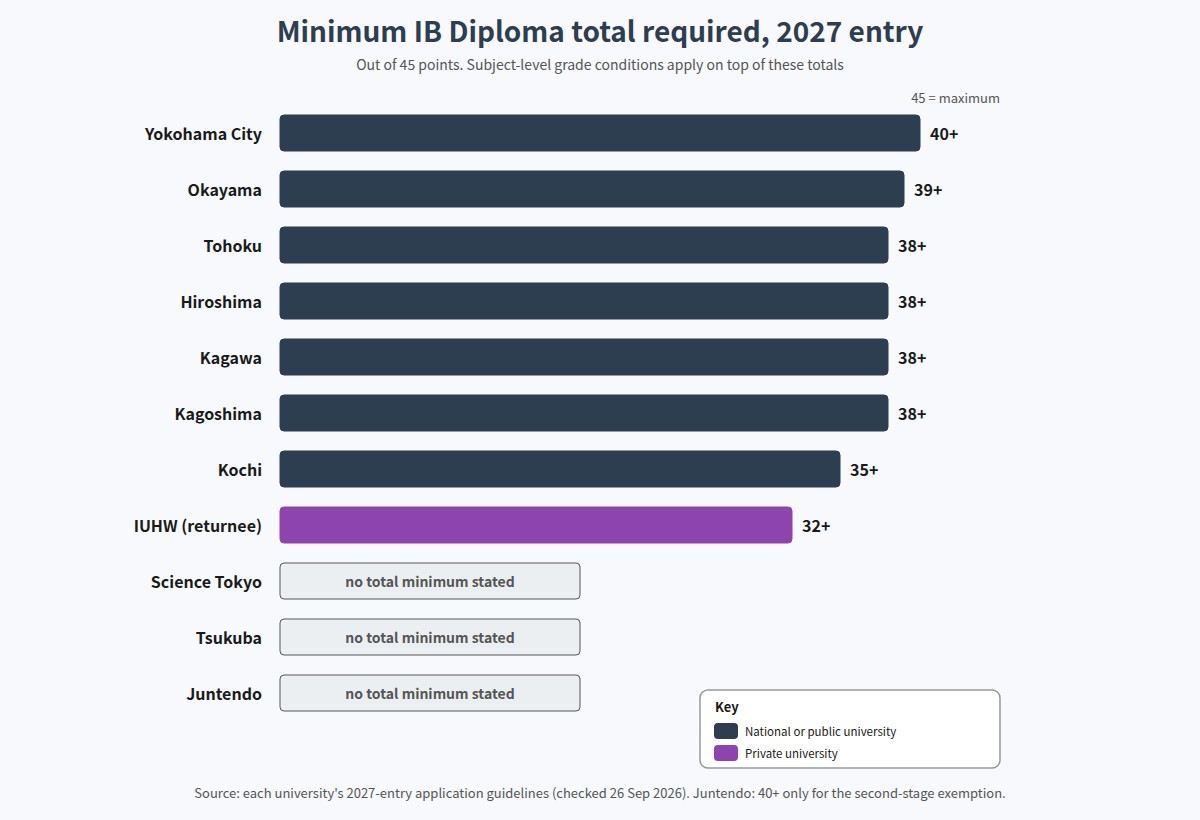
The IB Diploma is scored out of 45. Among the national and public universities that publish a minimum total, the range for 2027 entry is 35 (Kochi) to 40 (Yokohama City), and IUHW’s returnee route asks for 32, as Figure 2 shows. The Institute of Science Tokyo, Tsukuba and Juntendo do not set a minimum total for applying.
Honestly, though, the subject rules are where most families get caught out. Three patterns recur:
- Maths: several universities require maths at HL (Institute of Science Tokyo, Tsukuba, Tohoku, Kagoshima). Tsukuba accepts only Analysis and Approaches HL, not Applications and Interpretation HL.
- Two sciences: two of physics, chemistry and biology, usually with at least one at HL. Tohoku, Hiroshima and Tsukuba want both sciences at HL.
- Japanese: Japanese A, or Japanese B at HL (typically grade 6 or more).
In other words, the DP subject choice can decide whether your child is even allowed to apply, so read two or three universities’ guides before it is finalised.
Predicted grades or final results?
It depends on the university. Most of the national universities accept applications before the final results (with a school certificate and predicted grades) and then make a conditional offer. The final transcript must meet the same conditions, or the offer is withdrawn. The Institute of Science Tokyo also warns that an offer may be cancelled if the final total or subject grades are “very different” from the predictions.
Some routes are stricter. Tsukuba’s July round is only for students who already hold the Diploma (including May 2026 candidates), and Keio’s returnee exam does not accept predicted grades at all. Tohoku only accepts Diplomas awarded between April 2026 and March 2027, so an older Diploma will not qualify there. For November-session schools, the deadlines for sending final results (for example 12 January 2027 at Hiroshima and 1 February 2027 at Kochi) are the key dates to watch.
Timeline: selections run from August to February
| University | Applications | Exam or interview | Final result |
|---|---|---|---|
| Okayama (October round) | 28 September to 2 October 2026 | 5 December 2026 | 10 February 2027 |
| Hiroshima | 2 to 7 October 2026 | 23 October 2026 | 10 February 2027 |
| Tsukuba (October round) | 1 to 5 October 2026 | 26 to 27 November 2026 | 10 December 2026 (conditional offers for applicants expecting the Diploma; final confirmation later) |
| Hyogo Medical | 1 to 15 October 2026 | 15 November and 6 December 2026 | 11 December 2026 |
| Tohoku | 13 to 16 October 2026 | Written 7 November, interview 28 November 2026 | 4 December 2026 |
| Yokohama City | 28 to 30 October 2026 | 5 December 2026 | 22 January 2027 |
| Institute of Science Tokyo | 2 to 6 November 2026 | Essay 24 November, interview 25 November 2026 (26 November if there are many applicants) | 11 December 2026 (conditional for predicted-grade applicants; final notice from 9 February 2027) |
| Aichi Medical | 1 to 13 November 2026 | 28 November 2026 | 10 December 2026 |
| IUHW (round 2) | 2 to 9 November 2026 (eligibility check by 22 October) | 21 November and 5 December 2026 | 14 December 2026 |
| Kochi | 16 to 20 November 2026 | 18 December 2026 (17 December is a reserve day) | 10 February 2027 |
| Kagoshima | 20 to 25 November 2026 | 12 December 2026 | 10 February 2027 |
| Kagawa | 25 January to 3 February 2027 | Written 25 February, interview 26 February 2027 | 6 March 2027 |
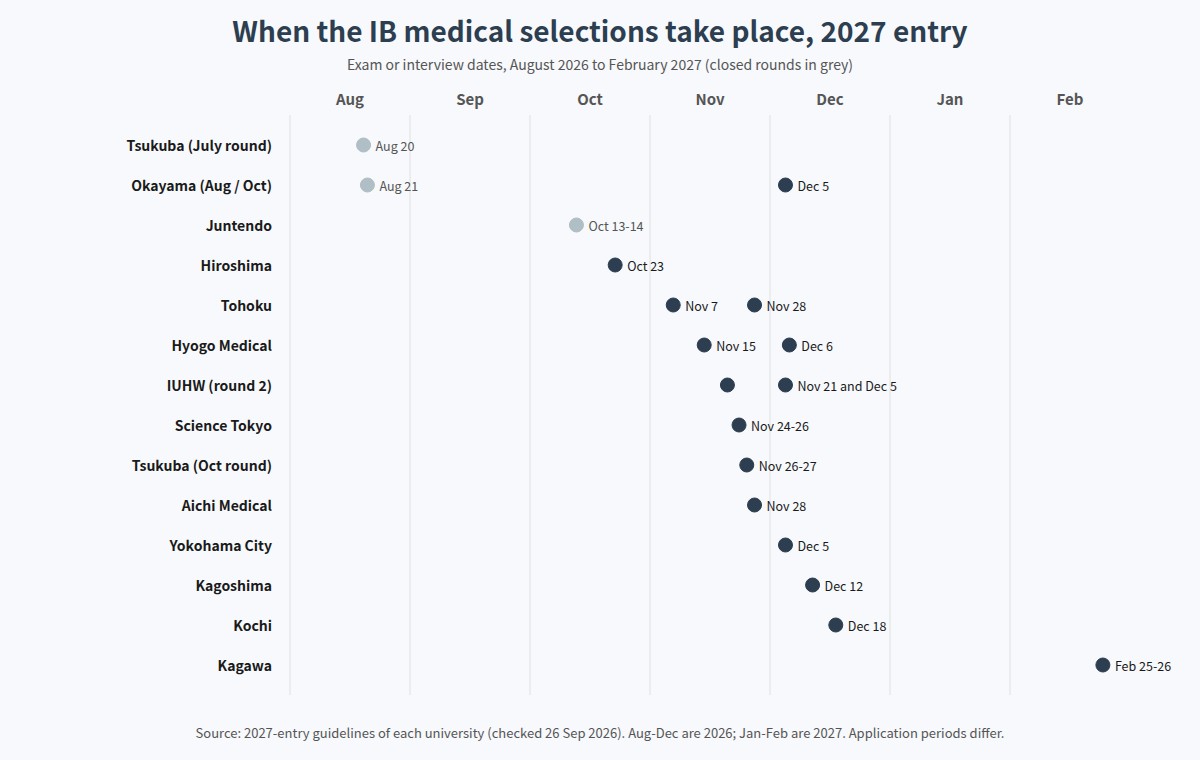
Source for the table and Figure 3: each university’s 2027-entry guidelines, checked 26 September 2026. Already closed for 2027 entry: Tsukuba’s July round, Okayama’s August round, Juntendo (applications 1 to 17 September 2026), IUHW round 1 and Keio’s returnee exam.
Can your child apply to several? Often yes, but check the rules. Kagawa, Kochi and Yokohama City require a promise to enrol if admitted, and Tohoku does not allow applying to its IB exam and its returnee exam at the same time.
Japanese language: how much is needed?
This is the biggest hurdle for many international families. Classes, hospital training and the national licensing exam are in Japanese, and so are most interviews. The universities set the bar through the DP language subjects: Japanese A (at grade 4 or more at several universities) or Japanese B at HL, usually grade 6 or more. A few offer an alternative for students whose school does not offer Japanese in the DP: Tsukuba and Kochi accept the EJU Japanese test instead, and Yokohama City accepts JLPT N1 (the top level of the Japanese-Language Proficiency Test) or level 3 or above of the Nihongo Kentei test.
If your child studies Japanese B at SL, look closely: several universities accept SL only at grade 7, and some accept Japanese B only at HL. IUHW is the main exception, with written tests in English, although its returnee route is limited to Japanese nationals and permanent residents.
Costs: national vs private medical schools
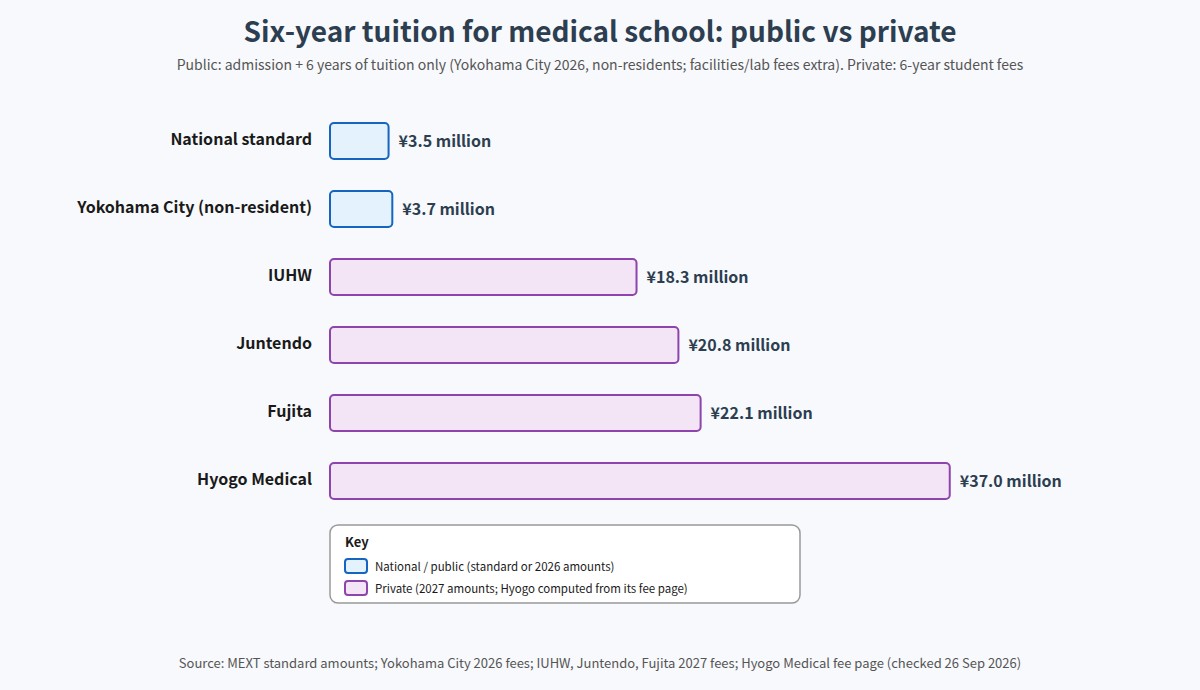
The gap is huge. National universities follow a standard amount set by the Ministry of Education (MEXT): tuition of 535,800 yen a year and an admission fee of 282,000 yen. Universities may charge up to 120% of the standard. The Institute of Science Tokyo, for example, lists medical tuition of 642,960 yen a year (2026 figure). Private medical schools charge several times more, as Figure 4 shows.
| University (fee year) | First year | Each later year | Six-year total |
|---|---|---|---|
| National standard (MEXT, from 2025) | ¥817,800 (admission ¥282,000 + tuition ¥535,800) | ¥535,800 | ¥3,496,800 (admission + tuition only) |
| Yokohama City University (2026) | Admission ¥141,000 (Yokohama residents) or ¥282,000, plus tuition ¥573,000 and a first-year facilities fee | ¥573,000 tuition (+ ¥42,000 lab fee) | ¥3,720,000 (non-residents; admission + tuition only, 2026 amounts; facilities and lab fees extra) |
| IUHW (2027) | ¥4,300,000 | ¥2,800,000 | ¥18,300,000 |
| Juntendo (2027) | ¥2,900,000 (+ ¥469,800 to ¥499,800 dormitory and other first-year costs) | ¥3,580,000 | ¥20,800,000 |
| Fujita (2027) | ¥5,196,000 | ¥3,386,000 | ¥22,126,000 |
| Hyogo Medical (as listed, September 2026) | ¥8,500,000 (+ ¥525,000 collected fees) | ¥5,700,000 | ¥37,000,000 (our calculation, before collected fees) |
Juntendo’s and Hyogo’s six-year totals are our own sums of the published yearly amounts. The IUHW, Juntendo and Fujita figures are for students entering in April 2027. IUHW also charges a support-association fee of ¥45,000 a year and asks students to save ¥70,000 a year (Years 1 to 5) for overseas clinical training. Living costs are extra everywhere.
Questions parents often ask
Is a score below 40 the end of the road?
Not at all. Among the national and public universities we checked, only Yokohama City asks for 40. Kochi asks for 35, and the Institute of Science Tokyo and Tsukuba set no minimum total (2027 entry). Subject grades and the interview matter just as much, so a 36 with the right subjects can open more doors than a 41 without HL sciences.
Can students at Japanese schools with the DP use these routes?
Yes, for the IB selections, which are based on the Diploma, not on where the school is. Hyogo Medical, for example, states that both Japanese-law high schools and international schools in or outside Japan are eligible, and that both Japanese-language and English-language DPs are accepted. The returnee exams are different: Keio requires two years at a foreign-system high school abroad, and IUHW’s returnee route has its own schooling conditions (for example two years, including the final year, at an international school), so check those carefully.
My child is not a Japanese national. Is medicine in Japan realistic?
Most IB selections set no nationality condition but require Japanese A or B (or JLPT N1 at Yokohama City). Some returnee routes are open only to Japanese nationals and permanent residents. IUHW’s international student selection is designed for foreign nationals, with 20 places across two rounds.
What about English tests?
Some universities require them (Hiroshima, Kagawa unless English is your child’s native language, Kochi, Yokohama City, Juntendo, Aichi Medical, Keio), while others ask only if your child did not take English in the DP (Institute of Science Tokyo, Tsukuba). Book tests early: Yokohama City accepts results from April 2024, Kochi (TOEFL) from April 2025, Juntendo from the two years before applications.
Summary
- Routes exist: for April 2027 entry we confirmed IB selections for medicine at nine national and public universities, plus private routes at IUHW, Juntendo, Aichi Medical, Hyogo Medical and Keio (returnee).
- Places are few: usually two to five, and some are “a few” or shared.
- Scores: minimum totals are 35 to 40 at the national and public universities that state one (32 at IUHW); subject rules on maths, two sciences and Japanese matter just as much.
- Predicted vs final: most national universities accept predicted grades with a conditional offer; Tsukuba’s July round and Keio require the Diploma already awarded.
- Japanese is essential: Japanese A or Japanese B HL is the usual requirement; IUHW is the main English-medium exam.
- Costs: about ¥3.5 million over six years at the national standard, against roughly ¥18 million to ¥37 million at the private schools listed here.
If medicine is on your child’s mind, compare two or three universities’ guides with the DP subject plan together. It takes an evening and can save a lot of worry.
Sources and references
- MEXT IB Education Promotion Consortium: university admissions using the IB
- Institute of Science Tokyo: IB selection (School of Medicine), 2027 guide
- University of Tsukuba: application guidelines (July and October IB rounds, 2027)
- Tohoku University: 2027 IB entrance exam guidelines (PDF)
- Hiroshima University: 2027 IB-type selection guidelines (PDF)
- Okayama University: 2027 IB selection guidelines (PDF)
- Kagawa University: 2027 IB selection guidelines (PDF)
- Kochi University: places and application guidelines (2027)
- Kagoshima University: 2027 IB selection guidelines (PDF, published 25 September 2026)
- Yokohama City University: IB special selection, School of Medicine
- Yokohama City University: fees (2026)
- IUHW School of Medicine: 2027 application guidelines and student fees
- Juntendo University: 2027 international selections guide (PDF)
- Aichi Medical University: IB selection (2027)
- Hyogo Medical University: IB quota (2027) and fees
- Fujita Health University: medical admissions and 2027 fees
- Keio University: returnee entrance exam (2026/2027 guide)
- MEXT: national university tuition standard amounts (PDF)
All information was checked on 26 September 2026. Places, conditions and dates can change, so please confirm with each university’s latest application guidelines before applying.
コメント