Enrolling your child in an IB school in Japan usually starts about a year before the first day,: portals, teacher recommendations, English tests, visas, one-time fees and, for Japanese families, a legal question about compulsory schooling. This guide puts the steps in order, from 12 months before entry to the first day, and gives you a checklist for each stage.
We have used real examples from the official admissions pages of four IB schools: Yokohama International School (YIS), St. Mary’s International School in Tokyo, Nagoya International School (NIS) and Okinawa International School (OIS), with extra examples from Fukuoka International School (FIS). All appear on the Japanese Ministry of Education (MEXT) IB consortium list as of 30 June 2026. We checked every fact on 26 September 2026; deadlines and fees change every year, so please confirm with each admissions office.
- The big picture: two school calendars
- Your 12-month timeline, stage by stage
- Stage 1: August to September 2026, about 12 to 11 months before entry (research and visits)
- Stage 2: September to November 2026, about 11 to 9 months before (applications)
- Stage 3: November 2026, about 9 months before (documents, tests and recommendations)
- Stage 4: November 2026 to February 2027, about 9 to 6 months before (interviews and decisions)
- Stage 5: straight after the offer (accepting and paying)
- Stage 6: March to August 2027, the months before the first day
- Age cut-offs: 1 September or 1 April?
- Documents families usually need
- English tests, interviews and recommendation letters
- Residence and visa requirements
- For Japanese families: the compulsory schooling rule
- Fees to budget for the first year
- Questions to ask on a school visit
- Questions parents often ask
- Summary
- Sources and references
The big picture: two school calendars
“IB school in Japan” does not mean one calendar, and the calendar changes the age cut-off and every deadline that follows.
- September age cut-off: YIS, St. Mary’s and NIS all place children by age on 1 September, and plan around an August intake (YIS, for example, lists key dates “For August 2026 Entry”).
- April start: OIS follows the Japanese school year. Its elementary guideline for April 2027 uses ages “as of April 1st, 2027”. Grade 1 applicants must be expected to finish preschool or kindergarten by 31 March 2027, and for Grades 2 to 5, families living overseas must be planning to come to Japan by 31 March 2027.
Your 12-month timeline, stage by stage
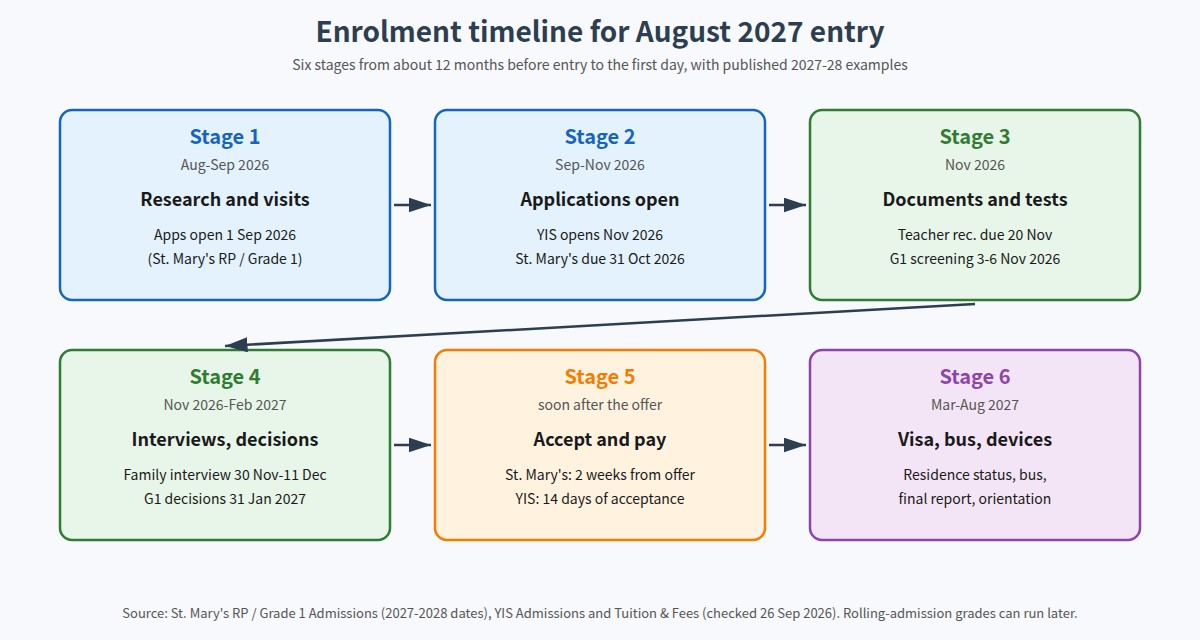
Figure 1 shows a typical sequence for an August 2027 start, using the dates St. Mary’s has already published for Grade 1 in 2027-28. Schools with fixed calendars for kindergarten and Grade 1 run early like this; for grades with rolling admissions, many steps can come later.
Stage 1: August to September 2026, about 12 to 11 months before entry (research and visits)
Build a shortlist and read each admissions policy, not just the brochure. Some schools open applications almost a year ahead: St. Mary’s opened its Readiness Program (kindergarten) and Grade 1 applications for 2027-28 on 1 September 2026, and NIS’s fee page says that for “ELC, Kindergarten, and Grade 1”, registration for the following school year “opens approximately 10 months before the start of the academic year”.
- Check each school on the MEXT IB consortium list (Article 1 or not, IB programmes).
- Read the admissions policy: eligibility, age cut-off, English and priority groups.
- Note the application opening date and the deadline for your child’s grade.
- Book a campus visit.
- Check when each school needs your residence status: FIS says expatriate students must have a dependent’s visa to apply.
- If you are a Japanese family, read the compulsory schooling section below before you apply.
Stage 2: September to November 2026, about 11 to 9 months before (applications)
Applications start with an online form and a non-refundable fee. YIS says its application process for 2027-28 “will open in November 2026” and starts with a pre-application form so the school can confirm eligibility. St. Mary’s asks for applications for Readiness Program and Grade 1 by 31 October 2026. All four schools charge an application or assessment fee: ¥50,000 at YIS, St. Mary’s and NIS for 2026-27, and ¥16,500 (tax included) for OIS elementary in its 2026 fee list.
- Create the portal account and submit the application form.
- Pay the application fee (check whether it is per child or per application).
- Ask current teachers early for recommendations; many schools send the forms directly to them.
Stage 3: November 2026, about 9 months before (documents, tests and recommendations)
Recommendations have their own deadlines: for 2027-28, St. Mary’s asks for the teacher recommendation by 20 November 2026 and holds Grade 1 on-campus screening on 3 to 6 November 2026. OIS holds its elementary assessments on 28 November 2026 and 30 January 2027 for April 2027 entry.
- Confirm that every teacher recommendation has been submitted.
- Book any English test (WIDA, MAP or the school’s own assessment).
- Get translations of school reports if needed (FIS, for example, asks for an English translation of any report not written in English).
- Prepare any medical form the school asks for.
Stage 4: November 2026 to February 2027, about 9 to 6 months before (interviews and decisions)
Interviews often involve parents too. St. Mary’s schedules Grade 1 family interviews between 30 November and 11 December 2026 and sends Grade 1 decision letters on 31 January 2027. For Readiness Program, decisions come on 28 February 2027.
- Prepare for a parent interview: why this school, your child’s learning, and how you will support English at home.
- Share any learning support needs honestly; schools such as YIS ask for an IEP or similar plan if you have one.
Stage 5: straight after the offer (accepting and paying)
Once you have an offer, the clock runs fast, so do not wait: with a St. Mary’s Grade 1 decision on 31 January 2027, payment would be due in mid-February. YIS asks for the registration fee within 14 days of acceptance. St. Mary’s asks for the registration fee and Development Fund “within two weeks from the date of offer”. At OIS, the entrance procedure deadlines for April 2027 entry are 11 December 2026 (first round) and 10 February 2027 (second round).
- Accept or decline the offer in writing by the stated date.
- Pay the one-time registration or entrance fee (see the fees section below).
- Complete enrolment forms: emergency contacts, policies, permissions. St. Mary’s lists a Health Record Form, Student ID Card Application Form and School Bus Application Form after acceptance.
Stage 6: March to August 2027, the months before the first day
- Check that your residence status is in place (see the visa section below).
- Apply for the school bus and check routes and pick-up times.
- Buy any required device, uniform or PE kit, following the school’s list.
- Send the final school report for the current year; St. Mary’s asks for it after acceptance.
- Note orientation dates. For an April start, everything runs earlier: OIS holds its elementary orientation for April 2027 entrants on 12 February 2027.
Age cut-offs: 1 September or 1 April?
At these schools, the grade is set mainly by date of birth rather than the grade your child is in now, although some add conditions such as completing the previous grade.
- YIS: grade placement is “primarily based on the student’s age as of September 1st in the academic year of entry” (Admissions FAQ).
- St. Mary’s: children “must be the appropriate age for the given grade level by September 1”; age 5 for Readiness Program, age 6 for Grade 1, up to age 16 for Grade 11. Applicants must also have completed a full year of the previous grade.
- NIS: its whole-school admissions policy (last reviewed October 2023) sets 1 September as the cut-off for all grades.
- OIS: for April 2027 entry, Grade 1 applicants must be “6 years old as of April 1st, 2027”, and Grades 2 to 5 must be 7 to 10 on the same date. Applicants who are foreign nationals, or who attend a preschool whose year does not start in April, can qualify under a separate criterion; ask OIS.
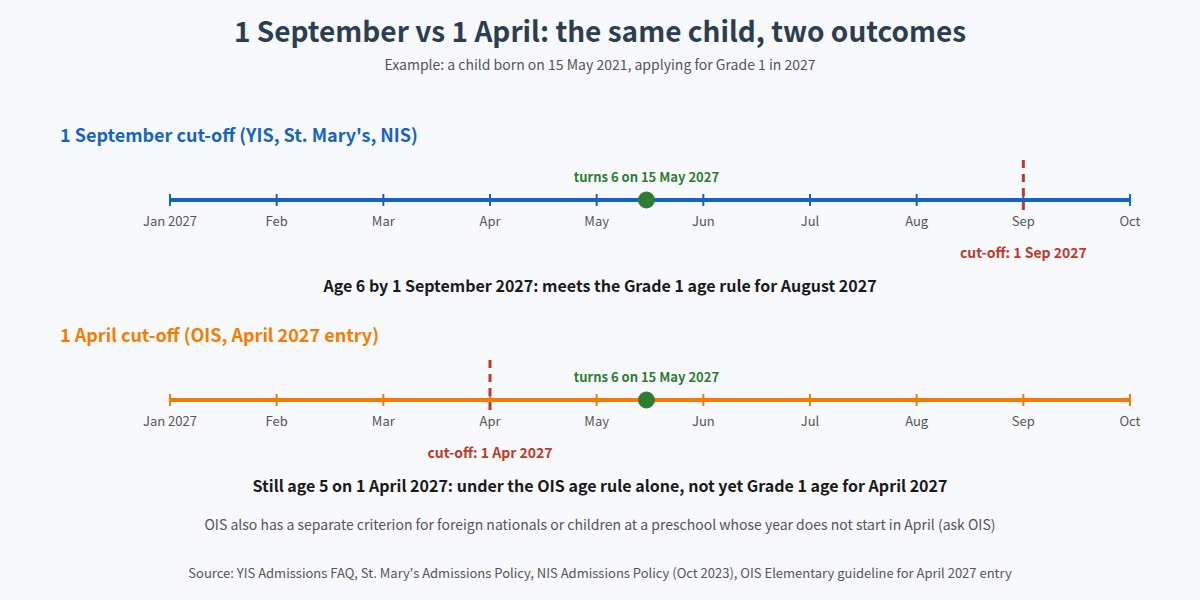
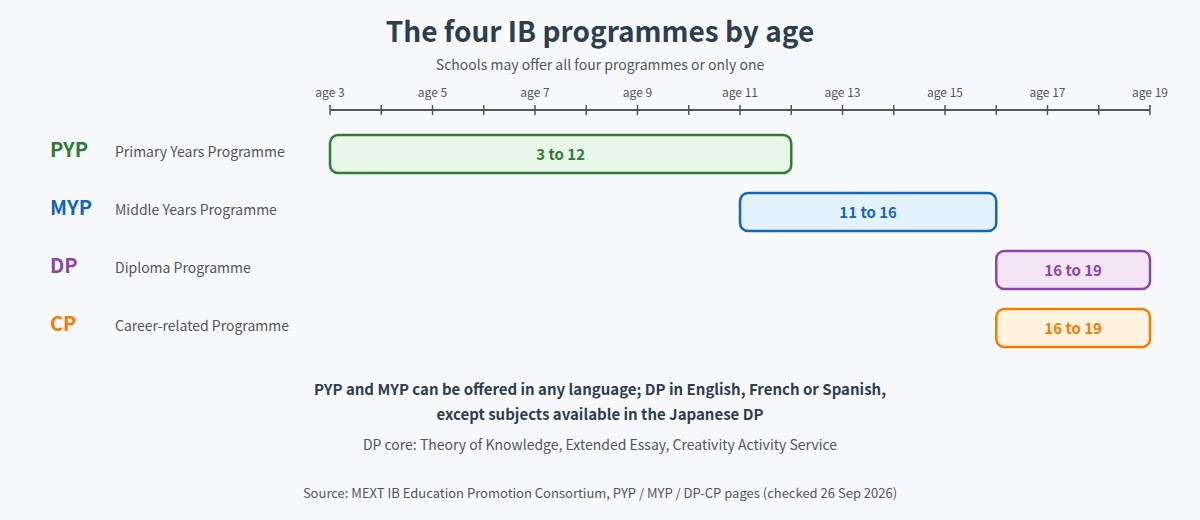
Figure 2 shows why this matters. Take a child born on 15 May 2021. They turn 6 before 1 September 2027, so they meet the Grade 1 age rule at a 1 September school for August 2027. But on 1 April 2027 they are still 5, so under the OIS age rule alone they would not yet meet the Grade 1 age requirement for April 2027 (other criteria may apply). If you are moving between the two systems, confirm the grade with the admissions office early.
Documents families usually need
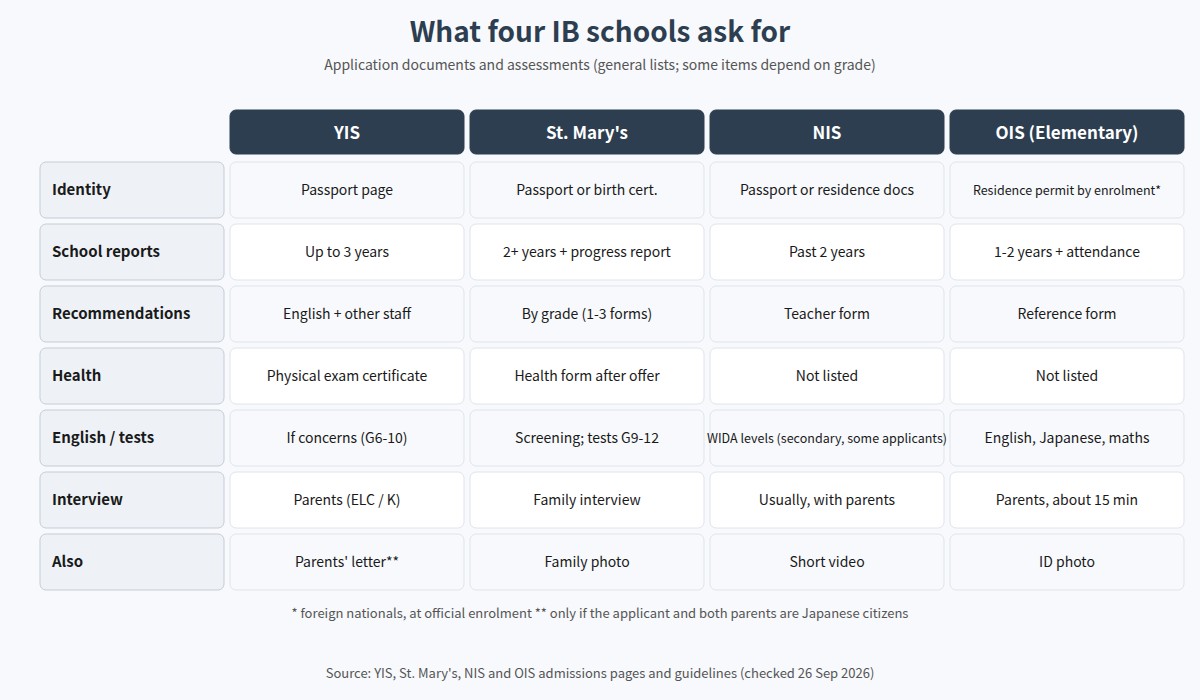
Here is what the four schools ask for on their current admissions pages.
| Document | YIS | St. Mary’s | NIS | OIS (Elementary) |
|---|---|---|---|---|
| Identity | Passport photo page | Birth certificate or passport page | Passport or Japanese residence documentation | Application form and ID photo |
| School records | Up to three years of reports, plus transcripts (FAQ: two years for Elementary and Middle School, three for High School) | At least two years, plus current progress report | Reports or transcripts from the past two years | One year (Grades 1 and 2) or two years (Grades 3 to 5) |
| Recommendations | English teacher and another staff member (“ELC Not Applicable” for these teacher recommendations); maths teacher for High School | By grade: kindergarten teacher (RP, Grade 1) up to English, maths and counselor or principal (Grades 9 to 12) | Confidential teacher recommendation form | Reference form from the current school |
| Health | Physician-signed physical examination certificate | Health Record Form after acceptance | Not listed on the application page | Not listed in the guideline |
| Other | IEP if any; parents’ letter if the child and both parents are Japanese citizens | Confidential information form, record release form, family photo; test scores for Grades 9 to 12 | Student, parent and family photos; a short video introduction | Attendance shown on report cards |
Easy to miss: OIS asks that report copies “clearly indicate attendance status”, NIS asks for a short video introduction, and YIS needs a parents’ letter only when the applicant and both parents are Japanese citizens.
English tests, interviews and recommendation letters
Does your child need English already? It depends on age and grade.
WIDA levels
NIS’s whole-school admissions policy (last reviewed October 2023) sets these minimum WIDA levels for “Secondary School Applicants (with no local public school options)”: Grades 6 and 7, Level 2; Grades 8 and 9, Level 3; Grade 10, Level 4; and Grades 11 and 12, Level 5 for the IB Diploma or Level 4 for the High School Diploma pathway. Applicants who could attend a local public school are instead expected to have a grade-level equivalent of English proficiency. Because the policy dates from 2023, ask NIS whether these levels still apply for your year of entry.
MAP tests
MAP is a reading and mathematics assessment. Fukuoka International School says it does not use a pass or fail admissions test, but students from Grade 3 upwards complete MAP testing for grade placement, and its application checklist asks for MAP results “within the last 6 months” if you have them.
Interviews and play sessions
- YIS: ELC and Kindergarten include “an informal play session and parent interview”; for Grades 6 to 10, an assessment and interview may be requested if there are concerns about English.
- St. Mary’s: for Grade 1 in 2027-28, there is on-campus screening, a group observation on 14 November 2026 and a family interview.
- NIS: the FAQ calls the interview “an important part of the admissions process”, although “on certain occasions, conditional acceptance can be granted without an interview”. The 2023 policy says it is in English and parents may bring a translator.
- OIS: the April 2027 elementary assessment includes English, Japanese and maths, a group activity for Grade 1, and an interview with parents of about 15 minutes.
English support after entry
St. Mary’s offers English language support from Readiness Program through Grade 8, only limited support for students entering Grades 9 or 10, and none for students entering Grade 11.
Residence and visa requirements
The schools in this guide expect children to live in Japan with a parent or guardian. NIS says it is not able to sponsor visas for students, and FIS and OIS require a dependent visa or other long-term residence status. Here is what they say:
- YIS: applicants “must live with at least one parent within commuting distance”, and at least one residing parent must be fluent in speaking, reading and writing English.
- NIS: the school is “not able to sponsor visas for students”, and “students must be eligible to enter Japan on a dependent visa to qualify for admission”. A legal guardian is required.
- FIS: expatriate students “must have a dependent’s visa to apply”, and non-Japanese applicants give visa details including status and period of stay.
- OIS: “Foreign nationals must hold a long-term residence permit (e.g., a dependent visa) at the time of official enrollment.”
If your move depends on a work visa, check early that your child’s dependent visa will be ready in time.
For Japanese families: the compulsory schooling rule
This section matters if your child holds Japanese nationality, including dual nationals. Japan’s School Education Act (Article 17) requires parents to send their children to an elementary school and then a junior high school (or an equivalent Article 1 school) from the first school year after the child turns 6 until the end of the school year in which the child turns 15, which is roughly Grades 1 to 9. Most international schools, including all four in this guide, are not “Article 1 schools” (ichijo-ko) under that law; the MEXT IB consortium list places them in its non-Article 1 section.
MEXT’s Q&A on international schools puts it plainly: 「保護者が日本国籍を有する子を一条校として認められていないインターナショナルスクールに就学させたとしても、法律で規定された就学義務を履行したことにはなりません。」 In English (our translation): even if a parent enrols a child who holds Japanese nationality in an international school that is not recognised as an Article 1 school, this does not fulfil the legal obligation to send the child to school. The MEXT consortium page adds: 「日本人の保護者は義務教育段階の子を一条校に就学させる義務を負っています。」 (Japanese parents are obliged to send children of compulsory school age to Article 1 schools.)
MEXT’s enrolment page adds that, since the 1984 Nationality Act revision, the duty applies to dual nationals too; it is not imposed on parents of foreign-national children.
The same MEXT Q&A also says that a child who finishes the elementary division of a non-Article 1 international school is not accepted into an Article 1 junior high school, and the same applies to transferring into a Japanese junior high part-way through. If your child may return to the Japanese system, think about this before Grade 1.
How the schools handle it:
- YIS: eligible applicants include Japanese nationals “with prior international education”.
- St. Mary’s: asks Japanese parents to “give full consideration to the legal implication”, and may consider children whose recent education was English-medium or who have an English-speaking expatriate parent.
- OIS: its Middle School page says students registered at an Okinawa public junior high school keep that registration while attending OIS and OIS reports attendance and grades to it. Its elementary page carries the same note on public school registration.
- FIS: says some exceptions are allowed “but require special procedures”.
We suggest speaking with both the school and your city’s board of education before you apply.
Fees to budget for the first year
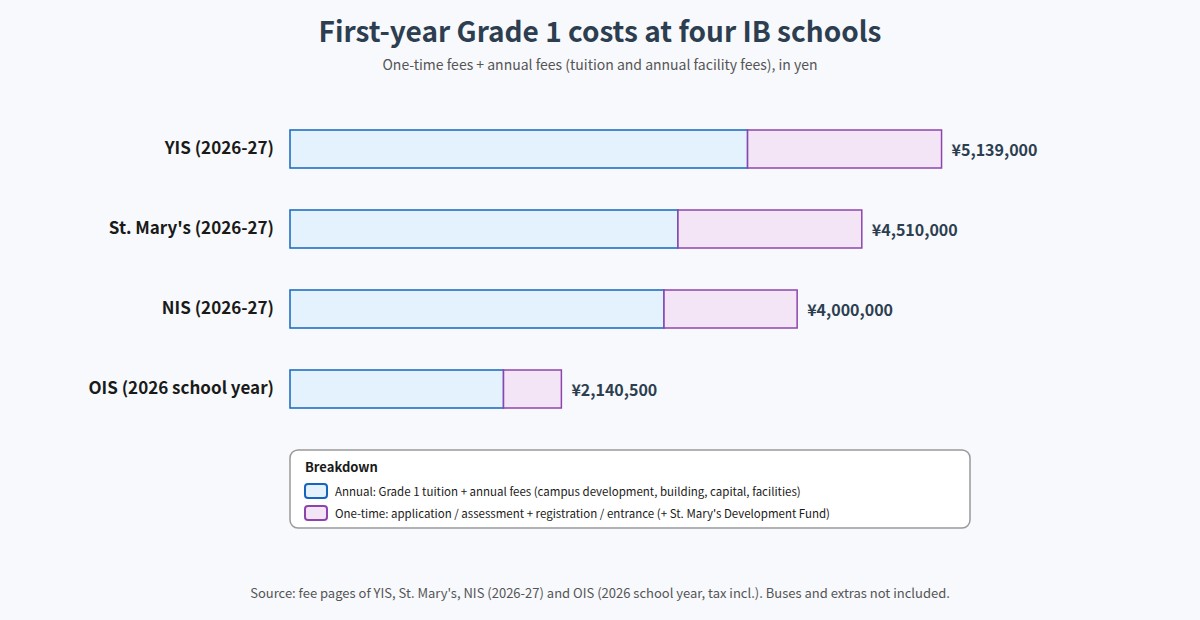
One-time fees make the first year the most expensive. Here is Grade 1 at each school, in its latest published fee year.
| School (fee year) | One-time fees | Annual fees (Grade 1) | First-year total |
|---|---|---|---|
| YIS (2026-27) | Application ¥50,000 + Registration ¥1,480,000 | Tuition ¥3,210,000 + Campus Development ¥399,000 | ¥5,139,000 |
| St. Mary’s (2026-27) | Application ¥50,000 + Registration ¥400,000 + Development Fund ¥1,000,000 | Tuition ¥2,860,000 + Building Maintenance ¥200,000 | ¥4,510,000 |
| NIS (2026-27) | Application ¥50,000 + Registration ¥1,000,000 | Tuition ¥2,700,000 + Campus Development ¥250,000 | ¥4,000,000 |
| OIS Elementary (2026 school year, April 2026 to March 2027) | Assessment ¥16,500 + Entrance ¥440,000 | Tuition ¥1,197,900 + learning environment fee ¥386,100 + Annual Capital Fee ¥100,000 | ¥2,140,500 (tax included) |
The totals are our own sums of the published fees. OIS lists its fees including consumption tax; the other three pages do not say how tax is treated. OIS has not yet published fees for the 2027 school year, and St. Mary’s and NIS have not yet published 2027-28 fees on the pages we checked, so budget for possible increases if you are applying for 2027.
Costs that are easy to forget
- School bus: ¥420,000 a year for both ways at St. Mary’s (2026-27); ¥500,000 a year for the NIS Neighborhood Pickup buses (2026-27); ¥395,000 a year for the YIS Tokyo bus (FAQ, tax included, year not stated).
- IB exam fees: St. Mary’s bills ¥20,000 per subject in December for students registered for IB exams (2026-27), while YIS says its fees include IB Diploma, ISA and PSAT exam fees, excluding resits (2026-27).
Questions to ask on a school visit
- Which grade will my child join?
- Is there space in that grade, and how does the wait pool work?
- What English level do you expect at entry for this grade, and what support is there after entry?
- Which IB programmes do you offer, and are you an Article 1 school?
- What are all the fees in the first year, including bus, devices and exams? Do they include tax?
- What learning support can you offer, and is there any extra charge?
Questions parents often ask
How early should we apply?
For entry points with fixed calendars, such as kindergarten and Grade 1, start about a year ahead. NIS says it accepts applications at all times of the year.
We live overseas. Can we still apply for an August start?
Usually yes. YIS reviews overseas applications on a rolling basis and recommends applying by early March (early February for high school) for August entry.
Can a Japanese child attend an international school?
Several schools in this guide consider Japanese nationals under their own conditions, but MEXT states that attending a non-Article 1 international school does not fulfil the legal obligation of compulsory schooling. See the section above.
Summary
- Start about 12 months ahead: some applications open almost a year before entry, such as 1 September 2026 for St. Mary’s Grade 1 in 2027-28.
- Check the age cut-off first: YIS, St. Mary’s and NIS use 1 September; OIS uses 1 April for its April 2027 intake.
- Gather documents early: one to three years of reports depending on school and grade, recommendations, and passport or residence documents.
- Plan for English and interviews: expect WIDA or MAP tests and parent interviews at some schools.
- Japanese families: MEXT states that a non-Article 1 international school does not fulfil the compulsory schooling duty for Japanese nationals.
- Budget for the first year: Grade 1 costs ranged from ¥2,140,500 at OIS (2026 school year) to ¥5,139,000 at YIS (2026-27), before buses and extras.
Sources and references
- MEXT: Q&A 11, compulsory schooling and international schools (Japanese) (checked 26 September 2026)
- MEXT: Enrolment in elementary and junior high schools (Japanese)
- MEXT IB Education Promotion Consortium: IB schools in Japan (as of 30 June 2026)
- Yokohama International School: Applying to YIS and Admissions FAQ
- Yokohama International School: Tuition and Fees 2026-2027
- St. Mary’s International School: Admissions Policy
- St. Mary’s International School: Application Requirements
- St. Mary’s International School: RP and Grade 1 Admissions (2027-2028 dates)
- St. Mary’s International School: Tuition and Fees, School Year 2026-2027
- Nagoya International School: Applying to NIS and Admissions FAQ
- Nagoya International School: 2026-27 Tuition and Fees
- Nagoya International School: Whole School Admissions Policy (last reviewed October 2023, PDF)
- Okinawa International School: Elementary (admissions guideline for April 2027 entry and 2026 fees, Japanese)
- Okinawa International School: Middle School (Japanese)
- Fukuoka International School: How to Apply and FAQ
コメント