K. International School Tokyo (KIST) is a co-educational, non-religious international school in Shirakawa, Koto-ku, teaching children from K1 (age 3) to Grade 12. It was founded in 1997, and its website says it has approximately 700 students from over 50 nationalities. If you are looking for an English-medium school in Tokyo that leads to the IB Diploma, KIST is very likely on your list.
This guide is based on the school’s website, its 2026-27 Admissions Handbook and the Japanese Ministry of Education (MEXT) IB consortium list, all checked on 26 September 2026. Fees and dates change every year, so please confirm details with the school before you apply.
KIST at a glance
| Item | Details |
|---|---|
| School name | K. International School Tokyo (KIST) |
| Founded | 1997; recognised as an educational foundation (gakko hojin) by Tokyo in 2000 |
| Type | Co-educational, non-religious; not an “Article 1” school |
| Campus | 1-5-15 Shirakawa, Koto-ku, Tokyo 135-0021 (nearest station: Kiyosumi-Shirakawa) |
| Grades | K1 (age 3) to Grade 12 |
| Students | Approximately 700 students from over 50 nationalities (school website, checked September 2026) |
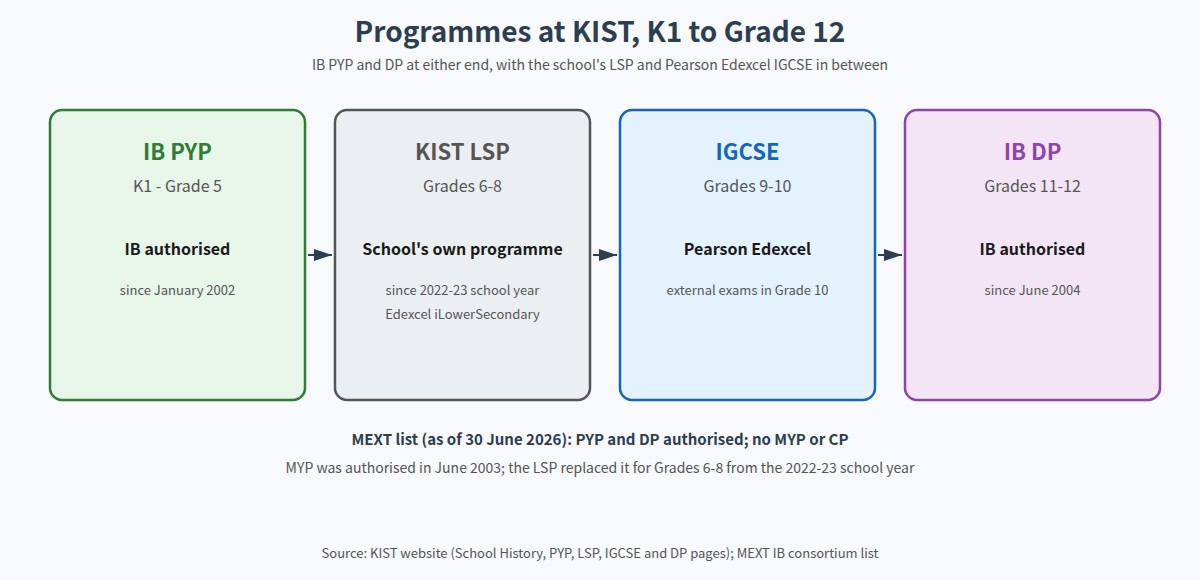
| IB programmes | Primary Years Programme (PYP) and Diploma Programme (DP); no MYP or CP (MEXT list, as of 30 June 2026) |
| Other qualifications | Pearson Edexcel International GCSE (IGCSE) in Grades 9 and 10 |
| Accreditation | Council of International Schools (CIS), fully accredited since February 2017 |
| Head of School | Dr Kevin Yoshihara (Head of School since August 2019) |
Which IB programmes does KIST offer? PYP and DP, not MYP
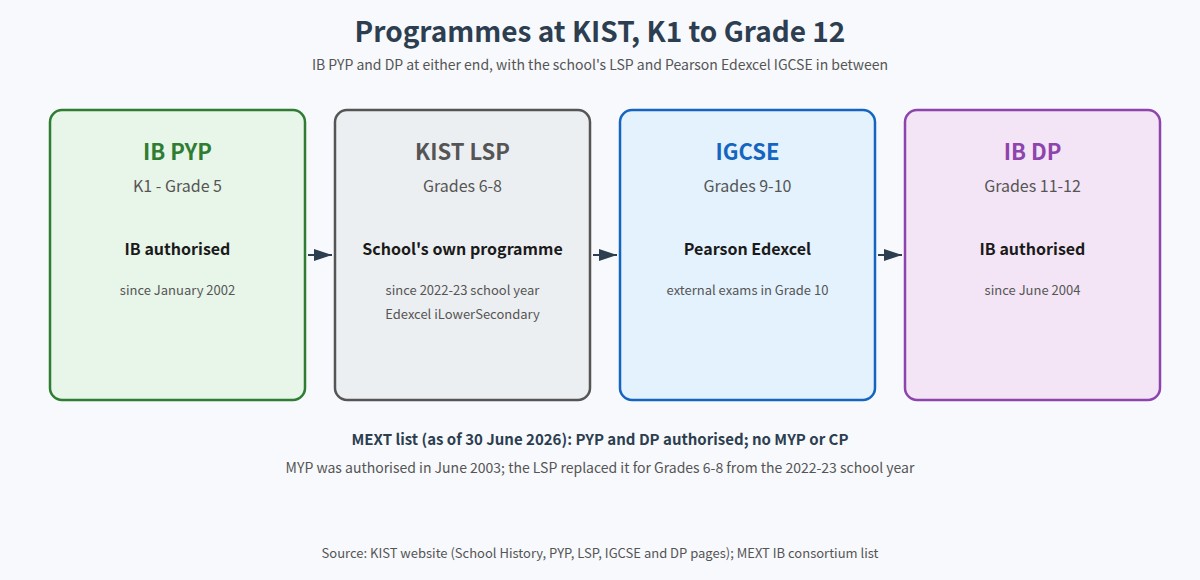
This is worth getting clear first, because older listings sometimes say KIST offers three IB programmes. The school’s history page records PYP authorisation in January 2002, MYP authorisation in June 2003 and DP authorisation in June 2004. For the 2022-23 school year, however, KIST introduced its own Lower Secondary Programme (LSP) for Grades 6 to 8, and the MEXT list (as of 30 June 2026) shows KIST with the PYP and DP only. The school’s Academic Performance page likewise says “KIST offers two IB programs (PYP and DP)”. We could not find a published date on which the MYP authorisation formally ended.
K1 to Grade 5: the IB Primary Years Programme
All children from age 3 to Grade 5 take part in the inquiry-based PYP. The aim, in the school’s words, is to develop “active, eager learners who ask questions and seek deeper understanding.”
Grades 6 to 8: the KIST Lower Secondary Programme (LSP)
The LSP is a three-year programme designed by KIST to prepare students for the IGCSE and the IB Diploma. Parts of the MYP framework are used in most subjects, while mathematics, science, English and computing follow the Pearson Edexcel iLowerSecondary curriculum. In Grade 8, students sit official Edexcel exams in mathematics and computing.
Grades 9 and 10: Pearson Edexcel IGCSE
KIST introduced the IGCSE in August 2019. Each two-year course leads to an IGCSE qualification based on external exams at the end of Grade 10 (the Academic Performance page states that all KIST students sit the IGCSE exams in Grade 10). From an MYP school, expect a switch to exam courses.
Grades 11 and 12: the IB Diploma Programme
KIST’s Academic Performance page states that “All students in Grades 11 and 12 at KIST study in the Diploma Programme”, while its results table shows that 82% to 97% of graduates in 2022 to 2026 were in the full Diploma. Students take six subjects (normally three at Higher Level and three at Standard Level) plus Theory of Knowledge, the Extended Essay and CAS. From the 2025-2027 options list:
- English and Japanese: Group 1 is English A Language and Literature; Group 2 includes Japanese A, Japanese B and Japanese ab initio. English A plus Japanese A qualifies for the Bilingual IB Diploma.
- Sciences: Group 4 lists Biology, Physics and Environmental Systems and Societies; Chemistry is in the Group 6 “Arts and Electives” list.
- Online and small classes: some online subjects cost extra, and a class with fewer than five students may not run.
IB Diploma results 2022 to 2026
KIST publishes five years of Diploma results on its Academic Performance page.
| Year | KIST average | Global average | Number of graduates | Students in the full DP | Attained Diploma |
|---|---|---|---|---|---|
| 2026 | 42.7 | 30.9 | 38 | 82% | 100% |
| 2025 | 42.0 | 30.6 | 33 | 85% | 100% |
| 2024 | 41.5 | 30.1 | 39 | 97% | 100% |
| 2023 | 41.1 | 30.2 | 37 | 86% | 100% |
| 2022 | 42.1 | 32.0 | 35 | 95% | 100% |
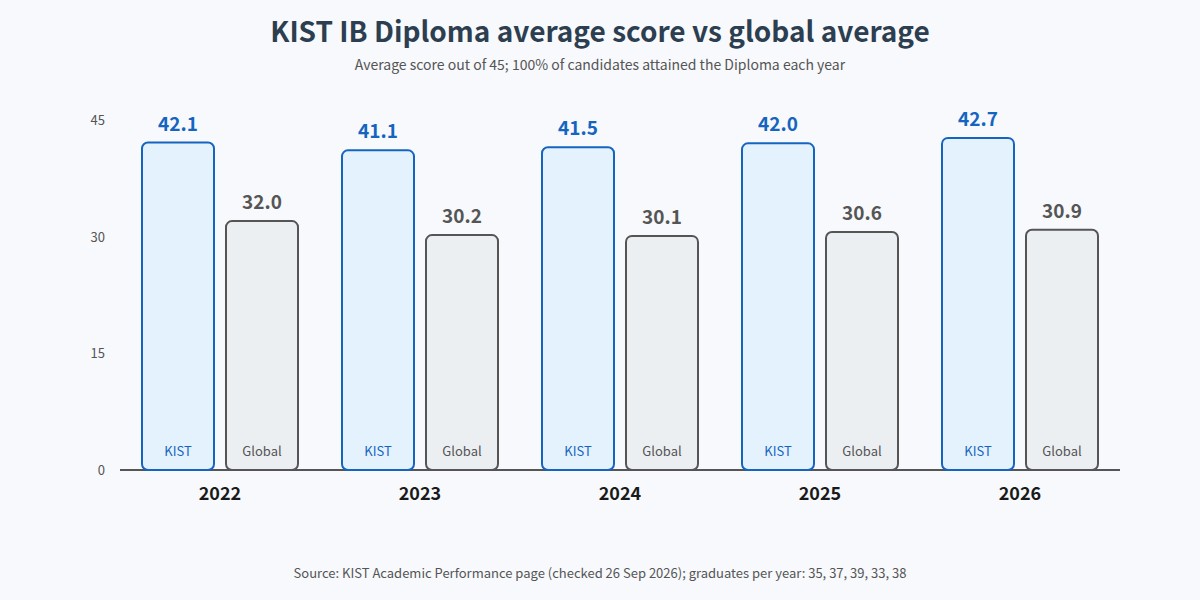
For the Class of 2026, the page reports an average of 42.7 out of 45 and states: “Seven (23%) students earned a perfect 45 points.” It adds that 94% of the cohort scored 40 or above. Note that seven of 38 graduates would be about 18%. Both percentages fit better with the roughly 31 full Diploma candidates implied by the 82% figure (7 of 31 is 23%), but the page does not state the base.
University destinations
KIST’s University Acceptance page lists highlight universities in each region where graduates have received offers after 2020. Examples include Cambridge, Oxford, Imperial College London and UCL in the UK; Stanford, Princeton and UC Berkeley in the US; Toronto and UBC in Canada; NUS and the University of Hong Kong in Asia; and the University of Tokyo, Keio, Waseda and ICU in Japan. These are offers, not enrolments, and no counts are given. University guidance counselling at KIST begins in Grade 9.
Tuition and fees for 2026-2027
These figures come from Section 7 of the KIST Admissions Handbook 2026-27; the school notes that tuition is adjusted annually.
| Fee (2026-2027) | Amount (JPY) | When |
|---|---|---|
| Application Fee (non-refundable) | ¥30,000 | Upon application |
| Enrollment Fee (non-refundable) | ¥300,000 | One-time, when first admitted |
| Capital Fee | ¥700,000 | One-time, when first admitted |
| Tuition: K1 to K3 | ¥3,020,000 | Annual |
| Tuition: Grades 1 to 9 | ¥2,850,000 | Annual |
| Tuition: Grades 10 to 12 | ¥2,970,000 | Annual |
| Building Maintenance Fee | ¥200,000 | Annual (reduced for April to June entry) |
| Community Association (CA) Fee | ¥1,000 | Annual |
| Program Progression Fee (Grades 1, 6, 9 and 11) | ¥5,000 | Invoiced separately |
| Camp Fee (Grades 5, 7, 9 and 11) | Varies by destination | With the first instalment |
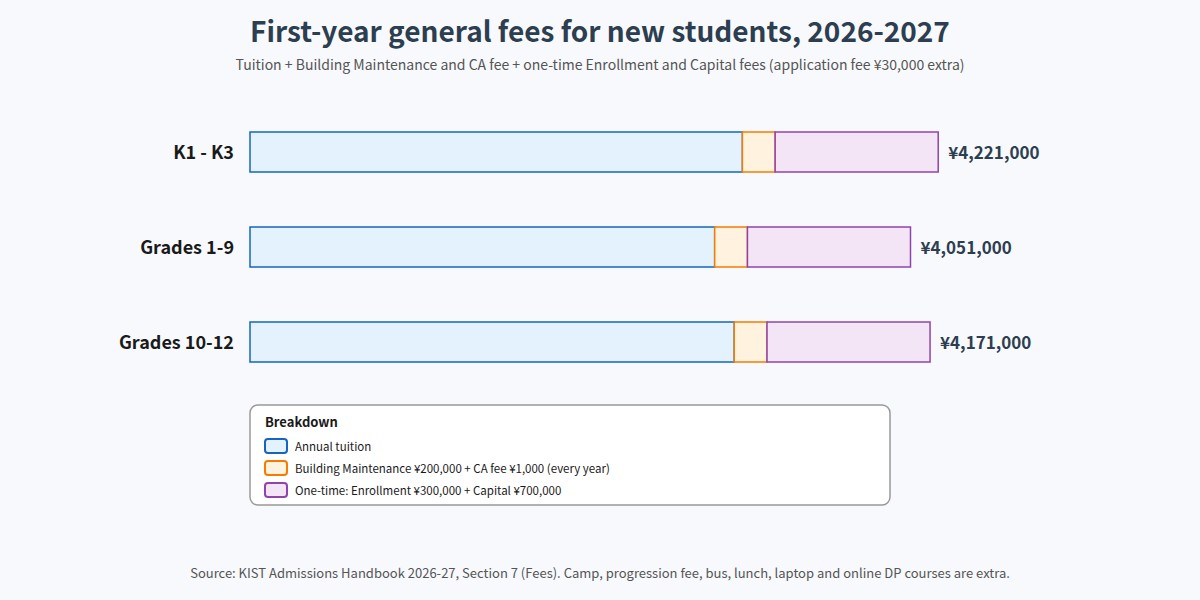
The Handbook gives first-year totals for new students (all general fees except the application fee): ¥4,221,000 for K1 to K3, ¥4,051,000 for Grades 1 to 9, and ¥4,171,000 for Grades 10 to 12. Add the ¥30,000 application fee and the amounts you actually pay in the first year become ¥4,251,000, ¥4,081,000 and ¥4,201,000, before any camp, progression fee or optional services. From the second year, the ongoing general fees are tuition plus Building Maintenance and CA fee: ¥3,221,000, ¥3,051,000 and ¥3,171,000 respectively at 2026-27 rates.
Tuition can be paid in full or in three instalments, and it includes teaching materials, excursions other than camps, most textbooks and examinations.
Other costs to plan for:
- School bus: ¥110,000 to ¥440,000 a year depending on the route and one-way or round trip, for Elementary children only. Secondary students cannot use the bus.
- School lunch: optional, ¥530 to ¥670 per meal before tax; the café cannot cater for allergies or special diets.
- After care (K1 to Grade 3 only): for example, ¥60,000 a month for five days a week.
- Laptop and books: Grades 9 to 12 must buy a Windows laptop (price not specified), and some Secondary textbooks and online DP courses are paid by families.
There is also a KIST Scholars’ Award that students in Grades 7 to 12 can apply for from their second year of enrolment. The school’s About page states that, thanks to its gakko hojin status, KIST is eligible for Japan’s High School Tuition Support Fund system. Note that a MEXT notice of 31 March 2026 removed foreign schools (kakushu gakko mainly for foreign nationals) from the national support fund itself from 1 April 2026: students enrolled before then keep the previous terms, and new entrants at previously designated foreign schools may receive equivalent support through the prefecture-run budget programme Koukousei-tou Shin-Shugaku Shien (MEXT), so ask the school which applies to your child. The support applies only to high-school-age students and depends on household requirements, so please confirm eligibility with the school and your local authority.
Admissions: age, English and timing
Age and grade placement
Because the school year starts in mid-August, KIST’s age cut-off is 31 July. For 2026-27, K1 is for children born between 1 August 2022 and 31 July 2023, Grade 1 for those born between 1 August 2019 and 31 July 2020, and Grade 12 for those born between 1 August 2008 and 31 July 2009. Younger children are never considered for K1.
English requirements and support
This is where planning ahead really matters. Except for children joining K1 at the start of the school year in August, applicants must have strong, age-appropriate English. The Handbook is very direct about older students: “applicants seeking admission to Grades 8 and above who are identified as requiring language support are not accepted.”
For admitted students, English support includes in-class help and a before-school LEAP programme in Elementary School, and in-class support plus Academic Writing classes in Grades 6 to 8. So the earlier your child joins, the more support is available. Please also note that KIST states it does not employ a learning needs specialist and “is unable to accept applications for students with special needs—learning, behavioral or emotional.”
The application steps
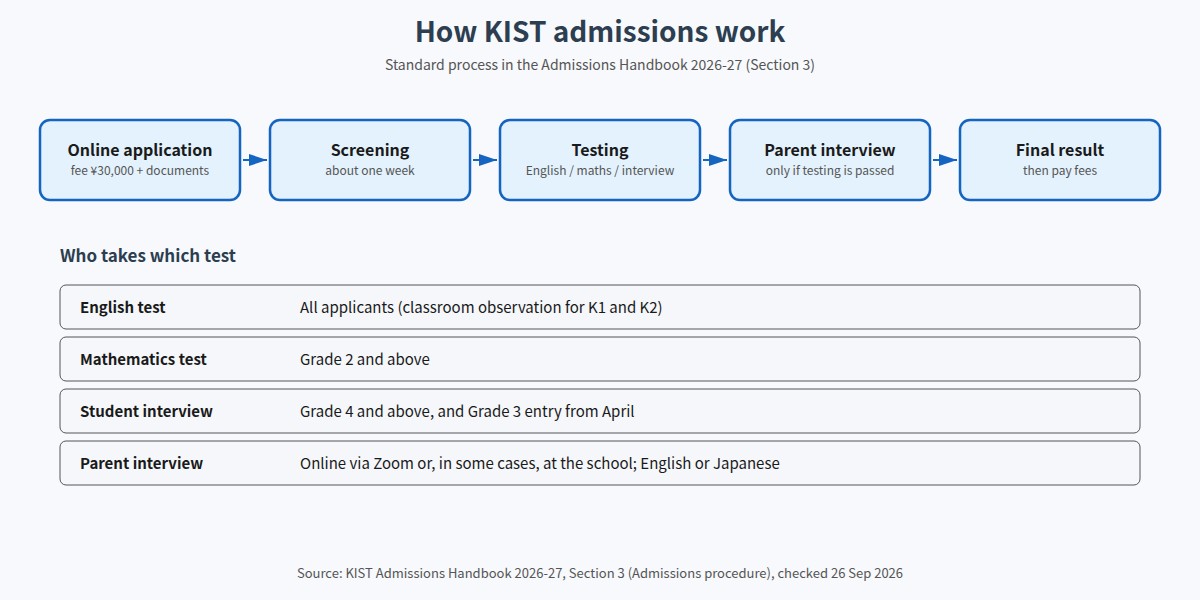
- Confirm availability by email if applying outside the main intake, pay the ¥30,000 application fee and submit the online application with documents.
- Screening (about one week), then testing: an English test for everyone (an observation for K1 and K2), a mathematics test from Grade 2, and a student interview from Grade 4 (and for April Grade 3 entry).
- A parent interview (online via Zoom or, in some cases, at the school) in English or Japanese, only for applicants who do well in testing; then the final result and fee payment.
When to apply
The main intake is in August, with entry also possible in January or April if places are available. For the 2026-27 school year, the main intake opened on 18 October 2025, closed on 16 January 2026, and results were issued on 27 February 2026. The Applications page now says applications for entry from November 2026 to June 2027, and from August to October 2027, open on 17 October 2026. Outside the main intake, applications are rolling and take about three to four weeks.
Special rules for Grades 10 to 12
- Grade 10: start-of-year applications are, in principle, not accepted after 31 May, and new students must attend a two-week summer programme in early August; mid-year entry only from an IGCSE course with matching subjects.
- Grade 11: start-of-year applications are not accepted after 30 September; later, only full IB Diploma transfers with matching subjects.
- Grade 12: only full IB Diploma transfers with matching subjects; IB Certificate students are not accepted for Grades 11 or 12.
What you will need
All applicants submit proof of name and date of birth, a recent ID-style photo, a recent family photo and proof of the application fee payment. From Grade 3, official school reports for the past three years (in English, with translations where needed) must come from the school itself, by school email, post or a sealed school envelope; a Confidential School Reference is needed from Grade 2 and a handwritten Personal Statement from Grade 8.
Learning support and student life
School day. The year runs from mid-August to mid-June; hours are 8:25 to 15:20 for K1 to Grade 5 and 8:25 to 15:35 for Grades 6 to 12.
Campus and activities. A new Main Building opened in January 2024, with a gymnasium on its top two floors. The school also lists a field, five science laboratories, music studios and a Student Care Office. Sports include basketball, volleyball, cross country and futsal, and the school mentions soccer and golf coaching by professional coaches. General club activities carry no additional fee, while after-school enrichment lessons (such as ballet or cricket) have separate charges.
Expectations. KIST has a strict dress code and puts strong weight on behaviour, parental support and “high moral character”.
Getting there
KIST is at 1-5-15 Shirakawa, Koto-ku, about three kilometres east of Tokyo Station. The school says it is a one-minute walk from Kiyosumi-Shirakawa Station, which is served by the Tokyo Metro Hanzomon Line and the Toei Oedo Line. Its Access page gives approximate train times of 12 minutes from Tokyo, 24 minutes from Shibuya and 30 minutes from Shinjuku.
Questions parents often ask
Is KIST an IB MYP school?
Not any more. It was authorised for the MYP in 2003 but introduced its own LSP for Grades 6 to 8 in 2022, and the current MEXT list shows the PYP and DP only.
My child is still learning English. Can they apply?
It depends on age. Children joining K1 in August are exempt from the English requirement, but from Grade 8 applicants needing language support are not accepted.
We are a Japanese family. What should we know?
KIST is not an Article 1 school. The Handbook explains that children with Japanese citizenship (including dual nationals) and children with at least one Japanese parent are required by law to attend a Japanese-recognised school between ages 6 and 15, and that attending KIST does not fulfil this requirement. The school asks families to check this with their local government.
Summary
- Co-educational, non-religious, K1 to Grade 12: founded in 1997, around 700 students from over 50 nationalities, in Koto-ku close to Kiyosumi-Shirakawa Station.
- IB at both ends: PYP (K1 to Grade 5) and DP (Grades 11 and 12), with the school’s LSP and Pearson Edexcel IGCSE in between; no MYP.
- Results: a DP average of 42.7 in 2026 against a global average of 30.9, with 100% of candidates attaining the Diploma each year from 2022 to 2026.
- 2026-27 fees: tuition from ¥2,850,000 (Grades 1 to 9) to ¥3,020,000 (K1 to K3), with first-year general fees of ¥4,051,000 to ¥4,221,000 plus the ¥30,000 application fee.
- Plan ahead: strong English is needed except for August K1 entry, students with special learning needs cannot be accepted, and Grades 10 to 12 have strict deadlines.
If KIST sounds right for your child, a good next step is to read the 2026-27 Admissions Handbook in full and note the 17 October 2026 opening date for the next round of applications.
Sources and references
- KIST: About KIST (checked 26 September 2026)
- KIST: School History
- KIST: Instructional Leadership
- KIST: PYP, LSP, IGCSE and DP
- KIST: IB Diploma Subject Options 2025-2027
- KIST: Academic Performance (DP results 2022-2026)
- KIST: University Acceptance
- KIST Admissions Handbook 2026-27: Admissions and eligibility
- KIST Admissions Handbook 2026-27: Admissions procedure
- KIST Admissions Handbook 2026-27: Student support
- KIST Admissions Handbook 2026-27: Fees
- KIST: Applications
- KIST: Facilities and Access
- Tokyo Metro: Kiyosumi-shirakawa Station
- MEXT IB Education Promotion Consortium: IB schools in Japan (as of 30 June 2026)
コメント