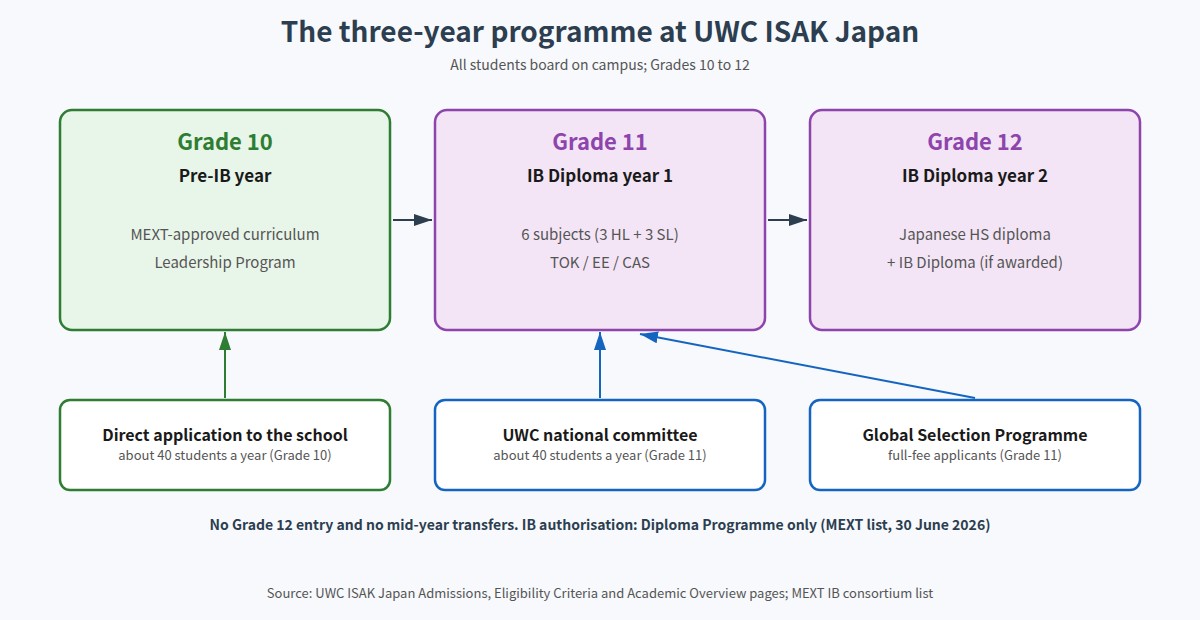
UWC ISAK Japan is a small, fully residential high school in Karuizawa, Nagano, where around 200 students from more than 80 countries live and study together for the IB Diploma. If your child is in Grade 9 or the last year of junior high school and you are curious about a boarding school in Japan with generous need-based aid, this guide is for you.
Everything below was checked on 26 September 2026 against the school’s website, its 2025-26 Annual Report, UWC’s pages and the MEXT IB consortium list. Fees and deadlines change every year, so please confirm the details with the admissions office.
- UWC ISAK Japan at a glance
- The programme: a Pre-IB year, then the IB Diploma
- IB Diploma results 2022 to 2024
- Tuition and fees for 2026-2027
- Financial assistance: how the need-based aid works
- Admissions: three routes into the school
- Boarding life and student support
- Getting to Karuizawa
- Questions parents often ask
- Summary
- Sources and references
UWC ISAK Japan at a glance
Unlike most international schools in Japan, the school only teaches the last three years of high school, and every student boards. On its Japanese-language academics page it describes itself as an Article 1 school recognised by MEXT, which is why graduates also receive a Japanese high school diploma.
| Item | Details |
|---|---|
| Legal status | Article 1 school, run by the school corporation 学校法人ユナイテッド・ワールド・カレッジISAKジャパン |
| Opened | August 2014 as the International School of Asia, Karuizawa (ISAK); joined UWC on 1 August 2017 as its 17th school |
| Grades | Grade 10 (Pre-IB) and Grades 11 to 12 (IB Diploma Programme) |
| Students (2025-26) | 199 students from 84 countries; 73 staff and faculty |
| IB programmes | Diploma Programme only (MEXT list, as of 30 June 2026) |
| Boarding | All students live on campus; no day students |
| Head of School | Arden Tyoschin (2025-26 Annual Report) |
According to its history page, Lin Kobayashi and Mamoru Taniya began planning the school in 2008 with 100 founding donors. United World Colleges (UWC) is a global movement whose mission is “to make education a force to unite people, nations and cultures for peace and a sustainable future”; UWC’s own page counts 18 UWC schools worldwide. In practice, your child’s roommate may come from Uganda, Bangladesh or the United States, and every student here counts as a UWC student, whichever route they took in.
The programme: a Pre-IB year, then the IB Diploma
The MEXT list (as of 30 June 2026) shows the school as authorised for the IB Diploma Programme only. If you would like the exact authorisation date, you can look the school up in the IB’s “Find an IB World School” directory.
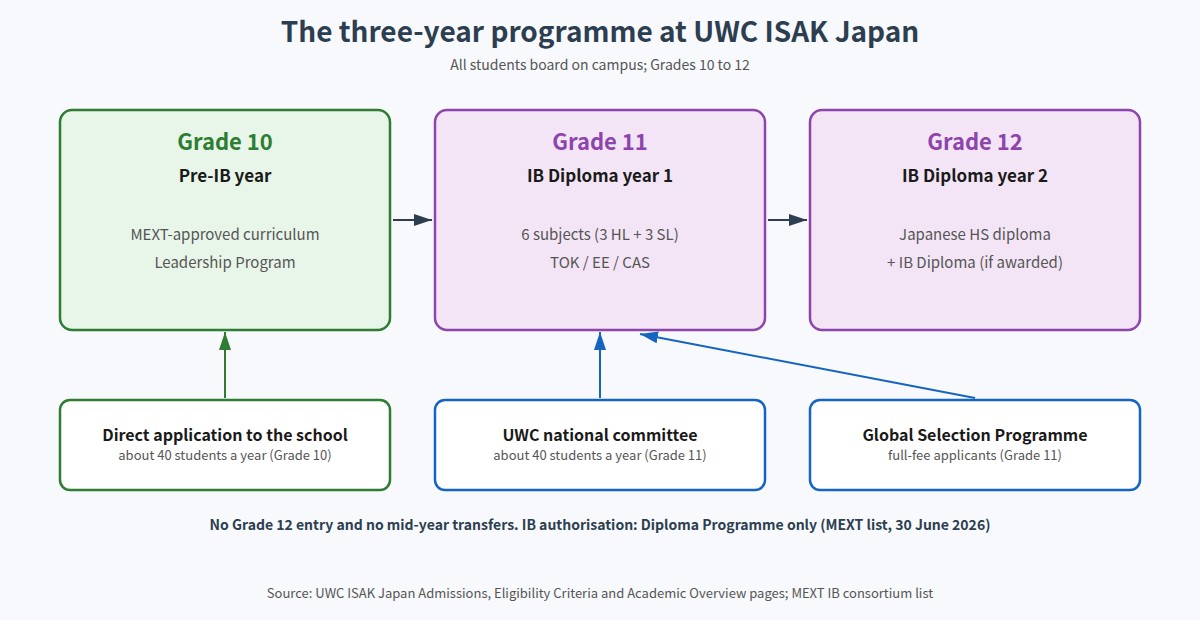
As Figure 1 shows, the structure is simple:
- Grade 10 (Pre-IB): a MEXT-approved curriculum in small, discussion-based classes plus the school’s Leadership Program, where students pick a problem they care about and act on it. The school also calls it a foundation year for building English.
- Grades 11 and 12 (IB Diploma): six subjects (three higher level, three standard level) plus Theory of Knowledge, the Extended Essay and CAS.
Grade 10 entrants continue into the Diploma automatically. Grade 11 entrants, selected through UWC, take only the two Diploma years. There is no Grade 12 entry and no mid-year transfer. Subjects include English, Chinese and Japanese literature courses; English B, Mandarin, Japanese and Spanish; History, Economics and Global Politics; the three sciences and Computer Science; and Film, Theatre and Visual Arts. The school adds that some students graduate with the UWC ISAK and MEXT high school diploma rather than the full IB Diploma.
IB Diploma results 2022 to 2024
The Academic Overview page shows results up to 2024; 2025 and 2026 results had not been posted when we checked in September 2026. World figures in brackets are those listed by the school.
| Year | Graduating class | Full Diploma entries | Pass rate (world) | Average points (world) | Bilingual diplomas |
|---|---|---|---|---|---|
| 2024 | 89 | 85 | 96.5% (80.1%) | 35 (30) | 35.3% |
| 2023 | 39 | 36 | 94.4% (79.7%) | 33 (30) | 52.8% |
| 2022 | 71 | 68 | 98.5% (86.1%) | 36 (32) | 35.8% |
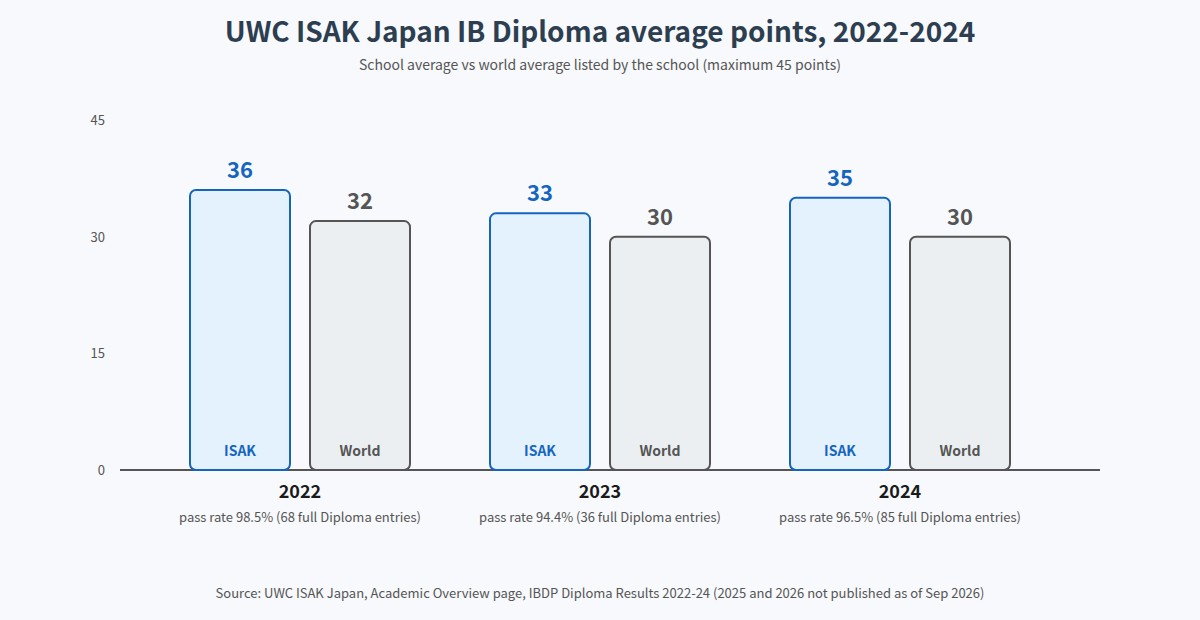
As Figure 2 shows, the school’s average stayed a few points above the world average each year, and the highest score was 43 in all three years. Cohorts are small and vary in size (only 39 in 2023), so one year can move the averages. The 2025-26 Annual Report adds that 80 students graduated in the Class of 2026, the tenth graduating class.
On universities, the University Advising page says graduates have gone to universities in sixteen countries, and some take a gap year first. The Annual Report lists alumni destinations such as Yale, Princeton, Oxford, the National University of Singapore, the University of Tokyo, Waseda, Keio and ICU, without student numbers per university.
Tuition and fees for 2026-2027
Let’s be honest: the headline fee is high, because it covers boarding and meals as well as tuition. Please read the financial assistance section before you rule the school out.
| Fee | 2026-27 (JPY) | 2025-26 (JPY) |
|---|---|---|
| Tuition Fee (annual) | ¥4,900,000 | ¥4,500,000 |
| Boarding Fee (annual) | ¥1,825,000 | ¥1,770,000 |
| Facilities Fee (annual) | ¥500,000 | ¥420,000 |
| Annual total | ¥7,225,000 | ¥6,690,000 |
| Application Fee (one-time) | ¥20,000 (2027 entry) | ¥20,000 |
| Enrollment Fee (one-time, on acceptance) | Not stated | ¥300,000 |
| IB Years Fee (Grades 11 and 12, annual) | Not stated | ¥230,000 |
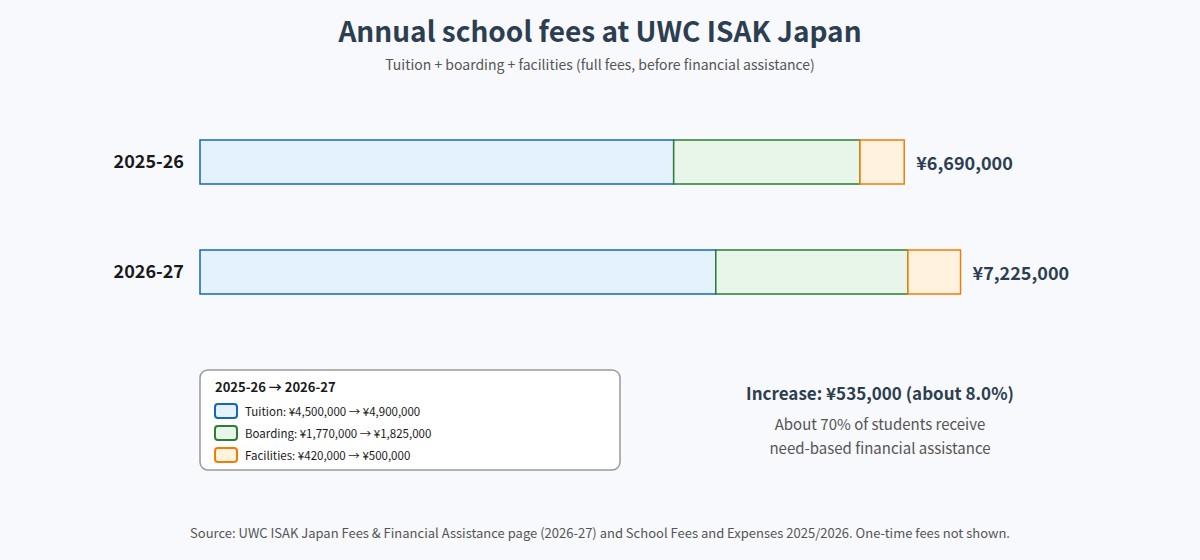
As Figure 3 shows, the annual total rose by ¥535,000 (about 8.0%). The 2026-27 fees page lists only the three annual fees: the ¥20,000 application fee comes from the 2027-entry How to Apply page, and the Enrollment Fee and IB Years Fee are 2025-26 amounts, so please ask admissions for current figures. As a rough illustration, if those still applied, a full-fee Grade 10 student’s first year would be about ¥7,545,000 (¥20,000 + ¥300,000 + ¥7,225,000). The 2025-26 schedule also says fees include tax and cover dormitory housing, daily meals, textbooks, insurance, Project Weeks and most trips; can be paid in July or in two instalments (July and December); and exclude a laptop, flights home and pocket money (about ¥5,000 a month), plus a refundable ¥40,000 security deposit.
Financial assistance: how the need-based aid works
This is the part that surprises many parents. The fees page says the school gives about ¥600 million in financial assistance a year and that 70% of students receive some support, including full scholarships; the 2025-26 Annual Report gives 76.4% for that year. For Grade 10 applicants:
- Need-based only: no academic or merit scholarships. Awards range from partial to full and are never repaid, but usually do not cover flights or pocket money.
- Apply with the application: the aid form (with a tax return or income statement) has the same deadline, and the award comes with the offer. Aid cannot be requested for the first time in Grade 11 or 12 unless circumstances change drastically. The 2025-26 fee schedule adds that the IB Years Fee is reduced in proportion to the aid award.
- What counts: income, assets, expenses, debt, number of children and their education costs. Admissions are “need-aware”, and families resubmit their finances each year.
Japanese families are eligible too: the page notes that in the 2022 school year nearly half of Japanese students received some aid. It also shows what families of enrolled Grade 10 entrants actually paid on average in 2025 (averages, not a guarantee, excluding the enrollment fee):
| Household income | 2025 average fees paid | Families |
|---|---|---|
| Under ¥5 million | ¥607,500 | 20 |
| ¥5 to 10 million | ¥1,750,000 | 13 |
| ¥10 to 15 million | ¥2,318,182 | 18 |
| ¥15 to 20 million | ¥3,388,889 | 7 |
| ¥20 to 30 million | ¥4,500,000 | 5 |
Grade 11 students selected by a UWC national committee should ask that committee about scholarships; students selected through UWC’s Global Selection Programme (GSP) are not eligible for scholarships.
Admissions: three routes into the school
Route 1: direct application for Grade 10
The school admits about 40 students a year directly into Grade 10, and roughly 30% of Grade 10 students are Japanese citizens or residents of Japan (admissions FAQ). For 2027-28 entry, your child must be in the equivalent of US Grade 9, UK Year 10 or the third year of Japanese junior high school, finishing it by August 2027, and must have been born between 1 January 2011 and 31 December 2012.
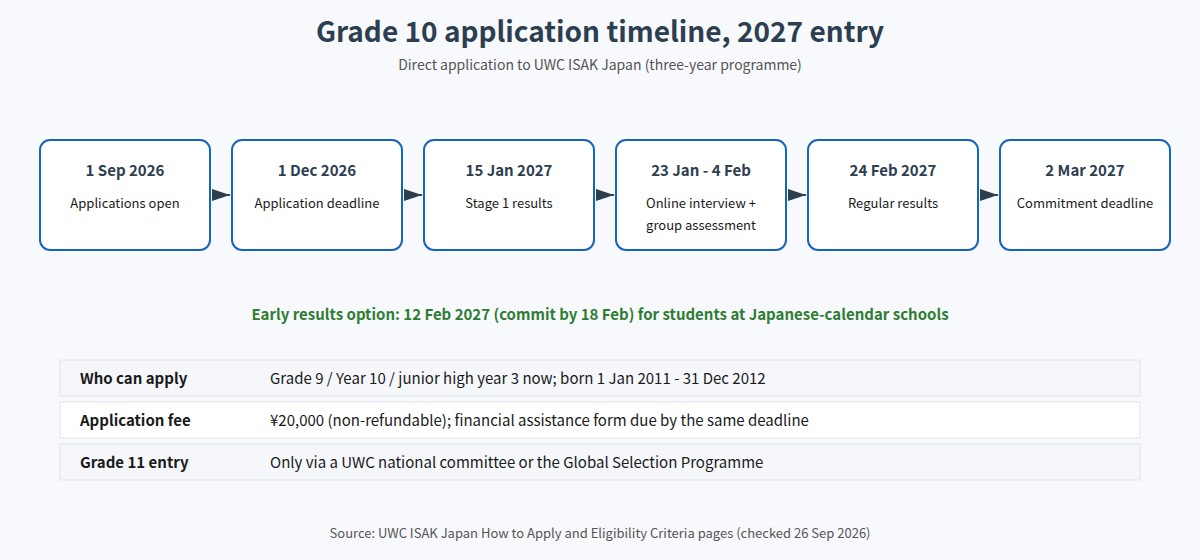
Applications opened on 1 September 2026 and close on 1 December 2026. As Figure 4 shows, Stage 1 results come on 15 January 2027, online interviews and group assessments run from 23 January to 4 February, and regular results are released on 24 February (commitment by 2 March). Students at Japanese-calendar schools can opt in to early results on 12 February, which the school says does not change their chances. The application includes short answers (up to 250 words), one longer response (up to 500 words), two videos of up to two minutes, one academic and one non-academic reference (in English or Japanese), transcripts for three years and a ¥20,000 fee. A late window from April to June is possible but not guaranteed, and it is for full-fee families only.
Route 2: a UWC national committee for Grade 11
The school does not take direct Grade 11 applications. About 40 students a year join in Grade 11 through the UWC national committee of their country of residence or citizenship, which is also the route for aid on a two-year place. In Japan, UWC Japan (the national committee, 公益社団法人UWC日本協会) says its 2027 guidelines will appear around late October, with first-round selection scheduled for 29 November 2026 and the second round on 25 January 2027. Its eligibility sheet asks for Japanese nationality or permanent residency, being, as of September 2026, in the first year of high school (April-start schools) or in the year before the IB Diploma starts, such as US Grade 10 (August or September-start schools), and still in that year at the first-round selection, being in principle 16 or older on 1 August 2027, and an English certificate (for example IELTS 4.0 or TOEFL iBT 42 or above). Ask the committee how school placements are decided.
Route 3: UWC’s Global Selection Programme
Full-fee families can apply for Grade 11 through the GSP. UWC’s page places UWC ISAK Japan in the band of 91,000 to 110,000 US dollars for two years, and the current window for 2027 entry closes on 30 September 2026. Only one UWC route can be used per year.
English requirements
Classes are in English except Japanese and foreign languages. For direct Grade 10 applications, the admissions FAQ asks for at least three years of English study and an intermediate level. No test score is required for this route (unlike the UWC Japan committee route above), but the school recommends EIKEN Grade 2, TOEFL 65, TOEIC 600 or IELTS 6 or higher. The application and interview are in English, though Japanese parents can complete their section in Japanese.
Boarding life and student support
Students share two-person or four-person bedrooms in houses of 12 to 18, each with a lounge, kitchenette and free laundry, usually with roommates from other countries. A faculty House Mentor and student Residential Advisors look after each house. Nurses, counselors and peer supporters work on campus, and each student belongs to a weekly Advisory group. Outdoor education, including winter snow sports, and Project Weeks are core parts of the programme.
Getting to Karuizawa
The Hokuriku Shinkansen from Tokyo to Karuizawa takes about 65 to 75 minutes, and the campus is about 13 km from the station, or 25 to 30 minutes by taxi. Campus visits are by reservation only.
Questions parents often ask
Can my child attend as a day student?
No. Residential life is a core part of the programme, so all students live in the on-campus residences.
My child goes to a Japanese junior high school. Is that a problem?
Not at all. Third-year junior high students are exactly who the Grade 10 route is for, there is an early results option for the Japanese calendar, and Grade 10 is designed as a foundation year for building English. Graduates also receive a Japanese high school diploma.
Is the Summer School part of admissions?
No. The Summer School page (ages 13 to 14) says attending is not a prerequisite for applying to Grade 10, although many students find it a good way to experience the school.
Summary
- A UWC boarding school in Japan: opened in 2014, joined UWC in 2017, an Article 1 school authorised for the IB Diploma.
- Three-year programme: Pre-IB Grade 10, then the Diploma, with a Japanese high school diploma as well.
- Results: average points of 36, 33 and 35 in 2022 to 2024, above the world averages listed by the school.
- 2026-27 fees: ¥7,225,000 a year including boarding, with 70% of students receiving need-based aid.
- 2027 entry: Grade 10 applications close on 1 December 2026; Grade 11 entry is only via a national committee or the GSP.
If this sounds like a good fit, join an information session or book a campus visit, and check the eligibility page together with your child. The essays and videos ask children to think about what they care about, which many families find valuable whatever the outcome.
Sources and references
- UWC ISAK Japan: Our History (checked 26 September 2026)
- UWC ISAK Japan: Academics (Japanese)
- UWC ISAK Japan: Academic Overview and IB results
- UWC ISAK Japan: Admissions FAQs
- UWC ISAK Japan: Eligibility Criteria
- UWC ISAK Japan: How to Apply
- UWC ISAK Japan: Fees and Financial Assistance
- UWC ISAK Japan: School Fees and Expenses 2025/2026 (PDF)
- UWC ISAK Japan: Annual Report 2025-26
- UWC ISAK Japan: Boarding School Life
- UWC ISAK Japan: University Advising
- UWC ISAK Japan: Get Directions
- UWC: Global Selection Programme, Entry 2027
- UWC Japan: 2027 selection notice (Japanese)
- IB: UWC ISAK Japan school page
- UWC: About (mission)
- MEXT IB consortium: IB schools in Japan (as of 30 June 2026)
コメント