Fukuoka International School (FIS) has served international families in Kyushu since 1972 and teaches children from Early Years (age 3) to Grade 12 on a riverside campus in Momochi, western Fukuoka City. If your family is moving to Fukuoka for work, or you are comparing IB schools outside Tokyo and Osaka, FIS is probably on your list. This guide brings together what the school publishes about its IB programmes, 2026-27 fees, admissions and recent IB Diploma results.
Everything below comes from the school’s website, its Tuition and Fees 2026-2027 document, its Academic Profile 2025-2026 and the Japanese Ministry of Education (MEXT) IB consortium list, all checked on 26 September 2026. Fees and availability change every year, so please confirm the details with the FIS admissions team before you apply.
- FIS at a glance
- IB programmes at FIS: from Early Years to Grade 12
- High school: the FIS Diploma and the IB Diploma
- IB Diploma results for the classes of 2022 to 2025
- Tuition and fees for 2026-2027
- Admissions: who can apply and how it works
- Learning support and student life
- Getting to FIS
- Questions parents often ask
- Summary
- Sources and references
FIS at a glance
FIS describes itself as an independent, non-profit, co-educational school. It is small and close-knit: the Academic Profile 2025-2026 counts 414 students from 40 nationalities and 62 educators from 17 countries.
| Item | Details |
|---|---|
| School name | Fukuoka International School (FIS) |
| Founded | 1972 (opened in August 1972, after the closure of the U.S. Air Force Base School in Itazuke) |
| Campus | 3-18-50 Momochi, Sawara-ku, Fukuoka (main campus on the Muromi River, plus “The Annex” about a 4-minute walk away) |
| Grades | Early Years (ages 3 and 4) to Grade 12 |
| Students (2025-26) | 414 students, of whom 133 are in high school; 40 nationalities; student to faculty ratio 7:1 |
| IB programmes | PYP, MYP and DP (no Career-related Programme), per the MEXT list as of 30 June 2026 |
| Accreditation | Western Association of Schools and Colleges (WASC), received in 2007 according to the school’s history page |
| Status in Japan | Run by a school corporation (gakko hojin); not an “Article 1” school under Japan’s School Education Act (listed among non-Article-1 schools by MEXT) |
| Head of School | Brian Freeman |
A little history helps explain the school’s character. FIS opened in 1972 to serve foreign residents and dual nationals, moved to its current Momochi site in 1990 with support from the local community, and added The Annex (originally a Fine Arts and Music Center) in 2003. The student body is genuinely mixed: the 2025-26 profile shows 23.5% of students with Japanese passports, 18.1% South Korean and 14.4% Chinese, and 27% holding dual nationality.
IB programmes at FIS: from Early Years to Grade 12
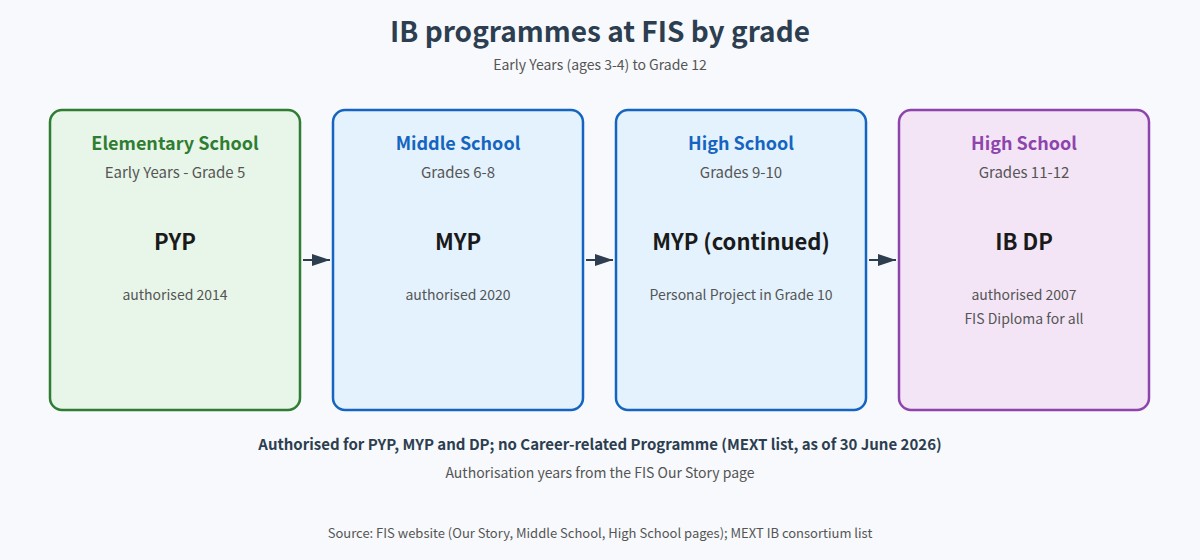
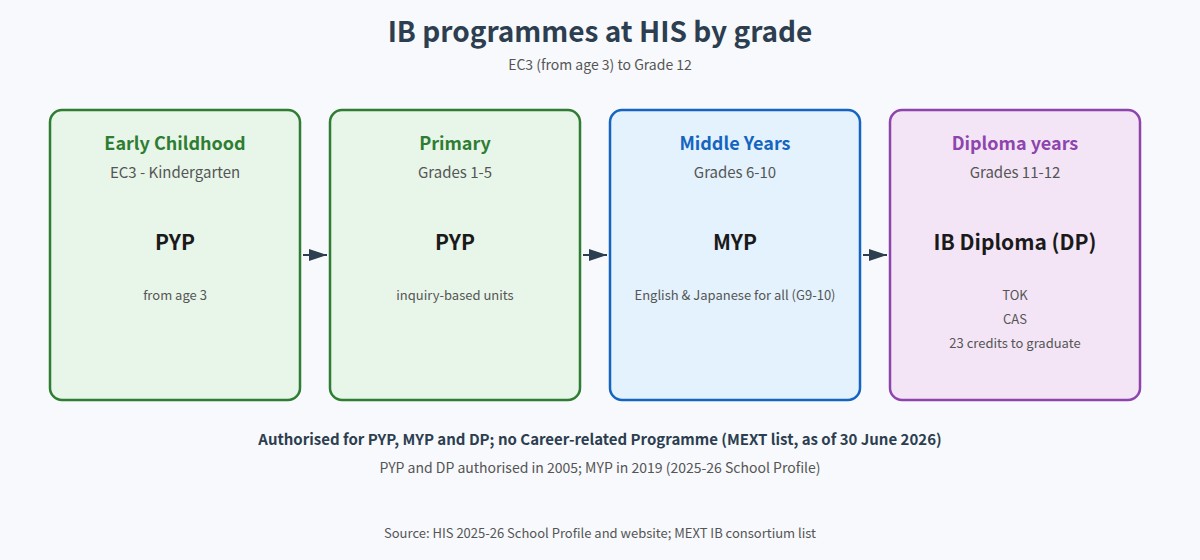
FIS is a full “IB continuum” school, which means your child can follow IB frameworks from preschool to graduation. The MEXT IB consortium list (as of 30 June 2026) shows FIS as authorised for the Primary Years Programme (PYP), the Middle Years Programme (MYP) and the Diploma Programme (DP), but not the Career-related Programme (CP). According to the school’s history page, the DP came in 2007, the PYP in 2014 and the MYP in 2020, and the school describes itself as “the first school in Kyushu to offer three IB programs”.
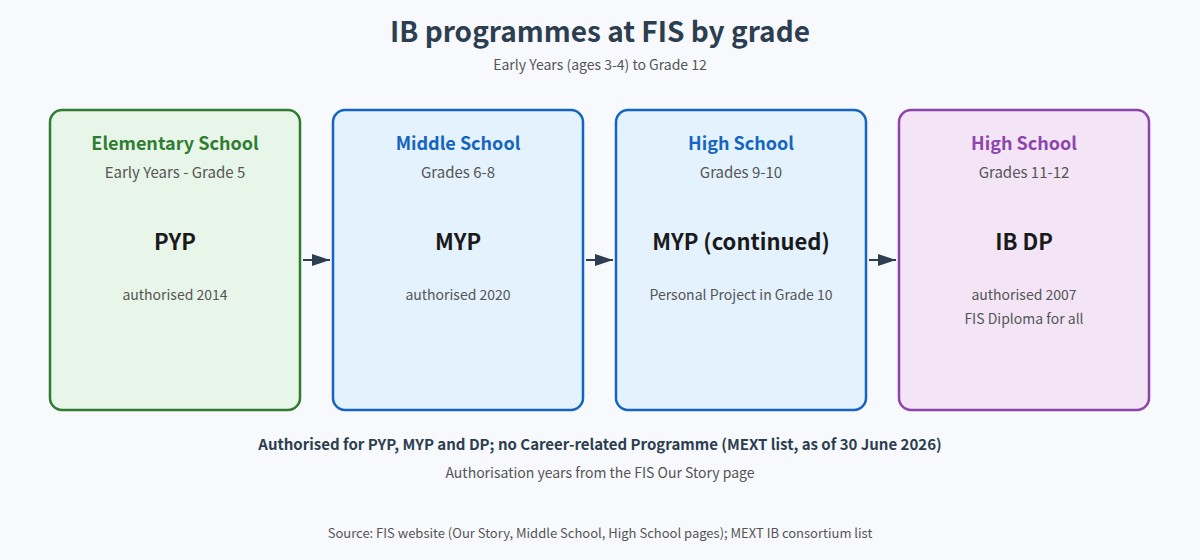
As Figure 1 shows, the programmes line up with the grades like this:
- Early Years to Grade 5: the PYP, where children learn through inquiry rather than only through separate subjects.
- Grades 6 to 10: the MYP, covering all eight MYP subject groups, with a Personal Project in Grade 10.
- Grades 11 and 12: the IB Diploma Programme.
Languages matter a lot to families in Japan. In the MYP, FIS teaches Language and Literature in English and Japanese, and Language Acquisition in Japanese, English and Spanish, with Japanese classes adjusted to each student’s prior experience. In the Diploma, the 2025-26 profile lists English and Japanese at Language A and B level and Spanish ab initio.
High school: the FIS Diploma and the IB Diploma
According to the Academic Profile 2025-2026, all students earn a WASC-accredited FIS Diploma, and the majority also aim for the IB Diploma. Graduation requires at least 24 credits, 85% attendance and completion of the IB’s Creativity, Activity, Service (CAS) programme. Because FIS Diploma courses follow IB Standard Level content, a student who is not ready for the full IB Diploma still has a recognised route to graduation, with or without IB Course Certificates.
IB Diploma results for the classes of 2022 to 2025
These figures are copied from the Academic Profile 2025-2026. The profile does not publish a pass rate, so the last column is our own calculation. Figure 2 shows the average scores.
| Class of | Graduates | IB Diploma candidates | Diplomas awarded | Average score | Highest score | Bilingual Diplomas | Awarded / candidates (our calculation) |
|---|---|---|---|---|---|---|---|
| 2025 | 30 | 26 | 23 | 33 | 44 | 11 | 88.5% |
| 2024 | 18 | 17 | 16 | 33 | 38 | 10 | 94.1% |
| 2023 | 31 | 28 | 24 | 34 | 41 | 19 | 85.7% |
| 2022 | 22 | 19 | 19 | 39 | 45 | 14 | 100% |
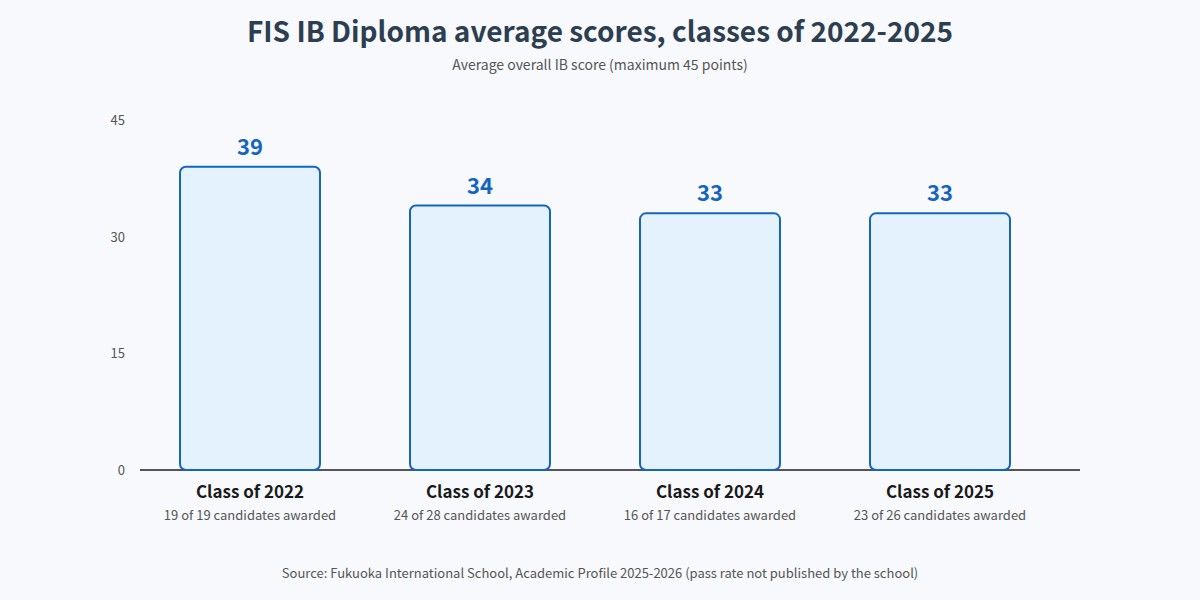
Many graduates also earn the Bilingual Diploma (19 of the 24 diplomas in 2023, for example). The Class of 2026 had 30 Diploma candidates, but their results were not yet in the profile when we checked. With 17 to 28 candidates a year between 2022 and 2025, a few students can move the average by several points, so look at the trend rather than any single year.
Where do graduates go?
The profile states that 87% of the Class of 2025 went to university and 13% took a gap year, with destinations in Japan (24%), the United States (19%), the United Kingdom (19%), Canada (15%), Australia (15%), Malaysia (4%) and Korea (4%). Universities marked as Class of 2025 enrolments include Keio, International Christian University, Kyushu University, the University of Toronto, King’s College London, the University of Sydney and Boston College.
Tuition and fees for 2026-2027
Let’s be honest: fees are a big commitment, so it helps to see the full picture early. These are the figures on the FIS Tuition and Fees page and its 2026-2027 fee document (stated as accurate as of 1 December 2025).
| Fee (2026-2027) | Amount (JPY) |
|---|---|
| Application Fee (one-time, non-refundable, includes a 4% card handling fee) | ¥52,000 |
| Acceptance Fee (one-time, non-refundable) | ¥350,000 |
| Development Fee (one-time for new students, non-refundable) | ¥500,000 |
| Early Years, ages 3 and 4 (annual tuition) | ¥1,855,000 |
| Kindergarten to Grade 5 (annual tuition) | ¥1,891,000 |
| Grades 6 to 8 (annual tuition) | ¥2,044,000 |
| Grades 9 and 10 (annual tuition) | ¥2,195,000 |
| Grades 11 and 12 (annual tuition) | ¥2,286,000 |
| Facility Fee (every year) | ¥200,000 |
| Accident Insurance, Library and Yearbook Fees (every year) | ¥4,800 + ¥5,000 + ¥6,000 |
| Extension Learning Fee (every year) | ¥10,000 (Early Years to Grade 5) / ¥5,000 (Grades 6 to 12) |
| Graduation Fee (Grade 12 only) | ¥10,000 |
| Week Without Walls trip (Grades 6 to 12, invoiced separately) | About ¥50,000 to ¥120,000 (estimated) |
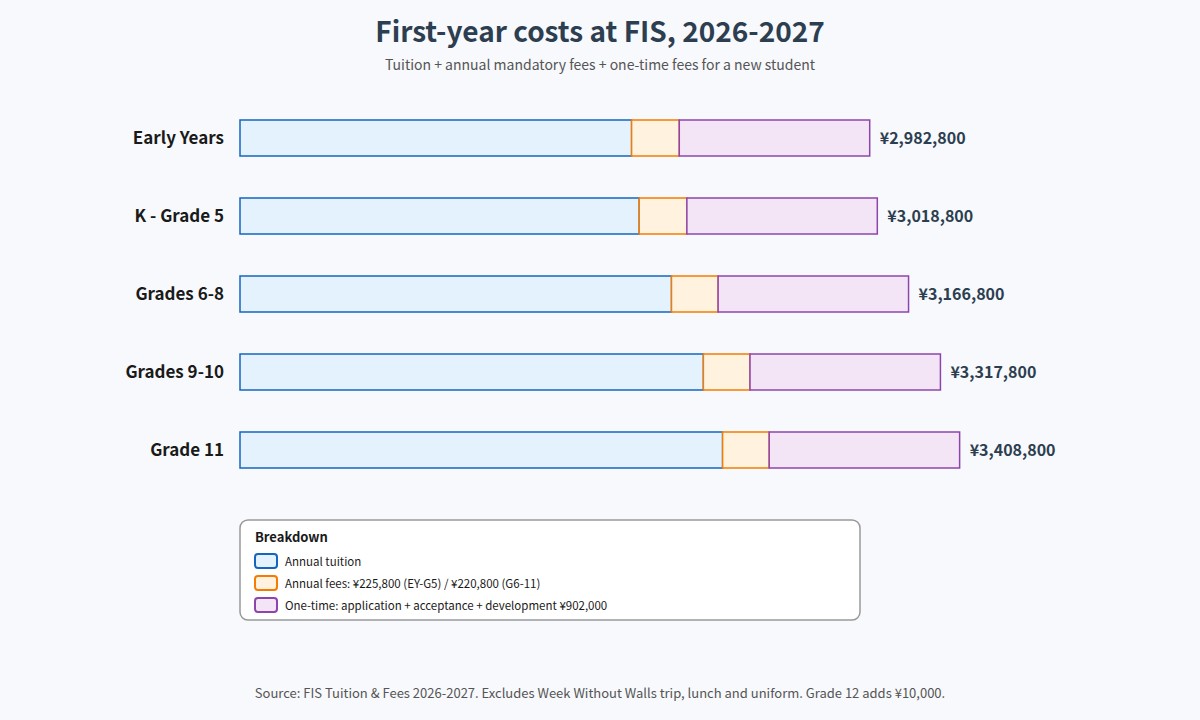
Putting it together: a new student pays ¥902,000 in one-time fees (¥52,000 + ¥350,000 + ¥500,000), and the annual mandatory fees come to ¥225,800 for Early Years to Grade 5 and ¥220,800 for Grades 6 to 11 (¥230,800 in Grade 12). So a new Grade 6 to 8 student’s first year in 2026-27 adds up to ¥3,166,800 (¥2,044,000 tuition + ¥220,800 + ¥902,000), before trips, lunch and uniform, and ¥2,264,800 a year after that at 2026-27 rates. Figure 3 shows every grade band, from ¥2,982,800 (Early Years) to ¥3,408,800 (Grade 11); Grade 12 adds the ¥10,000 graduation fee.
- Payment: one payment (25 August), two instalments (25 August and 25 December) or nine monthly instalments. The fee document says instalments require automatic bank withdrawal, but the Tuition and Fees web page says automatic bank account deductions are not available, so please confirm with the office.
- Late joiners: tuition is prorated by days, but all other fees are charged in full.
- Not listed: lunch prices (the service is optional), sibling discounts and consumption tax treatment. If your employer pays, check whether the one-time fees are covered. The Yearbook Fee and the Week Without Walls trip are not charged to students who join after publication or after the trip.
- Scholarship: the International Mindedness Scholarship offers significant tuition support for students in Grades 9 to 12. Applications are due by 15 January, parents must provide proof of financial need, and families whose fees are supported by a company, embassy or government are not eligible.
Admissions: who can apply and how it works
Priority system and eligibility
FIS welcomes all nationalities but says its primary mission is to serve the international community living in Japan for work, so admissions and waiting lists follow this priority order:
- Group 1: foreign students (neither parent nor student has a Japanese passport);
- Group 2: dual national students (one parent has a Japanese passport);
- Group 3: Japanese students returning from overseas or from another international school within Japan;
- Group 4: Japanese students.
Company transfers have higher priority, and siblings get priority within their group. Expatriate students need an official dependent visa (visitor visas are not accepted), FIS asks for a minimum one-year commitment, and students should live with a parent or legal guardian. For Japanese nationals in Grades 1 to 9, the FAQ notes that exceptions to the Compulsory Education Law require special procedures.
Age cut-off and English
Children aged 3 to 6 are placed by their age on 1 September (ages 3 and 4 in Early Years, 5 in Kindergarten, 6 in Grade 1), and Early Years children must be toilet trained. English is not required for Early Years, but “a certain level of English proficiency is necessary for both Elementary and Secondary students”. Children may take the WIDA assessment and can receive English Language Learner (ELL) support after enrolment, but if English would significantly affect a student’s studies, the school “may or may not be able to offer admissions”. At least one parent should have some English.
Steps and availability
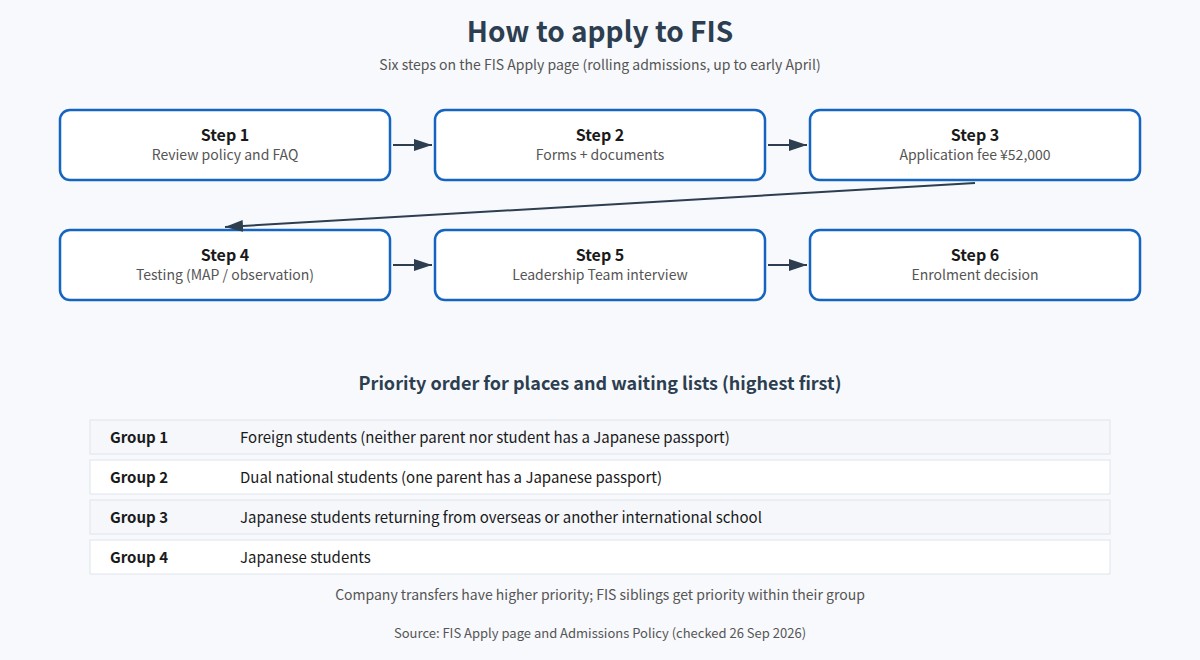
Admissions are rolling: applications are accepted at any time during the school year up until early April, rather than by a single fixed deadline. The Apply page lists six steps (Figure 4): review the policy and FAQ, submit forms and documents, pay the ¥52,000 fee by credit card, complete testing, interview with the Leadership Team, and receive the decision. There is no pass/fail exam: Grade 3 and above take MAP tests in mathematics and reading, and younger children have an observation. Documents include school reports from the past two years (translated into English if needed), passports, visa details and a writing sample for Grades 2 to 12.
Places are the real issue. Some grades are full, and qualified applicants may go into a Wait Pool, where offers are made on best fit, not first come, first served. The 2026-27 placement chart (as of 1 June 2026) showed Grades 5, 6 and 7 as “Wait Pool” for all priority groups and asked families to consult the office before applying for Grades 11 and 12, so check the latest chart first.
Learning support and student life
FIS calls itself inclusive and welcomes neurodiverse applicants, but says its support services are limited, so severe needs may be difficult to support; please include any relevant medical and behavioural records with your application (the school may ask for additional assessments). English support runs from small groups in elementary to English Language Acquisition classes in Grades 6 to 12, and the FAQ gives an elementary teacher to student ratio of about 1:7. There is a full-time counsellor and a school nurse.
Outside class there are after-school activities, three sports seasons and Week Without Walls trips for Grades 6 to 12. The main campus has a gymnasium, science labs and a 12,000-volume library, The Annex houses the Art Center and Design Lab, and a new four-storey North Building was completed in 2026, according to the school. The FAQ gives school hours of 8:20 to 15:00 (elementary) and 8:00 to 15:30 (secondary), and says there is no after-school supervision or care, so working parents will need to plan pick-up.
Getting to FIS
The school says both Momochi campuses are easily reached by public transport, and the school’s Careers page names Fujisaki Station as the nearest subway station. Note that FIS does not run a school bus, and younger children must be escorted by a parent or guardian, so try the school run before you choose where to live.
Questions parents often ask
My child speaks very little English. Can they still join?
For Early Years (ages 3 and 4), yes. For older children, some English is needed; the school assesses each child and offers ELL support, but may not offer a place if English would seriously affect their studies.
We are a Japanese family. Can our child apply?
Yes, and a number of FIS students are Japanese nationals. However, Japanese families are in priority Groups 3 and 4, and Grades 1 to 9 involve special procedures, so contact the admissions office early.
Does my child have to take the full IB Diploma?
No. Every graduate earns the FIS Diploma, and students can add IB Course Certificates or the full IB Diploma.
Summary
- IB continuum in Kyushu: PYP, MYP and DP (MEXT list, June 2026), with the DP since 2007.
- Small and diverse: 414 students from 40 nationalities in 2025-26.
- Results: IB Diploma averages of 33 to 39 points for the classes of 2022 to 2025.
- 2026-27 fees: tuition from ¥1,855,000 to ¥2,286,000, plus about ¥221,000 to ¥231,000 a year in other fees and ¥902,000 one-time for new students.
- Admissions: rolling until early April, nationality-based priority, a dependent visa for expatriate students, Wait Pools in some grades.
If FIS sounds like a good fit, the school encourages families to book a tour before applying. Visiting with your child is the best way to feel whether this community suits your family.
Sources and references
- Fukuoka International School: official website (checked 26 September 2026)
- FIS: Our Story
- FIS: Governance and Contact Us
- FIS: Tuition and Fees (2026/2027)
- FIS: Tuition and Fees 2026-2027 (PDF)
- FIS: Admissions Policy, Apply and FAQ
- FIS: Placement Chart for School Year 2026-2027 (PDF, as of 1 June 2026)
- FIS: Academic Profile 2025-2026 (PDF)
- FIS: Middle School and High School
- FIS: Wellbeing and Student Services
- FIS: International Mindedness Scholarship
- FIS: Careers (location and nearest subway station)
- FIS: Make an Impact (North Building)
- MEXT IB Education Promotion Consortium: IB schools in Japan (as of 30 June 2026)
コメント