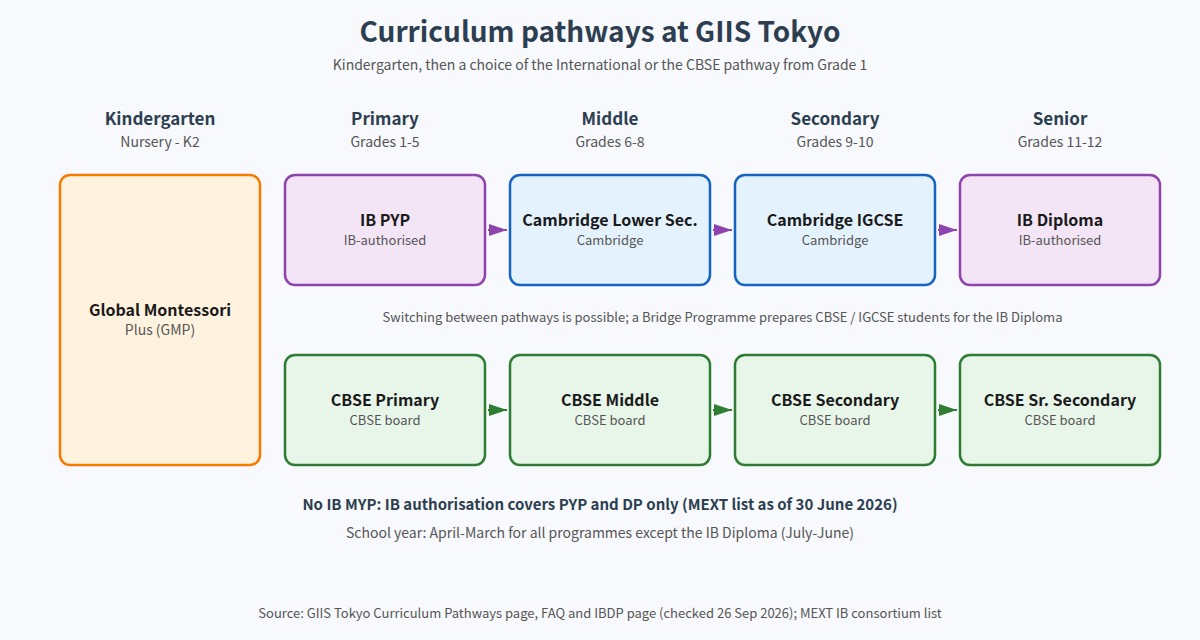
Global Indian International School (GIIS) Tokyo is an international school in Edogawa-ku, Tokyo, with four campuses around Nishi-Kasai, Higashi-Kasai, Kita-Kasai and Seishincho. What makes it unusual is choice: from Grade 1 your child can follow either an international pathway (IB Primary Years Programme, then Cambridge, then the IB Diploma) or the Indian CBSE curriculum all the way to Grade 12. If you live in eastern Tokyo, or you are an Indian family who wants to keep the CBSE option open, it is very likely on your list.
This guide covers curricula, campuses, 2026-27 fees, admissions and recent results, based on the school’s website, the IBO school directory, the MEXT IB consortium list and the 2025 Deming Prize report, all checked on 26 September 2026. Fees change every year, so please confirm details with the school before you apply.
GIIS Tokyo at a glance
| Item | Details |
|---|---|
| School name | Global Indian International School (GIIS) Tokyo; the IBO directory lists it as “Global Indian International School – Higashikasai Campus” |
| Established | 2006 (2025 Deming Prize selection report) |
| Group | Member of Global Schools Group; GIIS schools were founded by the Singapore-based Global Schools Foundation |
| Campuses | Four, all in Edogawa-ku, Tokyo: Nishi Kasai, Higashi Kasai, Kita Kasai and Seishincho |
| Grades | Nursery to Grade 12 |
| Students | 1,394 students and 150 staff, including 106 teachers, as of January 2025 (Deming Prize report); the school says students come from over 20 nationalities |
| IB programmes | Primary Years Programme (PYP) and Diploma Programme (DP); no MYP or CP (MEXT list, as of 30 June 2026) |
| Other curricula | Montessori kindergarten, Cambridge, CBSE |
| Legal status in Japan | Not an “Article 1” school (listed among non-Article-1 schools by MEXT) |
In 2025 the school also received the Deming Prize, a Japanese quality-management award run by JUSE. It recognises how the organisation is managed; it is not an academic accreditation.
Two pathways from Grade 1: International or CBSE
This is the key thing to understand. After kindergarten, families choose between two pathways (school “Curriculum Pathways” page and FAQ):
- Kindergarten (Nursery, K1, K2, ages about 2.5 to 6): Global Montessori Plus (GMP), a Montessori-based programme, at the Seishincho and Kita Kasai campuses.
- International pathway: IB PYP in Grades 1 to 5, Cambridge Lower Secondary in Grades 6 to 8, Cambridge IGCSE in Grades 9 and 10, and the IB Diploma Programme in Grades 11 and 12.
- CBSE pathway: the Indian Central Board of Secondary Education curriculum from Grade 1 to Grade 12, leading to the CBSE Grade 10 and Grade 12 board exams.
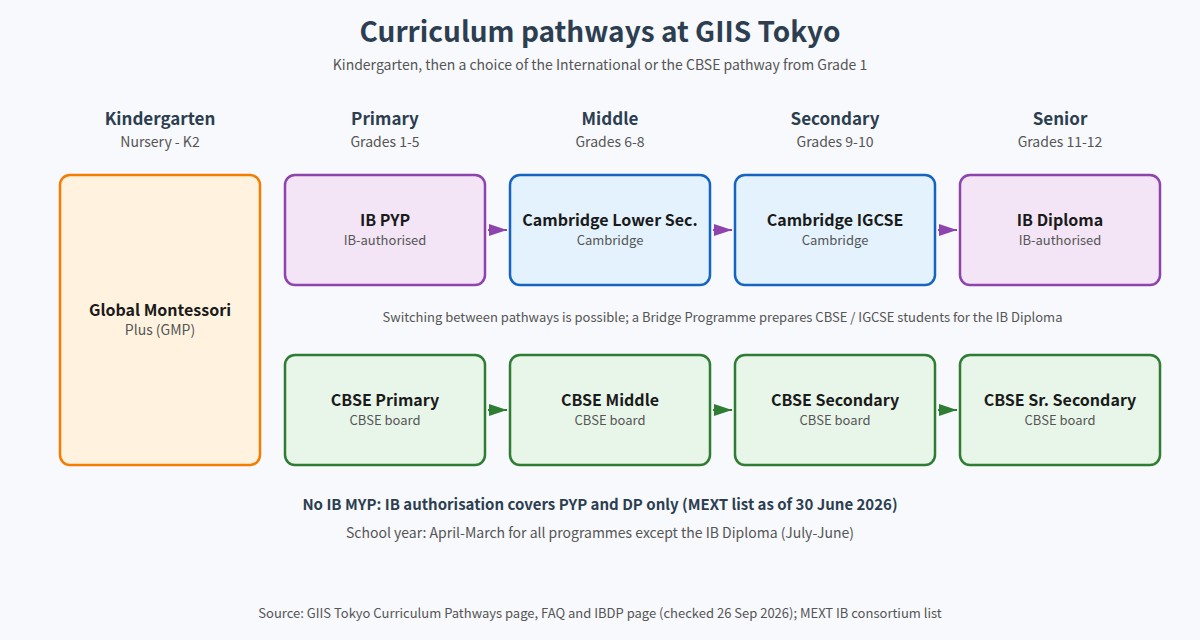
Notice what is missing: there is no IB Middle Years Programme. The IB applies at the two ends (PYP and DP), and Grades 6 to 10 use Cambridge. If your child is coming from an MYP school, expect a change of style, with IGCSE exams at the end of Grade 10.
The school says students may switch between pathways, and its IBDP page describes a Bridge Programme that prepares CBSE and IGCSE students for the IB Diploma.
The IB Diploma at GIIS Tokyo
The DP is a two-year course for students who have completed Grade 10, ‘O’ Levels or an equivalent, according to the school’s IBDP page. The IBO directory shows that GIIS has been an IB World School since 21 August 2020, and both the PYP and the DP were authorised in 2020. The IBO lists English and Japanese as languages of instruction.
Subjects registered with the IB include English A and B, Japanese A, Japanese B and Japanese ab initio, Chinese A, Economics, Business Management, Psychology, Biology, Chemistry, Physics, Computer Science and both Mathematics courses. The school adds that subjects such as Spanish, Philosophy and Film can be taken online through the Pamoja platform. The Japanese options suit bilingual children.
One practical detail: the IB Diploma runs on a July to June year, while all the other programmes (GMP, CBSE, PYP, Cambridge Lower Secondary and IGCSE) run from April to March.
Exam results 2025 and 2026
GIIS Tokyo publishes its results in school news releases. Here is what it reported for the last two years:
| Exam | Year | What the school reported |
|---|---|---|
| IB Diploma | 2026 | School average 33.5 points; top score 44; 22% of Extended Essays graded A |
| IB Diploma | 2025 | School average 35.4 points; 50% of students scored 35 or more; 69% achieved at least one 7 |
| Cambridge IGCSE | 2026 (June cohort) | School average 76% |
| CBSE Grade 10 | 2026 | 100% pass rate; school average 91.4%; highest score 98.2% |
| CBSE Grade 12 | 2026 | School topper 89.4% (science stream); average and pass rate not stated |
The school does not publish the number of IB Diploma candidates, so please keep in mind that averages from a small cohort can move a lot from year to year. Ask the school for the cohort size and Diploma pass rate when you visit.
The school runs a Career Counselling and University Guidance programme from Grade 8 to Grade 12, and its IBDP page says more than 100 universities visit its annual University Fair. Its placements page does not show years or numbers, so ask for a year-by-year destination list if this matters to you.
Tuition and fees for 2026-27
Let’s look at costs honestly. Fees are billed per term, and each term covers four months. The school’s fee page for the 2026-27 academic year gives the following amounts, which include 10% consumption tax:
| Programme (2026-27) | Tuition per term | Building fee per term | Term total | Registration (one-time) |
|---|---|---|---|---|
| GMP Nursery | ¥312,189 | ¥38,081 | ¥350,270 | ¥40,000 |
| GMP K1 and K2 | ¥345,402 | ¥38,081 | ¥383,483 | ¥40,000 |
| IB PYP (Grades 1-5) | ¥506,358 | ¥38,830 | ¥545,188 | ¥50,000 |
| Cambridge Lower Secondary (Grades 6-8) | ¥514,538 | ¥38,830 | ¥553,368 | ¥50,000 |
| Cambridge IGCSE (Grades 9-10) | ¥620,890 | ¥38,830 | ¥659,720 | ¥50,000 |
| IB Diploma (Grades 11-12) | ¥737,751 | ¥38,830 | ¥776,581 | ¥50,000 |
| CBSE Grades 1-5 | ¥378,616 | ¥38,081 | ¥416,697 | ¥40,000 |
| CBSE Grades 6-8 | ¥411,821 | ¥38,081 | ¥449,902 | ¥40,000 |
| CBSE Grades 9-10 | ¥458,317 | ¥38,081 | ¥496,398 | ¥40,000 |
| CBSE Grades 11-12 | ¥527,064 | ¥38,081 | ¥565,145 | ¥40,000 |
What does a full year cost?
The school’s 2026-27 fee summary says the year has three terms of four months each, so we have multiplied the term totals by three. One caution: the terms and conditions text on the same fee page still says “Each Academic year consists of four (4) terms”, so please ask the school to confirm the number of billed terms, especially for the IB Diploma, which runs July to June.
- International pathway (per year, 3 terms): IB PYP ¥1,635,564, Cambridge Lower Secondary ¥1,660,104, IGCSE ¥1,979,160, IB Diploma ¥2,329,743.
- CBSE pathway (per year, 3 terms): Grades 1-5 ¥1,250,091, Grades 6-8 ¥1,349,706, Grades 9-10 ¥1,489,194, Grades 11-12 ¥1,695,435.
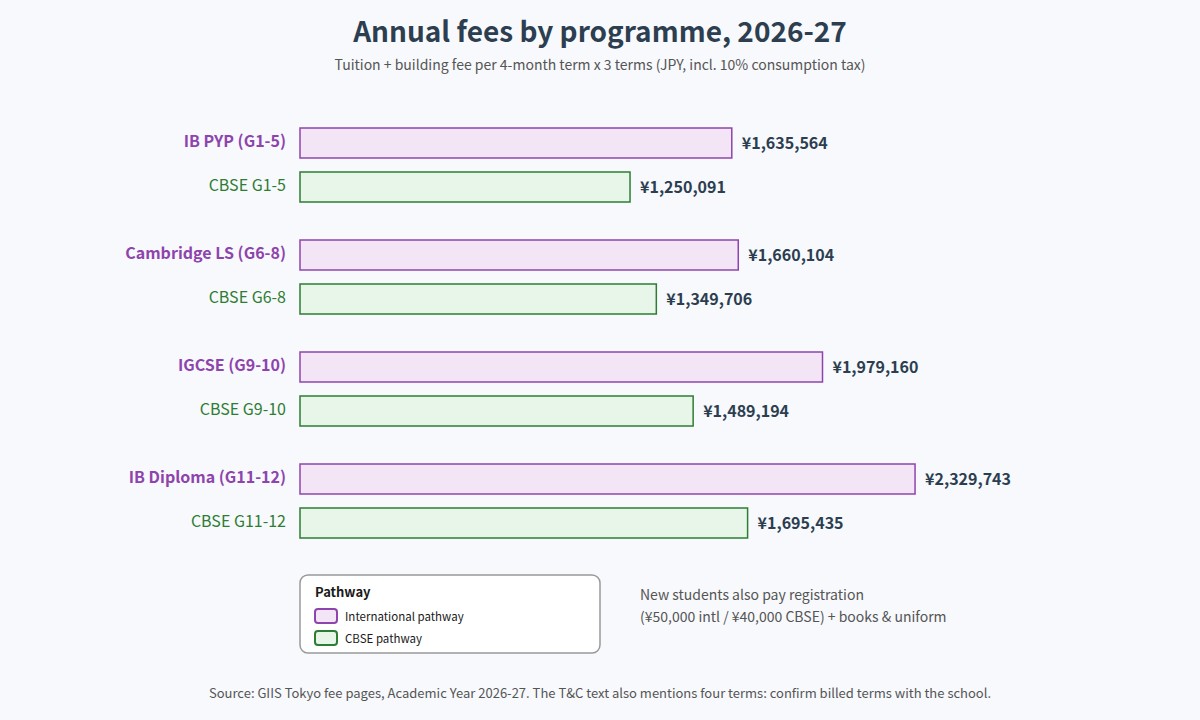
For a new student, add the one-time registration fee and books and uniform. The school gives an approximate value of ¥150,000 for books and uniform for new students in Grades 1 to 10 (¥90,000 for GMP). So the first year for a new Grade 1 PYP student comes to about ¥1,835,564 (¥1,635,564 + ¥50,000 + ¥150,000), and for a new CBSE Grade 1 student about ¥1,440,091 (¥1,250,091 + ¥40,000 + ¥150,000). For a new IB Diploma student it is ¥2,379,743 before books and uniform, which the page does not list for Grades 11 and 12. For IGCSE and IB Diploma, the page also notes that exam fees are “as per board”, so budget separately for those.
Other points from the 2026-27 fee pages:
- Sibling discount: 25% off tuition for the second and later children (not on bus or shuttle fees).
- School bus: a one-time registration of ¥25,000 and ¥50,820 to ¥177,694 per term depending on the route; shuttle registration is ¥10,000.
- After-school programme (GMP only): from ¥88,800 per term.
- Payment: the first term by credit card; later terms by auto-debit from a Japanese bank account. Late payment costs ¥100 per day.
- Withdrawal: one month’s notice is required.
The school also lists scholarships, including the Sadako Ogata Merit-Cum-Means Scholarship for Japan-resident families and merit, technology and sports scholarships for Grades 6 to 12. Amounts are not published, so ask what is open in your year.
Admissions: rolling entry, age and documents
When can you apply?
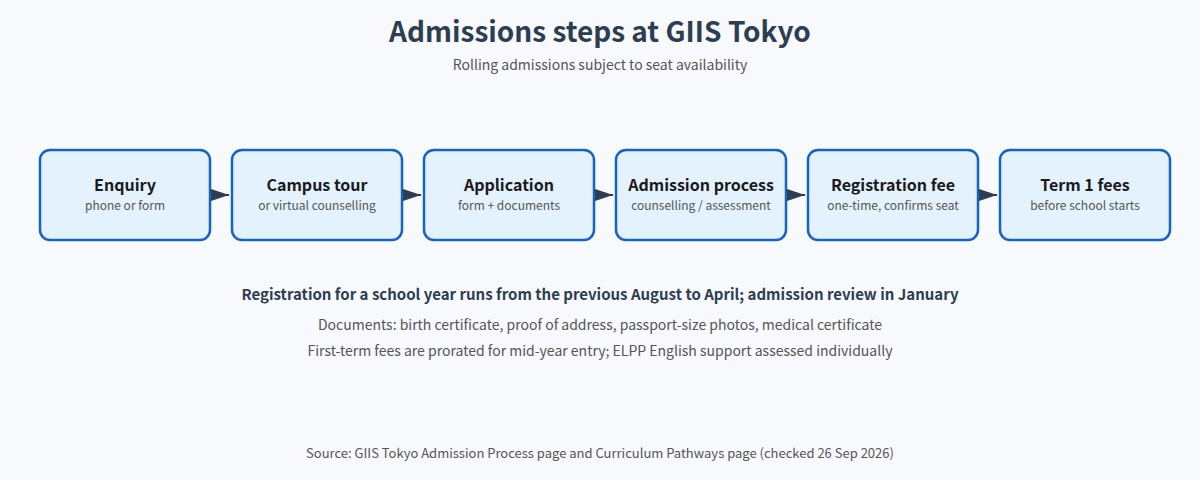
GIIS Tokyo accepts rolling admissions, subject to seat availability. Its admissions FAQ says registration for a school year runs from the previous August until April, and the admission review is held in January each year, but families moving to Tokyo during the year can also apply. The fee page notes that the school is for Japan-resident families only, with no visa or boarding support.
Steps
- Contact the admissions team (the school lists +81 3 6631 0442 for admissions enquiries).
- Visit the campus or join a virtual counselling session.
- Submit the application form and required documents.
- Complete the admission procedures (the school mentions counselling and assessment, and an individual English assessment for its English support programme).
- Pay the one-time, non-refundable registration fee, which confirms the seat.
- Pay the first-term fees before school starts; for mid-year entry these are prorated.
Entry ages
According to the school’s FAQ, children should be the following ages at the start of the academic year: Nursery 2.5 years, K1 3.5 years, K2 4.5 years and Grade 1 5.5 years (6 years for CBSE Grade 1). The exact birthday cut-off date is not published, and remember that the IB Diploma year starts in July while the others start in April, so check the placement for your child’s birth date with the school.
Documents
The admissions page lists a birth certificate, proof of residential address for parent and student, recent passport-size photographs, and a medical certificate from a certified medical practitioner. Ask for the full list for your child’s grade, as previous school records are also likely to be useful.
English requirements and support
The school does not publish a minimum English score. Instead it offers the English Language Proficiency Programme (ELPP), which the curriculum page describes as additional support “available alongside the regular curriculum — not instead of it”, assessed individually during admissions. The ELPP page says the programme is currently offered to students on the international curriculum (IB PYP, Cambridge Lower Secondary and IGCSE), while the Nishi Kasai campus page describes free English support for CBSE students too. If your child is still learning English, ask which support applies to your chosen pathway and grade, and whether there is any cost.
Campuses, school day and student life
The four campuses are all in Edogawa-ku; the school’s 2025 Deming Prize winners report describes them as situated within a span of 3 kilometres. Which campus your child attends depends on the pathway and grade (school website, 2026):
- Nishi Kasai (8-3-13 Nishikasai): the CBSE hub and administration office, near Nishi-Kasai Station on the Tokyo Metro Tozai Line.
- Higashi Kasai (9-3-6 Higashikasai): the international curriculum hub from Grade 3 (PYP Grades 3-5, Cambridge and IB Diploma); the campus page gives Kasai Station as the nearest metro station.
- Kita Kasai (2-10-20 Kitakasai): GMP kindergarten and Grades 1 and 2 of both PYP and CBSE.
- Seishincho (2-10-1 Seishincho): a GMP kindergarten campus.
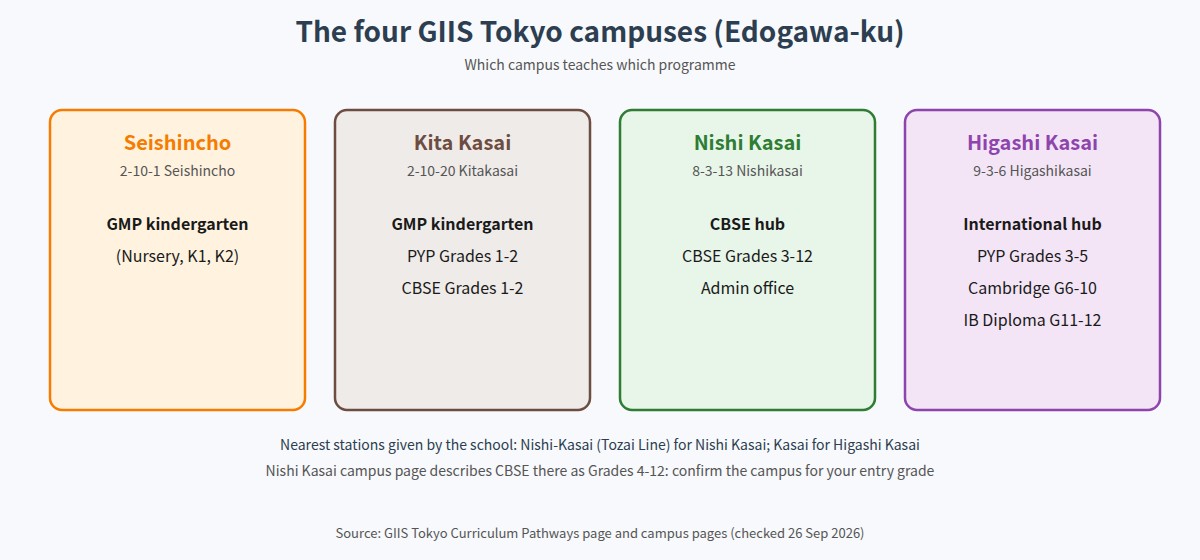
A small note: the Nishi Kasai campus page describes CBSE there as Grades 4 to 12, while the pathways page places CBSE Grade 3 there too, so check which campus your child would attend. The school bus covers Edogawa, Koto, Chuo, Chiyoda, Minato, Meguro and Urayasu, with shuttles to Kita Kasai and Seishincho.
School day. Kindergarten runs 9:00 am to 1:00 pm, Grades 1 to 10 until 3:20 pm and Grades 11 and 12 until 4:30 pm. The school’s FAQ gives a student-teacher ratio of “approximately 1:14”, meaning about 14 students per teacher.
Activities. The school’s “9GEMS” framework covers sport, arts and service alongside academics. The campus pages mention soccer, tennis, basketball, karate, robotics, coding, debate and a cricket club at Nishi Kasai.
Questions parents often ask
Is GIIS Tokyo only for Indian families?
No. The school says it welcomes students of all nationalities and that its community comes from over 20 nationalities, including Japanese, Indian, Chinese, Korean, Russian, Filipino and Nepali families. The 2025 Deming Prize report describes the student body as roughly half Japanese.
Does GIIS Tokyo offer the IB MYP?
No. Only the PYP and the Diploma Programme are IB-authorised. Grades 6 to 10 on the international pathway follow Cambridge Lower Secondary and IGCSE.
Can my child move from CBSE to the IB Diploma?
The school says students can switch between pathways, and it runs a Bridge Programme to help CBSE and IGCSE students prepare for the IB Diploma. Timing matters, because the CBSE year starts in April and the Diploma in July.
We are a Japanese family. Can our child attend?
Japanese children do attend, but GIIS Tokyo is not an Article 1 school. MEXT notes that Japanese parents must send children of compulsory school age to Article 1 schools, so consider the legal implications for Grades 1 to 9 first.
Summary
- Four campuses in Edogawa-ku, established 2006: 1,394 students as of January 2025 and a community of over 20 nationalities.
- Two pathways: IB PYP, Cambridge and the IB Diploma on the international pathway, or CBSE from Grade 1 to Grade 12; no IB MYP.
- Results: IB Diploma school average of 33.5 points in 2026 and 35.4 in 2025; CBSE Grade 10 average of 91.4% in 2026.
- 2026-27 fees: per four-month term, Grades 1-12 range from ¥416,697 (CBSE Grades 1-5) to ¥776,581 (IB Diploma), plus a one-time registration fee of ¥40,000 or ¥50,000; confirm the number of billed terms.
- Flexible entry: rolling admissions subject to seats, April-start year for most programmes and July for the IB Diploma, and English support through ELPP.
If GIIS Tokyo sounds right, book a tour of the campus for your child’s grade and ask about cohort sizes, billed terms and English support.
Sources and references
- GIIS Tokyo: official website and FAQ (checked 26 September 2026)
- GIIS Tokyo: Curriculum Pathways
- GIIS Tokyo: Fees 2026-27 and fee summary
- GIIS Tokyo: Admission Process
- GIIS Tokyo: IB Diploma Programme
- GIIS Tokyo: ELPP
- GIIS Tokyo: Scholarships
- GIIS Tokyo: Nishi Kasai Campus and Higashi Kasai Campus
- GIIS Tokyo: University Guidance
- GIIS news: IBDP Results 2026 and IBDP Class of 2025
- GIIS news: Cambridge IGCSE 2026 results
- GIIS news: CBSE Grade 10 results 2026 and CBSE Grade 12 results 2026
- IBO: school directory entry 060741
- MEXT IB consortium: IB schools in Japan (30 June 2026)
- JUSE: The Deming Prize 2025 report (PDF)
コメント