Okinawa International School (OIS) started in Naha in April 2003 as a small English-environment early-years school and has grown into an IB school that runs from age 2 to Grade 12. If your family is moving to Okinawa and you are looking for an IB option on the island, this guide brings together what the school publishes about its programmes, 2026-27 fees, admissions for April 2027 entry and its results.
This is the school in Okinawa, not Osaka International School, which uses the same initials. Everything below comes from the OIS website and 2027 admissions guidelines, the school information page OIS provides to the Okinawa Institute of Science and Technology (OIST, updated in 2026) and the Japanese Ministry of Education (MEXT) IB consortium list, all checked on 26 September 2026. Fees and dates change every year, so please confirm details with the school before you apply.
OIS at a glance
OIS follows the Japanese school calendar: the year starts in April and ends in March, in two semesters. Younger children attend a campus in Naha, and everyone from Grade 1 upward studies on a campus in Nanjo, in the south of the main island.
| Item | Details |
|---|---|
| School name | Okinawa International School (OIS); the high school’s legal name is 沖縄国際学院 高等専修学校 |
| Founded / operator | April 2003 in Naha; run by the school corporation PST Academy |
| Campuses | Naha Campus (Preschool and Kindergarten): 2-13-26 Tsubogawa 4F, Naha. Nanjo Campus (Grades 1 to 12): 143 Tamagusuku Fusato, Nanjo |
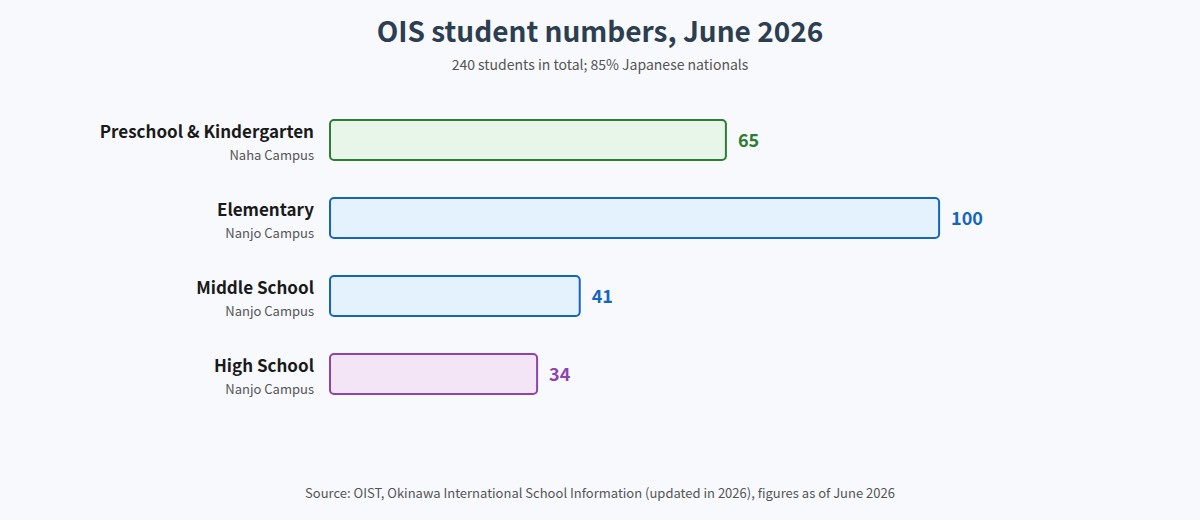
| Students (June 2026) | 240: Preschool and Kindergarten 65, Elementary 100, Middle School 41, High School 34. 85% are Japanese nationals |
| IB programmes | PYP, MYP and DP (no Career-related Programme), per the MEXT list as of 30 June 2026 |
| School day | Naha 7:30 to 15:00 (extended care until 18:30); Nanjo 8:00 to 16:00 |
With 240 students and at most 25 per grade in the middle and high school, OIS is a small school.
IB programmes at OIS: from age 3 to Grade 12
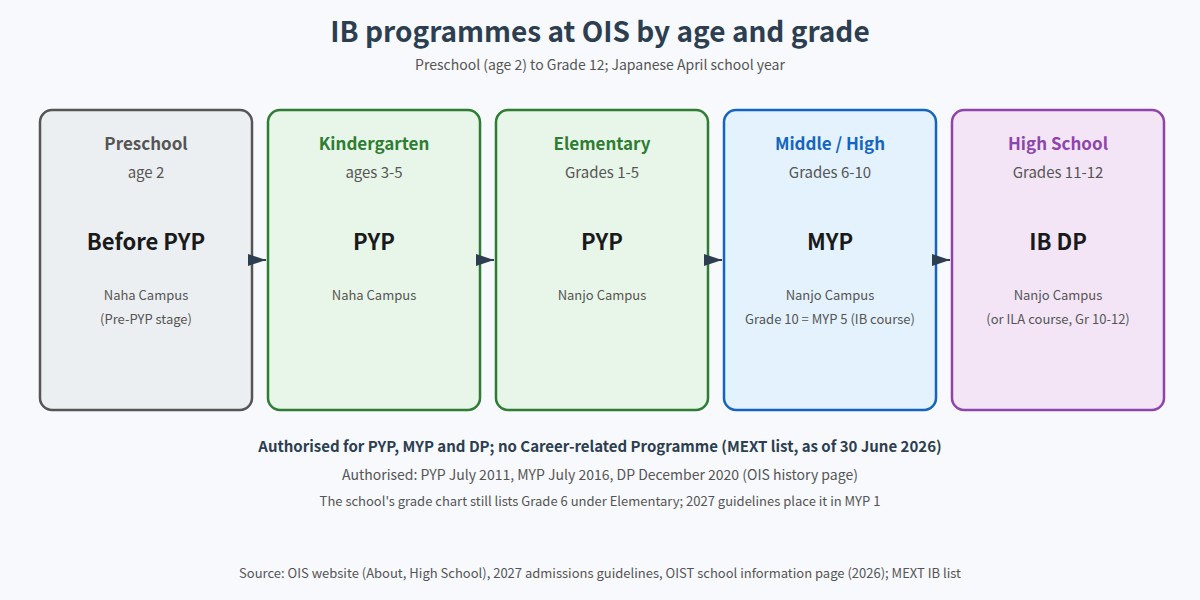
The MEXT IB consortium list (as of 30 June 2026) shows Okinawa International School as authorised for the Primary Years Programme (PYP), the Middle Years Programme (MYP) and the Diploma Programme (DP), in its section for schools that are not Article 1 schools under Japanese law. The school’s history page gives the dates: PYP in July 2011, MYP in July 2016 and DP in December 2020. On the OIST page, OIS describes itself as “the first and only IB Continuum School in Okinawa”.
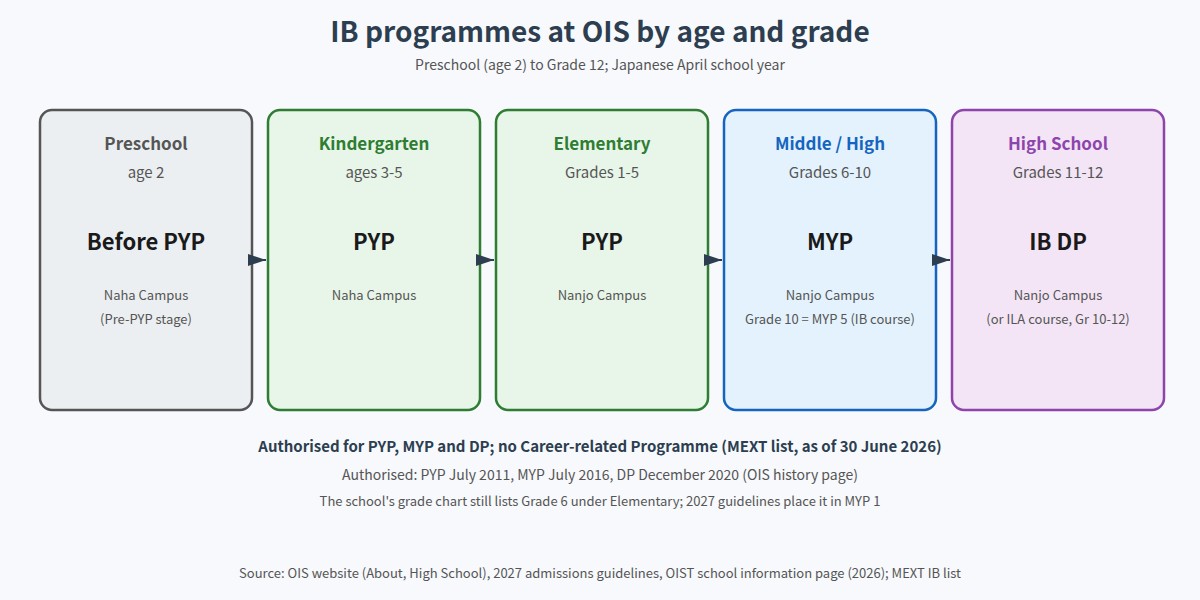
As Figure 1 shows, the programmes line up like this:
- Preschool (age 2, Cygnet class): the year before the PYP, which starts at age 3. The school’s grade chart calls it a PYP preparation stage (Pre-PYP).
- Kindergarten (ages 3 to 5) and Elementary: the PYP, which the OIST page says runs from age 3 through Grade 5, with learning organised around inquiry.
- Grades 6 to 10: the MYP. The 2027 middle school guideline describes Grades 6 to 9 as MYP 1 to 4, and the high school page describes Grade 10 on the IB course as MYP Year 5, “the final stage of preparation for the DP”.
- Grades 11 and 12: the Diploma Programme, with six subject groups plus Theory of Knowledge, the Extended Essay and CAS.
A note on grade names: because OIS uses the April school year, Grade 1 matches the first year of a Japanese elementary school, and placement depends on your child’s age at the start of April (the guidelines use 1 April for Grade 1 and 2 April for the preschool classes). The school’s grade chart still lists Grade 6 under Elementary, while the 2027 guidelines put it in the middle school, so do confirm where your child would be placed.
High school courses and legal status
From Grade 10, students choose between the IB course, which leads from MYP Year 5 into the full Diploma, and the International Liberal Arts (ILA) course, the school’s own three-year programme. The school says about 40% of Grade 10 ILA teaching is in Japanese, with the share of English rising each year.
The legal side matters if you are Japanese nationals or may later move into the Japanese system. The high school is a higher vocational school (高等専修学校), and the school states it is designated by MEXT as granting university entrance qualification, so graduates can sit Japanese university entrance exams. The OIST page describes the elementary and middle school as a non-accredited educational facility. The middle school page explains that students registered at a public junior high school in Okinawa keep that registration while attending OIS, and OIS reports their attendance and grades to that school. The elementary page carries the same statement under a heading about public elementary schools (its wording still says junior high school), so ask how it works for younger children.
Published results and university admissions
OIS publishes only limited results data. A post on the school’s news site states that in the November 2022 Diploma exams the OIS average was 40 points, against a world average of 30.94 for that session. It does not give the number of candidates. We found no pass rate or more recent results, so ask the school for its latest figures.
The same post lists university admission results as of 16 April 2024, including the University of Toronto, McGill, Waseda (SILS), Sophia and ICU for the IB course, and Hosei and the University of British Columbia for the ILA course. It does not say whether these are offers or final destinations. The long lists on the high school page are universities that accept IB applicants in general, not OIS destinations. The school information page on the OIST site says an academic guidance team supports students from Grade 8.
Tuition and fees for 2026-27
Let’s be honest: international school fees are a big commitment, and OIS charges several separate items. The fee pages are headed “2026年度”, the April 2026 to March 2027 school year. Amounts are in Japanese yen.
| Division (2026-27) | Annual tuition | Facilities fee (annual) | Annual Capital Fee | Entrance fee (one-time) | Assessment fee (one-time) |
|---|---|---|---|---|---|
| Preschool (age 2) | ¥961,000 | ¥142,000 | ¥90,909 | ¥400,000 | ¥15,000 |
| Kindergarten (ages 3 to 5) | ¥1,020,000 | ¥224,000 | ¥90,909 | ¥400,000 | ¥15,000 |
| Elementary (tax included) | ¥1,197,900 | ¥386,100 | ¥100,000 | ¥440,000 | ¥16,500 |
| Middle School (tax included) | ¥1,472,900 | ¥394,900 | ¥100,000 | ¥440,000 | ¥16,500 |
| High School, IB course | ¥1,792,000 | ¥372,000 | ¥90,909 | ¥400,000 | ¥25,000 |
| High School, ILA course | ¥1,556,000 | ¥372,000 | ¥90,909 | ¥400,000 | ¥25,000 |
Middle and high school assessment fees are from the guidelines for April 2027 entry. Preschool and kindergarten fees are not subject to consumption tax; the high school fee page does not say whether its amounts include tax. The OIST page shows middle school tuition as ¥1,427,900; we use the ¥1,472,900 on the school’s own page, which equals its pre-tax ¥1,339,000 plus 10% tax.
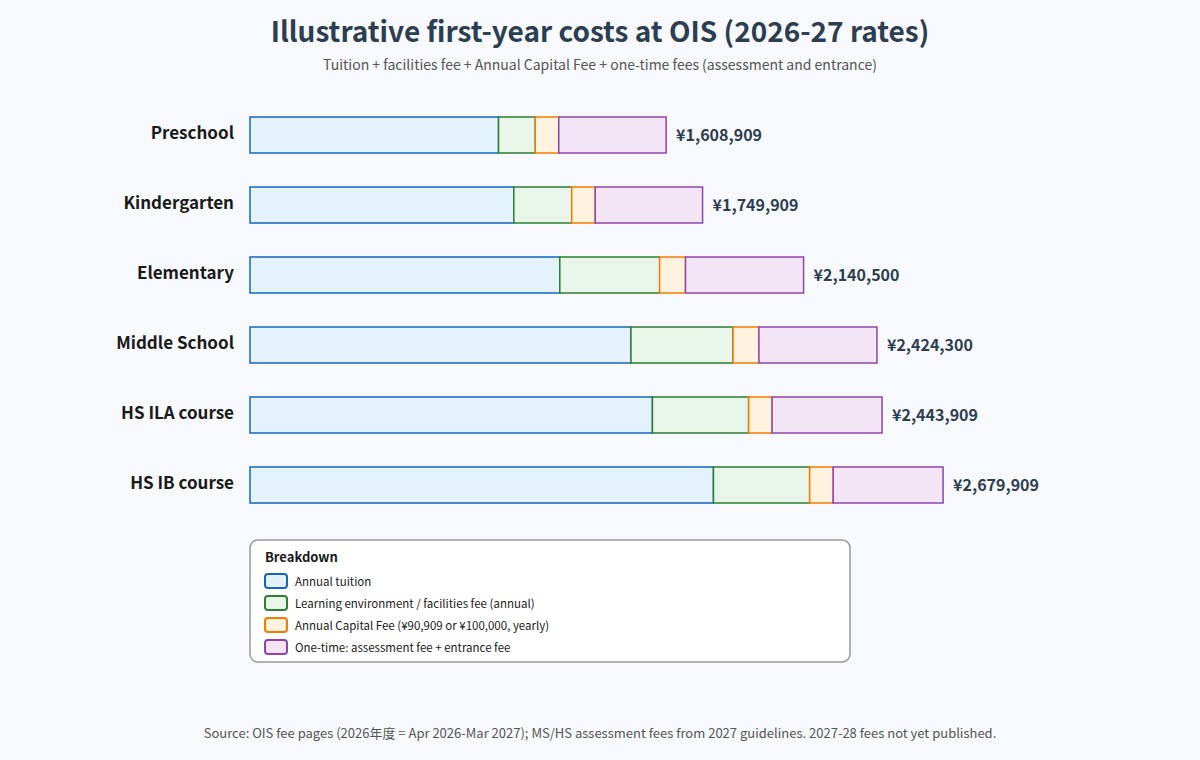
Adding these up gives an illustrative first-year cost at 2026-27 rates. Remember that a child starting in April 2027 will pay 2027-28 fees, which the school has not yet published, and that the middle and high school assessment fees come from the 2027 guidelines. On that basis, a new student joining the high school IB course pays ¥2,679,909 in the first year (¥25,000 assessment + ¥400,000 entrance + ¥90,909 Annual Capital Fee + ¥1,792,000 tuition + ¥372,000 facilities fee), and ¥2,254,909 a year after that at 2026-27 rates. For a new elementary student, the first year comes to ¥2,140,500 and later years to ¥1,684,000. Figure 2 shows each division.
- Siblings: the entrance fee is 25% off for siblings, and the Annual Capital Fee is charged once per family. The 2027 preschool and kindergarten guideline also gives 25% off tuition for a second child and 50% for a third.
- Not included: uniforms, personal materials, exam fees, lunch and the bus. For the high school, the school quotes about ¥100,000 for a laptop and ¥10,000 to ¥19,000 a month for the bus depending on distance (tax excluded).
- Refunds: the entrance fee and Annual Capital Fee are not refunded; annual or semester tuition is refunded from the month after withdrawal (middle and high school pages).
- Public support: with a care-need certification from your city, Japan’s free early-childhood scheme covers up to ¥37,000 a month for ages 3 to 5 (kindergarten page). From April 2026, Japan’s High School Tuition Support Fund has no income limit and pays up to ¥457,200 a year for private upper-secondary courses at specialised training schools (MEXT, FY2026). Eligibility depends on nationality or residence status (dependent-visa holders qualify only in limited cases), and the school’s page still shows the fiscal 2025 figure of ¥396,000, so confirm with the school.
- Scholarships: the high school has a scholarship admissions track, but its guideline was “in preparation” when we checked.
Admissions for April 2027
Good news for planning: all divisions share the same two main assessment days, Saturday 28 November 2026 and Saturday 30 January 2027. The middle school adds a third round on 1 March 2027, and the high school a third round in March 2027, with the date to be announced. Mid-year transfers are also considered.
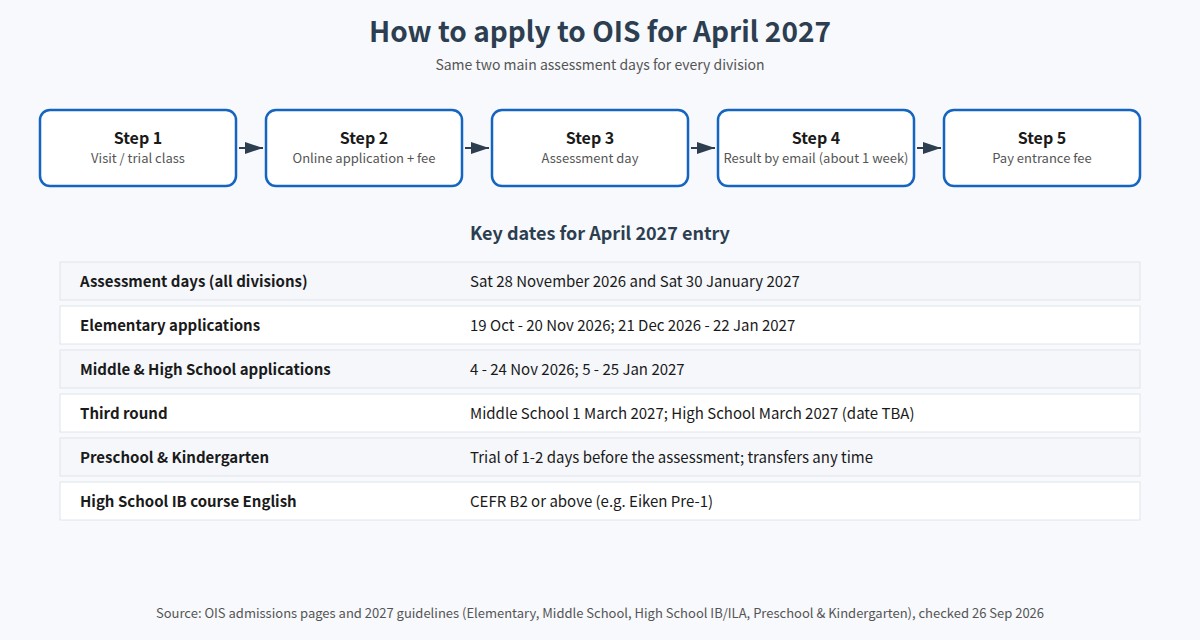
As Figure 3 shows, the flow is a visit or trial class, an online application with the fee, the assessment, results by email within about a week, and then the entrance fee. First-round applications run from 19 October to 20 November 2026 for the elementary school and from 4 to 24 November 2026 for the middle and high school.
- Preschool and Kindergarten: children must be 2, 3, 4 or 5 as of 2 April 2027, and a one- or two-day trial comes first. Staff observe understanding of English and Japanese, social skills, self-care and early recognition of letters, numbers and shapes, and interview parents.
- Elementary (Grades 1 to 5): tests in English, Japanese and maths, plus a parent interview; a trial class is compulsory for Grades 2 to 5. Grade 1 applicants should be 6 as of 1 April 2027. Foreign nationals need a long-term residence permit (for example a dependent visa) at enrolment.
- Middle School (Grades 6 to 9): up to 25 per grade. The child and parents must be able to communicate in English and/or Japanese. The assessment is an English test, a Japanese writing task for placement, a maths diagnostic and an interview.
- High School IB course: up to 25 per grade, with English at CEFR B2 or above (Eiken Pre-1, TOEFL iBT 72 to 94 or TOEFL Junior 850 to 900). The assessment is a 90-minute English test, a 50-minute maths test and an interview. The high school FAQ still mentions a lower B1 level, so confirm which applies.
- High School ILA course: the guideline asks for Japanese at JLPT N2 level or above.
Middle and high school applicants submit two years of transcripts, a statement of purpose in English, an English test certificate and a reference form from their current school. Families abroad can ask for an online assessment. Joining Grade 11 mid-year is possible only if previous subjects match OIS’s DP subjects, and entry into the final DP year is normally not accepted.
Learning support and student life
According to the OIST page, the elementary school helps Japanese-speaking children with English and gives other children Japanese support, and the middle school runs a support programme for English and maths.
There is a house system from elementary to high school, a student council in the middle and high school, and clubs such as karate and dance. In 2026 the high school signed a sister-school partnership with Cullinane College in Whanganui, New Zealand; Grade 10 and 11 students can join exchanges of three to four weeks with tuition and homestay covered (families pay airfare).
Getting to OIS
Because younger and older children study on different campuses (see Figure 4), where you live matters. The OIST page lists two bus courses for the Naha Campus and six routes for the Nanjo Campus, including routes from Ginowan and Urasoe, central Naha and Shuri, and Itoman.
Questions parents often ask
Is OIS in Ginowan?
No. The campuses are in Naha (ages 2 to 5) and Nanjo (Grades 1 to 12). Ginowan appears only as a stop on a Nanjo school bus route.
My child speaks little English. Can they still join?
For the youngest children, the school asks that the child or parents can communicate in Japanese or English. The middle school FAQ says motivation matters most and that students with above-average grades and Eiken Grade 3 or higher can build their English from there. The high school IB course, however, asks for B2-level English.
We are Japanese nationals. Can our child move back into Japanese schools?
OIS is not an Article 1 school. Middle school students who are registered at a public junior high school in Okinawa keep that registration, and the high school grants university entrance qualification. Please talk to the school and your local board of education before you decide.
Summary
- A small IB continuum school: PYP, MYP and DP (MEXT list, June 2026), with 240 students in June 2026.
- Two campuses: Naha for ages 2 to 5 and Nanjo for Grades 1 to 12, on an April-to-March calendar.
- 2026-27 fees: tuition from ¥961,000 (Preschool) to ¥1,792,000 (High School IB course); illustrative first-year totals from ¥1,608,909 to ¥2,679,909.
- Admissions: main assessments on 28 November 2026 and 30 January 2027; B2 English for the high school IB course.
- Results: an average of 40 in the November 2022 Diploma exams; ask for newer figures.
If OIS sounds like a good fit, contact the relevant campus about a visit or trial class. Visiting on a school day, with your child if you can, is the best way to feel whether a small IB school in Okinawa suits your family.
Sources and references
- Okinawa International School: official website (checked 26 September 2026)
- OIS: About the school (history and grade chart)
- OIS: Preschool and Kindergarten (admissions and 2026 fees)
- OIS: Elementary School (admissions and 2026 fees)
- OIS: Middle School (admissions, 2026 fees, public school relationship)
- OIS: High School (IB and ILA courses, 2026 fees, admissions)
- OIS: High School Entrance Examination Guideline, IB course (2027 admission, PDF)
- OIST: Okinawa International School Information (updated in 2026)
- OIS news: IBDP results (November 2022) and university admission results (as of 16 April 2024)
- MEXT: High School Tuition Support Fund, new system overview (FY2026, PDF)
- MEXT IB Education Promotion Consortium: IB schools in Japan (as of 30 June 2026)
コメント