IB schools in Japan put tuition front and centre, but the first invoice from an international school usually tells a bigger story. Registration fees, development funds, maintenance charges, buses, lunches, laptops, trips, English support and, in the final year, IB exam fees can add a surprising amount. This guide walks you through those extra costs one by one, using real 2026-27 fee schedules, so you can plan with fewer surprises.
Everything below comes from the schools’ own 2026-27 fee pages and PDFs, the Japanese Ministry of Education (MEXT) and the International Baccalaureate (IB), all checked on 26 September 2026. Schools are quoted as examples of how fees are structured, not as a ranking. Fees change every year, so please confirm them with the school before you commit.
- The big picture: four layers of cost
- One-time entry fees: the first invoice shock
- Annual compulsory fees on top of tuition
- IB exam fees and other Diploma-stage costs
- Buses, lunches and devices
- Trips, Week Without Walls and activities
- English support and learning support
- Deposits, sibling discounts and scholarships
- Government support: High School Tuition Support from April 2026
- Worked example: the first year of the Diploma at four schools
- Questions parents often ask
- Summary
- Sources and references
The big picture: four layers of cost
It helps to think of the budget in four layers:
- One-time entry fees: application, registration (or acceptance) and, at many schools, a development fund or capital levy. Almost always non-refundable.
- Annual compulsory fees: tuition plus a fixed building, facility or campus development fee.
- “If you use it” costs: buses, lunches, devices, trips, activities, English support and learning support.
- Diploma-stage costs: IB exam fees, graduation fees and transcripts that appear only in Grades 11 and 12 or after results.
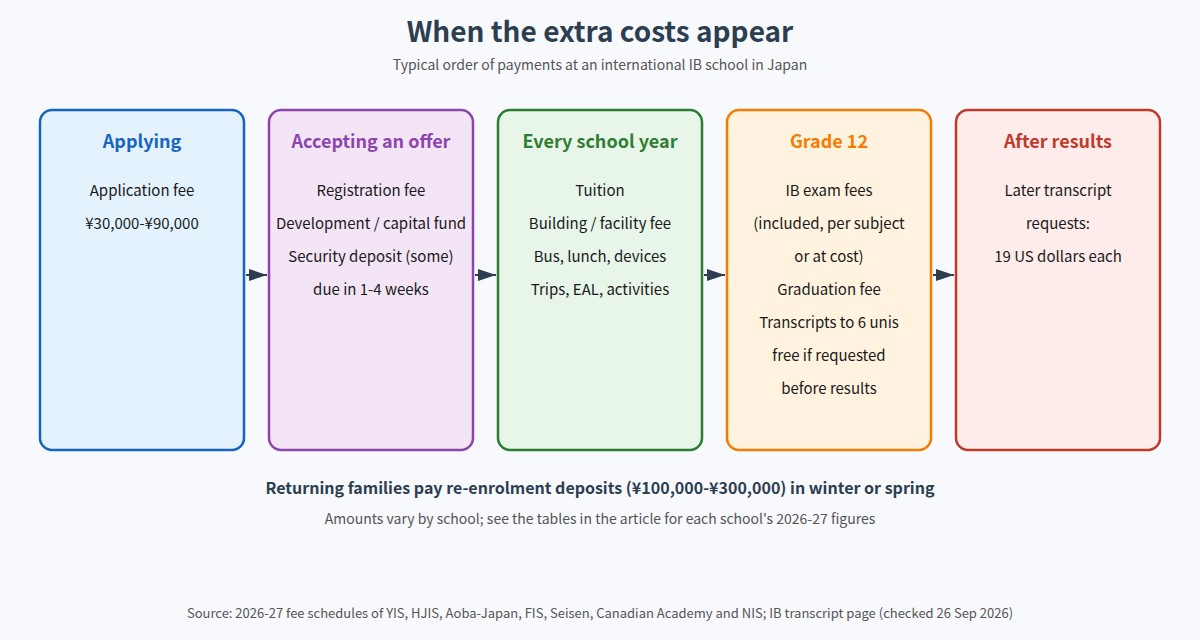
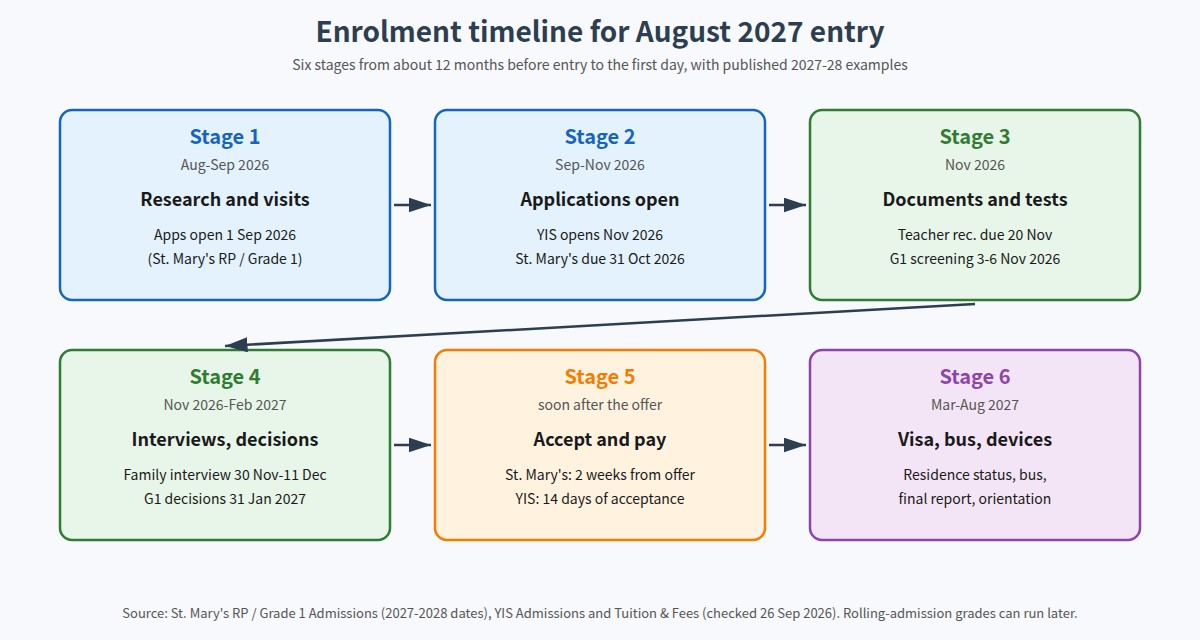
Figure 1 shows when each layer usually lands on your bank statement.
One-time entry fees: the first invoice shock
The size of the one-time fees surprises many families. They are typically due within one to four weeks of an offer, before the school year starts.
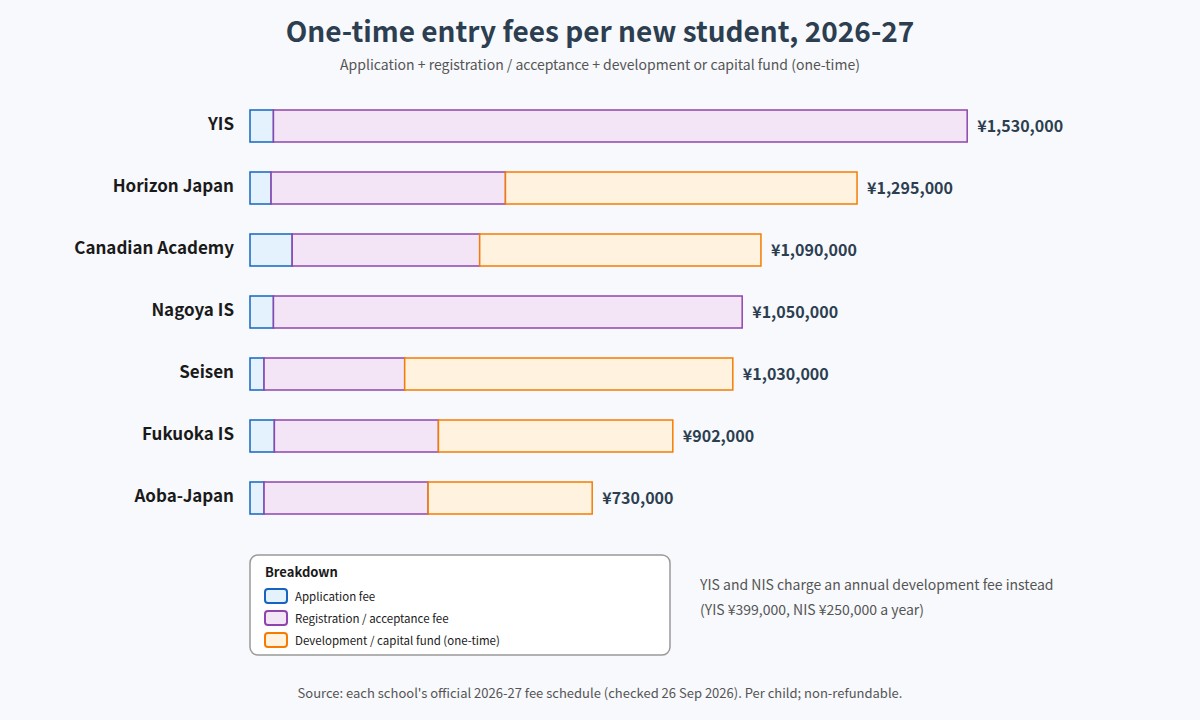
| School (2026-27) | Application | Registration / acceptance | Development / capital (one-time) | Total one-time |
|---|---|---|---|---|
| Yokohama International School (YIS) | ¥50,000 | ¥1,480,000 | none listed (annual fee instead) | ¥1,530,000 |
| Horizon Japan International School (HJIS) | ¥45,000 | ¥500,000 | Building Fund ¥750,000 | ¥1,295,000 |
| Canadian Academy (Kobe) | ¥90,000 | ¥400,000 | Capital Contribution ¥600,000 | ¥1,090,000 |
| Nagoya International School (NIS) | ¥50,000 | ¥1,000,000 | none listed (annual fee instead) | ¥1,050,000 |
| Seisen International School | ¥30,000 | ¥300,000 | Land and Building Development ¥700,000 | ¥1,030,000 |
| Fukuoka International School (FIS) | ¥52,000 | Acceptance ¥350,000 | Development ¥500,000 | ¥902,000 |
| Aoba-Japan International School (campus programmes) | ¥30,000 | ¥350,000 | Building Development ¥350,000 | ¥730,000 |
As Figure 2 shows, the one-time total at these seven schools ranges from ¥730,000 to ¥1,530,000 per child in 2026-27. Keep in mind:
- They are per child. Sibling discounts, where offered, usually apply to tuition only.
- Timing is tight. YIS wants registration fees within 14 days of acceptance, HJIS wants the registration fee, Building Fund and first tuition payment within one week, and Canadian Academy within 30 days or before the first day, whichever is earlier.
- Leaving and returning can cost again. HJIS waives its registration fee and Building Fund only for students readmitted within a year; Canadian Academy charges the registration fee again after twelve months away (but not the Capital Contribution); Fukuoka charges former students a ¥200,000 re-acceptance fee.
- Deposits. Canadian Academy also takes a ¥50,000 security deposit from new students, refunded net of deductions when they leave.
Annual compulsory fees on top of tuition
Next come fixed charges that every student pays each year, billed alongside tuition. For 2026-27:
- YIS: Campus Development Fee ¥399,000, not prorated for mid-year entry.
- Canadian Academy: Building and Development Fee ¥300,000, also not prorated.
- Horizon Japan: Maintenance Fee ¥250,000, plus a ¥5,000 PTA fee per family.
- Nagoya International School: Campus Development Fee ¥250,000.
- Aoba-Japan: Building Maintenance Fee ¥220,000 and a Family Community Membership Fee of ¥12,500 per family, billed in full with the first invoice.
- Fukuoka: Facility Fee ¥200,000, plus accident insurance ¥4,800, library ¥5,000, yearbook ¥6,000 and an Extension Learning Fee (¥5,000 in secondary).
- Seisen: Building Maintenance ¥150,000, listed under “Annual Fees” but called a one-time fee in the refund section, so ask how often it is charged.
If you arrive mid-year, ask exactly what the first invoice will contain: tuition may be prorated while these fees often are not.
IB exam fees and other Diploma-stage costs
This cost often catches families off guard because it appears in Grade 12, long after the budget was set. Schools handle IB Diploma exam fees in three ways:
- Included in tuition. YIS says its fees cover IB Diploma, ISA and PSAT exam fees, excluding resits.
- A fixed charge per subject. Seisen lists “IB Exams (per subject)” at ¥20,000 for 2026-27. A full Diploma candidate normally takes six subjects.
- Billed at actual cost. Aoba-Japan bills Grade 12 Diploma students at actual cost, notes that the amount can change with IB fees and the exchange rate, and gives “¥120,000 last year” as an example.
We could not find a current per-subject exam fee for Japan on the IB’s public pages, so plan with your school’s own figure. Other Diploma-stage costs:
- Online courses. Aoba-Japan charges Pamoja online courses at actual cost; Nagoya International School lists optional IBDP online courses at ¥50,000 to ¥60,000 per course.
- Graduation fees. ¥160,000 in Grade 12 at Aoba-Japan, ¥30,000 at Seisen and ¥10,000 at Fukuoka (2026-27).
- Transcripts. The IB sends results to up to six universities free if requested before results are released; later requests cost a processing fee of 19 US dollars per transcript.
Buses, lunches and devices
These everyday costs are easy to underestimate because they sit in small print below the tuition table.
School buses
Annual bus prices for 2026-27 include ¥257,000 one way or ¥418,000 both ways at Aoba-Japan; ¥310,000 or ¥420,000 at Seisen; ¥215,000 or ¥300,000 at Horizon Japan (or ¥2,500 per ride); ¥107,000 to ¥243,000 one way, or ¥194,000 to ¥441,000 round trip, by stop at Canadian Academy; and ¥500,000 for Nagoya International School’s neighbourhood buses. Fukuoka’s FAQ says it has no school bus, and YIS bills its bus separately without a price on its 2026-27 fee page.
Lunches
Aoba-Japan publishes an optional annual lunch price for 2026-27: ¥175,000 for Kindergarten and ¥200,000 for Grades 1 to 9. Horizon Japan’s Cezars Kitchen lunches vary in price by the items purchased, Canadian Academy families top up a Cezar’s Kitchen account, and Fukuoka’s lunch is optional at extra cost.
Laptops and tablets
YIS includes school-issued computers and tablets in its fees. Horizon Japan charges a ¥25,000 technology fee in Grade 1 for a school iPad, then expects an own iPad in Grades 2 to 4 and an own MacBook in Grades 5 to 12. Seisen requires some elementary students to buy an iPad through the school at a price that varies.
Trips, Week Without Walls and activities
Residential trips are a highlight of international school life, but whether they are in tuition varies. YIS says its fees cover most expeditions and field trips. Fukuoka estimates its Week Without Walls at about ¥50,000 to ¥120,000 for 2026-27, invoiced separately. Horizon Japan says Expedition Week trips are mandatory but not included in tuition (day field trips are). Nagoya International School lists optional sports and activity trips at ¥80,000 per international trip, ¥40,000 per nationwide domestic trip and ¥8,000 per regional trip, and optional secondary overseas trips such as Model UN at ¥100,000 to ¥200,000. Canadian Academy and Horizon Japan add that some after-school activities carry extra costs.
English support and learning support
If English is not yet your child’s strongest language, or your child has a learning need, this can become the largest extra cost of all.
- Horizon Japan: EAL (English as an Additional Language) support costs ¥500,000 a year if required in 2026-27. The school explains that the fee is paid while the service is received, and that a student who still needs EAL after one year of support continues in the programme without payment.
- Canadian Academy: the 2026-27 schedule states that the school does not charge additional fees for EAL services. However, students who need significant one-to-one learning support may be charged up to ¥3,500,000 for the Learning Support programme.
- Nagoya International School: ¥2,750,000 a year for students who require 1:1 support from an additional adult.
At several schools, support is a condition of enrolment decided after the school assesses your child. Sharing reports openly during admissions avoids surprises later.
Deposits, sibling discounts and scholarships
Re-enrolment deposits
Returning families usually pay a deposit in winter or spring to hold next year’s place. The 2026-27 schedules list ¥300,000 at YIS (due by 15 April), ¥300,000 at Canadian Academy (due by 27 February 2026 for the 2026-27 year) and ¥100,000 at Nagoya International School (due by 30 January). These are applied to next year’s fees but are generally non-refundable if you then withdraw.
Sibling discounts
Aoba-Japan gives 10% off the second child’s tuition and 15% off each further child’s (full-year students only). Horizon Japan gives 20% off the second child’s tuition and 30% off the third’s. YIS, Seisen and Canadian Academy do not list a sibling discount in their 2026-27 schedules, so ask rather than assume.
Scholarships and corporate programmes
YIS offers scholarships to students whose parents’ employers join its Corporate Contribution Program, and Seisen and Horizon Japan describe similar corporate plans. Osaka International School invites applications for its regular financial aid by the end of June. If your employer pays fees, ask HR whether it takes part in such a programme.
Government support: High School Tuition Support from April 2026
Japan’s national High School Tuition Support Fund (shugaku shienkin) changed on 1 April 2026. According to MEXT’s FY2026 overview and its notice of 31 March 2026:
- No income limit. The maximum is ¥118,800 a year at public high schools and ¥457,200 at private full-time high schools.
- Eligible schools. “Article 1” high schools (regular Japanese high schools) and certain other schools. MEXT removed so-called foreign schools, miscellaneous schools (kakushu gakko) intended mainly for foreign nationals, from the eligible list and abolished the designation that had covered some international schools.
- Eligible students. Residents of Japan who are Japanese nationals, special permanent or permanent residents, spouses or children of Japanese nationals or permanent residents, long-term residents (teijusha) recognised as intending to settle permanently, or, under conditions, Dependent-visa children who finished elementary and junior high school in Japan and intend to work here.
- Transitional support. Students already enrolled on 31 March 2026 who fall outside the new system (including Student-visa holders, at any school type) keep the old support.
- Budget support for new entrants. New entrants outside the new system (excluding Student-visa holders), at Article 1 schools or at foreign schools that were designated under the old notice, can get old-level support through a separate budget programme. At private schools, MEXT’s chart shows up to ¥396,000 for household incomes below about ¥5.9 million and ¥118,800 for incomes from about ¥5.9 million to below ¥9.1 million (¥118,800 at public schools); new entrants in households above about ¥9.1 million are not covered. The budget programme is run by prefectures with a national subsidy (3/4), so check that your prefecture offers it.
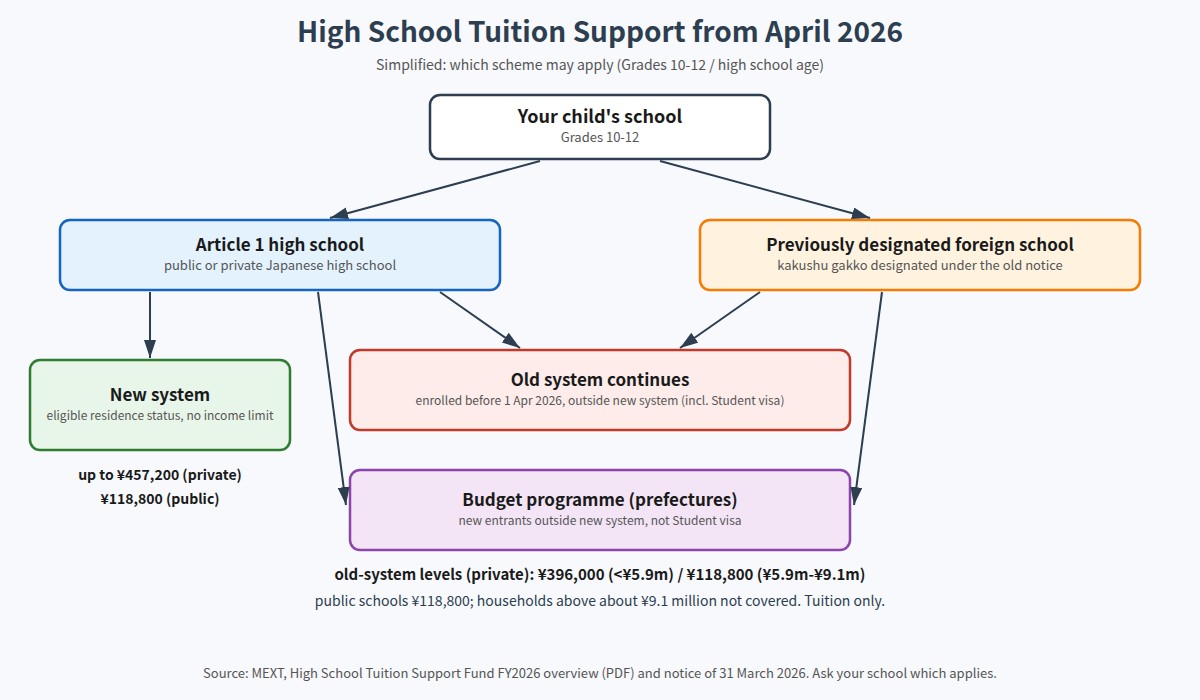
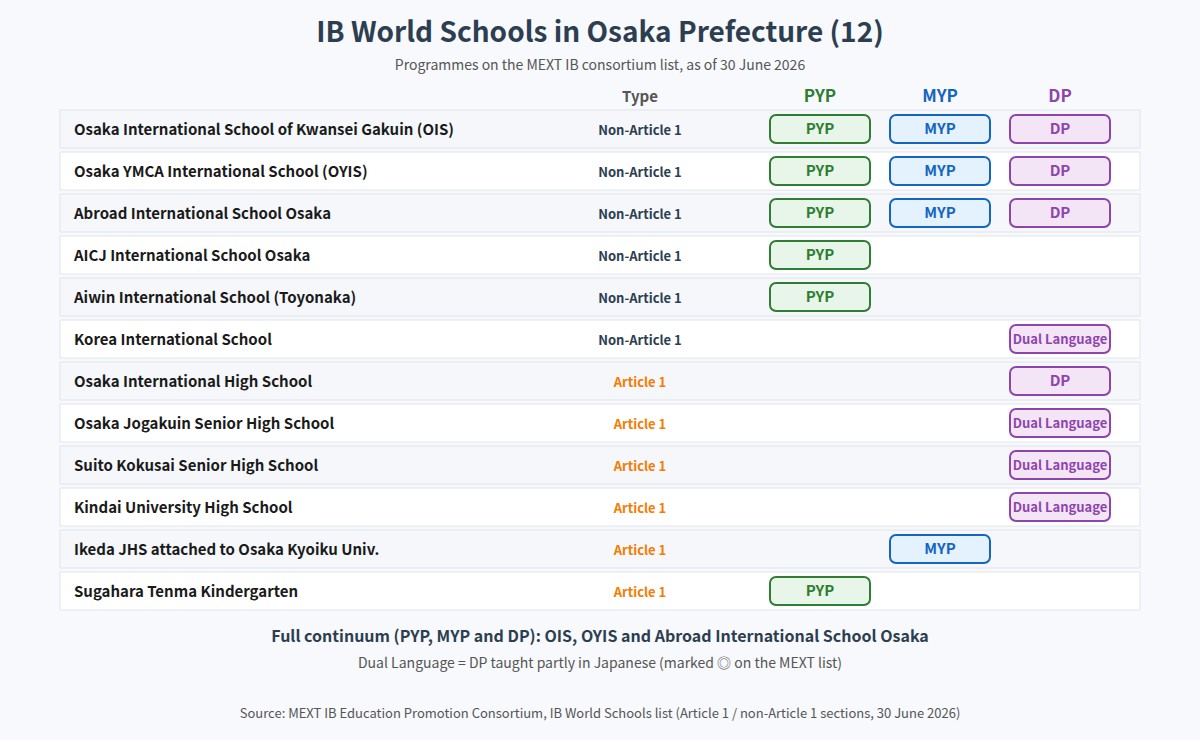
So the answer depends on the school type and your child’s residence status (Figure 3). Some fee pages predate April 2026: Canadian Academy’s 2026-27 schedule, for example, says it participates in the national fund and two Hyogo Prefecture programmes, subject to income requirements. Ask your school which scheme applies, apply through the school (which receives the money on your behalf), and remember it covers tuition only, not registration fees, buses or trips.
An Article 1 public example: Tokyo Metropolitan Kokusai High School
Article 1 schools with the IB Diploma have a very different cost structure. Tokyo Metropolitan Kokusai High School lists tuition of ¥118,800 a year, which it says is in principle not charged under Tokyo’s free-tuition system. Its extra costs are school-collected grade funds, higher for IB students because they include the Diploma Programme individual registration fee:
| Grade fund (school’s current fee page, 2026) | General course | IB students | Difference |
|---|---|---|---|
| Year 1 | ¥125,000 | ¥235,000 | ¥110,000 |
| Year 2 (includes the school trip) | ¥111,000 | ¥203,000 | ¥92,000 |
| Year 3 | ¥29,000 | ¥57,000 | ¥28,000 |
| Three years | ¥265,000 | ¥495,000 | ¥230,000 |
The page also lists an admission fee of ¥5,650, PTA (¥4,000 in Years 1 and 2, ¥7,500 in Year 3), a ¥5,000 student council fee each year and uniform items (for example ¥43,065 for the boys’ uniform and ¥18,040 for PE kit). Year 1 school-collected items for an IB student total ¥249,650 (¥5,650 + ¥235,000 + ¥4,000 + ¥5,000) before uniforms. Entry is through the school’s own selection in the Japanese high school system, so this is a different path rather than simply a cheaper international school.
Worked example: the first year of the Diploma at four schools
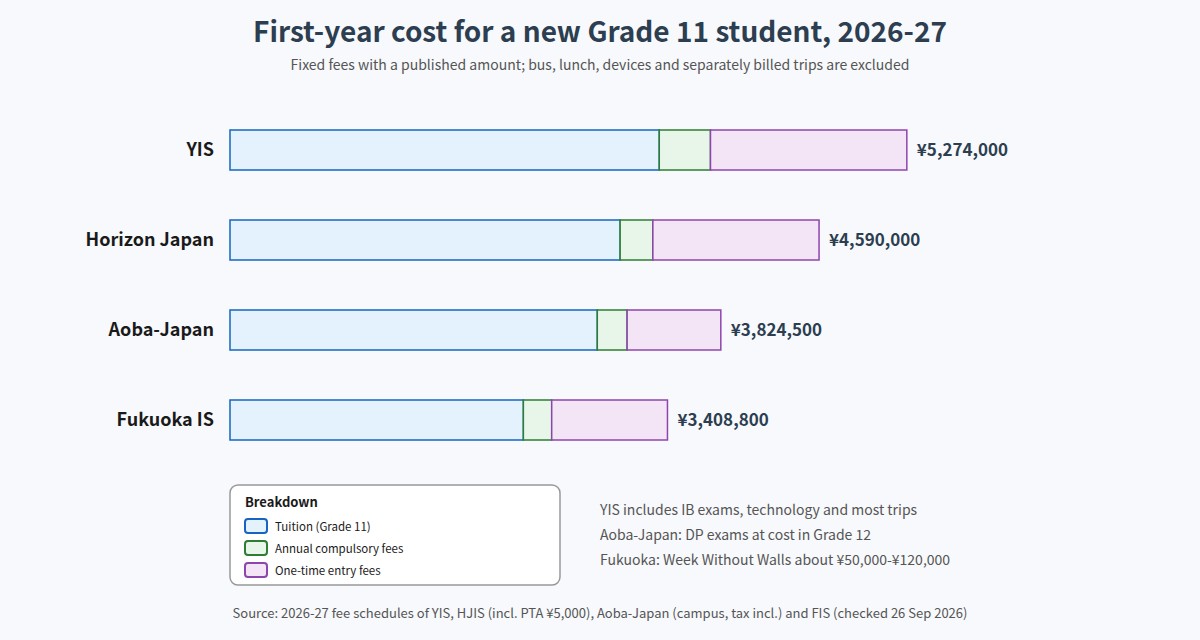
Here is what a new student joining Grade 11 in August 2026 would be billed in the first year, adding up the fixed fees with a published amount in each school’s 2026-27 schedule. Per-family fees (Horizon Japan’s PTA fee and Aoba-Japan’s family membership) are counted in full for this one child. Items without a fixed price, and optional ones, are listed in the last row.
| Grade 11 new student, 2026-27 | YIS | Horizon Japan | Aoba-Japan (campus) | Fukuoka IS |
|---|---|---|---|---|
| Tuition | ¥3,345,000 | ¥3,040,000 | ¥2,862,000 | ¥2,286,000 |
| Annual compulsory fees | ¥399,000 (campus development) | ¥255,000 (maintenance ¥250,000 + PTA ¥5,000) | ¥232,500 (maintenance ¥220,000 + family membership ¥12,500) | ¥220,800 (facility ¥200,000 + insurance, library, yearbook, extension learning) |
| One-time entry fees | ¥1,530,000 | ¥1,295,000 | ¥730,000 | ¥902,000 |
| First-year total of fixed fees | ¥5,274,000 | ¥4,590,000 | ¥3,824,500 | ¥3,408,800 |
| Of which, not tuition | ¥1,929,000 | ¥1,550,000 | ¥962,500 | ¥1,122,800 |
| Known extras not included | Bus, uniform, cafeteria, some activities (IB exams, technology and most trips are included) | Mandatory Expedition Week (price set per trip), own MacBook, EAL ¥500,000 if required, bus, lunch | Bus, lunch; in Grade 12, DP exams at cost (¥120,000 last year) and graduation ¥160,000 | Week Without Walls about ¥50,000 to ¥120,000 (invoiced), lunch |
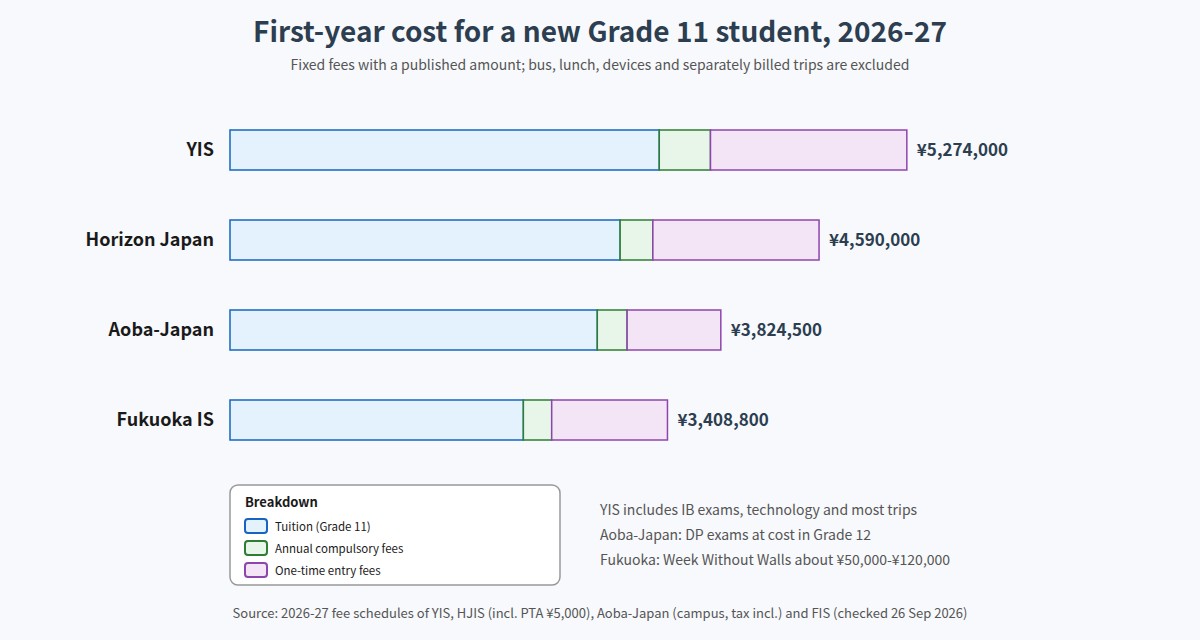
Figure 4 shows two things. The non-tuition part of the first-year bill is about ¥960,000 to ¥1,930,000 at these four schools. And packaging differs: YIS has the highest total of the four but includes IB exams, technology and most trips, while Aoba-Japan and Fukuoka bill some of those separately. Comparing tuition alone misses both points.
At 2026-27 rates, Grade 12 would cost ¥3,839,000 at YIS (Grade 12 tuition is ¥3,440,000 plus the ¥399,000 development fee), ¥3,295,000 at Horizon Japan, ¥3,254,500 at Aoba-Japan (with the ¥160,000 graduation fee, before DP exams) and ¥2,516,800 at Fukuoka (with the ¥10,000 graduation fee, before Week Without Walls). The two Diploma years then total ¥9,113,000, ¥7,885,000, ¥7,079,000 and ¥5,925,600 respectively, before the unpriced and optional items above (including Horizon Japan’s mandatory Expedition Week). Treat these as illustrations: fees usually rise, and Osaka International School, for example, announced an increase of about 4% for 2026-27.
Questions parents often ask
Is consumption tax added to international school fees?
It depends on the school and the item. Aoba-Japan states that its 2026-27 fees are “Tax Included”, while YIS, Horizon Japan and Fukuoka do not state the tax treatment on the pages we checked. If you are comparing schools, ask each one whether its figures include tax.
Are one-time fees ever refunded if we have to leave early?
Very rarely. Application and registration fees (and, where charged, development or capital fees) are described as non-refundable in the refund rules we read at YIS, Aoba-Japan, Horizon Japan, Seisen, Fukuoka and Canadian Academy. Some annual fees and tuition can be refunded if you give notice before set dates; for example, Aoba-Japan refunds the Building Maintenance Fee and first-semester tuition only if notice is given by 15 July. Read the refund policy before you pay.
Does an employer-paid package change anything?
Yes. YIS, Seisen, Horizon Japan and others run corporate programmes for employers who pay fees. Ask HR early: Canadian Academy requires corporate sponsors to pay in full by the due date, and Horizon Japan and Aoba-Japan hold families responsible even when an employer pays.
Summary
- Look beyond tuition: one-time entry fees at the seven schools we checked range from ¥730,000 to ¥1,530,000 per child for 2026-27, and are usually due within one to four weeks of an offer.
- Annual fixed fees add up: building, facility or campus development fees of ¥200,000 to ¥399,000 a year at the schools that list them as annual (Seisen’s ¥150,000 needs checking), often not prorated for mid-year entry.
- Check what tuition includes: IB exam fees, devices and trips are included at some schools and billed separately at others.
- Ask about support needs early: EAL and learning support can cost from nothing extra up to several million yen a year, depending on the school and your child’s needs.
- Tuition support changed in April 2026: eligibility now depends on the school type and residence status, so confirm with the school which scheme applies.
A good next step is to ask each school on your list for its full fee schedule and to fill in the four layers (one-time, annual, “if you use it” and Diploma-stage) side by side. It takes an evening, but it can save a lot of stress when the first invoice arrives.
Sources and references
- Yokohama International School: Tuition and Fees, Tuition Schedule 2026-2027 (checked 26 September 2026)
- Horizon Japan International School: Tuition and Fees and HJIS Tuition and Fees for School Year 2026-27
- Aoba-Japan International School: Tuition and Fee and School Fees 2026-2027 (PDF)
- Fukuoka International School: Tuition and Fees 2026/2027 and FAQ
- Seisen International School: School Fees 2026-2027
- Canadian Academy: Schedule of Fees, School Year 2026-27 (PDF)
- Nagoya International School: 2026-27 Tuition and Fees
- Osaka International School of Kwansei Gakuin: Fees 2026-2027
- Tokyo Metropolitan Kokusai High School: tuition and other expenses (Japanese)
- MEXT: High School Tuition Support Fund, overview of the new system from FY2026 (PDF, Japanese)
- MEXT: Notice on the enforcement of the amended High School Tuition Support Act, 31 March 2026 (Japanese)
- MEXT: Financial support for high school students (Japanese)
- International Baccalaureate: Requesting transcripts and certificates
- MEXT IB Education Promotion Consortium: IB schools in Japan
コメント