From the IB Diploma in Japan to US universities is a journey more and more families here are thinking about. Perhaps your child has just started the Diploma Programme (DP) and keeps asking: “Could I apply to college in the United States?” The US system can feel confusing from Japan. There is no single national exam, every university sets its own rules, and the calendar is quite different from Japanese university entrance.
This guide walks you through the main pieces in plain language: how US universities look at the IB, what IB credit can (and cannot) mean, the application platforms and deadlines for students entering in Fall 2027, testing and English requirements, costs and financial aid for international students, and a practical timeline for a Japan-based DP student from Grade 10 to Grade 12. Every rule and number below comes from official university, Common App or College Board pages, checked on 26 September 2026. US policies change from one year to the next, so please use this as a map and always confirm on each university’s own site before your child applies.
- How US universities look at the IB Diploma
- Application platforms and deadlines for Fall 2027 entry
- Testing: SAT, ACT and English proficiency
- Costs and financial aid for international students
- A timeline for a Japan-based DP student (Grade 10 to Grade 12)
- What school counsellors in Japan provide
- Questions parents often ask
- Summary
- Sources and references
How US universities look at the IB Diploma
The first thing to understand is that most selective US universities do not admit students on a single score. They read the whole application: school grades, the difficulty of the courses taken, teacher and counsellor letters, essays, activities and, at many universities, test scores. Yale, for example, describes considering all applicants “through the same whole-person admissions process” on its international students page. Stanford says it considers each application “within the context of the resources available to you”, and adds that there is no need to convert your marks into an American Grade Point Average (GPA).
Princeton makes another point that many parents in Japan ask about. Its page for international students states that “there is no preference or advantage to a particular system or country.” In other words, taking the IB is not a golden ticket, but it is also not a disadvantage. What matters is how well your child does within the programme their school offers.
Predicted grades: the number that travels with the application
Because DP final results arrive in July, long after US decisions are made, universities rely on predicted grades from the school. The wording differs from one university to another, so here is what each one actually says:
- Harvard: “If you study the IB curriculum or the A-level curriculum, then we expect that your school will send predicted grades”, based on classroom work and internal or mock exams.
- Stanford: students in an IB Diploma programme outside the US “are required to have a school official send us their predicted IB marks (including TOK/essay bonus points).”
- MIT: asks that predicted grades “be sent when ready”, and says final grades are only required for admitted students.
- Yale: applicants “may submit predicted IB scores, if available, but these are not required.”
So in practice, your child’s IB coordinator and counsellor play a central role. They are the ones who send predicted grades, which is why a good relationship with them matters (more on this later).
IB credit and advanced standing: every university is different
Many parents hope that strong Higher Level (HL) results will turn into university credit, perhaps even a shorter degree. Sometimes they do, but the rules vary enormously. Credit is usually decided after admission, when final results arrive, and it is a separate question from getting in. Here are four official examples, each with the year of the policy.
| University | What the official policy says |
|---|---|
| University of California (all campuses) | HL exams with scores of 5, 6 or 7 earn 8 quarter (5.3 semester) units per exam in designated subjects. Completing the IB diploma with 30 points or more adds 6 quarter (4 semester) units. Standard Level exams are not on the list, and there is no credit for Mathematics: Applications and Interpretation (2021 and later). Current UC IB credits page, checked September 2026. |
| Stanford University | Bulletin year 2026-27 chart: for example, HL Chemistry 5 or higher = 10 units; HL Mathematics: Analysis and Approaches 6 or higher = 6 units; HL Physics 5 = 4 units, 6 or higher = 8 units. External credit (exams plus college transfer credit) is capped at 45 units toward graduation. |
| Boston University | International Baccalaureate Guide 2026-2027: credit “for higher level subjects only with a grade of 7, 6, and 5”, typically 8 credits for each listed subject. Some subjects, such as English A: Language and Literature and Business Management, receive no credit. |
| Harvard College | “Harvard College does not grant degree credit for these kinds of pre-matriculation credentials.” The IB diploma “can serve as valuable placement tools” and in some cases can fulfil the language requirement (current Harvard College FAQ). |
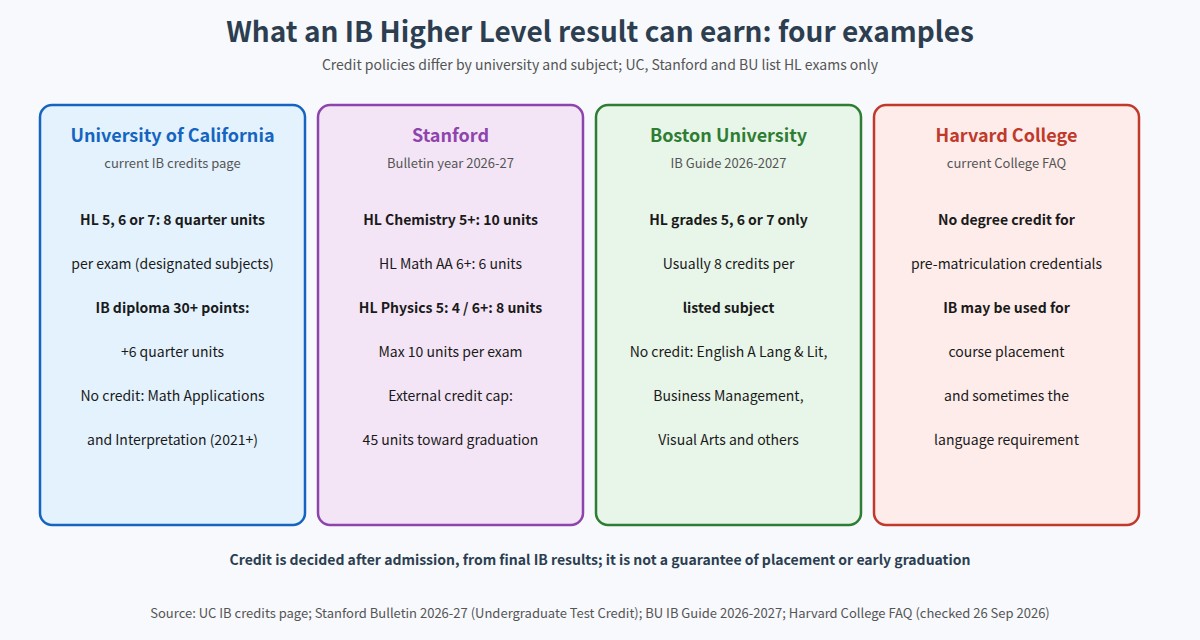
As Figure 1 shows, the same HL 6 in Physics could mean 8 units at Stanford, 8 quarter units at UC, 8 credits at BU, and no degree credit at Harvard (although it may help with course placement there). Two things are worth remembering. First, credit is almost always for HL exams only. Second, even where credit exists, Stanford’s Bulletin notes that credit “is not a guarantee” of placement into the next course, and UC notes that students who enter with IB credit are not required to graduate earlier. It is a nice bonus, not something to plan your budget around.
Application platforms and deadlines for Fall 2027 entry
Students who will start university in Fall 2027 (usually those in Grade 12 during 2026-27) apply this autumn and winter. Most private universities use the Common App, a single online platform where your child writes one main essay and adds each university’s own questions. Common App announced the opening of its 2026-27 application season in a news post dated 31 July 2026, so the platform is already open. The University of California uses its own UC Application instead: according to UC’s 2026-27 dates, the application opened on 1 August for Fall 2027 applicants and the filing period runs from 1 October to 30 November 2026.
A short glossary of the rounds:
- Early Decision (ED): binding. If admitted, the student commits to attend.
- Early Action (EA): non-binding. You hear early but can still wait until 1 May to decide.
- Restrictive or Single-Choice Early Action (REA/SCEA): non-binding, but it limits applying early to other private US universities. Check each university’s exact rules.
- Regular Decision (RD): the standard round, with deadlines in early January.
| University | Early round (decision) | Regular round (decision) |
|---|---|---|
| Harvard | Restrictive Early Action: 1 November (mid-December) | Regular Decision: 1 January (by end of March) |
| Yale | Single-Choice Early Action: 1 November (mid-December) | Regular Decision: 2 January (late March) |
| Princeton | Single-Choice Early Action: 1 November (mid-December) | Regular Decision: 1 January (late March) |
| MIT | Early Action: 1 November (mid-December) | Regular Action: 4 January (mid-March) |
| Stanford | Restrictive Early Action: 1 November, or 15 October with the optional arts portfolio (by mid-December) | Regular Decision: 5 January, or 5 December with the arts portfolio (by early April) |
| University of California | No early round | Filing period 1 October to 30 November 2026 (decisions March 2027) |
These dates were shown on each university’s admissions page on 26 September 2026. Most private universities do not print the cycle year next to the dates, Yale, Princeton, MIT, Stanford and UC ask admitted students to reply by 1 May; Harvard lists its reply deadline as early May. Harvard and Stanford state that deadlines are 11:59 pm in the applicant’s local time.
Testing: SAT, ACT and English proficiency
Testing policy changed a lot after 2020, and it is still changing. For students entering in Fall 2027, the pages we checked say the following:
| University | SAT/ACT for Fall 2027 entry | English proficiency test (TOEFL/IELTS/Duolingo) |
|---|---|---|
| Harvard | Required. IB actual or predicted scores are accepted only in exceptional cases, such as when a student cannot access a test site. | Not required; scores may be submitted |
| Yale | Required from the 2026-27 cycle (SAT or ACT only; AP and IB no longer count as alternatives) | Required for non-native speakers without two or more years at an English-medium school |
| MIT | Required | Strongly recommended for non-native speakers who have used English for fewer than five years or do not speak it at home or school |
| Stanford | Required | Not required; scores may be self-reported |
| Princeton | Optional for Fall 2027 entry; SAT or ACT required from the 2027-28 cycle (Fall 2028 entry) | Required if English is not your native language and your school does not teach in English |
| University of California | Not considered in admissions decisions or scholarships | Required if all secondary school was in a country where English is not the language of instruction; can be met by IB English A (SL 6-7 or HL 5-7) |
For Grade 10 and 11 families: from the 2027-28 cycle Princeton will require the SAT or ACT too, so planning for at least one sitting is the safer choice.
On English tests, the published numbers differ in meaning. MIT publishes minimum and recommended scores: for TOEFL iBT taken on or after 21 January 2026 (new 1 to 6 scale), a minimum of 5 and a recommended 5.5 (90 and 100 on the old scale), IELTS 7 and 7.5, and Duolingo English Test 120 and 125. Yale does not set strict minimums but says its “most competitive applicants” typically have TOEFL 5 or higher (or 100 before 21 January 2026), IELTS 7 or higher, or DET 120 or higher. UC’s system-wide minimums are IELTS 6.5, TOEFL iBT 4.5 (80 before January 2026) or DET 115, and it notes that a campus may require higher scores.
If your child attends a Japanese school where the DP is taught partly in Japanese, read each university’s wording carefully: whether the school is English-medium is often the key condition.
Costs and financial aid for international students
Let us be honest about money, because this is often the deciding factor. US private universities publish a “cost of attendance”, which includes tuition, housing, food and estimated personal costs. Here are three official figures for 2026-27, in US dollars:
| University (2026-27) | Tuition | Total cost of attendance | Notes |
|---|---|---|---|
| Harvard | 62,226 US dollars | 95,134 to 100,134 US dollars | Range depends on travel costs (0 to 5,000). Health insurance of 4,954 is extra unless covered by a family plan. |
| MIT | 66,720 US dollars | 92,760 US dollars | Student Financial Services budget for the Class of 2030 |
| Princeton | 68,140 US dollars | 94,624 US dollars | Transportation (about 50 to 5,000) is not included |
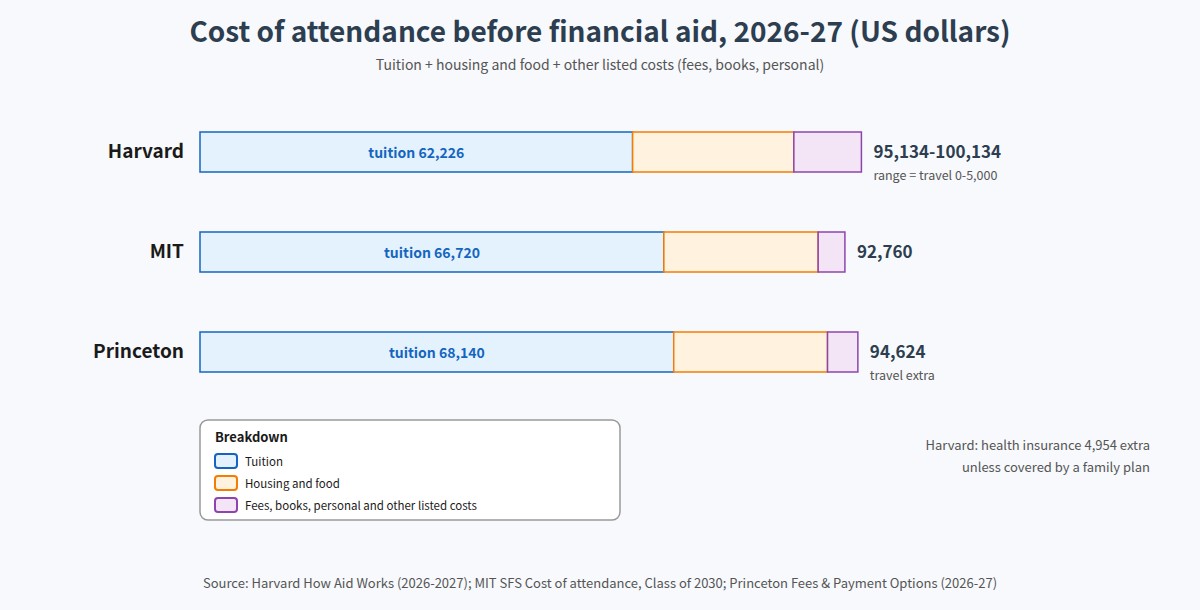
As Figure 2 shows, the full price before aid is over 90,000 US dollars a year at all three. That is a lot of money, but at these universities aid is based on need, so many families do not pay the full price.
Need-blind or need-aware: what it means for your child
“Need-blind” means that applying for financial aid does not affect the admissions decision. For international students, this is rare, so it is worth checking each university’s own statement:
- Harvard: need-blind; “International students are eligible for exactly the same aid as American students.” Harvard says the expected parent contribution is zero for families with annual incomes below 100,000 US dollars, and aid covers at least full tuition for incomes up to 200,000 US dollars.
- MIT: “Our admissions process is need-blind for all students, foreign and domestic.”
- Yale: all applicants “are evaluated without regard to their ability to pay”, and Yale meets 100% of demonstrated need.
- Princeton: admission is need-blind, and “the full need of all admitted international students is met”. Princeton does not offer academic or athletic merit scholarships.
- Stanford: need-aware for international citizens. If an international applicant says they will apply for aid, “that request will be a factor in our admission evaluation”. Stanford meets full demonstrated need for admitted students who applied for aid, but international citizens who say they will not apply and are admitted cannot apply for aid later.
Two practical tips. First, decide whether to apply for aid before your child submits, because at some universities it cannot be changed later. Second, financial aid applications have their own forms and deadlines: MIT lists 30 November for Early Action applicants and 15 February for Regular Action, and Princeton’s own Princeton Financial Aid Application is due 9 November for early applicants and 1 February for regular applicants. Gathering income documents from Japan, and translating them if needed, takes time.
A timeline for a Japan-based DP student (Grade 10 to Grade 12)
Here is a practical timeline built around the official dates above. International schools in Japan usually follow an August to June year, while Japanese Article 1 schools start in April; if your child’s school follows the April calendar or sits IB exams in the November session, ask the DP coordinator how predicted and final results will be reported.
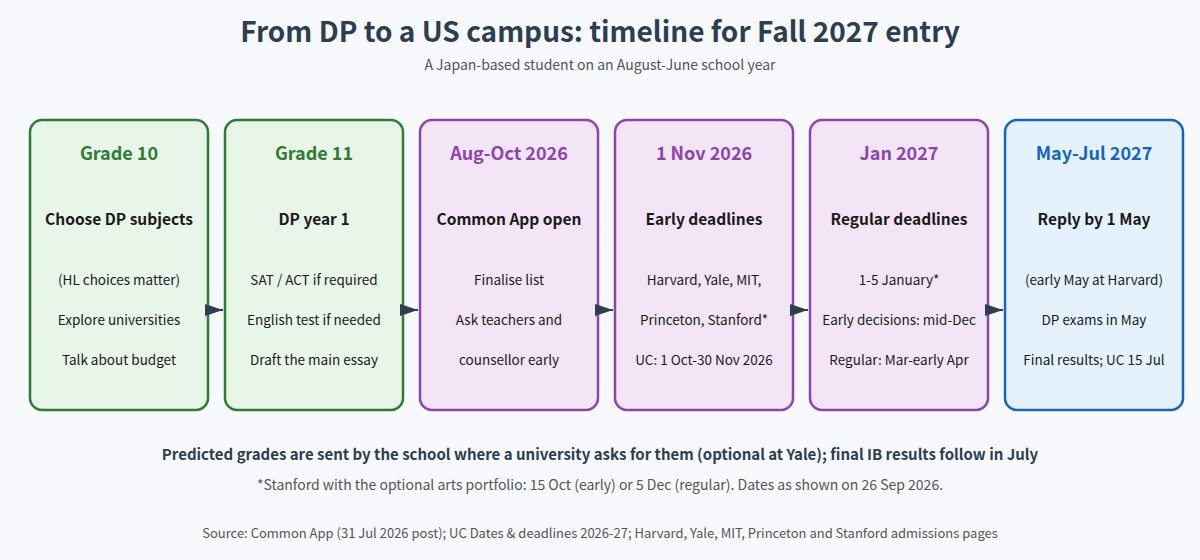
- Grade 10 (before the DP): choose DP subjects with care. Credit and preparation are usually linked to HL subjects, so if your child is aiming for engineering, for example, HL Mathematics: Analysis and Approaches and HL Physics keep more doors open (UC gives no credit for Applications and Interpretation). Start exploring universities and talk about budget honestly as a family.
- Grade 11 (DP year 1): take a first SAT or ACT if your list includes universities that require it, and an English test if needed. Build meaningful activities through CAS rather than collecting many small ones. Over the summer, draft the main essay.
- Grade 12, August to October: the Common App is open. Finalise the university list, ask two teachers for recommendations, and make sure the counsellor knows your plan so predicted grades can be sent. Harvard asks REA applicants to submit required test scores by the end of October.
- 1 November: early deadlines at Harvard, Yale, Princeton, MIT and Stanford (15 October for Stanford applicants with the optional arts portfolio, and 5 December for its regular round with a portfolio). The UC filing period runs from 1 October to 30 November 2026.
- Mid-December: early decisions. Early January: Regular deadlines (1 January for Harvard and Princeton, 2 January for Yale, 4 January for MIT, 5 January for Stanford).
- March to early April: Regular decisions. Reply by 1 May (early May at Harvard).
- May exams and July results: the student finishes the DP. Harvard asks IB students to send final results “as soon as they are released in mid-July”, and UC’s deadline for official AP and IB results is 15 July 2027.
What school counsellors in Japan provide
Your child cannot apply alone: US universities expect several documents to come from the school. From the university pages above, this typically includes a transcript, a school report, a counsellor letter, teacher recommendations and, for IB students, predicted grades sent by a school official. Princeton lists the School Report, counsellor letter, transcript and two teacher evaluation forms with each deadline, for example.
International schools in Japan usually have a university or college counsellor who knows this process well. At Japanese IB schools, the DP coordinator may take this role, and experience with US applications varies from school to school. It is a good idea to ask early, in Grade 10 or at the start of Grade 11:
- Who will write the counsellor letter and send predicted grades, and by when?
- Can the school provide transcripts and letters in English? (Stanford says applicants “cannot translate the documents themselves”.)
- If exams are in the November session, how will final results be sent?
Questions parents often ask
Will my child graduate early thanks to IB credit?
Do not count on it. Harvard grants no degree credit, Stanford caps external credit at 45 units and awards it subject by subject, and UC says students with IB credit are not required to graduate earlier. Think of credit as flexibility, not a discount.
Can my child skip the SAT because they take the IB?
At Harvard, Yale, MIT and Stanford, the SAT or ACT is required for Fall 2027 entry; Harvard accepts IB scores instead only in exceptional cases. Princeton is test optional for Fall 2027 but will require the SAT or ACT from Fall 2028 entry. UC does not use SAT or ACT scores in admissions.
We are a Japanese family. Does applying from Japan change anything?
Harvard says its “admissions and financial aid processes are the same for all applicants – regardless of nationality or citizenship”. The biggest practical differences are financial aid (need-aware at Stanford for international citizens) and English requirements, which depend on each university’s conditions, such as your child’s first language, whether the school teaches in English and for how long they have studied in English.
Summary
- Holistic review: US universities read the whole application; Harvard and Stanford expect predicted grades from the school, while Yale makes them optional.
- IB credit varies widely: UC gives 8 quarter units per HL 5-7 in designated subjects plus 6 for a diploma of 30 or more, Stanford awards subject-by-subject credit up to a 45-unit external cap (2026-27), BU gives credit for HL 5-7 in listed subjects (2026-27), and Harvard grants no degree credit.
- Fall 2027 deadlines: early rounds on 1 November, regular rounds 1 to 5 January (Stanford applicants with the optional arts portfolio: 15 October and 5 December), UC 1 October to 30 November 2026, reply by 1 May (early May at Harvard).
- Testing: SAT or ACT required at Harvard, Yale, MIT and Stanford; optional at Princeton for Fall 2027 (required from Fall 2028); not used by UC.
- Costs: 2026-27 cost of attendance is 95,134 to 100,134 US dollars at Harvard, 92,760 at MIT and 94,624 at Princeton before aid; Harvard, MIT, Yale and Princeton state need-blind admission for international students, Stanford is need-aware for them.
The US path takes planning, but it is very achievable from an IB school in Japan. Start the conversation in Grade 10, keep your counsellor close, and check every rule on the university’s own website in the year your child applies.
Sources and references
- University of California: IB credits (checked 26 September 2026)
- Stanford Bulletin: Undergraduate Test Credit (Bulletin year 2026-27)
- Boston University: International Baccalaureate Guide 2026-2027 (PDF)
- Harvard College: FAQ
- Harvard College: Application Requirements and First-Year Applicants
- Harvard College: International Applicants
- Harvard College: How Aid Works (2026-2027 cost of attendance)
- Yale: Application Timelines, Standardized Testing and International Students
- Yale: Application Update 2026-2027 (17 August 2026)
- MIT Admissions: Deadlines and Requirements and Tests and Scores
- MIT Admissions: transcript FAQ (predicted grades) and need-blind admissions FAQ
- MIT Student Financial Services: Cost of attendance for the Class of 2030 (2026-2027)
- Stanford: First-Year Applicants (deadlines), Standardized Testing and International Applicants
- Princeton: First-Year Application Dates and Deadlines, Standardized Testing and International Students
- Princeton: Fees and Payment Options (2026-27)
- University of California: Dates and deadlines (2026-27), Filling out the application and English language proficiency
- Common App: Common App opens application to launch 2026-27 season (31 July 2026)
コメント