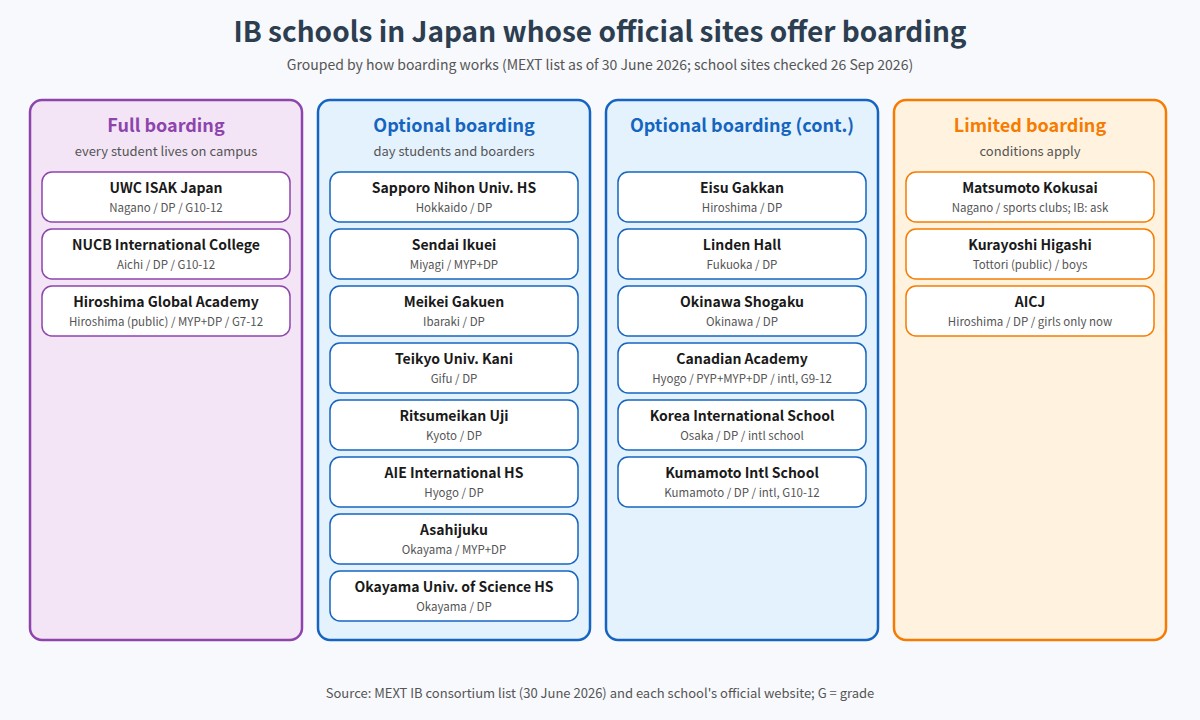
IB boarding schools in Japan are a real option if there is no IB school within reach of your home, if you are moving around for work, or if your child is simply ready for a bigger adventure. We checked every school on the Japanese Ministry of Education (MEXT) IB consortium list, as of 30 June 2026, and kept only those whose own official website says it offers a dormitory (寮, “ryo”) or boarding. The result is 20 schools, from a public school on an island in the Seto Inland Sea to a UWC college in Karuizawa.
For each school we asked what parents ask first: who may board, what the rooms are like, and what tuition and boarding cost. All facts come from the schools’ own pages and guides, checked on 26 September 2026; where something is not published, we say so.
What “boarding” means at Japanese IB schools
Boarding in Japan comes in three shapes.
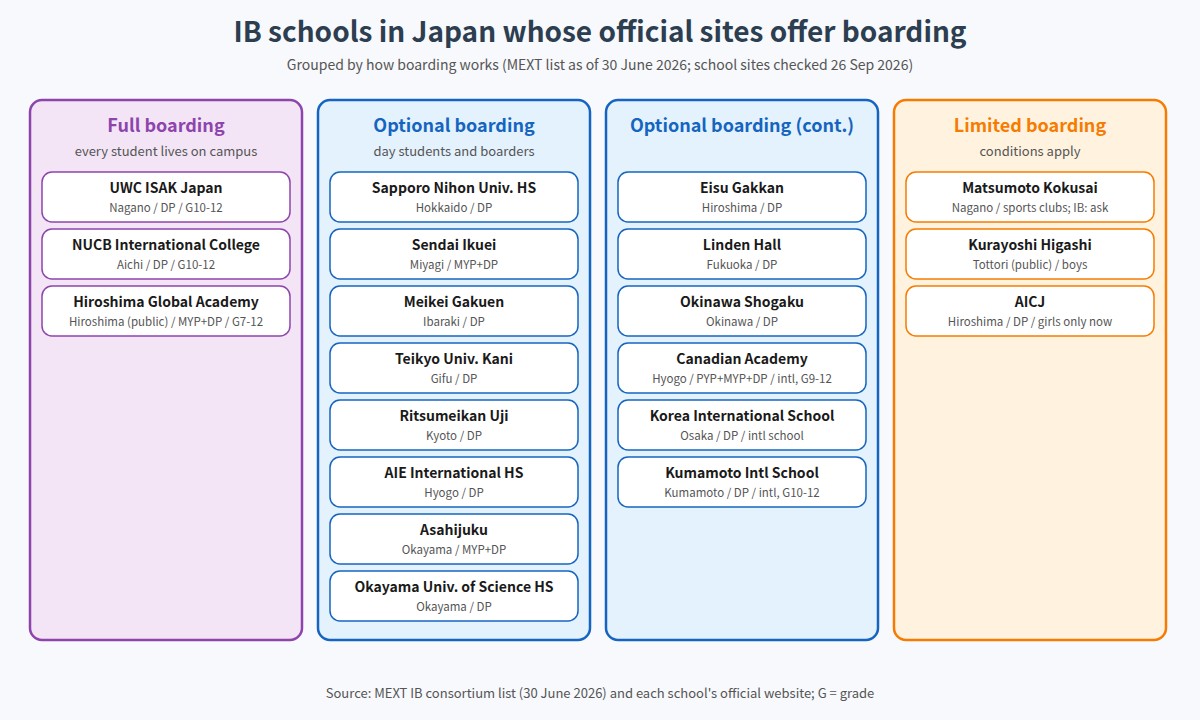
- Full boarding: every student lives on campus. On our list, UWC ISAK Japan, NUCB International College (国際高等学校) and Hiroshima Global Academy work this way.
- Optional boarding: most students commute, and a dormitory serves those who live far away. Most schools below work this way.
- Limited boarding: a dormitory exists, but only certain students may use it, for example members of particular sports clubs, boys from outside the prefecture, or only girls at the moment.
Another point that surprises many international families: 17 of the 20 schools are “Article 1” schools (一条校), recognised under Article 1 of Japan’s School Education Act. These schools follow the Japanese national curriculum alongside the IB, and many teach part of the Diploma Programme (DP) in Japanese. On the MEXT list, a double circle (◎) marks schools that run the Japanese-language DP. UWC ISAK, NUCB International College, Teikyo University Kani, Ritsumeikan Uji, AICJ and Linden Hall do not carry that mark, but it is still worth asking each school which subjects are taught in which language.
What about international schools? We also screened the 73 non-Article-1 schools on the MEXT list. Of the 31 that offer the MYP or DP, three describe boarding for their own students: Canadian Academy (Kobe), Korea International School (Osaka) and Kumamoto International School. We could not check Capital Tokyo International School; the other 27 showed no boarding on their homepages or main navigation.
All 20 schools at a glance
Figure 1 groups the schools; the table shows the latest published fees and their year.
| School | Prefecture | Article 1 | IB (MEXT list) | Boarding grades | Boarding + tuition in yen (latest published) |
|---|---|---|---|---|---|
| UWC ISAK Japan | Nagano | Yes | DP | G10-12, all board | 2026-27: 7,225,000 a year in total |
| NUCB International College (国際高等学校) | Aichi | Yes | DP | G10-12, all board | Tuition 2,100,000 + boarding 1,550,000 a year (no year stated) |
| Hiroshima Global Academy (広島叡智学園) | Hiroshima | Yes (public) | MYP, DP ◎ | G7-12, all board | Dorm 37,000 a month; HS tuition 9,900 a month (no year stated) |
| Sapporo Nihon University HS | Hokkaido | Yes | DP ◎ | High school (junior high: ask) | Dorm 68,000 a month from April 2026; IB tuition 33,000 a month (2025 amount) |
| Sendai Ikuei Gakuen HS | Miyagi | Yes | MYP, DP ◎ | Varies by dormitory | Not published for IB boarders |
| Meikei Gakuen HS | Ibaraki | Yes | DP ◎ | Junior and senior high | IBDP boarder 2,270,900 a year (2025 amounts) |
| Teikyo University Kani HS | Gifu | Yes | DP | IB course students | Not published |
| Ritsumeikan Uji HS | Kyoto | Yes | DP | High school | IB course 1,889,080 (2026); dorm 105,000 a month (no year stated) |
| AIE International HS | Hyogo | Yes (correspondence) | DP ◎ | High school (residence style) | 2026: 2,594,000 in year 1, IB costs extra |
| Asahijuku Secondary School | Okayama | Yes | MYP, DP ◎ | G7-12 | 2026: dorm 38,000 + meals 33,600 a month |
| Okayama University of Science HS | Okayama | Yes | DP ◎ | High school, selected | Room 23,000 a month + meals 1,160 a day (no year stated) |
| Eisu Gakkan HS | Hiroshima | Yes | DP ◎ | Mainly G7-12 | 2026: IB class 88,000 a month; boys’ rooms 20,000-38,000 a month |
| AICJ HS | Hiroshima | Yes | DP | Girls only at present | April 2026: IBDP 70,200 + dorm and meals 86,200 a month |
| Linden Hall School (中高学部) | Fukuoka | Yes | DP | Not stated (G7-12 school) | Tuition 110,000 + dorm 75,000-85,000 a month (2027 entry) |
| Okinawa Shogaku HS | Okinawa | Yes | DP ◎ | Junior and senior high | School fees 547,840 + IB 100,000 a year; dorm 65,200 or 92,700 (2026 guidebook) |
| Matsumoto Kokusai HS | Nagano | Yes | DP ◎ | Sports club members; IB: ask | 2026: dorm 35,000 a month + meals; tuition 38,000 a month |
| Canadian Academy | Hyogo | No (international school) | PYP, MYP, DP | G9-12 | 2026-27: boarding 3,500,000 + G9-11 tuition 3,240,000 a year |
| Korea International School (コリア国際学園) | Osaka | No (international school) | DP ◎ | Not stated | 2027 guide: dorm 900,000 a year + 80,000 entry; HS tuition 460,000 a year |
| Kumamoto International School | Kumamoto | No (international school) | PYP, DP | G10-12 | Dorm 95,000 a month + 100,000 entry (no year stated) |
| Kurayoshi Higashi HS | Tottori | Yes (public) | DP ◎ | Boys from outside Tottori | 2025: rent 40,000 + meals 30,000 a month |
We include a school if its site offers boarding IB students can use, or invites IB applicants to ask (as Matsumoto Kokusai does). Urawa Gakuin (soccer club dormitory) and Fukuoka Daiichi (club members only) are therefore not profiled.
School profiles
Full boarding
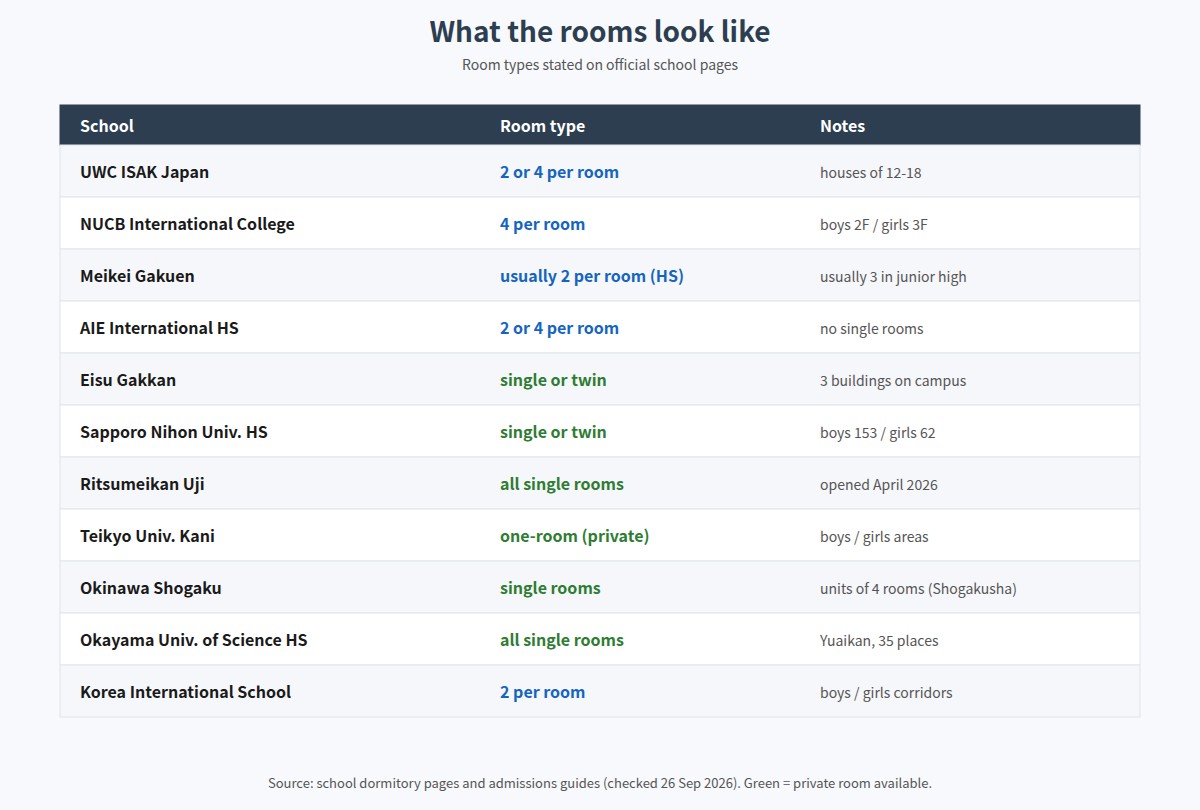
UWC ISAK Japan (Karuizawa, Nagano). A three-year English-language programme from Grade 10, with every student living on campus in “a two-person or four-person bedroom in a house for 12 to 18 students”. Most houses are single-gender; a blended house needs written parental consent. For 2026-27 the school lists tuition of 4,900,000 yen, boarding 1,825,000 yen and a facilities fee of 500,000 yen (7,225,000 yen in total), plus a one-time enrolment fee not shown on that page. It says it provides “approximately 600 million JPY in financial aid, with 70% of our students receiving some level of support”; aid is need-based and must be requested when applying for Grade 10.
NUCB International College (国際高等学校, Nisshin, Aichi). The school calls itself a “《全寮制》IB Boarding School” (full boarding). Entry is into Grade 10; applications for 2027 entry open on 1 October 2026; students move in in late August and classes start in early September. Students live four to a room, with boys and girls on separate floors, and the dormitory closes in the summer and winter breaks. The fee page lists a 500,000 yen entrance fee, then 2,100,000 yen tuition, 1,550,000 yen boarding (utilities and three meals included) and a 450,000 yen education fee a year, with no year stated.
Hiroshima Global Academy (広島叡智学園, Osakikamijima, Hiroshima). A public six-year island school with the MYP and DP. It takes 40 students into Grade 7 (in principle 20 boys and 20 girls), from anywhere in Japan, but the entrance test is in Japanese only. Its FAQ says the dormitory closes in long holidays, when “生徒全員が帰省” (all students go home). Junior high tuition is free; senior high tuition is 9,900 yen a month, other fees 18,000 yen and the dormitory 37,000 yen a month including about 30,000 yen for meals, all described as estimates.
Optional boarding in eastern and central Japan
Sapporo Nihon University High School (Hokkaido). Boys’ (153 places) and girls’ (62 places) dormitories within walking distance, with single and twin rooms. From April 2026 a single room costs 68,000 yen a month with three meals (girls’ twin 64,000 yen), plus 80,000 yen on entry. The 2026 admissions guide lists IB tuition of 33,000 yen a month and an IB course fee of 20,000 yen a month from January of Year 1, marked as 2025 amounts.
Sendai Ikuei Gakuen High School (Miyagi). IB sits in the Shuko course. The school lists several dormitories with staff on site; its July 2024 table shows Shuko course students in the Internat Fukudamachi boys’ dormitory. Dormitory fees are not published.
Meikei Gakuen High School (Tsukuba, Ibaraki). About 300 boarders (“300名程度”); high schoolers are “basically” two to a room. The 2026 guide accepts healthy students who can live in a group, including those whose parents live abroad, and recommends boarding if the commute exceeds 90 minutes. Its fees, marked as 2025 amounts, are 650,000 yen on entry for boarders, then 960,000 yen IBDP tuition and 1,066,700 yen for dormitory and meals a year, among other items.
Teikyo University Kani High School (Gifu). The IB course has an international residence (completed summer 2022) with “one-room” private rooms, separate boys’ and girls’ areas, three meals and resident advisers; commuting from home is also possible. Fees are not published online.
Optional boarding in western Japan
Ritsumeikan Uji High School (Kyoto). A new on-campus dormitory opened in April 2026, “立命館宇治高等学校生専用” (for the high school’s students only), with all single rooms, resident house masters, breakfast and dinner. It lists 69,000 yen a month for the room and 36,000 yen for meals, plus electricity, communications and 250,000 yen at the start. The 2026 fee sheet puts the IB course at 1,889,080 yen for students joining in high school.
AIE International High School (Awaji Island, Hyogo). A correspondence, credit-based high school (still Article 1). IB students choose the residence style or five-day commuting. The dormitory holds 14 boys and 14 girls in rooms for two or four, with no single rooms. The 2026 guide gives a residence-style first-year total of 2,594,000 yen and says IB course costs are set out separately.
Asahijuku Secondary School (Okayama). The dormitory takes Grades 7 to 12, and students may go home at weekends. The 2026 guide lists 85,000 yen on entry (entry and maintenance fees), then 38,000 yen a month for the dormitory and 33,600 yen for meals; the dormitory page quotes 35,000 yen for a single room, so ask which applies.
Okayama University of Science High School (Okayama). The Yuaikan dormitory has 35 places in single rooms, with boarders selected by essay and geographic factors. It costs a 30,000 yen donation on entry, 23,000 yen a month plus 1,160 yen a day for meals, and electricity at cost (no year stated).
Eisu Gakkan High School (Fukuyama, Hiroshima). Three dormitory buildings on campus with single or twin rooms, mainly for Grades 7 to 12. The 2026 guide lists the IB class at 88,000 yen a month plus a 300,000 yen DP fee in Years 2 and 3; boys’ rooms cost 20,000 to 38,000 yen a month plus about 1,600 yen a day for meals.
Linden Hall School, Secondary Division (Fukuoka). Regular entry is into Grade 7 only; later transfers depend on space. Boarding is 100,000 yen on entry and 85,000 yen a month (boys) or 75,000 to 85,000 yen (girls), on top of 138,500 yen a month in school fees (110,000 yen tuition, a 25,000 yen global education fee and 3,500 yen in association fees). Foreign nationals who need a student visa and wish to board pay an 85,000 yen monthly “Global Student” fee. It also lists 15,000 yen a month in language-trip savings and a lunch fee (optional from Grade 10). Fees are those listed for 2027 entry.
Okinawa Shogaku High School (Naha). Several dormitories take students from outside Okinawa and the islands. Shogakusha groups four single rooms into a unit. The 2026 guidebook lists school fees of 547,840 yen a year, an extra 100,000 yen IB fee, and dormitory fees of 65,200 or 92,700 yen with three meals (billing period not printed; ask).
Limited boarding
Matsumoto Kokusai High School (Nagano). The 150-place dormitory is mainly for members of specific sports clubs; the 2026 guide asks IB students who want to board to contact the school first. Boarding is 60,000 yen on entry and 35,000 yen a month, meals extra.
AICJ High School (Hiroshima). The dormitory page states “男子生徒の入寮は現在受け付けておりません” (boys are not being accepted at present), so for now this is an option for girls. Fees as of April 2026: 270,000 yen on entry, IBDP fees of 70,200 yen a month, a 55,000 yen dormitory entry fee, and 86,200 yen a month for dormitory and meals.
Kurayoshi Higashi High School (Tottori). The site says “県外生用の男子寮あります” (a boys’ dormitory for students from outside the prefecture) and asks girls to contact the school. The dormitory, shared with two other local high schools, has ten single rooms; the 2025 leaflet lists 40,000 yen rent and 30,000 yen for meals a month.
Boarding at international schools
Canadian Academy (Kobe, Hyogo). An international school with the PYP, MYP and DP. Its boarding page describes “a tight-knit and truly international group of 40 students, representing 21 nationalities”, with dorm parents living next door. The brochure form lists Grades 9 to 12. For 2026-27 it lists boarding at 3,500,000 yen and Grades 9-11 tuition at 3,240,000 yen, plus the fees in the cost table below.
Korea International School (コリア国際学園, Ibaraki, Osaka). Its residence page describes rooms for two (「2人部屋」), breakfast and dinner every day including Sundays and holidays, a resident dormitory supervisor, and boys’ and girls’ corridors separated by movable partitions. The 2027 admissions guide adds 80,000 yen on entry and 900,000 yen a year for boarders, subject to space; high school tuition is 460,000 yen a year.
Kumamoto International School (Kumamoto). A dormitory for Grades 10 to 12, run with Kyoritsu Maintenance near Suizenji Station, with resident staff. It costs 95,000 yen a month including breakfast and dinner, plus a 100,000 yen entry fee (no year stated).
Costs compared: an illustrative first year
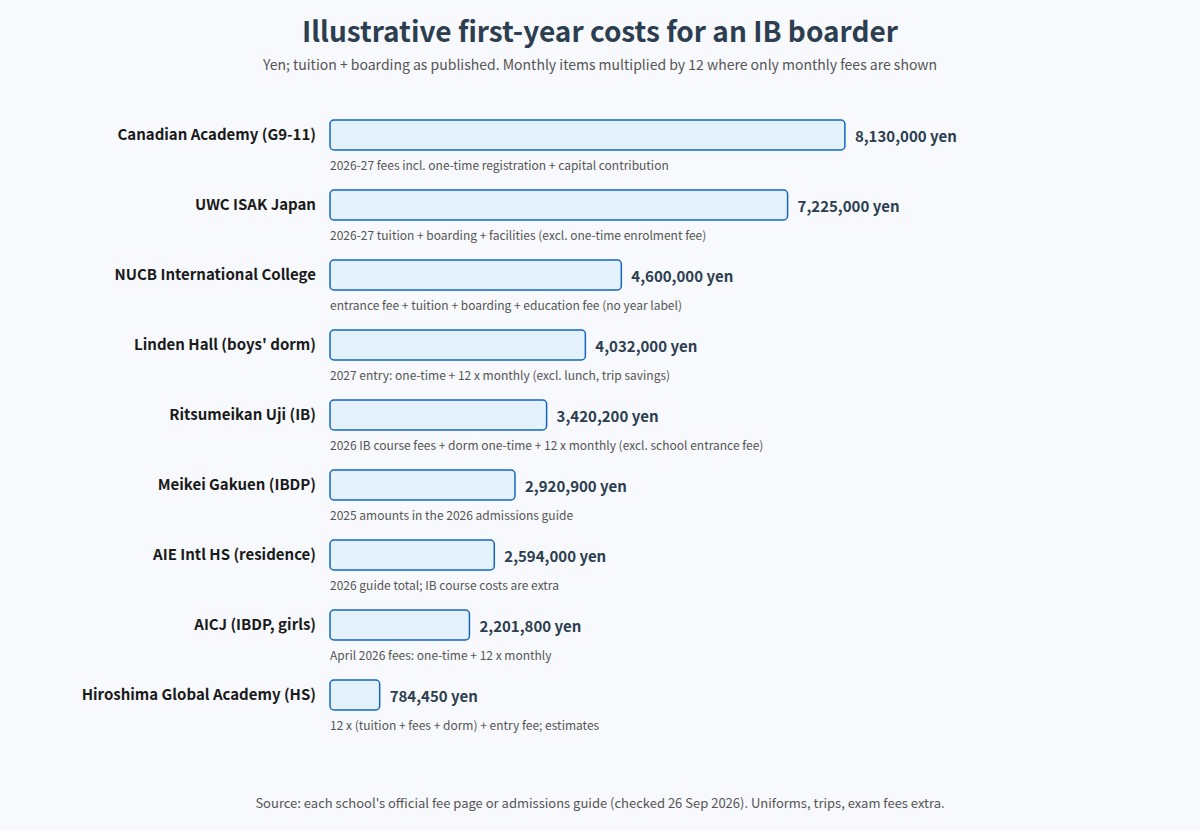
Schools publish costs by the year, by the month, or for last year. Figure 2 adds up tuition, boarding and one-time fees for nine schools that publish enough detail. Where only monthly amounts are given we multiplied by 12, which may overstate costs if holidays are not billed. Treat these as rough guides.
| School | How we added it up | Year 1 total (yen) |
|---|---|---|
| Canadian Academy (Grades 9-11) | 90,000 + 400,000 + 600,000 + 300,000 + 3,240,000 + 3,500,000 (2026-27) | 8,130,000 |
| UWC ISAK Japan | 4,900,000 + 1,825,000 + 500,000 (2026-27), before aid and the one-time enrolment fee | 7,225,000 |
| NUCB International College | 500,000 + 2,100,000 + 1,550,000 + 450,000 (4,100,000 in later years) | 4,600,000 |
| Linden Hall (boys’ dorm) | 1,250,000 entry fees + 100,000 dorm entry + 12 x (138,500 school + 85,000 dorm), 2027 entry; excludes school lunch and language-trip savings | 4,032,000 |
| Ritsumeikan Uji (IB course) | 1,889,080 + 250,000 + 12 x (69,000 + 36,000 + 1,760); school entrance fee (入学金) and electricity not included | 3,420,200 |
| Meikei Gakuen (IBDP boarder) | 650,000 on entry + 1,204,200 school fees + 1,066,700 dormitory (2025 amounts) | 2,920,900 |
| AIE International HS (residence) | Total printed in the 2026 guide; IB course costs extra | 2,594,000 |
| AICJ (IBDP, girls) | 270,000 + 55,000 + 12 x (70,200 + 86,200) | 2,201,800 |
| Hiroshima Global Academy (high school) | 5,650 entry fee + 12 x (9,900 + 18,000 + 37,000); estimates | 784,450 |
The gap is wide: the public Hiroshima Global Academy costs roughly a tenth of Canadian Academy’s or UWC ISAK’s published fees, and even less for families who qualify for tuition support. And with 70% of UWC ISAK students receiving aid, its published figure is not what many families pay. Eligible households can also receive Japan’s national high school tuition support (高等学校等就学支援金), which several guides mention.
These totals leave out uniforms, laptops, textbooks, trips, IB exam fees and travel home.
How to decide
With 20 schools, it helps to narrow the list in three steps, shown in Figure 3.
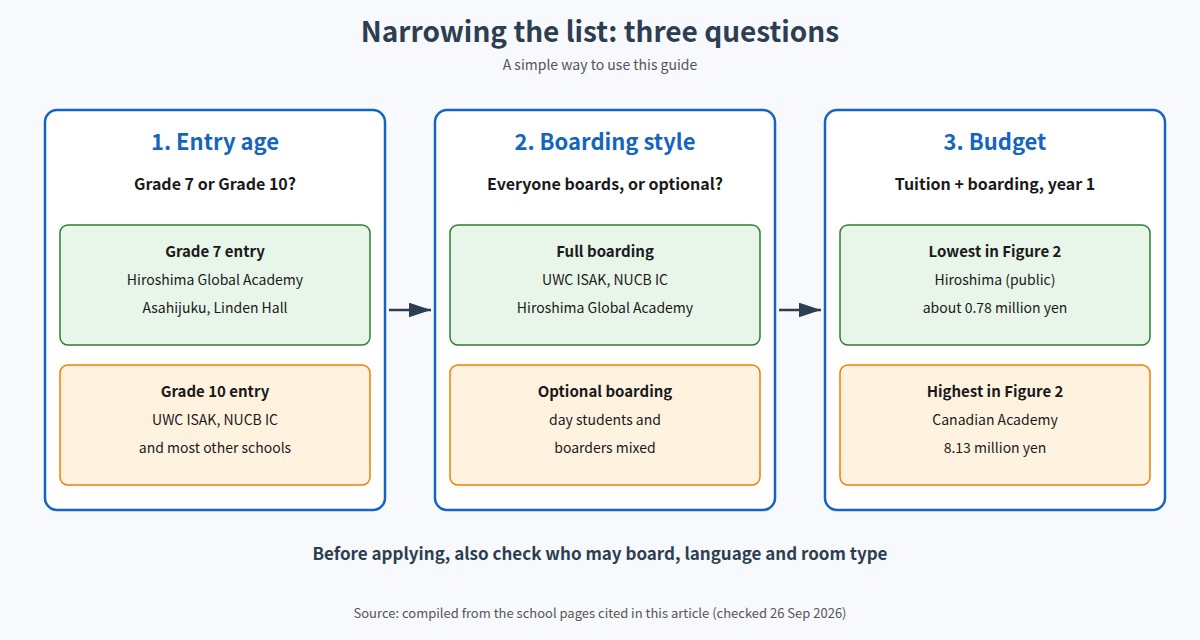
- Entry age: Hiroshima Global Academy and Linden Hall take their main intake at Grade 7, and Asahijuku’s dormitory starts from the first year of junior high. UWC ISAK and NUCB International College start at Grade 10, and Canadian Academy’s boarding brochure lists Grades 9 to 12.
- Boarding style: in full boarding everyone shares one routine; in optional boarding, ask how many boarders there are and what happens at weekends.
- Budget: use Figure 2 as a rough guide, then ask for this year’s figures.
Before you apply, also check:
- Who may board: gender, grade, club and distance rules. AICJ is girls only for now, Matsumoto Kokusai is mainly for sports club members, and Kurayoshi Higashi is for boys from outside Tottori.
- Language: if your child needs an English-language DP, start with schools without the ◎ mark and confirm the language of each subject.
- Room type: some children love a shared room, others need a door to close. Figure 4 shows what each school states.
See also our list of IB World Schools in Japan by programme and prefecture and our guide to public, private and international IB schools.
Questions parents often ask
Can my child come home at weekends?
Often, yes, but rules differ. Hiroshima Global Academy allows going home or out during set hours on days off, Asahijuku allows weekends at home, and NUCB International College does not allow overnight stays away. Ask for the written dormitory rules.
Do dormitories stay open in the holidays?
Not always. Hiroshima Global Academy closes its dormitory in Golden Week and the summer, autumn, winter and spring breaks; NUCB International College closes in the summer and winter breaks. If you live abroad, ask where your child would stay.
My child does not speak Japanese. Which schools are realistic?
Start with Canadian Academy and UWC ISAK, which teach in English, and with Teikyo University Kani, whose FAQ says all IB course subjects except Japanese are taught in English. NUCB International College and Linden Hall are also worth a look; Linden Hall’s page says students below a certain Japanese proficiency level take Japanese supplementary lessons. At Japanese schools, even in an English DP class, dormitory life and some subjects may be in Japanese, and Hiroshima Global Academy’s entrance test is in Japanese only.
Summary
- 20 schools on the MEXT IB list (as of 30 June 2026) offer boarding on their official sites: 17 Article 1 schools and three international schools.
- Full boarding: UWC ISAK Japan, NUCB International College and the public Hiroshima Global Academy.
- Costs vary widely: from about 0.78 million yen in an illustrative first year at Hiroshima Global Academy to 8,130,000 yen at Canadian Academy and 7,225,000 yen at UWC ISAK before financial aid (2026-27).
- Check the conditions: gender, grade, club membership and distance rules decide who can board, and some fee tables are last year’s amounts.
- Visit the dormitory: ask to see it and, if possible, talk to a boarder.
Boarding is a big step, and fit matters more than any ranking.
Sources and references
- MEXT IB Education Promotion Consortium: IB schools in Japan (as of 30 June 2026)
- UWC ISAK Japan: Fees and Financial Assistance (2026-27) and Boarding School Life
- NUCB International College: 学納金 (fees), 国際寮 and 入試情報
- Hiroshima Global Academy: Admissions, fees and FAQ
- Sapporo Nihon University HS: 学生寮 and 2026 admissions guide (PDF)
- Sendai Ikuei Gakuen: 学園寮 and IBDP
- Meikei Gakuen: 2026 high school admissions guide (PDF) and dormitory facilities
- Teikyo University Kani: 国際寮 and Q&A
- Matsumoto Kokusai HS: 2026 admissions guide (PDF)
- Ritsumeikan Uji Dormitory and Ritsumeikan Uji: 2026 fees (PDF)
- AIE International HS: 寮 and 2026 admissions guide (PDF)
- Asahijuku: 生徒寮 and 2026 returnee admissions guide (PDF)
- Okayama University of Science HS: 寮について
- Eisu Gakkan: 生徒寮について and 2026 admissions guide (PDF)
- AICJ: 寮 and 学費・寮費
- Linden Hall School Secondary Division: 入学案内
- Okinawa Shogaku: キャンパス・学生寮 and 2026 School Guidebook (PDF)
- Kurayoshi Higashi HS: 学校紹介 and 倉吉寮 leaflet (2025)
- Canadian Academy: Tuition and Fees (2026-27), Dorms and Surroundings and Support and Wellbeing
- Korea International School: 寄宿舎生活 and 2027 guide (PDF)
- Kumamoto International School: Dormitory (Grades 10-12)
- Fukuoka Daiichi HS: FAQ
コメント