Australia and Canada often come up when families in Japan start thinking beyond the United States and the United Kingdom for university. Both countries accept the IB Diploma directly, both publish clear rules for how they read IB results, and Canada in particular may turn strong Higher Level (HL) grades into university credit. If your child is in the Diploma Programme (DP) at a school in Japan and you are wondering what “applying to Australia or Canada” actually involves, this guide is for you.
This guide covers how each country reads IB results, how to apply from Japan, deadlines and intakes, tuition examples, and the Student visa and study permit, followed by a Grade 10 to Grade 12 timeline. We used only what universities, admissions centres and the two governments publish, all checked on 26 September 2026. Amounts are in Australian and Canadian dollars as published (yen amounts move with the exchange rate), and rules change every year, so please confirm each official page before applying.
- How the two systems differ
- Australia: how IB scores are converted into a rank
- Australia: how a student in Japan applies
- Australia: IB score and tuition examples at three universities
- Australia: the Student visa (subclass 500)
- Canada: how applications work
- Canada: IB requirements and HL transfer credit at four universities
- Canada: Fall 2027 deadlines
- Canada: tuition examples for international students (2026-27)
- Canada: the study permit, PAL/TAL and proof of funds
- A Grade 10 to Grade 12 timeline for a DP student in Japan
- Questions parents often ask
- Summary
- Sources and references
How the two systems differ
In Australia, selection for school leavers is mostly based on one number, the ATAR (Australian Tertiary Admission Rank) or a university’s “selection rank”, and an IB total is converted onto the same scale. In Canada there is no national rank: each university, often each programme, sets its own IB requirements and prerequisite subjects, and may award first-year credit for HL results. Put simply, Australia is mostly about the total, while Canada is about the total plus the right subjects at the right level.
Australia: how IB scores are converted into a rank
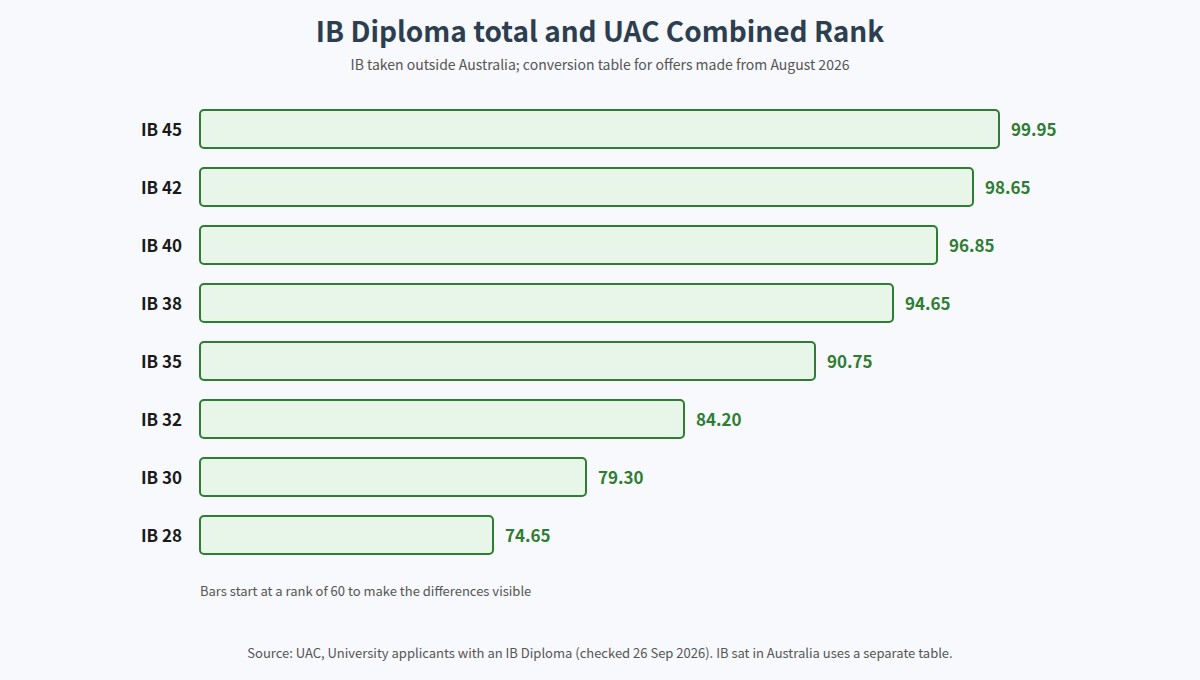
The Universities Admissions Centre (UAC), which handles applications for universities in New South Wales and the Australian Capital Territory, publishes a table that converts the IB Diploma total into a “Combined Rank”. The table that applies to your child is the one “for all applicants except those sitting the IB in Australia since November 2022”, which covers a DP taken at a school in Japan. According to UAC, it is used for offers made from August 2026. IB students who sit the exams in Australia use a different table with decimal scores, so please do not mix the two.
| IB Diploma total (out of 45) | UAC Combined Rank (offers from August 2026) |
|---|---|
| 45 | 99.95 |
| 42 | 98.65 |
| 40 | 96.85 |
| 38 | 94.65 |
| 35 | 90.75 |
| 32 | 84.20 |
| 30 | 79.30 |
| 28 | 74.65 |
| 24 | 64.60 |
Source: UAC, “University applicants with an IB Diploma” (checked 26 September 2026); selected rows of the 24 to 45 table.
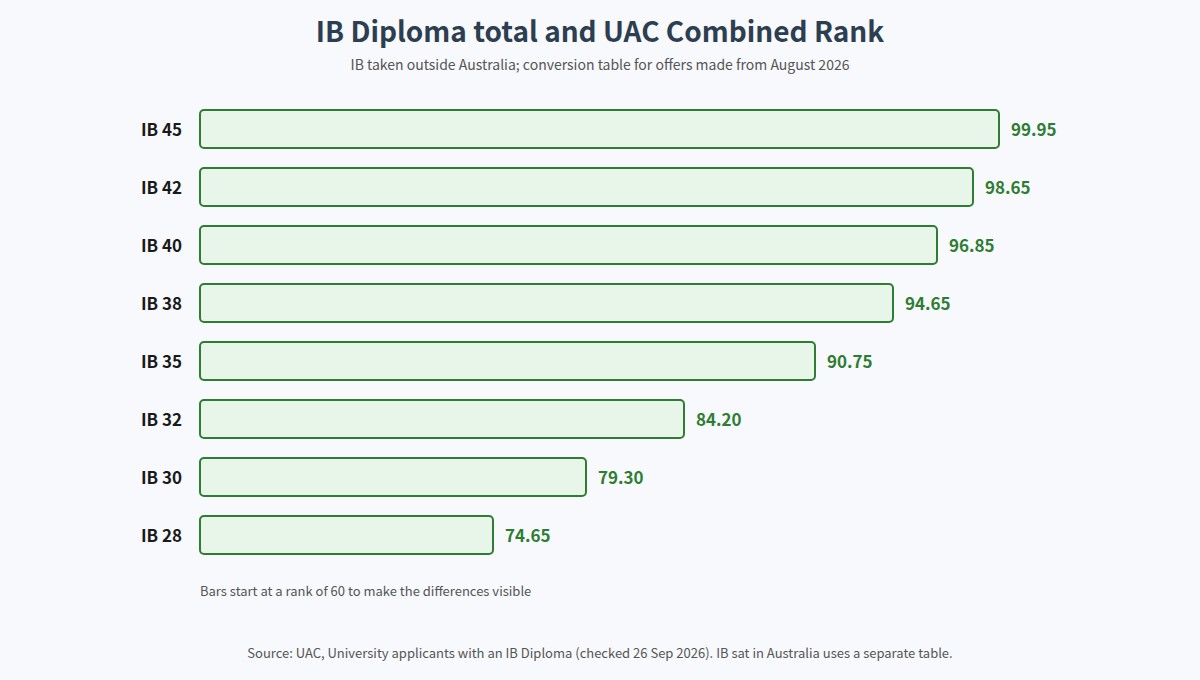
As Figure 1 shows, moving from 35 to 40 points lifts the rank from 90.75 to 96.85, while each extra point above 40 adds less. This is a conversion, not an offer: each course still sets its own selection rank, prerequisites and English requirement.
Australia: how a student in Japan applies
The route depends on the university rather than the country. Here is what three universities say.
- The University of Sydney: “Most international students apply directly” to the university. The UAC route is required only for students studying an Australian Year 12 qualification or “an International Baccalaureate (IB) diploma in Australia”.
- The Australian National University (ANU): its international applications page says that students completing the International Baccalaureate “should submit your application through the Universities Admissions Centre (UAC)”, and that UAC application fees apply.
- UNSW Sydney: its international application page says that “International students currently undertaking one of the following qualifications need to apply for undergraduate courses through Universities Admissions Centre (UAC)”, and the list includes “an International Baccalaureate Diploma”. Please confirm with UNSW.
In Victoria and Queensland, the admissions centres VTAC and QTAC are mainly for students taking Australian Year 12 or the IB in Australia; international students with an overseas qualification generally apply directly.
Intakes: February and July
The main intake is Semester 1 (February or March), and many courses also have a mid-year intake in July or August. The University of Sydney, for example, lists Semester 1 (February) with applications closing on “1 December of the year prior to commencement”, and Semester 2 (August) closing on “29 May of the commencing year”. ANU’s Semester 1 2027 applications close on 15 December 2026.
Exam timing matters here. May-session results come out in early July, after the Australian year has started, so a May 2027 candidate usually looks at a mid-year 2027 intake (where offered and where an offer can be made in time) or Semester 1 2028. November-session results come out in early January, which fits a February or March start better, although applications still go in on predicted grades before the December closing dates.
Australia: IB score and tuition examples at three universities
Please read the brackets carefully: these are not all the same kind of figure.
| University and course | IB figure (what it means) | International tuition (year, as published) |
|---|---|---|
| University of Sydney, Bachelor of Commerce (3 years, February or August start) | 38 (IB Diploma entry score in the 2026 International Admission Guide); English: IELTS Academic 7.0 overall with 6.0 in each band | 56,300 Australian dollars (2026 indicative Year 1 fee per full-time load) |
| UNSW Sydney, Bachelor of Science | 31 (“an indication of the IB you would have needed to gain entry to this degree in 2026”, guide only) | 61,000 Australian dollars (2026 indicative first-year fee); 194,000 Australian dollars indicative to complete the degree |
| ANU, Bachelor of Commerce | 31 (listed on the 2027 programme page next to a selection rank of 80; ANU guarantees entry at a selection rank of 80 or above, subject to prerequisites) | 57,640 Australian dollars (annual indicative fee on the 2027 programme page) |
Sources: University of Sydney 2026 International Admission Guide; UNSW Bachelor of Science page; ANU Programs and Courses 2027, Bachelor of Commerce (all checked 26 September 2026). Tuition excludes health cover and living costs.
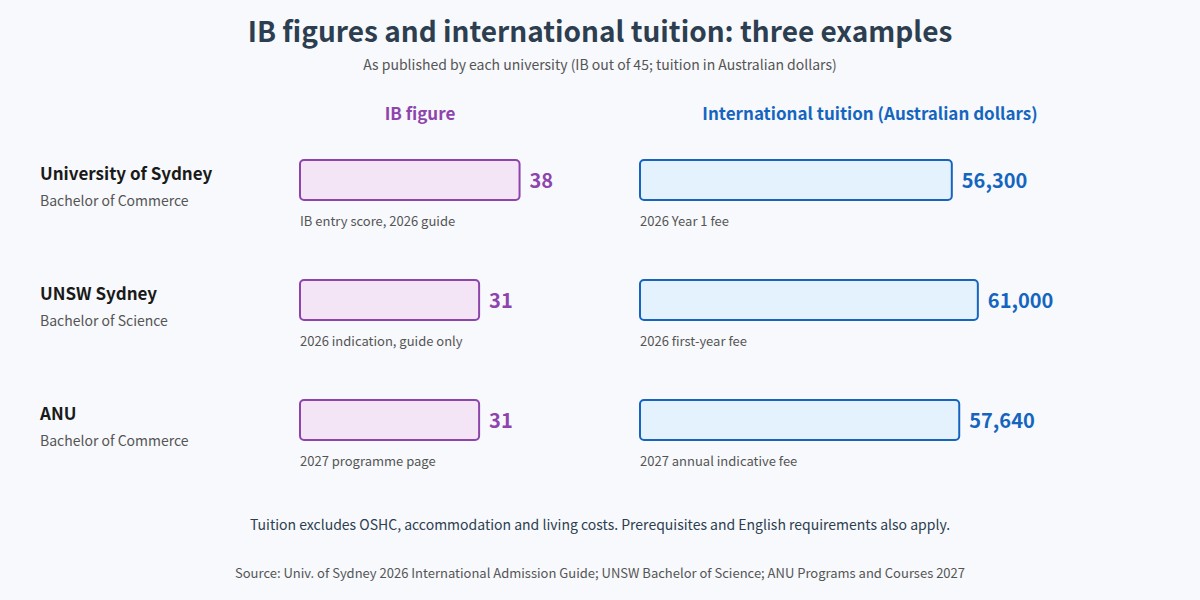
As Figure 2 shows, the IB figures range from 31 to 38 for these three courses, and first-year international tuition sits between about 56,000 and 61,000 Australian dollars. A published IB figure is a guide, not a promise, and 2027 or 2028 entrants will pay the fee schedule for their own start year.
Australia: the Student visa (subclass 500)
Once your child has an offer and a Confirmation of Enrolment (CoE), the next step is the Student visa (subclass 500). The key points from the Department of Home Affairs:
- Visa application charge: under the Home Affairs Legislation Amendment (2026 Measures No. 1) Regulations 2026 (F2026L00874), the base charge for a primary applicant increased from 2,000 to 2,500 Australian dollars from 1 July 2026.
- Financial capacity: if your child is asked to show funds, Home Affairs lists 12-month living costs of 29,710 Australian dollars for a student, plus the first 12 months of course fees (less anything already paid) and travel costs. As a guide for applicants outside Australia (other than parts of Africa), it suggests 2,000 Australian dollars for travel.
- Health cover: students must hold Overseas Student Health Cover (OSHC), and cover must start from the day they arrive in Australia, not the day the course starts.
- Students under 18: applicants under 18 must show a welfare arrangement. Check this if your child will still be 17 at the start.
- Genuine Student requirement: applicants explain their reasons for studying in Australia.
- Work: the visa allows work of up to 48 hours a fortnight while the course is in session.
Canada: how applications work
There is no national application system; the portal depends on the province.
- Ontario (for example, the University of Toronto, the University of Waterloo and McMaster University): applications go through OUAC, the Ontario Universities’ Application Centre. Applicants who are not at an Ontario high school, including IB students at schools in Japan, normally apply as “Group B” (formerly called the “105” application).
- British Columbia (for example, UBC): through the university’s online application.
- Quebec (for example, McGill University): directly through the university’s application portal.
Canadian universities usually make their first decisions on the high school transcript and IB predicted or interim grades, and then confirm the offer when final results arrive. UBC, for example, uses final IB results “to confirm your admission decision and any first-year credit you may be eligible for”.
Canada: IB requirements and HL transfer credit at four universities
This is where Canada gets interesting: several universities may award first-year credit for good HL results, which can mean fewer courses to take later.
| University | IB admission basics | Credit for IB results |
|---|---|---|
| University of Toronto | Minimum: the IB Diploma with English at HL or SL; prerequisites depend on the area of study | Arts & Science (St. George), UTM, UTSC and some other divisions may award up to 3.0 full credits for HL exams with a minimum grade of 5; no credit for SL; no IB transfer credit in Applied Science & Engineering |
| UBC | General and degree-specific requirements vary by campus and degree; no single IB cut-off is published | First-year credit is assessed course by course on the final IB results (HL and some SL subjects, with minimum grades set per subject) |
| McGill University | “The Diploma with grades of 5 or better on each Higher and Standard Level subject is the minimum expected for most programs”; many programmes require higher grades | “A maximum of 30 credits of advanced standing may be granted for the International Baccalaureate Diploma” |
| University of Waterloo | Six IB courses with at least three at HL; totals and prerequisites vary by programme | Considered for individual HL courses with normally a minimum final grade of 5; for example, up to 4.0 units in the Faculty of Arts for full Diploma holders; no first-year exemptions for IB courses in Engineering programmes other than Architecture |
Sources: University of Toronto (IB requirements, transfer credit), UBC (International Baccalaureate), McGill (IB requirements), University of Waterloo (IB transfer credit), all checked 26 September 2026.
The practical message: HL results can matter twice in Canada, for admission and for possible credit (often from a grade of 5), although the grades needed differ by university, programme and subject. It pays to choose HL subjects that match the intended programme.
Canada: Fall 2027 deadlines
- University of Toronto: 15 January for most faculties (including Arts & Science at St. George), with a recommended early application date of 7 November.
- UBC: application deadline 15 January 2027 (11:59 p.m. Pacific time). High school applicants from outside Canada must submit required documents by 15 March 2027.
- McGill: application 15 January; supporting documents 1 March.
- University of Waterloo: Engineering programmes other than Architecture, 15 January 2027 (documents 1 February 2027); most other programmes, 1 February 2027 (documents 15 February 2027).
- McMaster University: deadlines vary by programme and applicant group, and are listed programme by programme in the OUAC guide for 2027 entry.
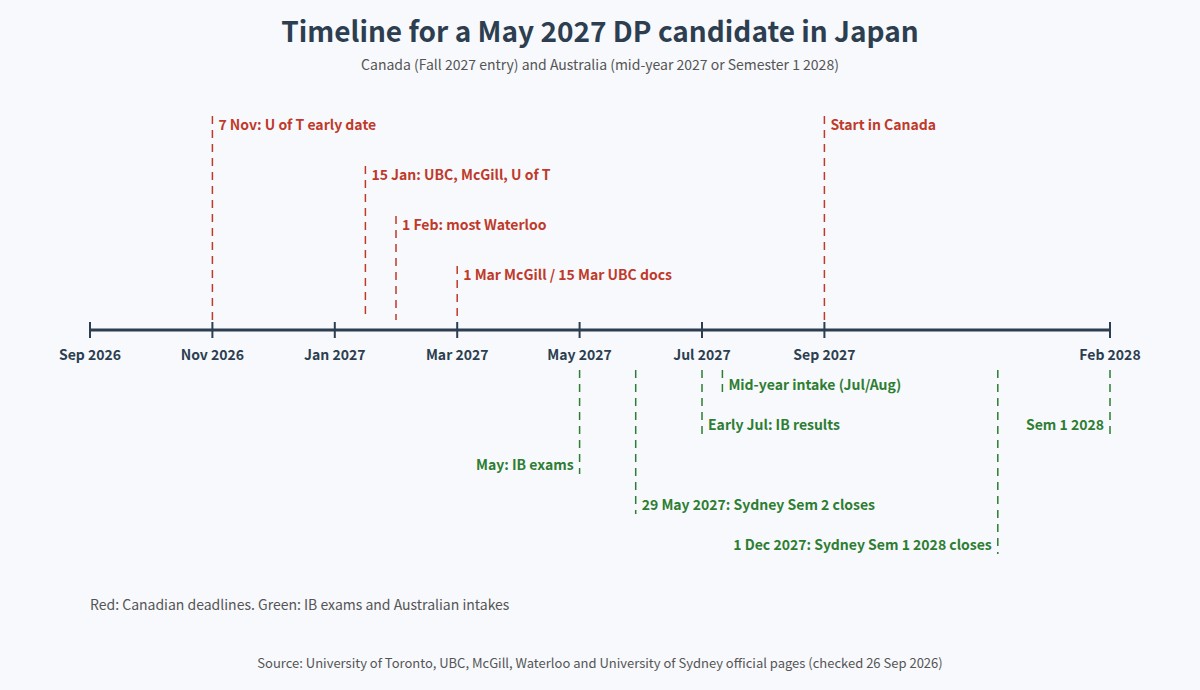
Figure 3 puts these dates on one line with the Australian intakes.
Canada: tuition examples for international students (2026-27)
These are 2026-27 fees; Fall 2027 entrants should check the 2027-28 amounts once published.
| University and programme | International fees, 2026-27 |
|---|---|
| UBC Vancouver, Arts | 1,717.68 Canadian dollars per credit; 51,530.40 Canadian dollars for a 30-credit year (tuition only) |
| McGill, Bachelor of Arts (admitted Fall 2026) | Tuition 54,000 Canadian dollars; total fees including student fees and international health insurance 57,646.94 Canadian dollars |
| University of Toronto, Arts & Science (St. George), Year 1 | Programme fee 66,110 + incidental and system access fees 2,842.93 + UHIP 948 = 69,900.93 Canadian dollars |
| University of Waterloo, Faculty of Arts, first year | About 58,000 Canadian dollars for two terms (tuition and incidental fees, based on September 2026 starters), plus about 1,500 Canadian dollars for books and supplies |
Sources: UBC Vancouver Academic Calendar (undergraduate tuition fees); McGill Student Accounts (Bachelor of Arts); University of Toronto Tuition Explorer 2026-27; University of Waterloo (first-year tuition estimates). All checked 26 September 2026.
Canada: the study permit, PAL/TAL and proof of funds
After an offer, your child applies to Immigration, Refugees and Citizenship Canada (IRCC) for a study permit.
- Provincial or territorial attestation letter (PAL/TAL): IRCC says a PAL/TAL is “usually required” to apply for a study permit. The listed exemptions include master’s and doctoral programmes at public institutions from 1 January 2026, but not bachelor’s degrees, so an undergraduate outside Quebec will normally need one. The letter comes through the university and is valid for the cap year in which it is issued; 2027 rules had not been published when we checked.
- Quebec: students going to a Quebec university such as McGill need a Quebec Acceptance Certificate (CAQ) instead of a PAL/TAL.
- Proof of funds: for applications made on or after 1 September 2026, a single student going to any province other than Quebec must show 23,448 Canadian dollars a year for living expenses (up from 22,895 Canadian dollars). This is in addition to first-year tuition and transport to and from Canada. For Quebec, the provincial government sets 24,617 Canadian dollars for one person for one year (applications from 1 January 2026), again separate from tuition and transport.
- Fees: the study permit application fee is 150 Canadian dollars, and biometrics, when required, cost 85 Canadian dollars per person.
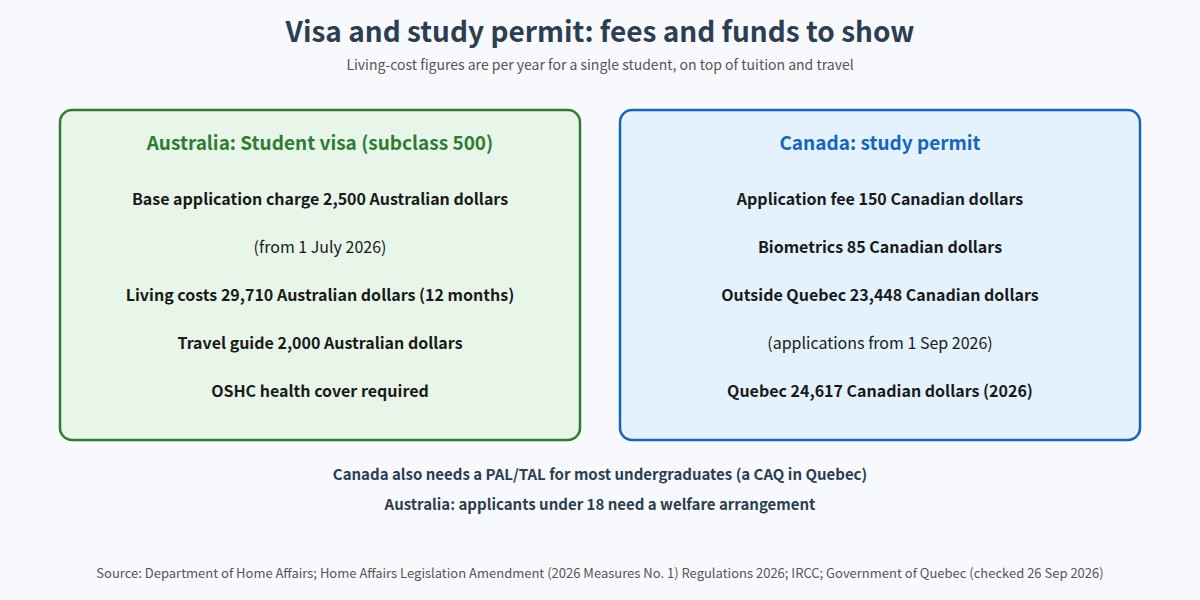
As Figure 4 shows, the funds you need to demonstrate are larger than the fees themselves. A simple example for Canada: a student going to UBC Arts would show first-year tuition of 51,530.40 Canadian dollars (2026-27 rate) plus living expenses of 23,448 Canadian dollars, which comes to 74,978.40 Canadian dollars before travel and student fees.
A Grade 10 to Grade 12 timeline for a DP student in Japan
Here is a practical timeline for a student who will sit the May 2027 exams, using the deadlines above. School calendars in Japan differ (many international schools start in August, Japanese schools in April), so adapt the months to your child’s school.
- Grade 10 (before the DP): choose HL and SL subjects with both countries in mind. Check programme prerequisites (for example, mathematics for commerce or science).
- Grade 11 (DP year 1): build strong grades, because the transcript is part of the early decisions in Canada. Shortlist universities and take IELTS or another accepted test if required.
- Grade 12, September to November 2026: ask the school about predicted grades and transcripts; open Canadian applications (the University of Toronto recommends applying by 7 November).
- December 2026 to February 2027: submit Canadian applications by 15 January (UBC, McGill, Toronto, Waterloo Engineering) or 1 February (most Waterloo programmes; Waterloo documents are due 1 or 15 February 2027). For Australia, note the closing dates for your intake (at Sydney, 29 May 2027 for Semester 2 2027 and 1 December 2027 for Semester 1 2028, following its published rule).
- March to May 2027: submit documents (McGill 1 March, UBC 15 March for applicants outside Canada); receive offers; sit the IB exams in May.
- July 2027 onwards: final IB results confirm the offer; apply for the Canadian study permit with the documents described above. For an Australian mid-year start, the visa needs a CoE and there is very little time after early-July results, so ask the university early how it handles timing; Semester 1 2028 entrants have several months.
Questions parents often ask
Q. What IB score does my child need for Australia?
It depends on the university and course. In our examples, the published IB figures were 31 (UNSW Science, ANU Commerce) and 38 (Sydney Commerce). Using UAC’s table, 35 points converts to a Combined Rank of 90.75 and 40 points to 96.85. Prerequisite subjects and English requirements apply as well.
Q. Can HL subjects really count as university credit?
In Canada, they can (see the table above), but conditions differ by programme and Engineering is often excluded, so read the page for your child’s intended programme.
Q. Can my child start university in 2027 if the exams are in May 2027?
For Canada, yes: the Fall 2027 cycle is built around predicted grades and final results in July. For Australia, a May 2027 candidate will usually look at a mid-year 2027 intake where available, or at Semester 1 in February or March 2028.
Summary
- Australia converts the IB total into a rank: in UAC’s table for IB taken outside Australia, 40 points is 96.85 and 35 points is 90.75 (offers from August 2026).
- The route depends on the university: Sydney takes direct applications; ANU and UNSW ask IB Diploma students to use UAC.
- Australian examples: IB figures of 31 to 38 and first-year international tuition of 56,300 to 61,000 Australian dollars at Sydney, UNSW and ANU.
- Canada rewards strong HL grades: HL grades of 5 or above matter for admission and may earn first-year credit (up to 30 credits at McGill).
- Canadian deadlines for Fall 2027: mostly 15 January 2027 (1 February for most Waterloo programmes).
- Plan the funds early: 29,710 Australian dollars a year for living costs in Australia, and 23,448 Canadian dollars (outside Quebec) or 24,617 Canadian dollars (Quebec) in Canada, on top of tuition and travel.
A good first step is to sit down with your child and one programme page from each country, noting prerequisites, the IB figure and the deadline.
Sources and references
- UAC: University applicants with an IB Diploma (checked 26 September 2026)
- VTAC: Quick start guide for international students
- University of Sydney: Application dates
- University of Sydney: 2026 International Admission Guide (PDF)
- UNSW Sydney: Bachelor of Science
- UNSW Sydney: How to apply (international)
- ANU: International applications
- ANU: Bachelor of Commerce (Programs and Courses 2027)
- Department of Home Affairs: Student visa (subclass 500)
- Federal Register of Legislation: Home Affairs Legislation Amendment (2026 Measures No. 1) Regulations 2026, explanatory statement
- OUAC: Undergraduate Application Guide
- OUAC: McMaster University programmes and deadlines
- University of Toronto: Requirements for international high schools
- University of Toronto: Transfer credits for high school students
- University of Toronto: Deadlines
- University of Toronto: Tuition Explorer (2026-27)
- UBC: International Baccalaureate
- UBC: Dates and deadlines
- UBC Vancouver Academic Calendar: Undergraduate tuition fees
- McGill University: IB admission requirements
- McGill Student Accounts: Bachelor of Arts fees
- University of Waterloo: Deadlines
- University of Waterloo: IB transfer credit
- University of Waterloo: Tuition estimates
- IRCC: Provincial or territorial attestation letter
- IRCC: Proof of financial support
- IRCC: Fee list
- Government of Quebec: Costs of studies
This guide is based on official information checked on 26 September 2026. Requirements, deadlines and amounts can change, so please confirm the latest details with each university and government before applying.
コメント